The Intent Growth Blueprint
The path to finding new growth with intent
We have become stuck, not only in an entrenched way of thinking, but with slowing growth and few remaining levers to pull.
It’s an approach that has taken many mature brands about as far as it can. Yet, the demand for growth isn’t going away. It never will.
Traditionally, this has left leaders and teams with a limited number of options. Assuming new products and markets are off the table, we have little choice but to either continue trying to raise conversion rate across all visitors or get more visitors in the first place.
The thing is, we have optimised our default pages and experiences to the point where squeezing any extra juice is a diminishing return.
And while acquiring new visitors, from social to email, is in many ways getting easier and more targeted, it’s also getting noisier and costlier.
There will always be generic growth to find and optimisations to make. But after hitting a certain level of maturity or performance, every brand hits a plateau. Growth is no longer predictable. No longer sustainable.
This is why we believe ecommerce doesn’t just need another growth hack. It needs a new perspective of the people it’s selling to. It needs to focus more on stages, not pages. It needs intent.
Many people in ecommerce agree with us too. Time and time we see nodding faces in response to the sentiments above.
We’ve also backed up the problem with research. Surveying 2,000 online shoppers, as well as analysing 100 ecommerce experiences and 669 million ecommerce events, to highlight The Intent Gap.
We’ve even proven targeting real-time intent can find new growth. Across multiple use cases. You can see this in our customer stories from the likes of Bensons For Beds, On The Beach and Seasalt Cornwall. And in our Closing The Intent Gap Playbook.
But, as with all new approaches, change can be daunting. Moving from generically optimising, measuring on website-first metrics such as conversion rate, towards, well, something more human feels like a big step.
The right step. But a big one nevertheless.
This is why we’ve created The Intent Growth Blueprint.
Your roadmap to finding new growth using real-time intent.
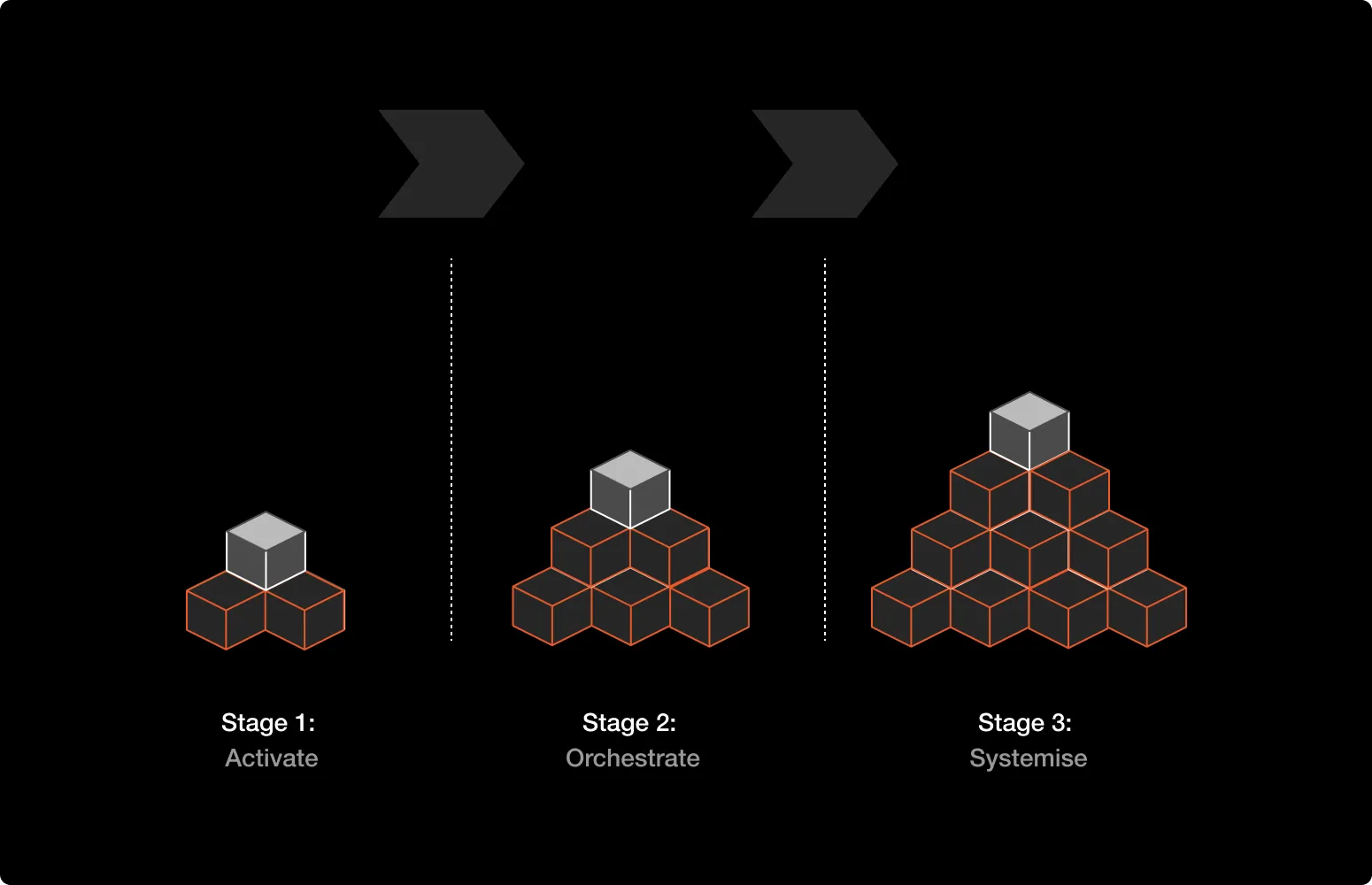
After finding new growth for brands from many verticals, we‘ve proven a three step blueprint.
Stage 1
Visitors segmented by real-time intent signals
Deliver experiences at high-impact moments
Automatically test timing and delivery
Clear uplift reporting vs non-intent holdback
Session summaries shared to CRM/CDP
Fast growth without added resource
→
Stage 2
Identify specific opportunity segments
Dynamic campaigns adapt in real time
Sequenced campaigns evolve as intent shifts
Alerts surface new moments worth acting on
CRM and offsite campaign optimisation
Greater control through Campaign Manager
→
Stage 3
Full access to event-level intent data
Insight Agent surfaces patterns and context
Journeys orchestrated end-to-end
Message strength & cadence adapt to intent
Intent data integrated into analytics
Intent-first approach to experience design
The Intent Growth Stages

Not just by edging up conversion rate with page-first, catch-all CRO.
Not just by taking a more-is-more approach to customer acquisition.
But by understanding and responding to visitor intent.
This growth blueprint is designed to be a roadmap to adopting and scaling this approach. A guide on how to move from the website-first way of today, to a visitor-first tomorrow.
At this point we should flag that, yes, we have built what we believe to be the best product to help ecommerce brands use intent at scale. So while this maturity scale is written in line with our framework and customers, it is intended to be a general guide.
Let’s get into it.
Activate
1-2 weeks

At this stage, you’ll activate Agentic Campaigns targeting key shopper moments, such as basket abandonment, or for more general experience optimisation. These campaigns are designed to require minimal set-up, showing measurable uplift within days using our Optimisation Agent, which handles testing and delivery automatically. Our Optimisation Agent is specifically built to find both the optimal segment (or segments) and timing for your experience. Unlike traditional multi-arm bandits, our optimisation agent works customer-first, not website first.
Why is Stage 1 important?
Ecommerce personalisation has long been slow, manual and resource-heavy - in part because it has been focused on the website rather than the customer. Agentic Campaigns remove that friction. They prove the value of both Made With Intent as a product, and intent as a personalisation trigger. Showing that this growth lever can be instant, automated, and effective without the need for developer time or complex configuration.
You'll:
Launch experiences that start driving incremental revenue within days
Show tangible ROI in weeks
Demonstrate how intent is the unlocked growth lever in ecommerce
Lay the groundwork for always-on optimisation, handled entirely by the Optimisation Agent, not your team
The primary benefit of doing this is driving more revenue and conversions, while proving that intent-based experiences are more effective than the non-intent equivalent through our Agentic Campaigns.

Your role here is **light-touch**, we’ve designed it that way to reduce time to value and necessary effort from you and your team. You aren’t required to understand the intricacies of intent data at this stage. Instead our team will work with you to up-skill you on what you need to know to get your first campaigns live and driving value. As you continue using intent, they’ll introduce you to additional concepts to enhance your knowledge.
You’ll:
Select your Agentic Campaigns (typically 3–5), and define the response you want to have with guidance from your Customer team
Collaborate on setup; our team works with you to configure your campaigns with no heavy code or design work required
Go live quickly; the Optimisation Agent immediately begins testing and learning in the background
Review results; see uplift in engagement, conversion, and revenue through clear, automated reporting
At this stage, ecommerce teams typically begin to:
Work with new, consistent intent datapoints (such as our proven Intent Framework)
Segment visitors by intent in real time
Understand the mindset and composition of their traffic based on the intent of the visitors
Reframe internal questions from “What’s the bounce rate?” to “What’s the intent stage of this audience?”
This sets the foundation for acting on intent in future stages, but the value of Level 1 is clarity. It’s where you start seeing the gap between how you design and how people buy.
This isn’t a tactical step. It’s a strategic one.
Most brands never stop to rethink the basics, or learned behaviour. Like how they analyse performance, or how they segment visitors. That’s why this stage stands out.
By building a shared language around intent, your team becomes better equipped to question existing metrics, advocate for more relevant experiences, and contribute to stronger, more sustainable growth strategies.
This is the level where brands stop only thinking in pages, and start thinking in stages too.
Challenge the default metrics. Start by questioning whether conversion rate and bounce rate alone are telling the whole story.
Ask better questions. In your next optimisation meeting, replace “What’s the drop-off?” with “What’s the visitor’s intent at this stage?”
Surface new human context. Use intent data to understand how many visitors are actually in-market, and which aren’t, even when they land on the same page.
That’s it. Once your experiences are live, the agent takes over.
At this stage we’ll also set up your lightweight session summary, which sends a simple intent score into your CDP or CRM. This gives you early visibility of behavioural strength without requiring any extra configuration, and lays the groundwork for deeper integrations later on.
Agentic Campaigns are designed to get you live and seeing value fast. They contain a set of pre-configured strategies powered by real-time intent and delivered automatically by the Optimisation Agent. Each strategy is focused on a core part of the customer journey, with multiple response types to choose from depending on your business goals.
These strategies are:
Browse Abandonment with Intent. Designed to reduces browse abandonment through contextual, real-time prompts.
Basket Abandonment with Intent. Designed to do the same for basket abandonment.
Product Visits with Intent. Designed to boost consideration by surfacing value, reassurance or urgency on product pages.
Returning Visits with Intent. Designed to support returning visitors to pick up where they left off in their journey.
Experience Optimisation with Intent: Designed to find impact across the entire visitor journey, independent of these other focus areas.
Each of these strategies is powered by intent signals and optimised automatically. You’ll choose the moments and experiences that align with your goals, and the Optimisation Agent managing testing and delivery automatically.



Some customers remain at this Activate stage for their entire partnership, relying on the Optimisation Agent to continuously maximise impact with zero additional effort from you and your team
However, Stage 2 may be the next step for you if:
You have business specific objectives you want to use intent to solve, and have the internal capacity to support this
You want to better understand intent, and start integrating intent insights into your broader experimentation and tech stack. You may also wish to explore optimising CRM campaigns with intent signals (for which your integration has already been set-up)
You want to explore dynamic, multi-layered campaigns that evolve based on a visitor’s intent
You want to begin focusing on in-page, dynamic content based on the stage and signals a visitor is showing
You’d like greater control and customisation via Campaign Manager, whilst keeping automation at the core
Orchestrate
Identify priorities and design experiences around your strategy.
This stage is perfect if you have an established personalisation or optimisation team and you want to begin bringing intent into your ways of working outside of the initial campaigns. If there’s appetite, you can also start exploring post-visit experiences with your visitors, enhancing campaigns such as Abandon Browse or Abandon Cart.
You’ve seen what intent can do, and the value it can bring. Now, you’re ready to scale that impact.
In this sense, Orchestrate means expanding your control over the use cases of intent, allowing you to solve specific business challenges with the framework you’ve seen drive greater impact using Agentic Campaigns.
You’ll go through a period of learning with your Customer Success team to support you in further understanding intent data. This will enable you to begin using intent to solve business specific challenges using our performance dashboard and segment builder. Perhaps you want to focus on a certain traffic source, or category. Interrogating intent data will allow you to highlight segments of opportunity, who can be delivered a targeted campaign using our advanced campaign manager. You’ll also be supported by our Alerts and Notifications, highlighting to you when an opportunity for action arises.
The advanced campaign manager includes dynamic campaigns; allowing you to alter both over-page and in-page content dependant on a visitor’s intent, and sequenced campaigns; where you can build multi-experience campaigns that fire as a visitor moves through different segments. For both of these, executions vary from over-page experiences to in-page dynamic content; such as in-grid content slots on PLP, or homepage carousel banners.
For some of our most advanced customers, you may also wish to use intent within your wider tech stack, such as personalisation platforms. As part of the advanced campaign manager, you’ll gain access to Third Party Triggers - enabling you to embed intent segmentation into existing experience processes.
Finally, at this stage you may begin experimenting with intent outside of your in-session experiences. By integrating Intent with your CDP and CRMs, you can optimise your Abandon Browse and Abandon Cart campaigns based on the summary of a visitor’s session. Or, develop targeted campaigns for visitors based on their Intent Stages & Interests.
Resource needed from your team can vary, based on the complexity of the campaigns you wish to launch. This stage allows you drive even more value from intent campaigns by driving hyper personalisation at scale, whilst you continue to benefit from the Optimisation Agent’s self-learning delivery.

At this stage, you’re evolving from activating Agentic Campaigns to designing advanced, intent-driven experiences that solve specific business challenges, both on and off-site. You’ll start using the data behind intent to identify opportunities, build targeted campaigns, and manage more complex personalisation journeys - all supported by automation. Naturally, this requires more dedicated time from your side compared to the initial Activate stage.
You’ll:
- Identify opportunities using intent data through our performance dashboard and segment builder, working with your Customer Success team to uncover segments to target.
- Set up alerts and notifications contextual to your business goals in order to be alerted of opportunities for campaigns
- Design and launch dynamic campaigns that adapt in real time - changing both over-page and in-page content (e.g. homepage banners, PLP grids, or PDP blocks) based on a visitor’s intent.
- Build sequenced experiences that evolve as a shopper moves through different stages of intent.
- Use the Campaign Manager to visualise, schedule, and control advanced experiences across your site.
- Review and optimise through a mix of manual insight and automation; segment performance and uplift are captured in real time, with the Optimisation Agent supporting where appropriate.
- Integrate with your CRM and CDP platforms, to optimise campaigns such as Abandon Browse and Abandon Cart with Intent signals
- This stage is about expanding what’s possible with intent; combining creativity with automation to deliver hyper-personalised experiences at scale.


As with Stage 1, many customers stay at the Orchestrate stage, utilising our high level insights to drive hypotheses and creating targeted in-page and over-page campaigns.
However, moving to the Stage 3 may be applicable if you want to make intent the basis of all your on-site experiences. Pushing the boundaries of in-session, in-page real-time experiences with full visibility and exploration of your data.
Stage 3 could be right for you if:
You’re ready to go beyond the high-level intent insights available in Stage 2 and access your full dataset; with the ability to query, analyse, and visualise intent data in depth
You want to push the boundaries of real-time in-page experiences, surfacing dynamic components to visitors based on where they are in their journey
You want to uncover why campaigns perform the way they do and explore trends across audiences, categories, and experiences through raw data analysis, and iterate on campaigns with these insights
You’d benefit from self-serve analytics that allow you to dig into intent signals and campaign outcomes without relying on pre-defined performance dashboard.
You’re ready to use the Insight Agent to power both day-to-day decision-making and campaign strategy.
You want to integrate your intent data into your broader analytics ecosystem (e.g. GCP, Azure, Snowflake).
Your team is ready to use this visibility to inform experimentation and strategic planning, identifying new opportunities that lead to you building end-to-end intent-first experiences
Systemise
This is where data and decision-making converge. You gain access to the full intent dataset, as well as unlocking the Insight Agent. You start to ask more sophisticated questions of your dataset, for both insights and hypotheses but also campaign performance. Diving deeper into not just what worked, but why, to help you inform what to do next.
Intent shifts from being a trigger for individual campaigns to a strategic intelligence layer within your business. It guides how you shape experiences across the site, and powers personalisation across your stack.
You’re using the most advanced campaign capabilities, such as dynamic component slots that change with a customer’s intent - giving them the right functionality at the right time. You’re beginning to orchestrate journeys rather than launch isolated experiences, using intent as the engine that shapes how a visitor moves through your site in real time.
Why is Stage 3 important?
In Stage 2, you start to work with high-level insights in our performance dashboard, as well as understanding your audience through our segment builder. This is great to identify opportunities for targeted campaigns specific to your business objectives. However we know some customers will want to take this a step further; going beyond these insights to query, analyse, and visualise intent data in depth with full flexibility.
The Systemise stage is about enabling this. You’ll start working directly with the raw, event-level dataset that sits behind the high-level insights. This means you’re no longer confined to aggregated metrics. Instead, you can interrogate the data in full detail: every interaction, signal, and journey. You’ll be able to ask and answer precise questions about performance at an event-level, uncovering not only what happened but why. For example, you might explore how visitors in a specific intent stage behaved on PDPs, how different signals affected engagement for a particular category, or which journeys most strongly influenced conversion.
Beyond understanding your audience, this level of visibility allows you to perform deeper campaign analysis. Rather than simply tracking overall uplift, you can understand the detail, how performance evolved over time, and where opportunities or inefficiencies exist.
You’ll also unlock the Insight Agent, which serves two key roles:
- General insights: helping you interrogate intent data at scale in relation to your business context. Surfacing patterns, anomalies, and opportunities through natural language questions.
- Campaign performance analysis: providing deeper context and recommendations around what worked, why, and how to improve or expand on it in future iterations.
This deeper level of analysis allows you to go beyond one-off optimisations and start designing end-to-end experiences rooted in real behaviour, not assumptions. With full access to your dataset, advanced campaign tools, and the Insight Agent, you’re using intent as the foundation for how you design, deliver, and improve your customer journeys.
This is also the moment where you begin orchestrating journeys in a more connected, adaptive way. Ensuring every interaction is shaped by real-time signals rather than static templates or pre-set rules, and pushing the boundaries of what real-time adaptive experiences look like.
Finally, Stage 3 is where your intent data begins to extend beyond the platform. You can integrate directly with cloud and analytics environments, such as GCP, Azure, Snowflake, or CDPs, to join intent signals with your broader data stack (e.g. transactional, CRM, or product-level data). This enables teams to build unified views, automate insight workflows, and run advanced modelling within your own systems.
At the beginning of this stage, we’ll work with you and your team to further enrich your knowledge of intent, and our Intent Framework in order to be able to look at our data, and your website, in a new way
Primary benefit: You’ll drive even greater impact from intent by uncovering what your visitors actually need, when they need it. Your entire digital experience will begin to be driven by intent, as you reframe how your organisation sees it’s visitors.

At this stage, you’ll go beyond the high-level intent insights available in Stage 2 and gain full access to your dataset; giving you the ability to query, analyse, and visualise intent data in depth. You’ll use these insights to design more adaptive, end-to-end experiences, grounded in real customer behaviour.
This is the most time intensive stage of the Growth Blueprint, allowing you to truly embed intent in your organisation.
You’ll:
Explore the Intent Framework in full, learning how signals, stages, and journeys connect to performance outcomes across your site
Use the Insight Explorer to interrogate raw intent data by business objective, category, page type, or traffic source - identifying key trends, friction points, and opportunities.
Run self-serve analytics, creating and customising dashboards so you can dig into intent signals and campaign outcomes without relying on pre-defined reports.
Use the Insight Agent to uncover general insight (e.g. where journeys are stalling) or campaign-specific learning (e.g. which variant worked best, and why)
Design connected experiences, using the Campaign Manager’s advanced functionality to act on insights and launch targeted experiences that address what you’ve uncovered. Building journeys that adapt in real time and pushing the limits on intent first experiences.
Analyse campaign performance in greater depth through the raw data
Export data into your cloud environment (e.g. GCP, Azure, Snowflake) or connect to your CDP to join with other datasets and feed broader customer strategies
Feed insight directly into activation, using what you learn to continuously evolve your campaign strategy and influence wider personalisation efforts across your stack
Many teams at this level find intent becomes embedded in their day-to-day decision-making - shaping how they brief, design, and evaluate digital experiences across the organisation.



How progression works
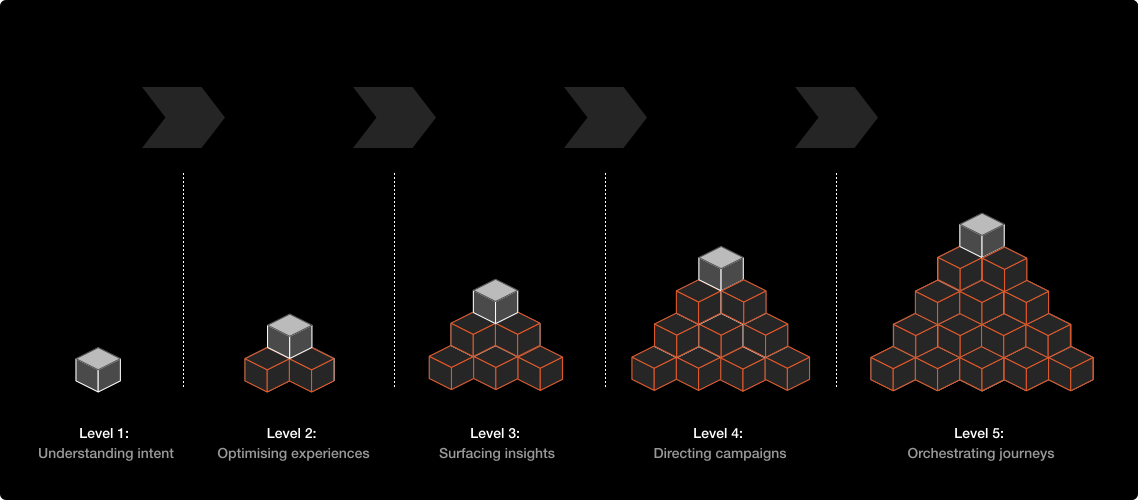
The Intent Growth Blueprint isn’t intended to be a checklist.
Some brands progress quickly. Others spend longer in certain stages, testing, learning, and proving ROI. That’s expected.
What matters isn’t how fast you move, but how deeply you adopt the mindset.
The stages also aren’t rigid. Early levels often overlap. You may experiment with Stage 3 thinking while still building Stage 2 foundations. You may even decide to stay at Stage 1 or 2 for the foreseeable.
That’s the strength of the blueprint. It flexes to where you are, and where your growth needs to come from next.
This is how you move from diminishing, catch-all optimisation toward sustainable, contextual growth.
From treating visitors as traffic to sell to, to treating them as people to connect with.
Wherever you are today, this blueprint helps you move forward with intent-based experience optimisation. With clarity, confidence and commercial impact.
If you’ve read this far, you’re already thinking deeper about intent than many in the industry. But we’re willing to bet (try us) that it won’t be this way for too long.
You’ve seen how innovative brands move from generic journeys to contextual growth, by using real-time intent to shape how they understand, respond to and convert visitors.
Each stage in this blueprint reflects a shift. From proxies to predictions. From averages to individuals. From pages to stages. From features to journeys. From isolated wins to orchestrated growth.
And right now, that shift matters more than ever. Traffic is expensive. Competition is fierce. Site visits are fleeting. Teams are stretched. The brands that win next won’t do it by squeezing 0.1% out of tired templates. They’ll do it by seeing what others don’t, and responding in real time.
If that’s where you want to go next, book a demo to see how Made With Intent helps ecommerce brands unlock the full value of real-time intent.