The Made With Intent Product Journey: where we‘ve been and where we‘re going
Since then, we’ve proven that theory.
We built the first real-time optimisation framework designed around intent.
We evolved it into a platform - enabling teams to see, explore, and action behaviour in real time.
We helped brands move from insight → action, surfaced to their customers in real-time
And now, we’re making all of that automated, fast, and accessible to every ecommerce team.
We’ve spent the last six months not just building, but thinking deeply about where this space is heading. And we now have a clear view of the future we’re moving toward, and how we’re helping brands get there.
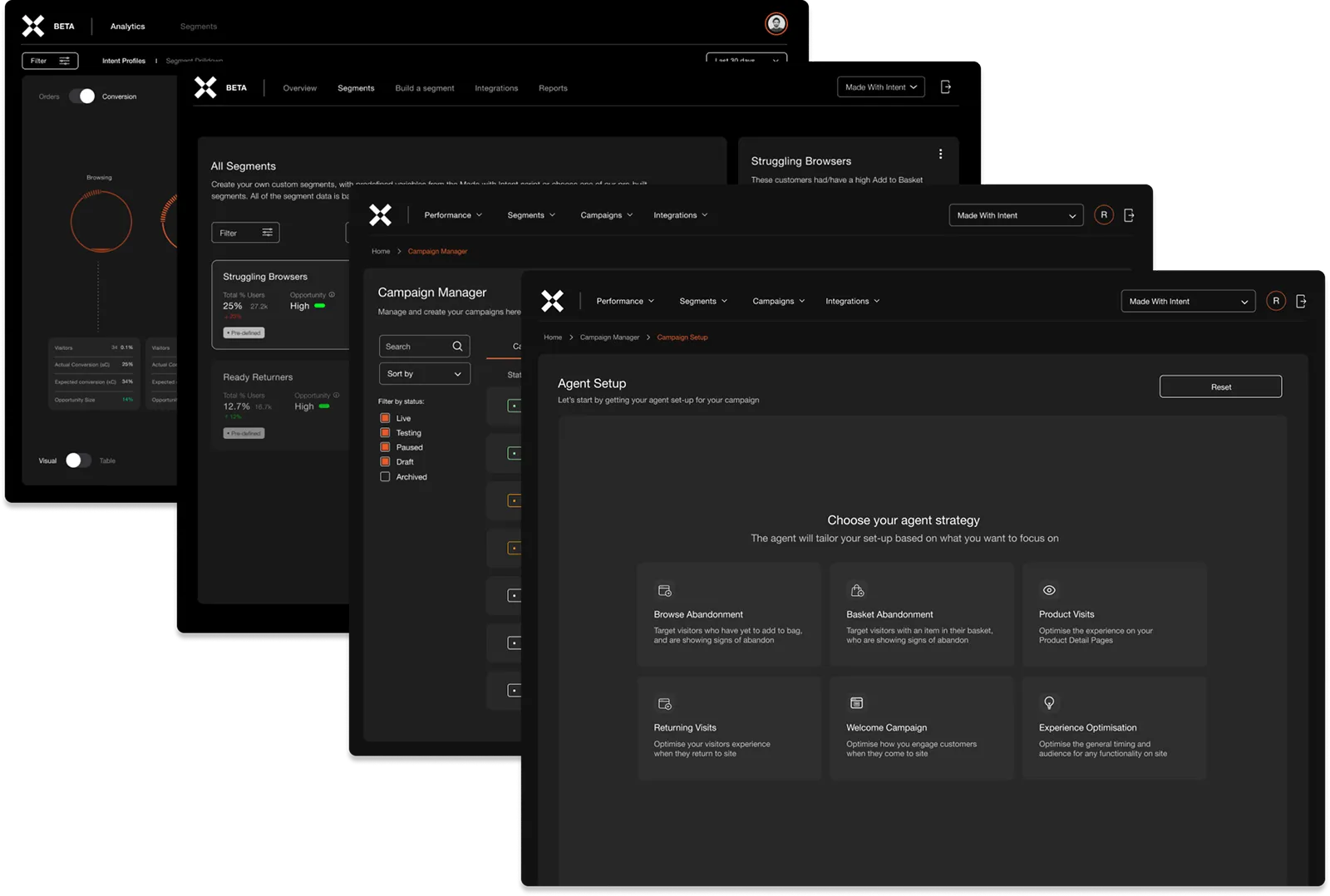
Our product journey

We introduced a new way to see ecommerce traffic - not as page views and conversions, but as dynamic visitor mindsets evolving in real time. It was insight-led, instinct-driven, and the foundation for everything that followed.
We integrated with existing tools to bring intent into execution, enabling segmentation and triggering in real time. It worked, but it revealed a deeper truth: to deliver truly adaptive experiences, we had to own the delivery layer ourselves.
With Campaign Manager, we moved from insight to direct execution, empowering teams to launch real-time, intent-led experiences without workarounds.
We’re reducing time to value through agent-led workflows, server-side decisioning, and smarter activation. Not just optimising campaigns, but building the foundation for truly adaptive ecommerce experiences.
2023: The Year of Circles
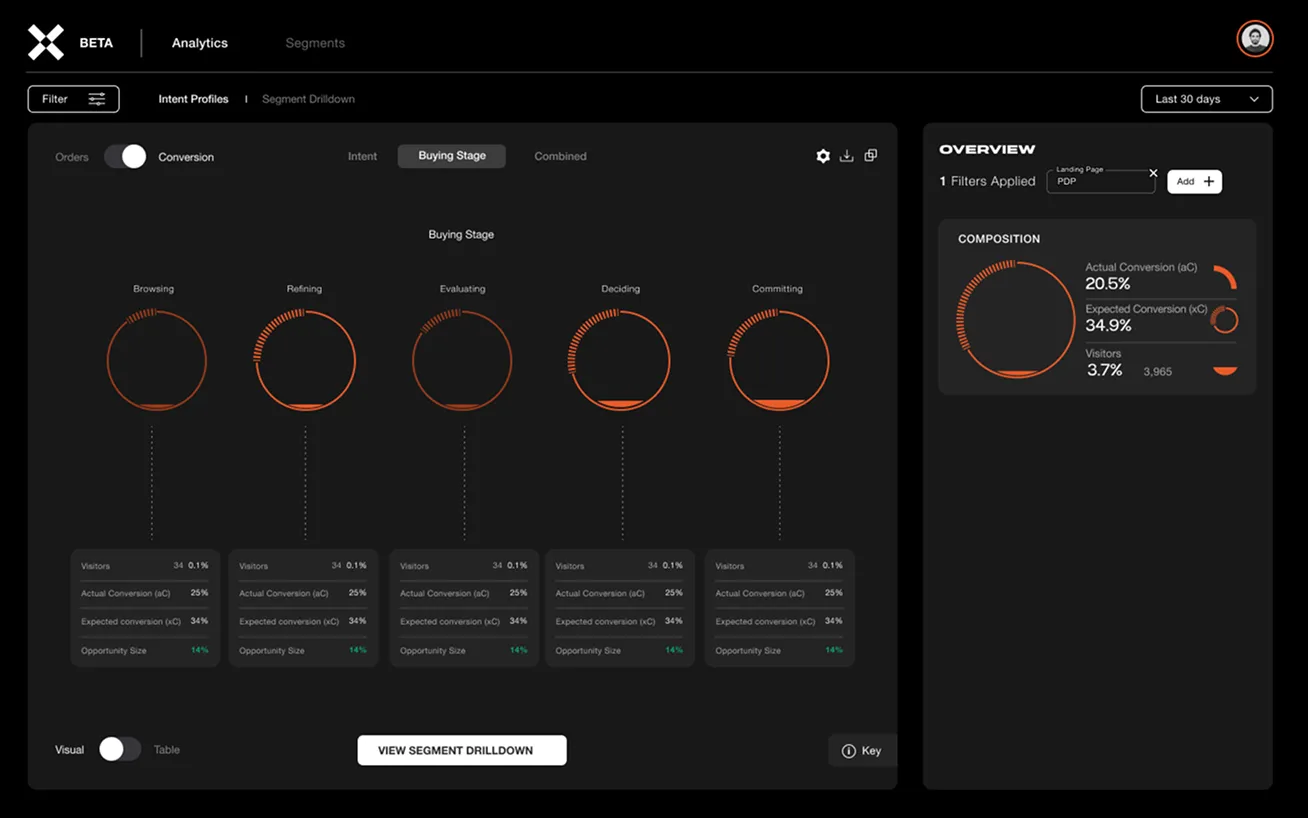
As pioneers in the Intent landscape, we began with a foundational principle: that intent isn’t a static attribute - it’s a dynamic state that changes with context, behaviour, and mindset.
So we built a model that interpreted live behavioural signals to classify visitors based on their intent in real-time, allowing brands to act on this and serve the most appropriate experience to their visitors.
Our first product mapped this visitor intent into visual ‘circles’ helping brands see their traffic in a new way: not by page views or conversions, but by visitor mindset (hence, the lore of the circles).
Under the hood, our earliest models predicted outcomes like conversion or exit using live behavioural inputs. But they were built site by site, relying on rigid tracking and custom setups.
So we rebuilt it - training a shared neural network across all retailers to recognise standardised behavioural patterns. This removed cold starts and improved accuracy, but it still assumed a level of consistency most sites didn’t have (something we’d go on to tackle!).
We didn’t yet have the platform or the model we do today. But we had something more important: proof that intent matters.
It worked. Brands using Intent saw new growth. The circles helped people understand what was happening.
In a category that was only just emerging, we were early - giving customers a new way to understand intent, long before others had even entered the space. But the product wasn’t yet built for self-service action.
TLDR: 2023 was instinct-led. We proved the concept. But we needed to go from insight to impact.
2024: The Year of Trying to Be Actionable (via Integrations)
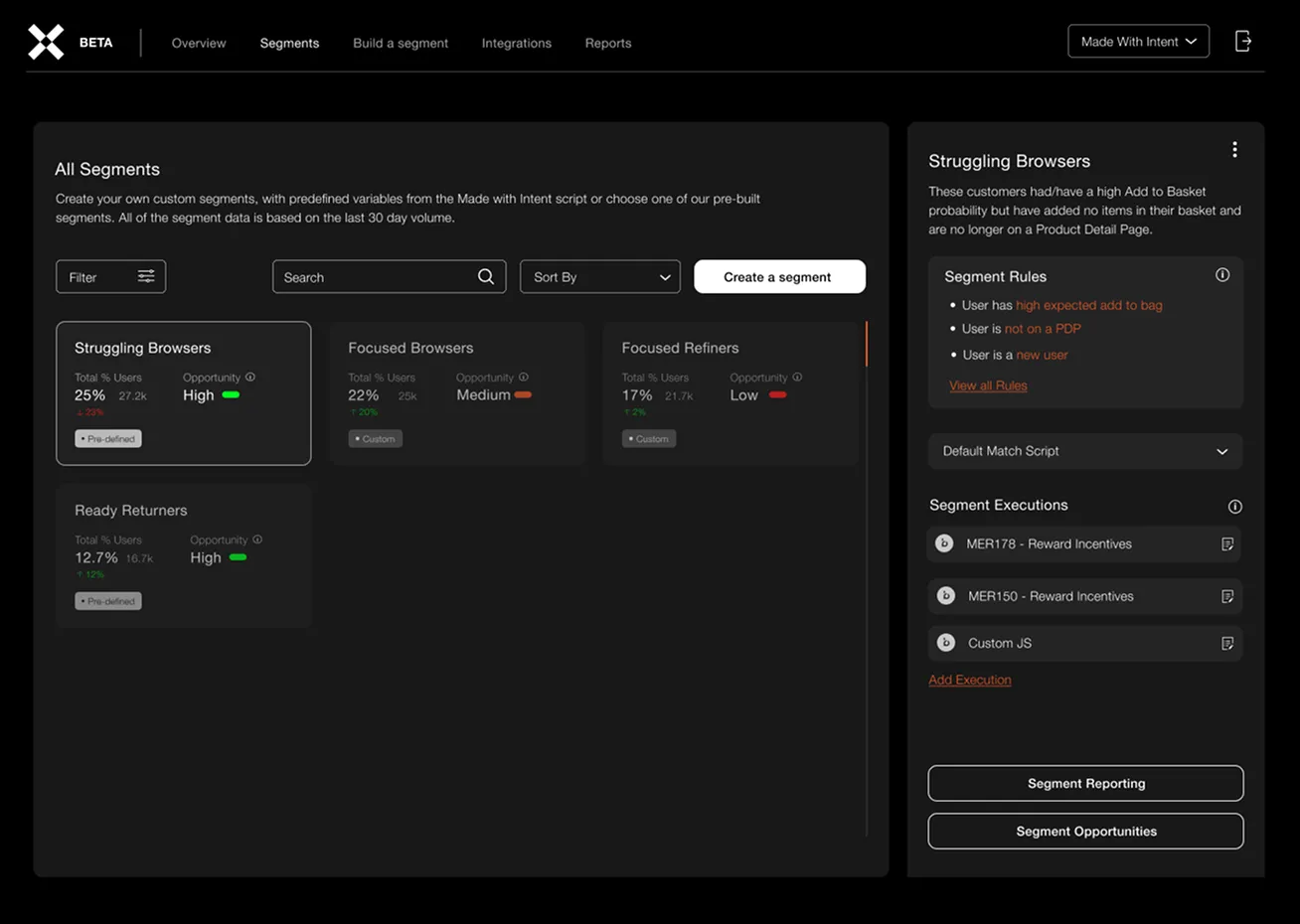
In 2024, we made a big bet: instead of owning the full experience delivery, we’d work with your existing tech stack to power actionability.
We believed the fastest way to make Intent actionable was to meet brands where they already were, by plugging into the tools they already used: Bloomreach, Dynamic Yield, AB Tasty, and more.
It was a sensible step. And it unlocked a lot:
Segment Creation; customers could now define and create their own high-intent audiences
Segment Executions; customers could trigger campaigns in other platforms from those segments
We began to solidify our core use cases - from discounting to email capture and discovery
We saw proof that customers could take action based on real-time data
And we came out of BETA
In doing so, we strengthened our position in the intent platform landscape. We made it even easier to interpret user behaviour and mindset, whilst starting to support action.
But here’s what we learned:
Some of those platforms weren’t set up for real-time delivery, and to be truly complimentary, we needed that. So we hit walls when we tried to push real-time signals into them. Workarounds were needed, and it wasn’t a quick, simple experience that unlocked the power of intent for a whole team.
And as we tried to go self-serve (too early), friction grew. Teams needed more support. The workflows weren’t seamless. The gap between insight and action was still too wide.
From a modelling perspective, this year was a step-change in reliability and deployability.
We introduced auto-tracking; allowing the model to understand behaviour even when tracking was incomplete or inconsistent
We added affinities; enabling the model to learn what users preferred, without manual setup
And we taught the model to understand the site itself; combining live user behaviour with knowledge of site structure, funnel design, and pricing strategy
This made our predictions more accurate, and allowed our customers to make more confident real-time decisions.
TLDR: We thought integrations would be the fastest path to actionability. And while they helped, they exposed a bigger truth: to deliver real-time intent-led experiences properly, we had to build the delivery layer ourselves.
2025: The Year of the Campaign Manager
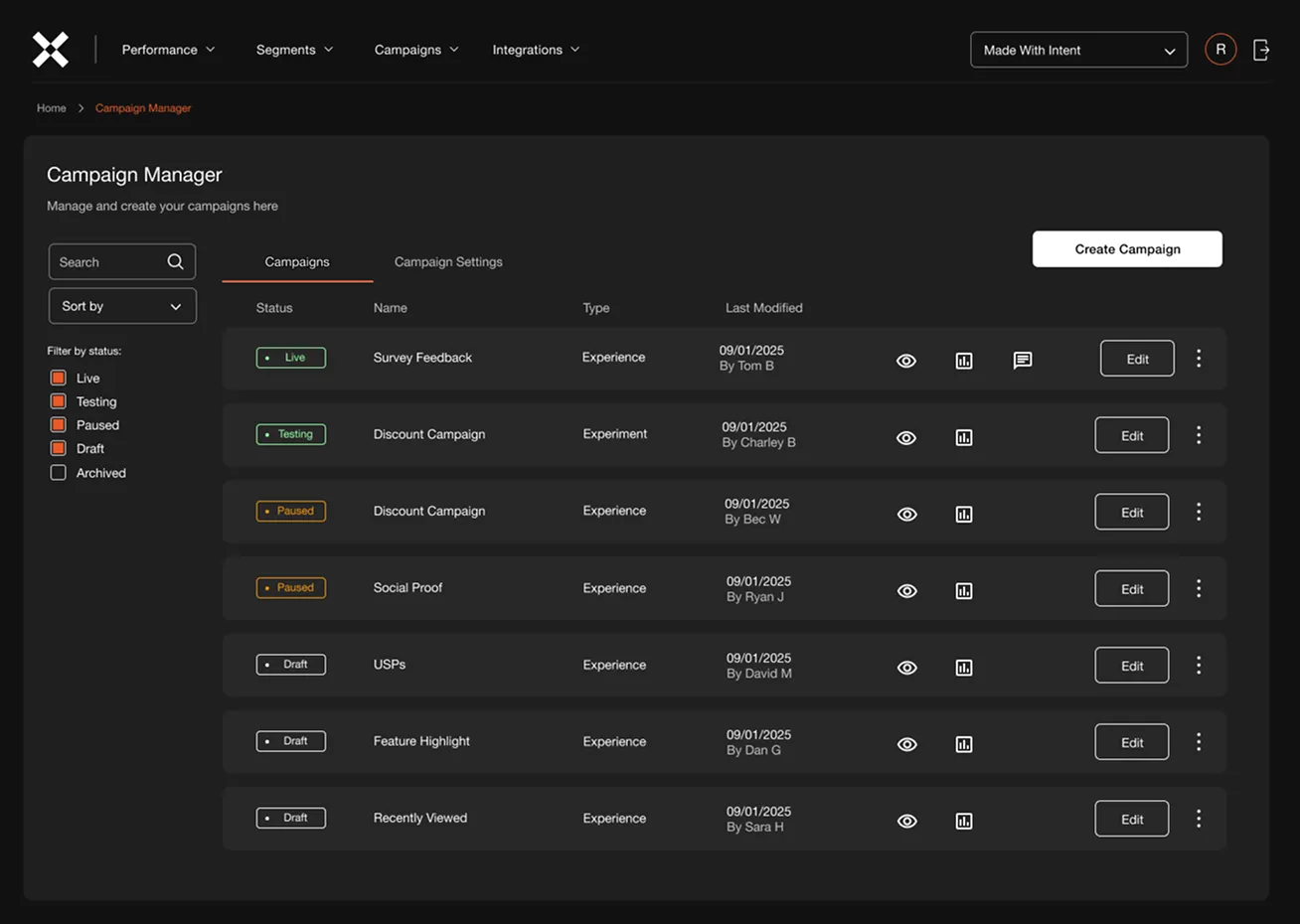
This was the year we built what we needed to become: an experience optimisation platform for running intent-based real-time campaigns.
No more workarounds or relying on other systems to do the heavy lifting. And it worked.
Here’s what changed:
Campaign Manager launched - enabling anyone to launch intent-led experiences without code
In-page content blocks were launched alongside overlays, allowing for seamless, embedded adaptive experiences
Third-party triggers made Intent the decision layer, even if you still wanted to use your own tools
Usage exploded; with 3+ campaigns launched per month per customer, on average
We shipped 50+ improvements based on usage signals and customer feedback
And we replaced the Intent Performance Score with something better..
We introduced a more intuitive framework, shaped by how people actually shop, and how our customers businesses were thinking.
It included:
Intent Stages: a signal that places shoppers along a linear path from low intent to high intent as they move closer to conversion. Giving teams a stable view of how ready a shopper is to buy
Intent Signals: such as Shopper Mindset: allowing customers to understand what a shoppers behaviour is in that moment
This allowed teams to more easily understand where a shopper is, and how they should respond.
At this point, we became standouts in the intent platform landscape. No other tool enabled brands to both understand and respond to real-time customer intent - all in one platform.
TLDR: This was the year we truly started delivering value at scale. We were no longer just a source of insight - we became the engine behind real-time, relevant experiences.
2026: The Year of Automation
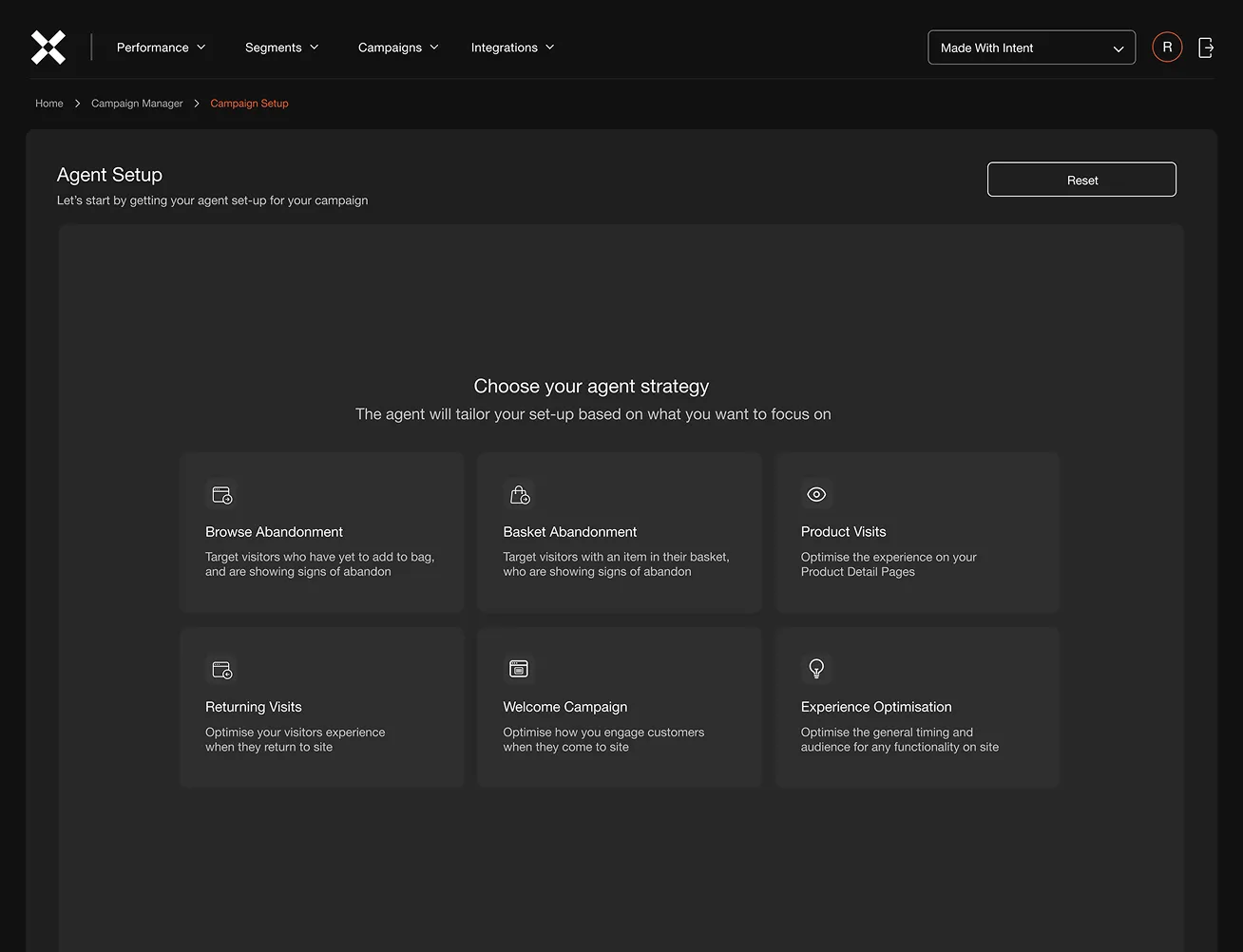
This year, one of our core focuses is on reducing time to value.
How do we make everything we’ve built faster, easier, and more accessible to teams? No matter the size, capacity or skill level.
That means automation, and the introduction of more agentic workflows. But automation isn’t just about making it quicker to launch a campaign. It’s about making Made With Intent the decision engine behind your entire ecommerce experience.
This is what we’re releasing the first half of the year to support this:
Agentic Campaigns; you simply set the agent’s strategy, decide the experience, and let them find the optimal segment for you
WYSIWYG Editor; adapt, replace, or insert content blocks without code
Prompt-based experience creation; just tell us what you want to build. We’ll do the heavy lifting
Server-side Decisioning; control site features, incentives and experiences in real time — before a page even loads. All powered by a visitor’s intent.
New Insights Area; explore your intent signals by page, audience, or behaviour to dive deeper into your visitors
Natural Language Interfaces; segment creation, campaign reporting - all via conversational prompts
Alerts & Notifications; get alerted on how your campaigns are performing, and insights change. So you can log in when it matters
Underneath this, we’re strengthening the foundations.
We’re introducing structured datasets and product feeds to support activation such as recommendations, and refining the product experience so teams always know what to do next.
And our model will also continue to evolve. We’re now expanding it to understand even more context, including:
Site performance and speed
Product and page-level success
Vertical-specific shopping behaviour
This means intent won’t just reflect what a customer wants to do, but how likely the site is to convert that intent right now.
TLDR: Faster build. Smarter decisions. Faster results.
As for 2027 and beyond...
We believe the future of intent-based growth is automated, fast and accessible. You won’t need a 100-person team to get value from our product.
AI is evolving fast, and expectations are rising. Two years ago, the idea of prompt-led, adaptive experiences felt futuristic - and now it’s here.
That’s why we’re not locking ourselves into a long-term roadmap that assumes we know exactly what ecommerce will look like in 2028. We have ideas, of course, but more importantly, we’re staying flexible.
Being the most innovative intent platform in the world means building with agility. It means reacting to new technology as it arrives, and ensuring our customers can adapt and see value from it quickly.
So while we can’t say exactly what’s next, we can say this:
Our focus will remain on capitalising on the moments that matter, bringing you new growth, and making sure we stay at the forefront of what’s possible.