Cotswold Outdoor Group's early win with agentic campaigns didn't add anything to its website. It took a countdown timer that every visitor used to see and showed it to far fewer of them. Revenue went up.
That result is the core of what Chris Roche, Customer Intent Lead at Cotswold Outdoor Group, calls the case for subtraction. A big part of optimising a website, he argues, is deciding what not to show and who not to show it to.
Subtractive optimisation means removing on-page elements, like timers, banners, delivery messages, and trust badges, for the visitors who don't need them, instead of adding more for everyone. Real-time intent signals make it possible to keep an element for the visitors it helps and hide it from the visitors it distracts.
Editor's note: This post is a write-up of an Intent Live session with Chris Roche, Customer Intent Lead at Cotswold Outdoor Group, which runs Cotswold Outdoor, Snow+Rock, and Runners Need. The session was hosted by Charley Bader, VP Strategy & Ops, and Colin Spooner, Principal Value Consultant, both at Made With Intent. You can watch the full session below.
Why eCommerce teams default to adding things
Every eCommerce team knows the Monday trade meeting. Sales are soft, and someone in leadership asks what's going to change this week to turn it around.
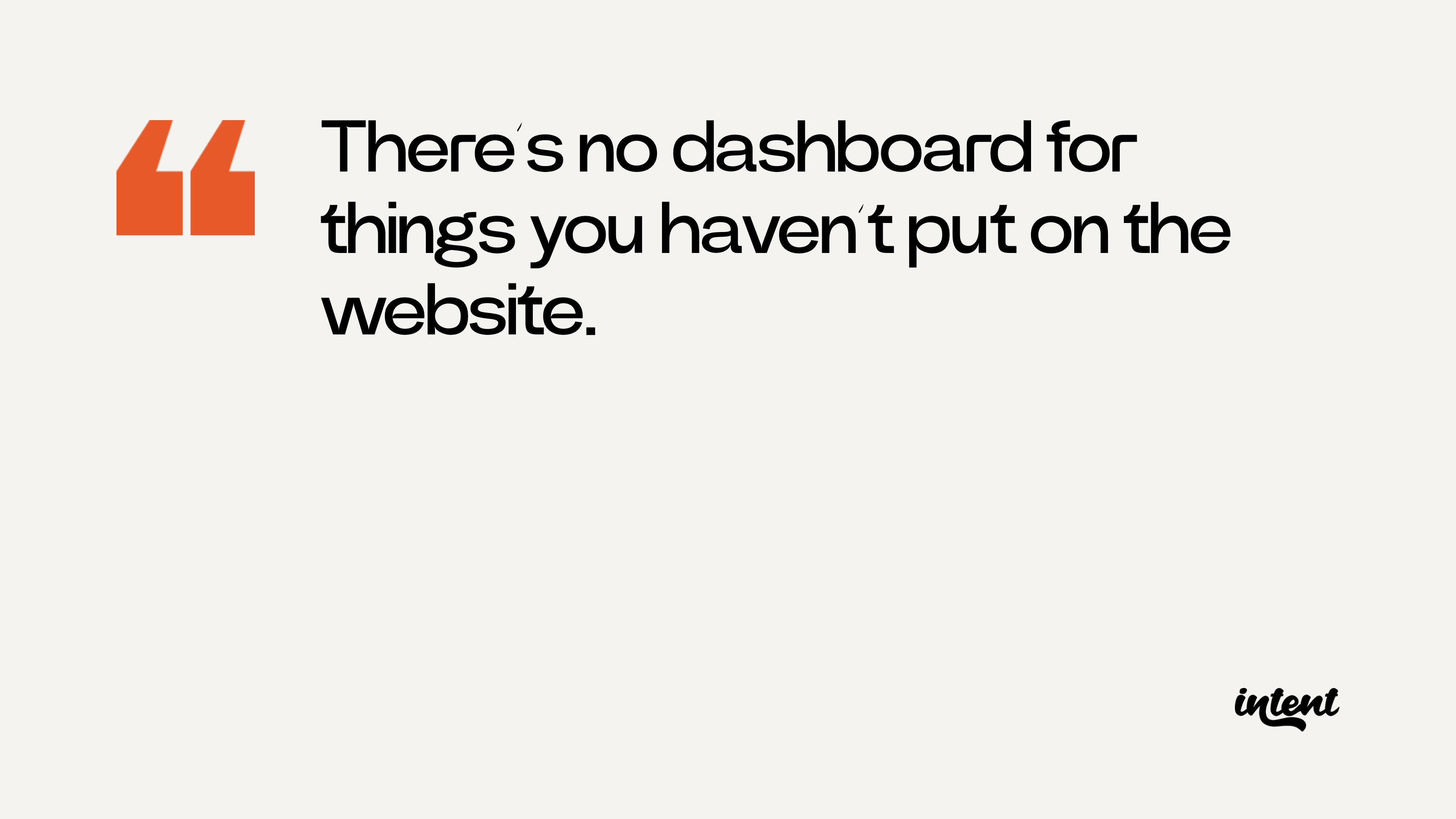
The answer is almost always an addition, like a banner, a badge, a pop-up, or a timer. Chris doesn't put that down to laziness. Addition is what the system rewards. "There's no dashboard for things you haven't put on the website," he said.
He gave three reasons the bias sticks:
• Additions are visible. Next Monday, you can point at the new banner and say "this is what we did."
• Subtraction isn't a metric. An absence is hard to put in a deck or a trade report.
• Restraint doesn't get credit. "You get credit for launching a feature. People tend not to get promoted for not launching a feature."
The bias runs deeper than eCommerce. Chris recommended Subtract by Leidy Klotz, whose research team found that people systematically overlook subtractive changes when solving problems, and are even less likely to spot them under cognitive load. A Monday trade meeting with soft numbers and a dozen other fires is hardly a low-load environment.
The shop floor already knew how to do this
Before joining Cotswold, Chris ran his own menswear business, with a couple of stores and a website. He hated being pounced on by shop assistants, so he trained his own staff to hold back. His best example was the colleague who ran the denim section, the store's biggest revenue driver. He let silence fill the gaps and stood back, stepping in only when a customer needed a push towards the till.
That skill never made it online. A good shop assistant reads who just walked in. A website, for most of the last 20 years, has shown the same banners to everyone, because until recently there was no real-time behavioural signal telling it who to leave alone.
Charley Bader, VP Strategy & Ops at Made With Intent, made the point that most brands don't have a feature problem:
"A lot of the time you have all of the right features on your site already, but it's just making sure you're giving them to the customers when they actually need them, rather than a blanket rule for everyone."
Example one: the countdown timer everyone saw
Outdoor retail is fiercely competitive, and Cotswold's trade calendar is packed with promotions. For years, each one closed out with a site-wide countdown timer. Same timer, same urgency, same message, whatever the visitor was looking at. Chris compared it to walking into a shop to look at jeans and having an assistant tell you the footwear offer ends tomorrow. It isn't relevant, so it's noise.
The timer had earned its place the usual way. It won an A/B test, so it went live for everyone, permanently. But an average win says nothing about who it lost:
"What about the people on this side that it didn't work for, or that it was detrimental for?"
When Made With Intent came under his remit about a year ago, Chris needed an early win to get the business on board with the idea of intent. He chose the timer and rebuilt it:
1. Off site-wide. The timer appears only on product pages.
2. Promotion-specific. It shows only on products that are in the promotion.
3. Agent-decided. An agentic campaign decides which visitors see it, based on whether they look ready to buy.
The reasoning is simple. Urgency pushes buyers through checkout. For a visitor still in discovery mode, the same urgency can be counterproductive and drive them away.
Revenue was the primary metric, and Chris described the uplift as "fantastic", with gains across the secondary metrics too. The approach is now part of Cotswold's standard toolkit for promotions.
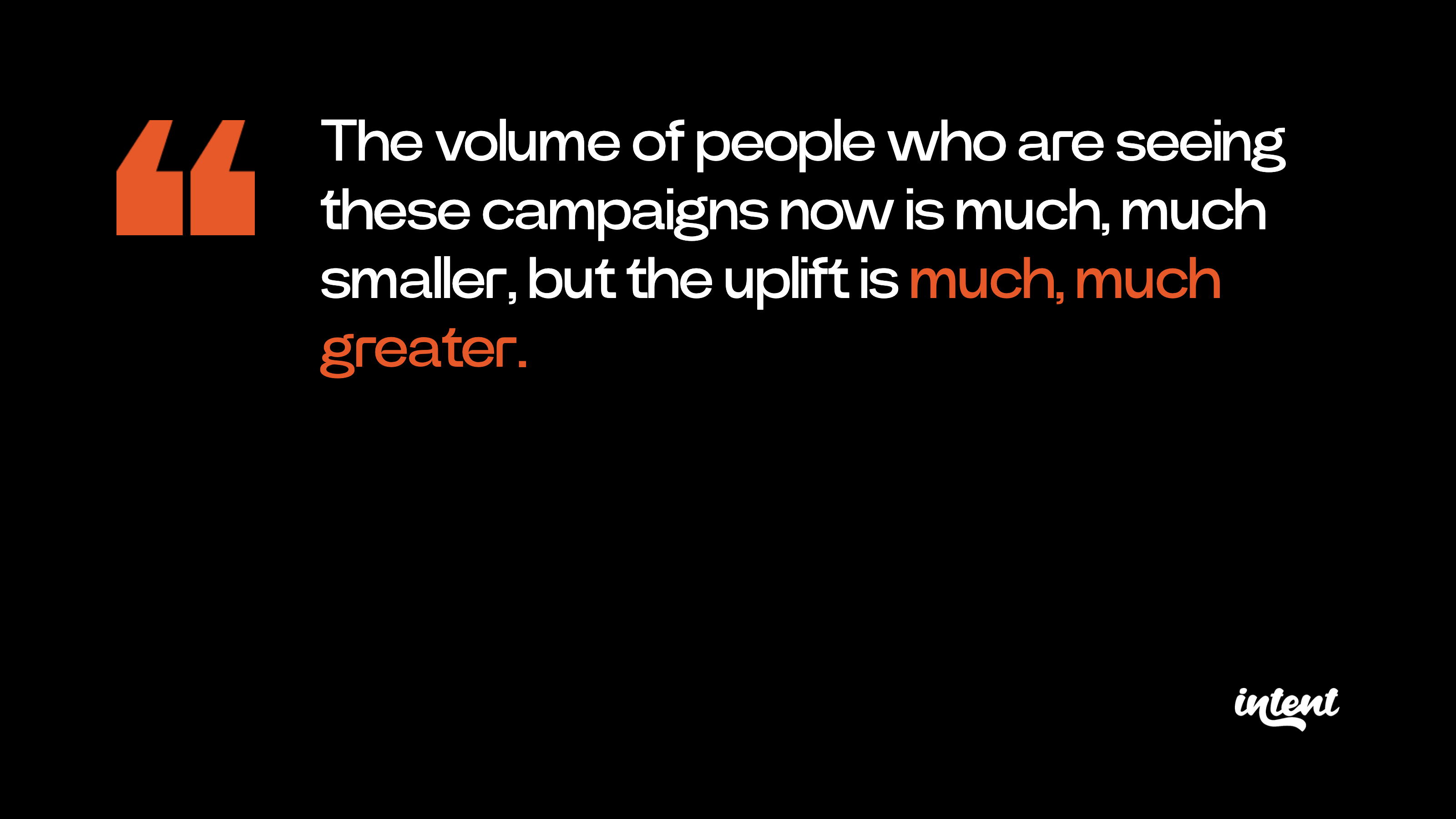
To be fair to the sceptics, the test changed three things at once: where the timer appeared, which products it appeared on, and who saw it. It proves the overall approach works, not exactly how much of the lift came from the agent's targeting alone. What Chris highlighted was the shape of the result: "The volume of people who are seeing these campaigns now is much, much smaller, but the uplift is much, much greater because it's targeted."
Lift among a narrower audience will almost always look bigger, so that on its own proves little. What counts is the metric Cotswold set as primary, which was revenue.
Example two: free delivery answers a question nobody asked
The second example is earlier-stage and Chris was clear it's a directional read, not a finished result.
Runners Need offers in-store gait analysis, where experts assess your stride and match you to the right running shoes. Leadership wanted that expertise visible online, and the obvious move was a banner. Instead, the team built an inline gait analysis module on the product page, sitting below the size buttons, explaining how it works and letting visitors book. It drove strong interaction without hurting site-wide sales.
Then Chris asked a different question. If a visitor needs gait analysis before they know which shoe to buy, they're very unlikely to buy online in that session. So which parts of the product page are irrelevant to them? "If you're not ready to buy a pair of shoes, free delivery is answering a question you're not asking," he describes.
The same applies to the payment trust icons. They matter in checkout. If you're not about to enter card details, they're clutter. So for visitors the agent identifies as gait analysis candidates, the team strips out the free delivery message, the payment icons, and several other messages further down the page.
Early signs are positive: more gait analysis interaction and more bookings. Just as important is the guardrail. Sales from shoppers who don't need gait analysis haven't dropped, which is the check that matters if the agent ever hides trust signals from someone who was ready to buy. Cotswold sometimes pays to acquire this traffic, and the goal was never to send buyers off to a store visit they didn't need.
It's not the first time the group has seen this pattern. Cotswold Outdoor previously cut returns by showing sizing guidance only to high-intent shoppers at the moment they were choosing a size.
Getting leadership to sign off on doing less
Colin Spooner, Principal Value Consultant at Made With Intent, asked the obvious question. How do you walk into a Monday trade meeting and say you removed something?
Chris didn't pretend it was easy. When Cotswold launches an offer, one of the first questions from leadership is still when the site-wide timer or banner is going live. Moving away from that took education, and he credits a digital director and head of eCommerce who are open to testing.
His approach, in practice:
• Win early. The timer test mattered because its uplift bought momentum for every idea that came after it.
• Drip-feed the concept. He slipped a few lines about the intent dashboard into Monday trade meetings, and gave talks to other departments. Now other teams come to eCommerce asking what the intent data says about the lines in their upcoming promotions.
• Report honestly. "When you have the winners, let people know. But also when things don't work, be honest. Report honestly, have defensible numbers."
• Show your reasoning. As Chris put it, "leadership cannot see something you've removed", so you have to surface the thinking behind it.
Subtraction isn't the same as stripping things out
Colin suggested subtraction might be faster than building new features, since hiding an element doesn't need design or development. "It could literally be a simple show/hide that you give to the agent."
Chris didn't agree entirely. Subtraction isn't easier, because the work is in the thinking. What does this visitor need to see right now to make a good decision, get through checkout, or find the information they came for?
He's not advocating a cull. Choosing not to intervene can work when it's a deliberate choice for a specific visitor, the same principle behind Diamonds Factory letting its agent choose no intervention for 52% of customers. It's addition and subtraction together, done carefully, one change at a time, tested and iterated.
In the Q&A, a viewer asked whether visitors who no longer see the timer get something else instead. They do. Cotswold is modelling what Chris called a friction hierarchy: the minimum nudge each visitor needs to move towards a purchase. Depending on the visitor, that might be the countdown timer, a simple delivery or trust message, or, for someone at an early stage, a fit guide.
The first timer test was deliberately kept clean, timer or no timer, to prove the concept. Another campaign is now modelling the wider range of alternatives.
Wrapping up: who is each element on your page for?
The argument Chris makes isn't that less is always more. It's that eCommerce has spent 20 years adding things for everyone because it had no way of knowing who to leave alone. That constraint no longer holds.
He left viewers with a challenge. Go through your own site. "Pick something that's always there, whether it's a banner or a timer or a module, and really ask who it's for, what question it's answering." If you can't answer that, test taking it away for the visitors it isn't helping.
If you want to see how that works in practice, take a look at how Made With Intent handles content prioritisation by intent, or book a demo to see an agentic campaign in action.

Become an Intent Insider
Get subscriber-only insights we don't publish anywhere else and event invites before anyone else.
By submitting this form you agree to our (more than fair) terms.