
Let’s picture online shopping sometime in the next decade.
The homepage doesn’t exist. The product page doesn’t exist. The basket isn’t a fixed page you click through to. The interface arranges itself around you, live, based on where you are in your decision: considering what you’ve already researched, helping with whatever might be stopping you from buying, encouraging you with what would help you purchase.
Is this science fiction? We don’t think so. We already have the pieces. The first is intelligence; predicting and reading visitor intent continuously and in real time gives you the ability to see where the visitor is in their decision and the hesitations and motivations that come along with that.
The second is an agentic delivery mechanism. Serving components, content, messages autonomously aligned to that intent.
Made with Intent has both.
Let’s break down where we might be in a couple of years.
To wet your whistle, we'll give you the two pillars of our hypothesis now, ahead of exploring the topic in more detail.
The website becomes responsive.
Not in the 'looks good on a phone' sense, what we mean is responsive to your customers behaviour. There'll be an always-on listening layer where each visitor's behaviour gets evaluated, and then, it serves individual components or content what it takes to move them forward with their purchase. This won't be like old-school personalisation, where website-first rules and website-first segments dictate "show this to anyone who's done this". It'll be in real-time and respond to human-first needs in the moments that matter. Ironic that isn't it? Personalisation focuses on the person, not the website.
The interface dissolves.
In this vision of ecommerce websites, on-site experiences will be entirely driven by a series of intent-responsive components. Going beyond an individual message, and moving towards a completely responsive interface. There'll be no webpages, nor standardised templates. Gone are the days of talking about 'we'll optimise the PDP' or 'lets focus on the PLP'. Visitors will simply be matched with whatever they need to see at any given time. The interface will continuously adapt itself to the shopper and their needs, every single time.
Sounds interesting? Read on to explore how we’ve arrived at this conclusion.
AI has already changed shopper behaviour
The discovery side of ecommerce has already changed. When Google released AI overviews, quite literally overnight, website clickthrough rate (CTR) dropped enormously. The folks at Search Engine Land estimate that it's around 61% for organic clicks, and 68% for paid clicks.
Adobe Analytics reported AI-referred traffic to US ecommerce websites is up 4,700% year-on-year. This is mainly attributed to LLMs like ChatGPT, Claude, and Gemini.
So, what's happening here? Essentially, and you'll already be aware of this, your shoppers are doing more of their browsing inside of an LLM. They're asking ChatGPT questions about the dresses they want, the trainers they want, the food they crave and much more.
They're arriving at your website with more intent to purchase, more commercial impetus than say two-three years ago. Does this mean when they land on your site, does the job of the website need to change? Is it more about allowing them to build confidence in you and your brand as opposed to selling the product? Is the objective of the website not to get the visitor to convert, but to increase the chances of them converting?
"Or, put differently, if a large part of the discovery is done before hitting your website, your site only has a small chance to influence customers in the moment. The moments that matter. These moments are fleeting. If your site engagement reduces, time on site will reduce, your chances of influencing a customer to take an action also reduce."
This will hit consumables more than the considered purchase. Machines will eventually own the "don't ask me, just keep me stocked" experience. They're logical, observant, and patient in a way humans aren't. Google and PayPal are embedding AI into auto-replenishment now. There are 361,000 consumables merchants on Shopify alone, and most of them will feel this before they've had a chance to plan for it.
There's another emerging use case consumers have been using AI for. Think OpenClaw, think agents, and think having your own personal shopper. Gartner reckon there's something in this and have projected 15% of revenue could be represented by machine customers within the next two years.
Predictions are predictions. Gartner made a prediction in 2024 suggesting search engine volume will drop by 25% in 2026, due to AI chatbots and such, dominating search. Fast forward two years, and that's not happened. Google still has a 90% share of global search traffic, and comparatively speaking, ChatGPT doesn't really get a look in. Sure, it's rising at an astronomical rate, but from a standing start: 0.10% of traffic turns into 0.12% year-on-year.
The more interesting thought experiment is what happens next with LLMs. Will there be checkouts in LLMs? Will bots, which you've spent your whole career railing against because they skew your analytics, and create dummy orders, now peruse your site on behalf of their humans? Will you need to build structured data, feed pricing via API, and optimise your PLP and PDP to be read by machines? Will websites even exist?

Buyers will arrive on your site with more intent to purchase than they did two or three years ago, but you’ll only have a fleeting moment to influence them.
What AI won’t change
Nope. Agentic commerce certainly is the hot, new topic that leaves VCs frothing at the mouth, but we don't think that'll happen any time soon, for the current generation, and specifically for the vast majority of products. Here's three reasons why your site will always be the destination for shoppers. Or, at least, the most desired destination. The primary destination.
Brands will need to protect their brand (and margin)
LLMs are another channel. Like affiliates, marketplaces, social commerce they just become something else to add to the mix, they won't become the mix. Your website will still exist, don't worry.
Like an affiliate, LLMs will take a cut of any sale where agents are used, and yes, that's a hefty price. Shopify will use Open AI and charge an extra 4%, straight off your margin, to any customers using ChatGPT to checkout for example.
It's not necessarily the margin that's the sticking point, though, it's the brand equity.
LLMs won't bring your brand, its equity, and the control you have over pricing your own products, and this, as we'll discuss later, is very important.
The lack of control of how your brand is viewed, seen, felt will not be tolerated by businesses.
There will always be a need for a centralised destination.
People will have done more research before they arrive
Ever since the Internet was invented, it upended the way people gather information to make purchase decisions. Take buying a car. Before the Internet, the humble salesperson in the car showroom would do the heavy lifting as to why the electric windows were such an amazing feature. Or why GTi made such a difference over the GT version of the car you want to buy.
Now, by the time you enter a car showroom, if you haven't bought online, you'll have already been through a catalogue of evaluating criteria. You'll have:
By the time you arrive at the showroom, the salesperson simply has to facilitate the transaction. It's a case of taking that intent that already exists and capitalising on it.
In this new, agentic-driven era of shopping, this decision process gets put on steroids. Expect agents to crawl your site, your competitors and send their human a comprehensive analysis, with its recommendation, based on the criteria outlined by the person directing the agent before you reach the website itself.
We think this will be exaggerated for higher value purchases; more discovery pre-site, but higher human involvement on site. It's the same principle as buying something more expensive. You'll typically need more time to evaluate and consider these sorts of purchases because there's more risk involved. Giving your agency to a non-entity, like you would in agentic commerce, just feels wrong.
Compliance will always be essential
Who is going to get sued? Who is to blame? Like everything in life we need to ask just one question: Who is someone going to sue when that person isn't a person, it's an agent?
If we're betting, we think a reason OpenAI reneged on their decision to become an ecommerce operation agent in early 2026 is because of governance, not complexity.
GDPR, CCPA, there are so many regulations that you, as a business will be familiar with, and will continue to be applicable to you as you do business. With your website being the primary place you do business, you'll still need something that's controllable, auditable, and solely yours.
Even in a fully agentic future, we don't envision a world where that will change, and consumer rights will be diminished.
If the website isn’t going anywhere, what changes?
The visits to your site become more valuable. If people are spending more time in LLMs discovering pre-purchase, by the time they arrive at your website, they'll be far closer to buying. Their intent will be higher. Your site engagement will likely decrease as a result. Casual visits will become rarer. Tyre-kickers might become less frequent. Ultimately, more and more of your visitors are fleeting. Your job is to facilitate and nurture. If we're putting our commercial hat on, your job is actually to capitalise. Instead, your brand will become increasingly more important. The numbers say it bluntly:
Your website, your brand, indeed, you as a company becomes the differentiator. Trust becomes the underlying factor. How you treat customers when they’re ready to take meaningful actions towards a purchase will be the differentiator. Visits to your website become higher-stakes.
If someone is pretty much decided on what they want and they’re evaluating who you are as a business, showing the “wrong” thing — like an inappropriate pop-up or pushing the sales message too hard (or too soft) — could frustrate them. Worse, they could leave and shop with your competition.
The shop reshapes itself around the shopper, every single time.
Why now?
Quite simply: technology that was once exclusive is now possible for the rest. Made With Intent’s proprietary Large Event Model (LEM) can accurately predict your visitors’ intent within the moments when decisions are actually made — and respond to it, automatically, there and then.That's how you capitalise on your fleeting visitors.
Before we explain how, here’s how your ecommerce website improves its performance right now:
The problem with this is that it isn't truly real-time. Nor is it really focused on the person, the human. But the visitor. You're reacting to information that you've gathered, analysing it hours after it's already happened, and reacting to it too late.
Your A/B tests give you a snapshot result (a "winner" or "loser"). Your analytics package tracks page views and behaviours, retrospectively. You understand what might move the needle for conversion, but it's generalised, on a proxied behaviour like traffic source, and when the moment has already passed.
"Genuinely continuous real time means reacting in the moment. Heck, even predicting the moment before it happens. Not waiting for the next click. Capturing scroll velocity, hover dwell, accordion expansion timing, hesitation between elements, inactivity after intent-building actions. On a single product page that's 20 to 40 micro-interactions — each one evaluated and fed back into our intent model in milliseconds."
The difference between what ecommerce does now and what we give you the ability to do is the difference between reacting to abandonment and preventing it. Between showing a pop-up because someone clicked away, and showing it because they're losing interest. Between showing everything all of the time to everyone, and showing content that matters to that person there and then.
And the technology to do all of this, and more, now exists. It exists with Made With Intent. We won't rehash too many details from our how it works page, but here's a summary:
Made With Intent continuously reads every visitor's intent and decides which experiences they should see and when they see them. 800+ behavioural signals per event, per visitor in real time, feeding a purpose-built neural network, a Large Event Model trained on 50bn+ ecommerce events across hundreds of retailers. True visitor intent. This is the intelligence that powers the decision.
You can then take an experience, a piece of persuasive content, a message, a discount and our agent will allocate them dynamically to the right person, at the right time; across hundreds of different intent combinations. Learning what works for which visitors and getting smarter with every session. In effect it decides who gets what, when, or whether to show anything at all. This makes your website truly responsive to what the shopper needs right there and then, in the moments that matter.
The difference lies between reacting to abandonment and preventing it.
What the future of ecommerce actually looks like
We reckon there are two phases brands will transition through in the coming years. The first is already happening. The second is the end of the website as a static artefact.
Intent-driven experiences.
The site arranges itself around behaviour.
This is already happening. This is what we do for over 100+ brands. Over the next 12 months, we'll see more and brands heading this way. It's the only way to stand out, to out-perform; to see and capitalise on user intent.
Let's stop optimising the PDP and PLP (where did those acronyms even come from?). Page types that are generic and completely arbitrary. Instead, optimise for the visitor and where they are in their journey — the buying stage, whether they're discovering, considering, likely to buy or ready to leave. We often say stages not pages to consolidate this thinking.
Your site will be responsive. It will arrange itself to adapt to whatever intent the buyer is showcasing at the moment they're on the site.
“Personalisation has never been achievable for two reasons. The first: we’ve been optimising the wrong metric — optimising for pages, the website, the architecture. Ignoring the ‘person’ in ‘personalisation’ altogether.
This is where we start, and — actually — where we already are.
Phase 1: components that respond to user intent.”
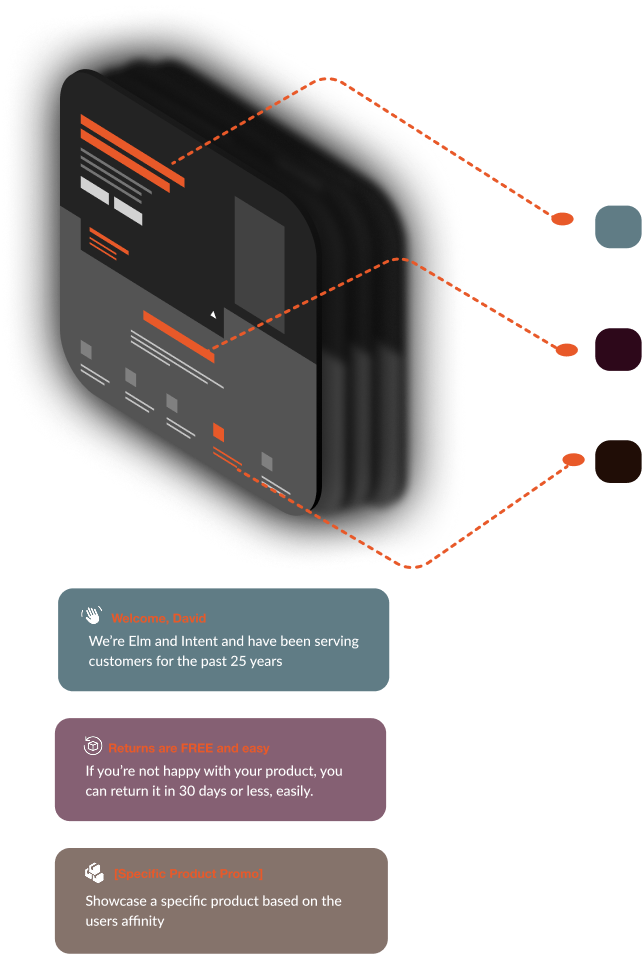
A fluid, intent-driven interface.
The end of the website as a static artefact

“The second reason personalisation has never been achievable is the lack of scalability. Hundreds of segments — all website-first, not human-first — rule-defined, each a static snapshot defining a ‘winner' or a ‘loser'.
Agentic delivery mechanisms make this possible. Think of a multi-arm bandit that continually operates on the context of the individual's intent. That's exactly the promise Made With Intent delivers on.”
A bit further down the road, we'll probably see something like this. You won’t have pages on a website per se. There won’t be templates. The architecture will be a series of composable components working together in harmony. When there won’t be pages or templates, there also won’t be a fixed journey, like the infamous PLP, PDP, basket and then checkout. A single “page” pulling in, referencing and responding with content blocks as and when the user needs it.
Imagine, a user browsing will see a series of components rendered against the visitors buying stage to the exact moment they're in; a discovery one. An acknowledgement that the visitor is currently in a discovery mode and a response that supports the user based on what they need there and then. The opposite of a one size fits all, templated website. Or imagine a user showing signs of hesitation. Your intent agent picks up on that sign and serves a message, a component, there and then within the moment to prevent that inevitable abandonment. It's a response, or intervention, to prevent or support users to take an action. It feels like your age-old sales assistant in the store, right? A person looking, listening and observing a shopper and responding with intuition in the moment.
Experiences stop being served from attributes of the site (rules-based, static, retrospective), and start being served by an agent acting on behaviours of the human (responsive, individualised, predictive). The shop, in effect, reshapes itself around the shopper.
Our final thoughts
Ecommerce businesses are contemplating the future and those conversations currently surround two core areas. The first: how they should adapt to AI search. The second: how agentic commerce should be tackled.
But we think they’re the wrong questions to focus on. Instead, we think you should be asking yourself: how in this world of AI, can we be more human? Ironic isn’t it? Personalisation has always been the goal and never been achievable. Until now.
If we focus on the right metric (visitor intent, phase 1) and using agents to scale our efforts (agentic experience delivery, phase 2) we’ll be in a position where page templates don’t need to exist. Where website infrastructure is fluid, not static. Where the website feels like a real-life sales assistant with intuition, responding to what customers need at the moment.
AI changes everything. But what it doesn’t change is that purchases — particularly more considered ones — end with a human, on your site, making a decision. These humans are giving brands signals they miss; they can’t see, can’t respond to, and therefore can’t capitalise on.
The future of ecommerce is about the shop reshaping itself around the shopper. The question is, are you moving with it?