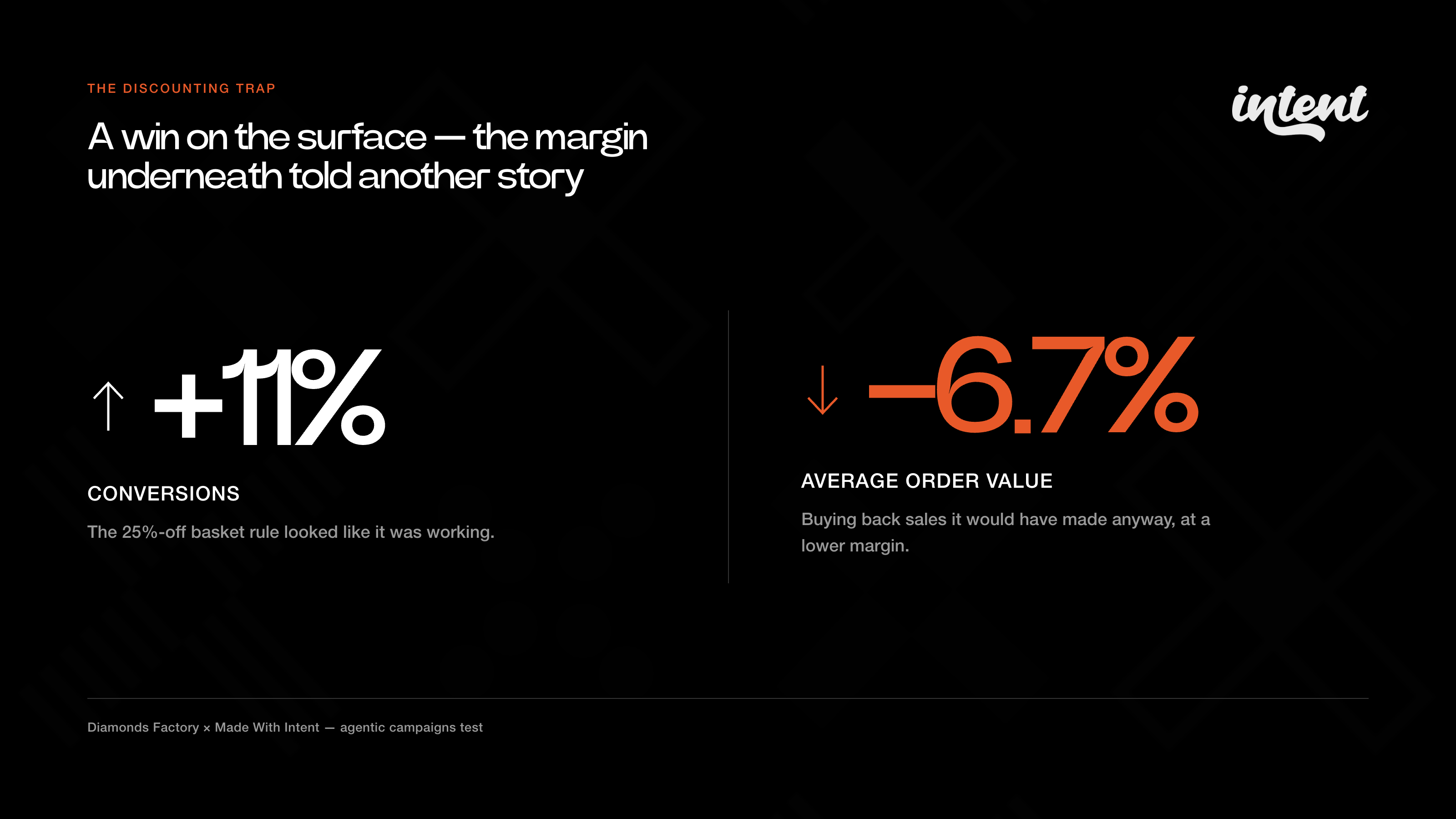
Diamonds Factory ran a basket abandonment discount and watched conversions climb 11%. On paper, it looked like a win, right?
It wasn't. Average order value fell 6.7% in the same period, and once the discount depth was accounted for, the "win" was worth barely £8k a month.
So, the luxury jewellery brand tried something different. It handed the decision to our agentic campaigns, told it to optimise for revenue per customer instead of conversion rate, and gave it the option to do nothing at all.
Our model decided that for 52% of customers, nothing was exactly the right call. That decision alone was worth £1.6m in incremental annual revenue.
Editor's note: This post is a write-up of an Intent Live session featuring Jo Homer, Director of CX at Neve Jewels Group, the parent company of Diamonds Factory. Jo walked through a real, live test of Made With Intent's agentic campaigns, hosted by Charley Bader, VP Strategy & Ops, and Colin Spooner, Principal Value Consultant, both at Made With Intent.
Diamonds Factory is a made-to-order luxury jewellery brand, one of the brands under Neve Jewels Group. Jo was upfront that this wasn't automation for automation's sake. It was a genuine test of what happens when a business gives an AI the ability to make real commercial decisions, and watches closely what it actually decides.
Agentic campaigns, Made With Intent's most recent product launch, replace the old manual approach (build a segment, write a rule, set it live, hope the hypothesis was right). You stay in control of the strategy, the moment being targeted, and the goal being optimised for. But the moment-to-moment decision, based on real-time visitor intent, who sees what and when, goes to an AI agent that keeps learning and reallocating traffic as it goes.
The discounting trap that feels like a win
The original brief was simple: catch basket abandonment before a customer leaves, offer 25% off, and recover the sale. It's the default move for most eCommerce brands, and doubly so in a vertical as competitive as jewellery, where discounting is normal.
The first-pass numbers looked good. Conversions were up 11%. However, the problem is what sat underneath it. Average order value dropped 6.7% over the same period. Diamonds Factory wasn't gaining new revenue so much as buying back sales it would likely have made anyway, at a lower margin.
As Jo Homer, Director of CX at Neve Jewels Group, put it:
"We were basically training the customer to wait for a deal, which in return was affecting margin."
Diamonds Factory fell into a similar trap many retailers fall into. A single rule applied to everyone optimises for the metric that's easiest to see (conversions) while diminishing the one that matters (margin).
For a luxury brand, the cost isn't only the discount itself. It's what the discount teaches the customer to expect next time. Train customers to wait for 25% off, and full price starts to look like a mistake they'd be silly to make.
It's a familiar story for anyone who has run basket abandonment campaigns before. A rule fires the same offer at every visitor who matches a condition, regardless of why they left.
Some were genuinely price-sensitive and needed the nudge. Others were already going to buy and simply hadn't checked out yet. Blanket rules can't tell the difference, so it pays the same discount for both.
Changing the question the model was answering
The shift that mattered wasn't really about AI. It was about changing what "success" meant.
Diamonds Factory moved from a single rule (25% off, applied to everyone) to an agentic campaign with four possible responses: a 25% discount, a 15% discount, a trust-building message, or no intervention at all. Crucially, the goal changed too, from conversion rate to revenue per customer.
That distinction is easy to state and hard to act on, because it means giving up control over exactly which lever gets pulled and letting the model decide, case by case, based on what it observes. As Jo describes it:
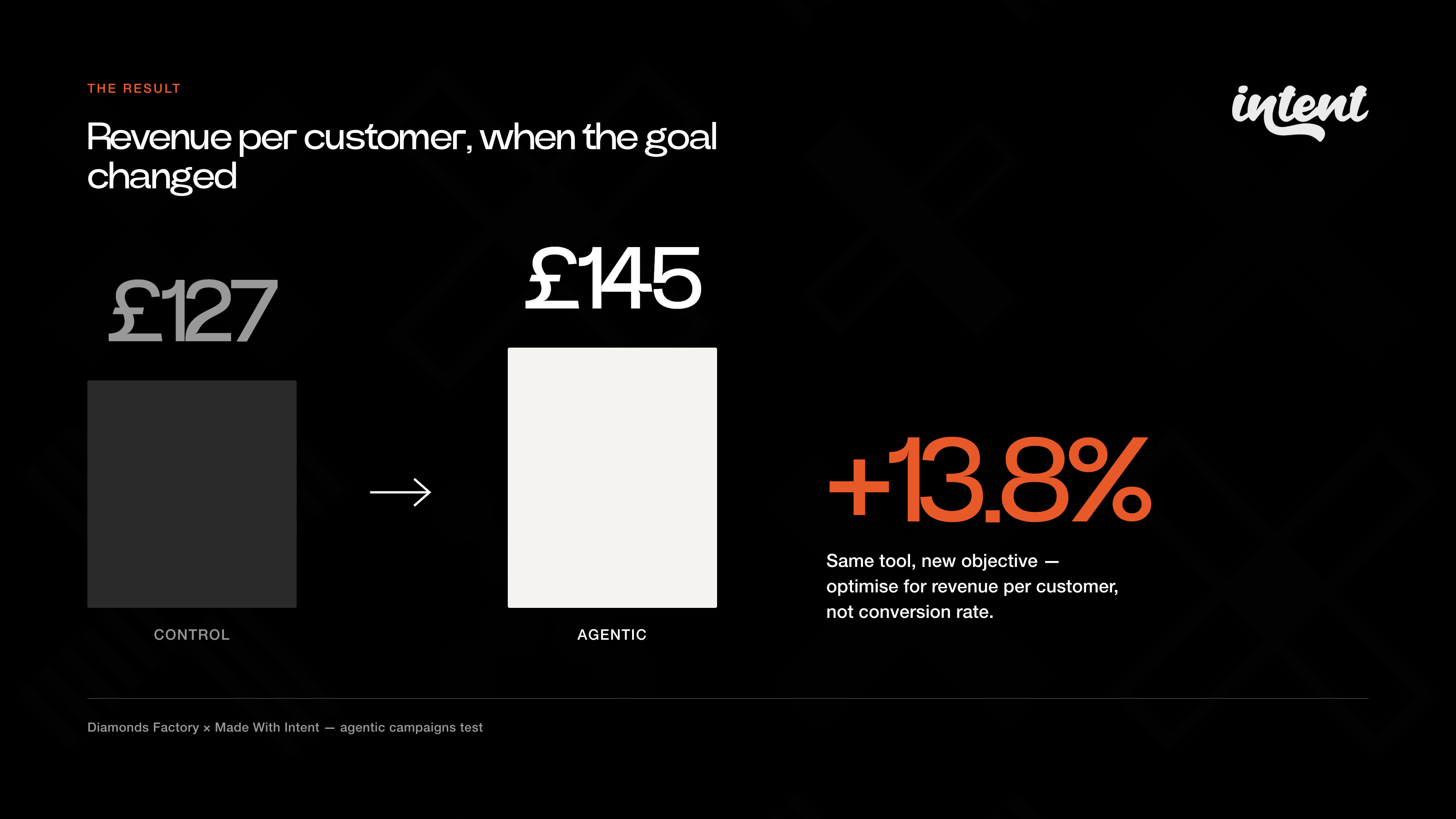
"The tool didn't change. The objective did. And that's the real unlock in some cases."
The model started with no historical or behavioural data. It had to learn the pattern from scratch, in real time. The result: revenue per customer rose from £127 in the control group to £145 in the agentic group. A 13.8% uplift.
"It didn't come from offering more," Jo said. "It was offering much smarter."
Jo frames the difference as hiring someone and handing them a script to read, versus hiring someone and trusting them to think on their feet. A script covers the cases you anticipated. Under the agentic model, the system sets its own rules based on what it actually observes in customer behaviour, and updates them continuously rather than waiting for the next quarterly review.
What our agentic model found without being told
Neither Jo nor anyone on her team instructed our AI model to look for a basket-value threshold.
It found one anyway, identifying a specific value point below which doing nothing consistently maximised revenue, and above which a discount or message made more sense.
It also separated customers by where they sat in the buying journey, not just by what was in their basket. Shoppers who looked like they were still comparing options, still in a research mindset rather than a checkout mindset, were shown trust messaging instead. So, things like craftsmanship, heritage, and guarantees.
A discount at that stage would have read as pushy. The model inferred that without being told what a "research mindset" should look like.
"The model basically developed a theory of buyer psychology without being given one," Jo said. "No human would take months, sometimes years, to get to that kind of analysis."
Device behaviour told a similarly specific story. On desktop, 79% of customers were offered some form of discount. On mobile, 96% were shown nothing. The model had, in effect, worked out that mobile sessions were browsing sessions rather than buying sessions, and treated them accordingly, without anyone telling it.
The value of restraint
Marketers are trained to intervene. Numbers dip, and the instinct in the room is always "what should we do about this," never "should we do anything at all." Jo made the point that in a hundred trading meetings, that second question rarely gets asked, let alone answered with "nothing."
In this case, the model decided that 52% of customers were best served by being left alone entirely.
"The highest value of action really was the restraint," Jo said. "The agent knew when to get out of the way."
That restraint was worth £1.6m in annual incremental revenue. Not because doing nothing is inherently valuable, but because for those customers, any intervention would have either converted someone who was already going to buy (at a needlessly reduced margin) or interrupted someone who wasn't ready to be nudged.
This figure is the outcome of testing across three separate markets, over more than a hundred individual tests.
Turning Made With Intent into a trading lever
Beyond the topline number, the agentic model isn't a fixed campaign. It's something Diamonds Factory can turn on and off in step with its trading calendar.
Around Black Friday, for example, the team pauses the agent so customers already in a high-intent buying mode aren't shown a discount they didn't need. When trading returns to business as usual in January, the campaign flips back on, and the model picks up its learning from where it left off.
"It's a lever we can control," Jo said, describing how the model compounds its learning across each on/off cycle rather than resetting.
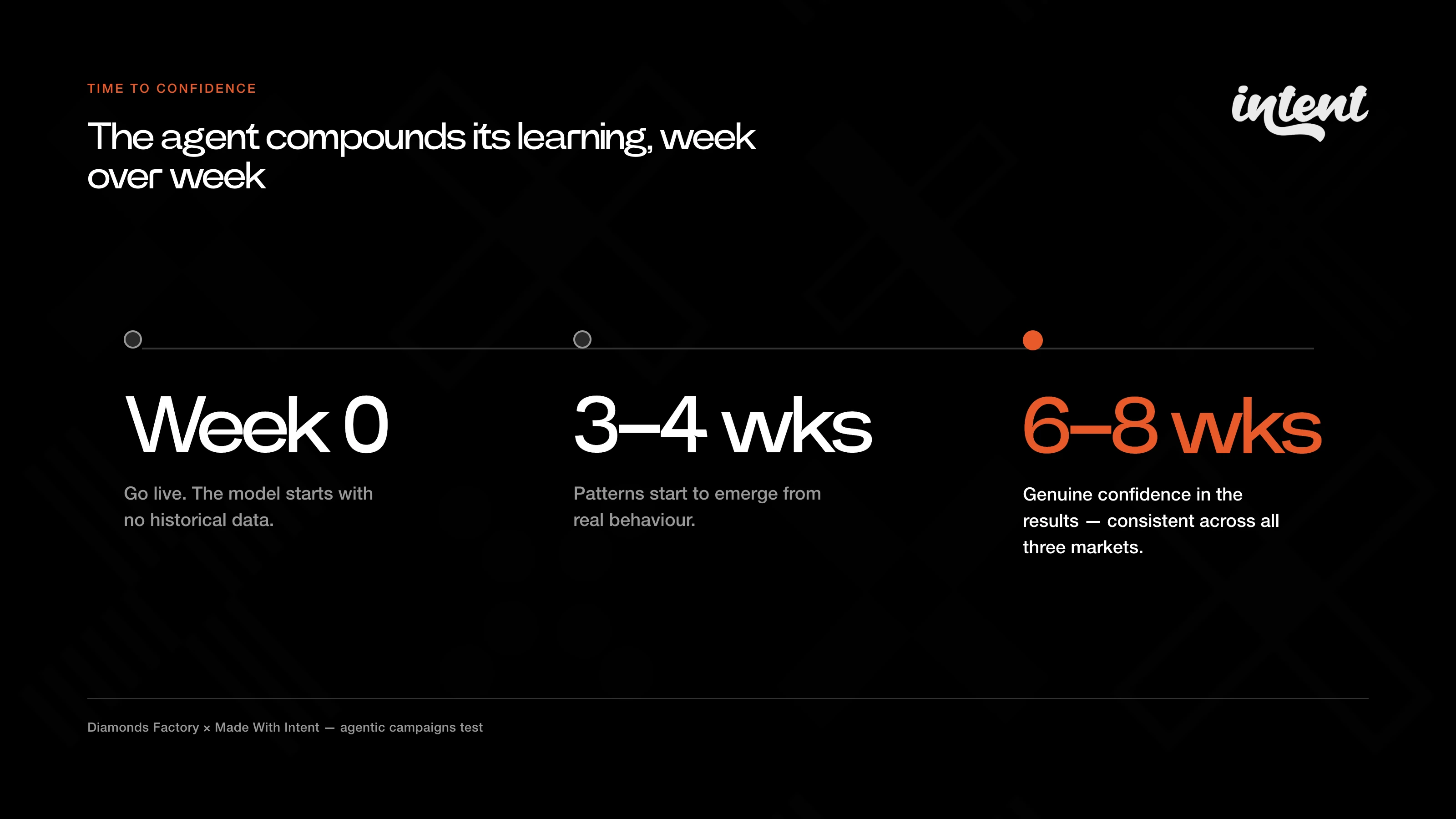
That reframes the agent from a one-off experiment into infrastructure. It’s something that learns continuously and can be dialled up or down around known peaks and troughs. Jo's team started seeing patterns emerge after three to four weeks, and reached genuine confidence in the results within six weeks to two months, consistent across all three markets tested.
What setting up agentic campaigns looks like
Colin Spooner, Principal Value Consultant at Made With Intent, walked through the mechanics live during the session, because "agentic" can sound more abstract than it actually is.
Setting up a campaign starts with choosing the moment it targets (new customer arrival, returning visitor, browse or basket abandonment), then the goal it optimises for, revenue per customer, conversions, or something custom like a credit application.
From there, you build the toolkit of possible responses: a discount at whatever depth makes sense, a trust message, a finance nudge for customers who might be mid-month on cash flow, and, deliberately, a do-nothing option.
The agent then goes into a learning phase, typically two to four weeks, working out which response suits which individual, before it starts compounding that performance over time.
What this doesn't mean
The point that came out from the session is that a single discount applied to everyone, regardless of where they are in the journey, is a blunt instrument in a world that calls for something more precise.
It also doesn't mean every brand will find that 52% of its customers are best left alone. That figure is specific to Diamonds Factory's price points and customer base, and a mass-market retailer with a lower average order value would likely see a different split.
What should generalise is the method, not the exact number: test more than one response, optimise for a metric that reflects margin as well as conversion, and make "do nothing" a genuine option rather than an assumption nobody checks.
In conclusion: From what rule should we apply, to what does this customer need
The shift Jo describes isn't really technical, even though the mechanism is AI. It's a change in the question being asked. Diamonds Factory moved from "what rule should we apply" and "what do we think will work" to "what does this specific customer need right now."
Sometimes, as this blog post shows, the right answer to that question is nothing at all. That's a harder thing for a marketing team to sit with than a 25% discount, but it's the one that protected both the brand's margin and its positioning as a luxury retailer, while still growing revenue per customer by double digits.
If you're running basket abandonment campaigns on a single blanket rule, the question worth asking isn't whether your discount converts. It's whether it's the right decision for the customer in front of you, or just the easiest one to set and forget.
Not every abandoned basket is a fire to put out. Some are customers who are always going to come back, and every discount you throw at them is a margin you don't need to give away.
Curious what an agentic approach could do in your own basket abandonment process? Book a demo with Made With Intent to see it in action.
If you liked this article and want to join our next webinar, follow the link to join our next Intent Live session.

Become an Intent Insider
Get subscriber-only insights we don't publish anywhere else and event invites before anyone else.
By submitting this form you agree to our (more than fair) terms.