Intent-led solutions

Experimentation is evidence to determine whether something works. Intent decides who receives what, when (or whether they need it at all). “Does this work.” Think of this as 80% exploration, and 20% exploitation.
The first works towards the best single answer for everybody to prove a hypothesis. The second works out where a single answer was never going to be enough; scaling a proven hypothesis for true commercial gain. “For whom does it work best, when should it be shown, and do a proportion of users even need it at all?” Think of this as 20% exploration, and 80% exploitation. Where testing tells you whether an experience works, but Intent decides who receives it, when, and whether they need it at all.
In this blog post, we'll identify the differences between Intent and experimentation, so you can understand when to utilise each strategy to further your business goals.
Defining A/B testing
An A/B test answers one single bounded question.
Does this change (a treatment) move the metric we care about, across our traffic, better than the alternative does (a control)?
It's a hypothesis, and what comes out the other end is 80% knowledge (learnings) and 20% value (hopefully positive gain). A primary "does this prove or disprove our hypothesis" binary answer.
Our intent engine answers a different question, and it answers it again every few seconds throughout a users session:
Given what this visitor is doing right now, which of the experiences we already know works suits them at this moment in time? (If any)
What comes out of that is not just a single decision, but hundreds of them a second, all trying to move the agents primary goal, or reward. The open question stopped being does this work a long time ago. What's left is who needs it, and when.
For example: if a visitor starts showing signs of basket abandonment. You can put a returns message in front of them, or a discount, or a trust signal, because you already trust all three of those mechanics. What you don't know is which one that particular person needs, at what point, or whether they need any of them at all. That's the decision the agent is making.
There are several reasons why experimentation (read: split testing) might not be an appropriate mechanism; here are four reasons:
But first, a note on the word experimentation. Throughout this set, experimentation means the whole practice of using evidence to drive ideas: user research, usability testing, prototyping, quasi-experiments and switchbacks where a split isn't possible, and A/B tests where it is. The split test is one instrument inside it, usually the last step rather than the whole of it.
1. Averages can lie.
An A/B test reports an average treatment effect which can hide segments or audiences that have a detrimental or negative impact.
An A/B test reports an average treatment effect. That's the whole point of it. Randomising across your population is what buys you a causal claim in the first place. The price you pay is that the average swallows everything inside it. A headline +2% can be +12% for hesitant first-timers and -4% for loyal returners. Same test. Same green tick. Two completely different stories.
Statisticians call these heterogeneous treatment effects, and there's good evidence that acting on them beats a blanket rollout. In one worked simulation of a ranking change, treating only the 69% of users predicted to benefit delivered a 2.2% gain in revenue per user against shipping it to everybody. A CUNY study of financial aid nudges captured roughly 75% of the total benefit while treating half the population.
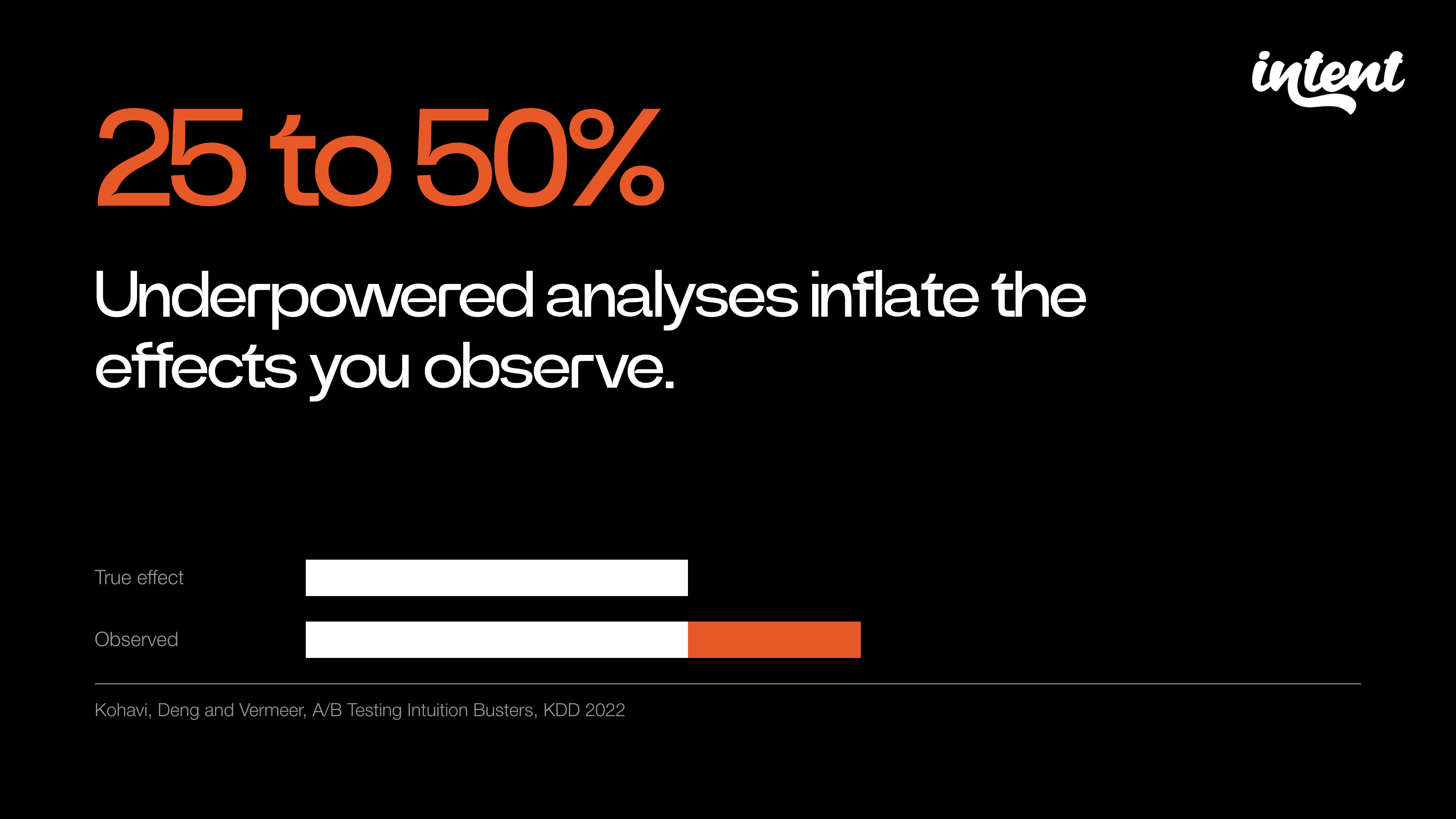
Experimentation is deliberately built to stop you trusting the segment breakdown. Pre-registration, power calculations, no post-hoc slicing. Those rules exist because sliced results are where false positives breed. Kohavi, Deng and Vermeer's A/B Testing Intuition Busters (KDD 2022) found that underpowered analyses inflate the effects you observe by 25 to 50%. At the power levels most mid-market programmes actually run at, over half of your significant results are false positives. So the question you have to answer to deploy well, for whom, is the question your test is worst at answering. That's a boundary, and a sensible one. Intent sits on the other side of it. It predicts for every visitor in advance, rather than carving up a sample after the fact.
Where Intent solves this problem: The experience is being delivered across hundreds of contexts, reallocating to where the experience "works" (where it's best seen and best felt), excluding it from where "it doesn't work." In theory, it only looks and focuses on the good, excluding the bad.
2. Testing assumes the trigger.
Every A/B test starts from a fixed, assumed rule (usually on page load). The trigger "when to show it" is often assumed, arbitrary, and based on a website proxy like "3 page views" or "PDP" rather than genuine user intent.
Nearly every A/B test starts from a fixed rule. Show this on the PDP after three pageviews. Fire this on exit intent. Serve this to returning visitors. Then it tests which creative performs best inside that rule.
The treatment gets examined. The trigger gets assumed.
There's a practical reason for that. The trigger space is far too big to write out by hand. Nobody can enumerate every combination of buying stage, purchase confidence, abandon risk, intent trend and product affinity, let alone power a test across them. So teams pick a proxy or an average and move on.
Proxies are usually where the damage happens. These are largely based on website attributes as opposed to personalised signals. Returning visitor stands in for higher intent. Mobile stands in for lower intent. Pageview count stands in for engagement, when a confused shopper racks up far more pageviews than a decisive one, and high intent visitors often convert inside three.
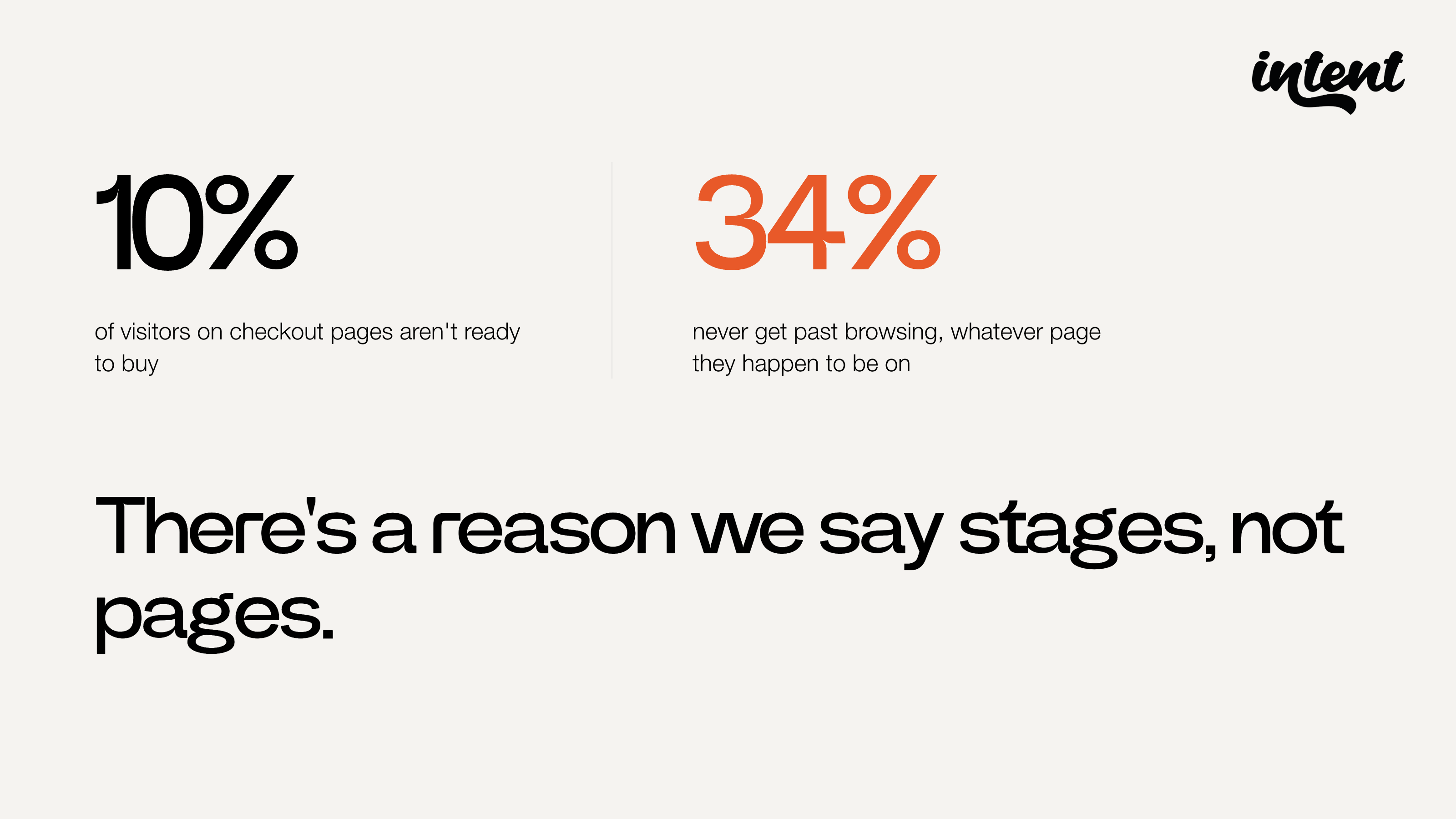
Our own Intent Gap research found 10% of visitors on checkout pages aren't ready to buy. And 34% never get past browsing, whatever page they happen to be on. There's a reason we say stages, not pages.
Where Intent solves this problem: Intent agentic delivery serves the individual at a moment in time. A user might need an experience on the 3rd page view after 30 seconds, a different user might need it after 50 seconds, a different user might need it after 9 page views and 1 second. The continuous prediction modelling gives a threshold to meet first, and then a mechanism to automate a decision second.
3. Statistical significance is a search for one answer.
The search for statistical significance can a) slow you down and b) inhibit your ability to personalise to different segments.
Significance exists to license a claim about a single population, and the claim is singular by design where B beats A: one answer, for everyone. That is exactly what costs time.
You need a sample big enough to speak for the whole population with a minimum detectable effect. If you want the claim to be about a segment instead (what some call "personalisation") you need that sample inside the segment too, so the wait multiplies. Most claim they don't have the traffic to personalise because of this.
Experimentation vendor's posterior is a belief about a variant. One distribution per arm, computed across everybody who saw it, resolving to a single winner for all your traffic. Better maths than a p-value, and the shape of the answer is identical. One number per variant, and a threshold you wait to cross before you act.
Our posterior at Made with Intent is a belief about a variant given a context. Where their question is whether B beats A, ours is whether B beats A for a visitor in this intent state, at this point in their session. The model predicts reward conditional on context, so what comes out is a policy; hundreds of answers, running at once.
Put it this way: instead of a human designing three segments and running three underpowered tests, the winner goes to the agent alongside its alternatives and the segment level optimisation runs continuously. Three mechanisms make that more traffic-efficient than a segmented test. Worth understanding rather than taking on trust.
1. Allocation is adaptive. Thompson Sampling draws plausible performance rates from each variant's posterior and routes traffic accordingly, so your exploration cost falls as confidence climbs rather than sitting at 50% for the duration. In practice agentic campaigns push 80 to 90% of traffic to the winner inside two to three weeks. A fixed-allocation A/B test takes around six. Optimised Control shrinks the control group automatically as confidence grows.
2. Without waiting for statistical significance. It borrows statistical strength across slices. This is the important one. Made With Intent runs a contextual bandit, not a multi-armed one. A multi-armed bandit only learns from the data each arm receives, so every segment needs its own volume, which is the same problem as a segmented A/B test in different clothing. A contextual bandit trains a model that predicts reward given context, so it can estimate performance for a combination it has never directly seen. Show it mobile traffic, low intent traffic and a particular page separately and it can predict for "mobile, low intent, that page" by generalising from how each component behaves. A hand-built segment can't borrow like that. Every cell starts at zero.
3. You're not assuming which segment to slice or review. The agent can build up to 500 contextual combinations and up to 75 moment-based triggers per campaign, and it trims its own feature selection to keep each slice sample-rich. Nobody has to guess which distinctions matter before there's evidence about which ones do.
Why we don't report per-segment significance
This surprises experimentation-native teams more than anything else in the product. It's a deliberate methodological choice.
Run an independent significance test on every intent combination and multiple comparisons swallow the results. At α = 0.05, roughly 14 independent tests give you about a 50% chance of at least one false positive. A hundred tests will throw up around five false positives by chance alone, and across hundreds of combinations you'd be manufacturing findings.
We trialled per-segment significance reporting and pulled it, because it surfaced spurious and inverse correlations. For example, users traverse through different stages of intent in their journey, at what point is a user in low intent and when did they see the treatment?
The per-segment decisions get justified differently. Is the model calibrated, meaning when it says 70% does it convert around 70% of the time (measured by expected calibration error)? Is it discriminating, meaning can it rank likely converters above unlikely ones (AUC around 0.84)? A well calibrated probability is a legitimate basis for acting on a slice. An underpowered significance test on that same slice is not.
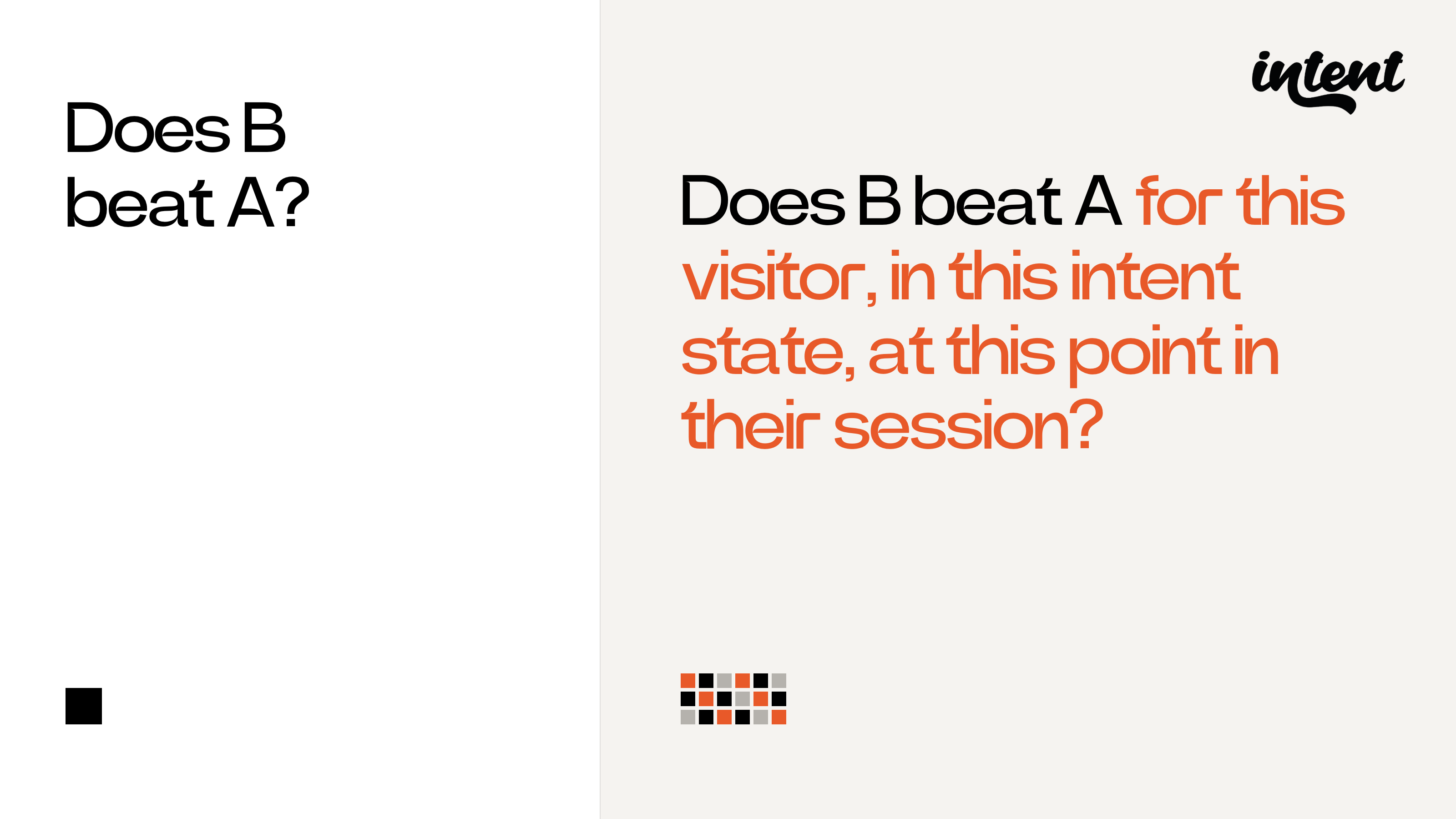
This calls back to something we talked about earlier.The reason you shouldn't chase per-segment significance in your testing tool is the same reason we don't chase it in ours. Prediction is the right instrument for the for whom question, retrospective slicing isn't.
Why we don't report on single variant uplifts
You get one clean causal number, control against the agent's allocation, measured the way any experimentation lead would want it measured. You give up per-arm inference, and in exchange the arm is adaptive. That's the trade. An A/B test gives you clean inference on every arm and one winner for everybody. An agentic campaign gives you clean inference on one arm, and a different winner in every context.
Load five experiences into an agentic campaign and it looks like a five-arm test. It isn't. It's actually a two-arm experiment, the same shape as any A/B test you've run. The difference being:
• Control. A baseline you define.
• Variant. The agent's allocation across all five experiences.
A traditional A/B test asks which variant wins with a blanket rule. An agentic campaign asks a different question with an adaptive rule (it's a reason why we call them campaigns, not experiments)
Does allocating these experiences by intent beat applying a blanket rule?
We don't report on single variant uplifts eg: Variant B is better by 5% because:
1. There's no single number to give you. Experience B might be the winner for high intent, budget-conscious mobile visitors and the loser for low intent desktop. That's the entire point of running it this way. Collapsing it to one figure puts back exactly the average this campaign exists to get rid of.
2. The arms were never randomised against control. Traffic reaching experience B was chosen by the agent, on context and accumulated evidence. It isn't a random slice of your audience so there's no effective control. Comparing a deliberately selected group against everybody is confounded by construction, and nothing in the data separates the effect of the experience from the effect of the selection.
3. You'd be reading a state the system has already left. If experience B was struggling in a context, the agent would have noticed days ago and moved traffic away (hence: reallocation). The number in front of you is an average across a period in which allocation was actively changing, and the campaign has moved on since. Acting on it means acting on history the agent has already corrected for.
That distinction does three things, in order.
1. It changes what you can personalise. A per-variant posterior can only ever produce one answer for everyone, however good the statistics behind it are. Varying what people get requires probability conditional on the person. That's the whole game, and it matters far more than the frequentist argument ever did.
2. It changes when you can act. Certainty becomes a dial rather than a gate. At 62% probability, Thompson Sampling tilts the allocation and updates again tonight. Nobody declares anything. A stopping rule stops being necessary once allocation is continuous.
3. It changes how fast you get there. Nothing is waiting for a threshold, so allocation improves from the first night onward. There's no finish line to reach before the work starts paying.
Where Intent solves this problem: Our posterior at Made with Intent is a belief about a variant given a context. Where experimentation question is whether B beats A, ours is whether B beats A for a visitor in this intent state, at this point in their session. The model predicts reward conditional on context, so what comes out is a policy; hundreds of answers, running at once based on a series of probabilities using a contextual bandit.
4. Limited to a single answer for only one point in time.
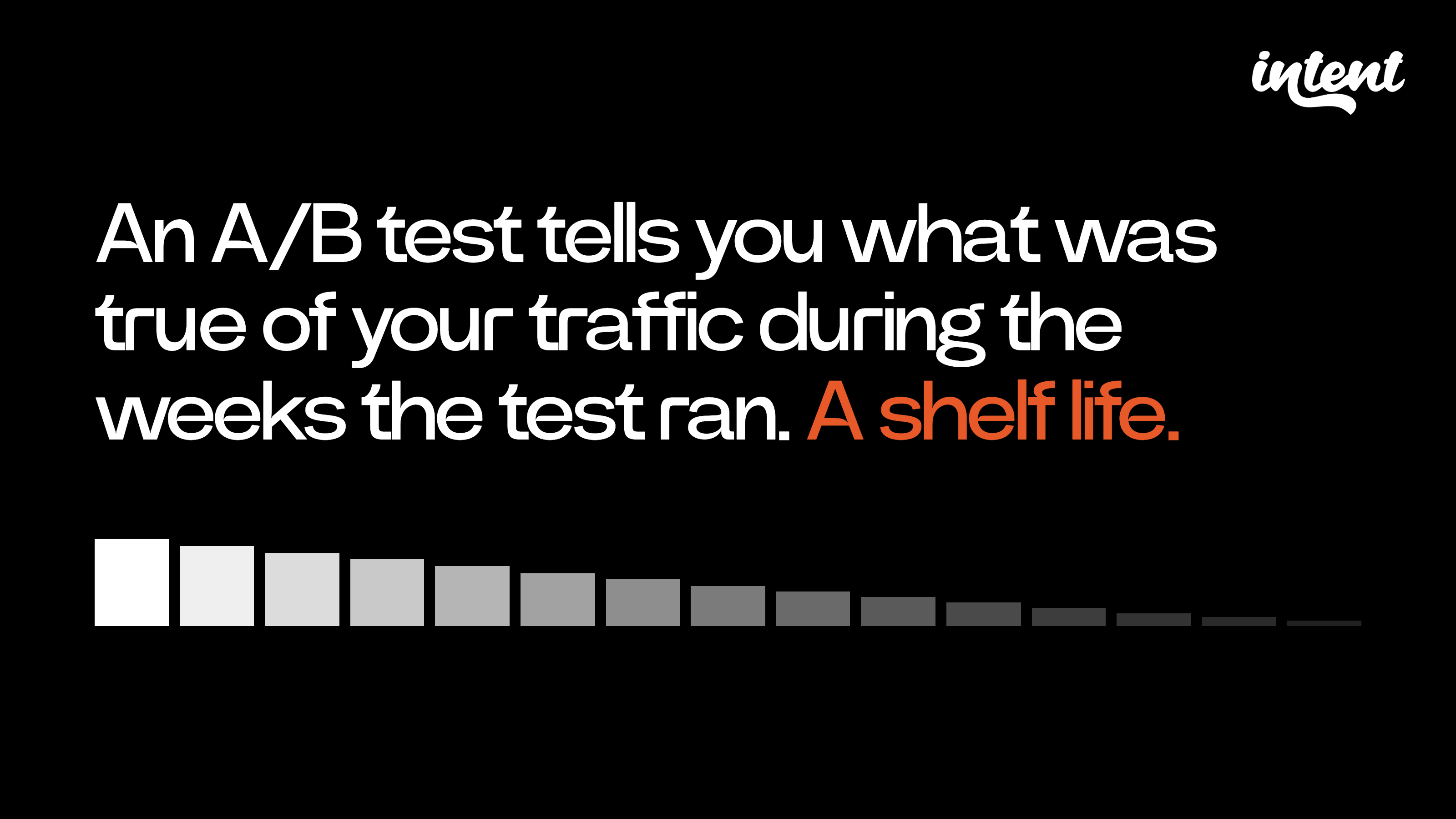
An A/B test only tells you what was true of your traffic during the weeks the test ran.
An A/B test tells you what was true of your traffic during the weeks the test ran; a shelf life. Nothing about that answer refreshes itself so brands often end up "re-testing" the same thing a few years later, hoping there's no change from a previous positive test. The world moves on, results degrade as users become "used" to the treatment, competitors copy; not to mention that your purchase lifecycle varies by days, weeks, months, years.
For example: a Microsoft experiment on MSN.com saw replacing one button with another produce a 4.7% increase in overall clicks. The daily breakdown post launch showed the difference decreasing rapidly day over day as users learned the change, leading to the team shut the experiment down mid-way. The conclusion was that the observed treatment effects "are not always permanently stable, sometimes revealing increasing or decreasing patterns over time."
There are a few reasons why this happens.
1. Novelty and primacy wear off. A new element gets attention because it's new. Returning visitors are briefly worse off because it isn't what they knew (which is why tests are often split, somewhat arbitrarily, between new and returning users)
2. Buying patterns differ throughout the year. December traffic behaves nothing like March traffic, different intent, different price sensitivity, different tolerance for being interrupted (especially for retailers)
3. The population itself drifts. Mix of paid traffic allocation shifts, category mixes alter or a competitor changes their delivery proposition. Macro-economic factors alter the interaction effect.
Does a mature site slowly accumulate a layer of decisions that were correct once, are serving everybody by default, yet are answerable to nobody? It is entirely possible to have a well-governed testing function and a site full of expired answers at the same time.
Where Intent solves this problem: Continuous allocation doesn't have this failure mode, because it never declares anything. The posterior is a live belief rather than a verdict, continually reallocating and therefore responding to changes, not static. Allocation is re-scored against current behaviour and retrained nightly, and standing exploration keeps a small share of traffic asking whether the current answer is still the right one. When February stops behaving like November, the agent finds out because it never stopped looking.
Intent vs experimentation: In depth
We've done a quick reference table on the differences between Intent and experimentation. Take a look, send it to your colleagues. You're welcome.
Experimentation and Intent aren't solving the same problem, and treating them as substitutes is where most testing programmes stall. An A/B test proves whether something works for everybody, on average. But it can't tell you who needs a returns message versus a discount versus nothing at all, and it becomes redundant the moment the traffic that validated it moves on.
Intent picks up where that boundary sits, deciding who an experience is for, when, and whether they need it at all, re-scored every few seconds instead of declared once and left to expire. Most eCommerce teams already have the first instrument. The second is what turns that evidence into revenue, visitor by visitor, instead of one rollout for everybody.
Book a demo to see how Made With Intent can help you deliver more appropriate experiences to your customers.


Your A/B testing programme just found a winner. A new discount banner lifted conversion by a healthy margin, the test ran long enough to be statistically significant, and the result is sitting in a dashboard somewhere with a green checkmark next to it. Mission accomplished, right?
For most eCommerce teams, the default answer is the same: roll it out to 100% of visitors.
That decision gets made without a second thought, because it doesn't feel like a decision at all. It feels like the natural conclusion of a successful test. You've gone and validated your hypothesis. And when you've got a winner, there's a paper trail to an uplift.
It isn't. It's a choice, and for most brands it's the wrong one.
A/B testing tells you which experience wins across your traffic as a whole. It doesn't tell you which specific visitor should see that winner, or when. That's a different question, that's answered in an entirely different way. It's a decision that requires you needing to know something about the person you're serving an experience to in the first place.
Let's be clear — A/B testing definitely has a place
A/B testing tools do exactly what they're built to do, and they do it well. They replace opinion with evidence. A test that runs to statistical significance tells you, with confidence, that variant B outperforms variant A on your website or mobile app.
Made With Intent customers continue to use tools like Convert, VWO, and AB Tasty alongside our tool, because testing answers a question nothing else can: does this specific change move the number we care about?
Think about what a test actually proves. It proves that, across hundreds or thousands of visitors, variant B beat variant A. It says nothing about any single visitor in front of you right now. Statistical significance is for large volumes of people not a prediction about the individual standing at your checkout, which is a limitation CRO metrics share more broadly.
The difference between A/B testing tools and Made With Intent
Should 100% of people get your A/B test winner?
Once a test determines a winner, most teams roll that experience out broadly, often to every visitor who fits the original test's targeting. Many testing tools do offer segment targeting: device type, geography, new versus returning.
Some brands go further and layer in basic rules, like showing a winning banner only after 30 seconds on site, or only to visitors on their third page view. These rules feel like personalisation. They're really just a slightly more granular version of the same default: a fixed condition, checked once, applied broadly.
But look closely at how it gets set up. Teams choose segments once, at test design time, and then leave them alone. Even a well-built intent-based segmentation programme needs continuous application, not just at launch, or it drifts back into the same static-rule problem.
A rule that says "show this to returning visitors" doesn't change three minutes later when a returning visitor starts behaving like someone about to abandon their basket, or like someone who was going to buy anyway with or without an incentive.
The real problem is narrower and more difficult to solve. The targeting decision is frozen at the moment the test launches, while the person in front of it keeps changing their mind. (Their intent)
A discount that lifts conversion in aggregate can still be the wrong call for two specific people in your test group. A first-time visitor who's price-sensitive and hesitating needs it. A loyal customer who's already three products deep into checkout, on their fourth order this year, does not.
It's the same tension at the heart of whether discounting is a race to the bottom or a genuine growth lever. There's no problem with offering discounts, but it can be a blunt instrument or entirely inappropriate depending on where your customer is at in their buying journey.

How reading intent allows you to respond immediately to changing demands
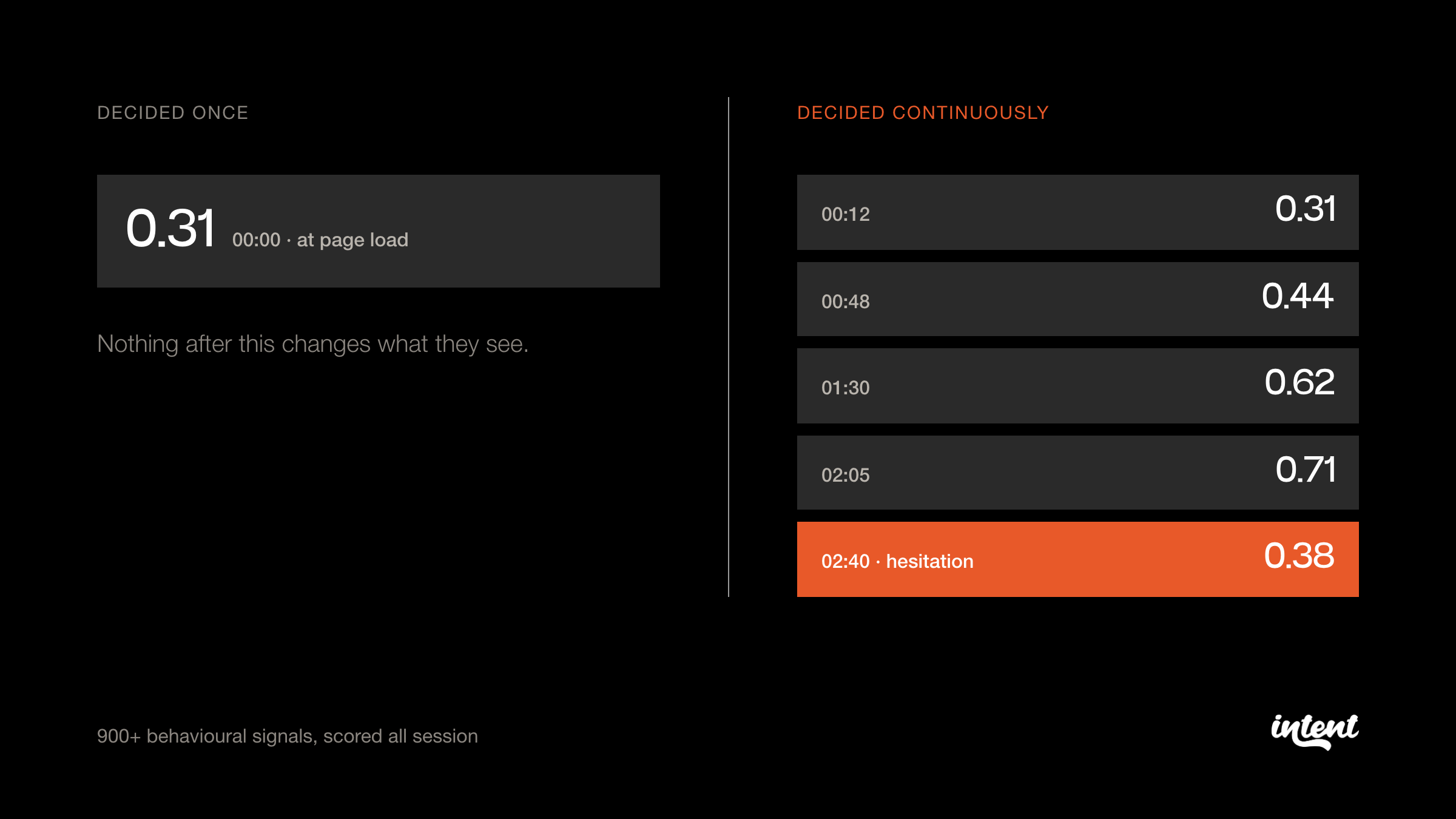
A/B testing tools make their decision once, when the page loads or the session starts. Whatever segment a visitor falls into at that moment determines what they see for the rest of that test.
But purchase intent isn't fixed at page load. A visitor can arrive browsing casually, spend four minutes comparing two products, add one to their basket, then hesitate at the price for 30 seconds before starting to type a discount code into Google in another tab. That's not a static segment. That's a person, moving in real time, and most testing infrastructure was never built to react to this situation as it unfolds.
Some testing and CRO tools react to single behavioural triggers: an exit-intent popup fired on mouse movement toward the browser bar, a scroll-based banner, a basic engagement score. We think those are great, and definitely worth using. However, they're single-trigger rules, checked once a condition is met, and not a continuous read on a person as they use your website and apps.
What real-time behavioural data adds
Made With Intent's platform tracks over 900+ behavioural signals through each visitor's session, including scroll speed, click sequences, time spent, and product comparison patterns, updating its prediction of purchase intent continuously rather than once. When intent shifts, the response can shift with it.
None of this means every session tells a dramatic story. Plenty of visitors browse, leave, and never come close to converting in that session, and no amount of real-time signal turns a casual browser into a buyer. The claim isn't that every visitor is secretly ready to buy. It's that the visitors who are ready look different from the ones who aren't, and a rule set once at test launch can't tell the difference between them three minutes into the session.
What real-time intent-based deployment looks like
Picture the same winning discount from earlier. Instead of firing it to every visitor who matches a fixed segment, an intent-based system asks a narrower question: Is this specific visitor showing signals of hesitation or exit risk right now, or are they already moving smoothly toward checkout?
Made With Intent's Intent Scoring analyses those signals continuously and its Timing Engine decides the moment to act, rather than firing on a page-load rule or a fixed timer. A hesitant first-time visitor comparing prices across tabs might see the discount. A returning customer already at the payment page, showing no hesitation signals at all, doesn't need it, and doesn't get it. This is what discounting with intent looks like in practice: the same offer, reserved for the visitors who actually need it to convert.
The winning experience from your test doesn't change. Who receives it, and when, does.
Take a product page test that proved a scarcity message ("only 3 left") increased add-to-basket rate. Fired at everyone, it also lands on a loyal customer who's bought the same product line four times before and knows exactly what they want. To that visitor, it reads as pressure, not information. Deployed by intent, the same message is reserved for the visitors actually showing comparison and hesitation behaviour, the ones it was designed to nudge in the first place.
How an actual company used Made With Intent alongside A/B testing
Appliances Direct, a UK home appliances retailer, ran into a version of this problem. Their discounting was broad and largely untargeted; offers went out early in the visitor journey, without real-time context, regardless of whether a given shopper actually needed the incentive to convert.
Using Made With Intent, they began reserving discounts for visitors showing genuine exit and abandonment signals, rather than firing them to everyone who matched a static segment. They left everyone else to convert at full price, as they were always going to.
In the end, they made a 42% saving in margin previously given away to visitors who would have converted regardless, without a drop in conversions from the visitors who needed the discount to purchase.
But don't take our word for it. Take a look at our Appliances Direct case study and make up your mind yourself.
That figure lines up with a broader pattern. Made With Intent's own Intent Gap research found that 83% of shoppers have used a discount code despite being ready to pay full price.

Why new test winners are rare
That scarcity of new winners isn't unique to Appliances Direct. Research from Microsoft's own experimentation team, drawn from thousands of controlled experiments at Bing and elsewhere, found that only 10 to 20% of test ideas move the metric they were designed to move, and that a genuine breakthrough, the kind of result that reshapes a programme rather than nudging it, shows up in roughly one in 500 experiments. The findings come from Kohavi et al.'s Seven Rules of Thumb for Web Site Experimenters (2014). Most of what a mature testing programme finds after the early wins are used up is small, single-digit-percentage gains, not new step changes.
Testing tells you what works. Intent tells you for whom, right now.
None of this is an argument against testing. It's an argument for finishing the job testing starts.
Your A/B testing programme answers one question well: does this experience outperform the alternative? What it was never built to answer is a second, quieter question that gets decided by default instead of by design: who should see this winning experience, and at what moment in their session?
Testing finds your best experience. Making sure it reaches the right person, at the right moment, without giving away margin to people who didn't need it, is a different problem, and it needs a different kind of data to solve.
If you want to see what your existing winning experiences would look like deployed by real-time intent instead of a blanket rule, book a demo and we'll walk through it against your own traffic.

Editor's note: this article is adapted from a recent Intent Live session with Jack Simkins, Digital Product Manager at Golfbreaks.com. Watch the full recording here.
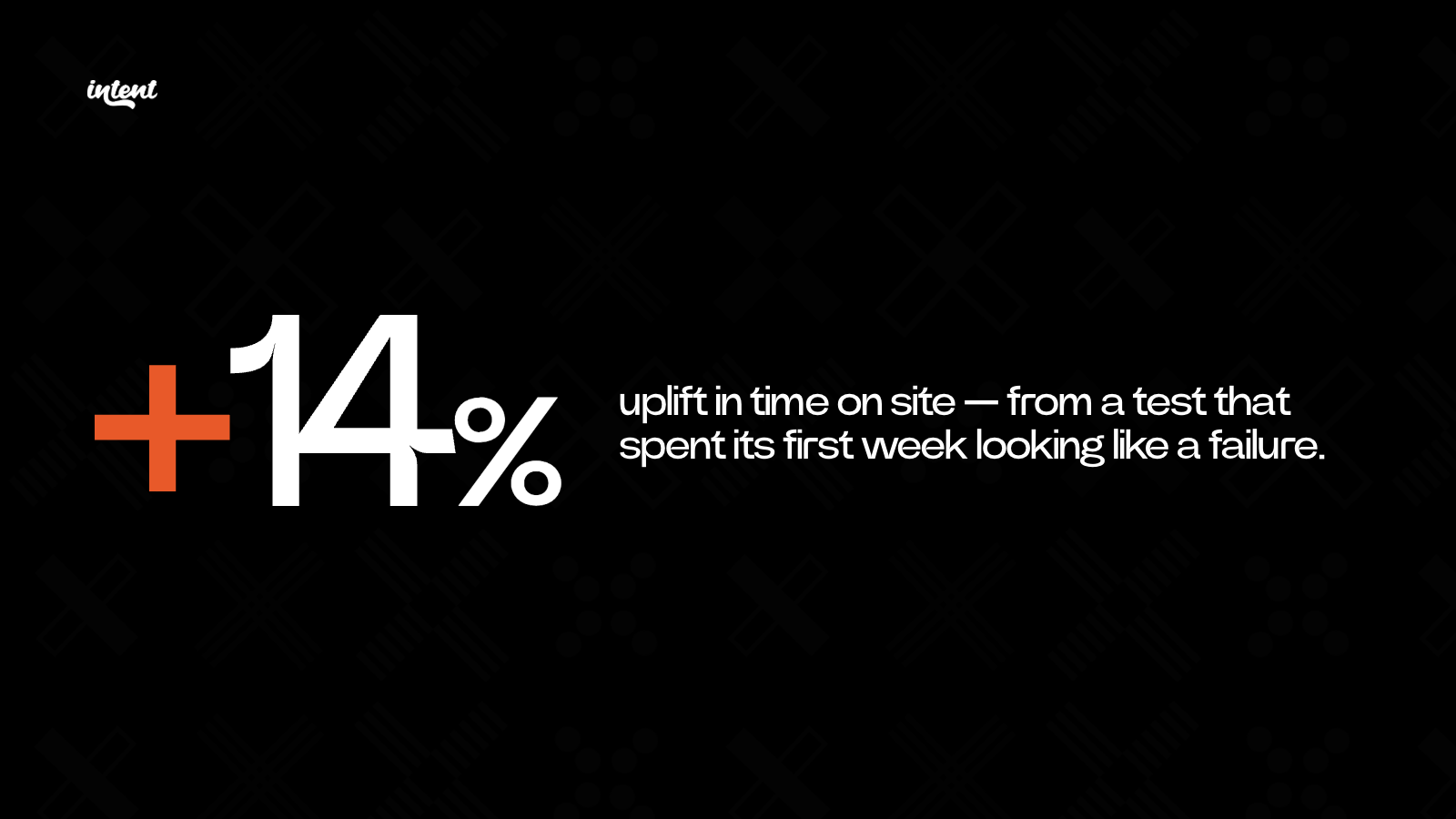
A test that lifted time on site by 14% still spent its first week looking like a failure. Conversion rate was down. Under a traditional A/B testing programme, Golfbreaks.com would have pulled the experiment.
They didn't. And the reason why says a lot about what happens when a genuinely high-consideration purchase journey meets a testing programme built for one-session eCommerce.
Golfbreaks.com is a golf tour operator based in Windsor, with offices in Copenhagen and Charleston, though the Made with Intent account focuses on the US and UK. It sends golfers on trips ranging from a single night in the UK to a week in Spain or Portugal, across a lot of different golfer segments. It's a lead generation business first. Visitors don't check out online in one sitting, they enquire, then a sales agent works out flights, transfers, accommodation, and course access, and gets them to a booking over the phone, sometimes weeks later.
That's not unusual for travel, where research and comparison typically happen across several separate visits and sites before a decision gets made. Optimising a single-session conversion rate for a purchase that actually plays out over weeks measures the wrong moment entirely.
A booking journey that can't be forced into one session
Jack has spent seven years at Golfbreaks.com, the last couple focused on conversion rate optimisation. "We've got quite a unique scenario whereby we're trying to encourage that inquiry," he said. "Particularly in travel, in the industry in general, it's quite an unusual thing to not be able to book entirely online."
A small portionof trips get booked online. But most go through a sales agent, because a golf trip has too many moving parts (courses, transfers, flights, accommodation, and group logistics) for most visitors to configure and commit to in one sitting.
Colin Spooner, Principal Value Consultant at Made with Intent, put his finger on why that matters: "It's not our traditional eCommerce brand where it's a pure purchase journey. But that almost plays into the hands of intent, where you need to think about that considered purchase and how to get people through the funnel before even thinking about the booking, weeks and months down the line."
Measuring what happens before conversion
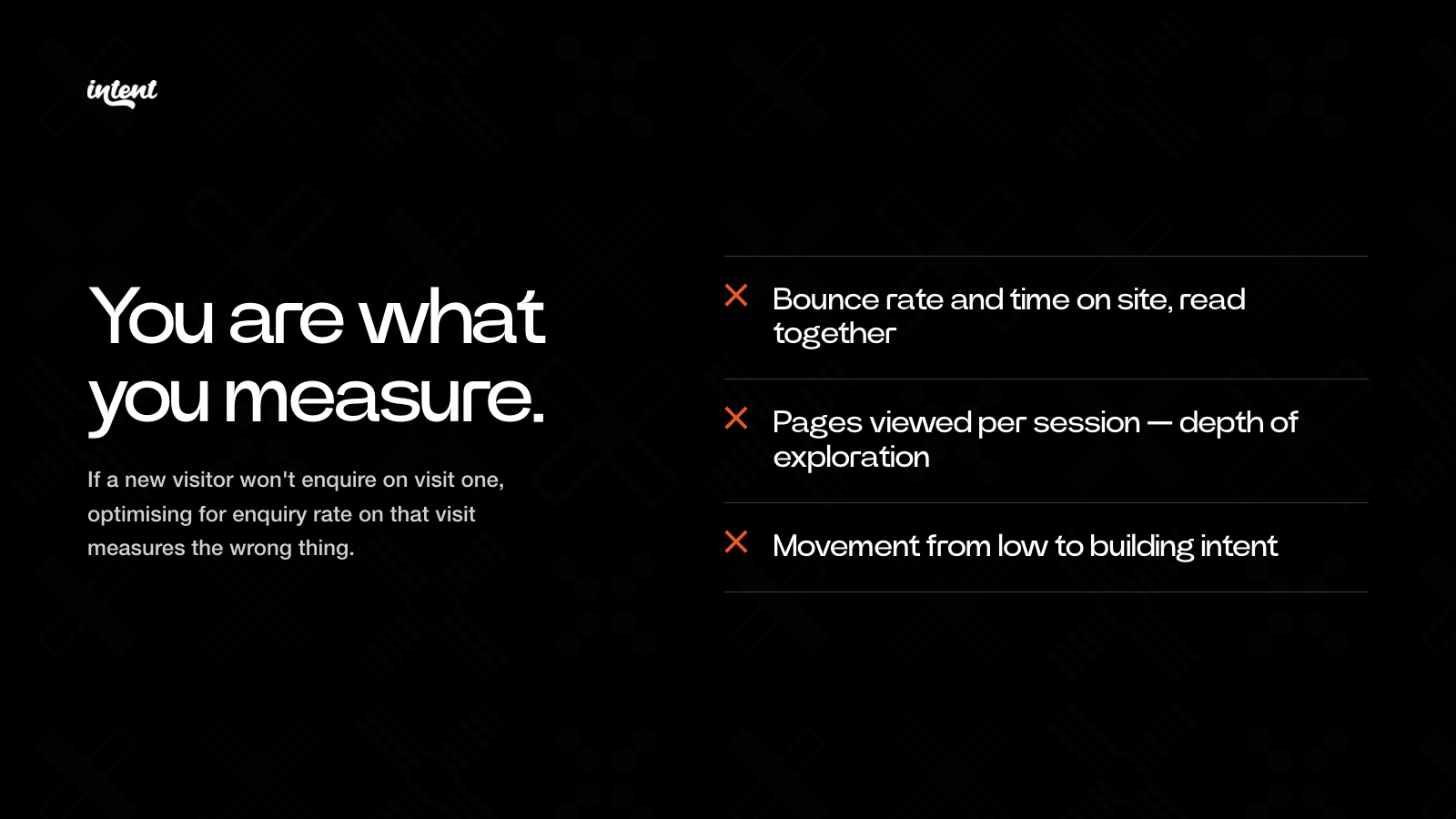
"You are what you measure" is a phrase the Golfbreaks.com team has adopted internally. If a new visitor is unlikely to enquire on their first visit, optimising purely for enquiry rate on that visit measures the wrong thing.
So alongside enquiry rate, the team tracks bounce rate and time on site together (a new visitor who bounces immediately clearly hasn't been given a reason to stay), pages viewed per session as a depth-of-exploration signal, and, specifically, movement from low to building intent, the kind of signals behind Made with Intent's content prioritisation and messaging use cases. None of these are vanity metrics here. They're proxies for whether a visitor is progressing through a decision process that runs across several sessions, not on a single visit.
Before building any experience, the team asks these questions to get in their customers shoes:
- What is a brand-new visitor actually trying to work out?
- Who are Golfbreaks.com?
- Can we be trusted?
- Do you have to pay full price up front?
- Can you book online at all?
That last one is really important. Because Golfbreaks.com can't be booked entirely online, setting that expectation early avoids disappointment later in the funnel, right when a visitor is closest to converting. As Colin put it, getting that messaging right up front was "a huge realisation" for how the whole experience needed to be built.
What agentic campaigns change about testing
Golfbreaks.com's testing programme runs on Made with Intent's agentic campaigns. In standard A/B testing, you decide up front which segment sees which variant, based on a hypothesis about who will respond to what. Agentic campaigns invert that: you define the strategy (the moment you're trying to influence, and the goal, whether that's enquiries, conversions, or a secondary metric) and hand the agent your set of tactics. It tests them against real segments and works out which one performs best, for whom, and when, using the same intent signals that power the rest of the platform.
For Jack, a self-described non-developer, the practical benefit was speed. "The tool allows me to get these experiences up much faster," he said. "My concept-to-live process is significantly shorter... it means the agents have got time to learn."
But the deeper change is what gets removed. "No longer am I having to set up those individual segments, or serve experiences to segments that I think will benefit from them," he said. "It's in the hands of the agent to then work out what segments it would benefit from... It's a much wider net." A message built for low-intent visitors might also help a segment already building toward a decision. A manual test is only as good as the human guess behind who it's shown to. An agent testing against a hundred segments simultaneously doesn't have that blind spot.
The "do nothing" variant is a genuine conversion tool
One of the more counter-intuitive parts of Golfbreaks.com's setup is what Jack calls the "do nothing" variant. In standard A/B testing, every visitor sees a control or one of several variants. Agentic campaigns add an option where the visitor sees nothing added or changed at all.
"The do nothing essentially sits within those variants as a copy of the control," Jack explained. "It's a safety net because it prevents us from showing negative experiences to customers that don't need to see it."
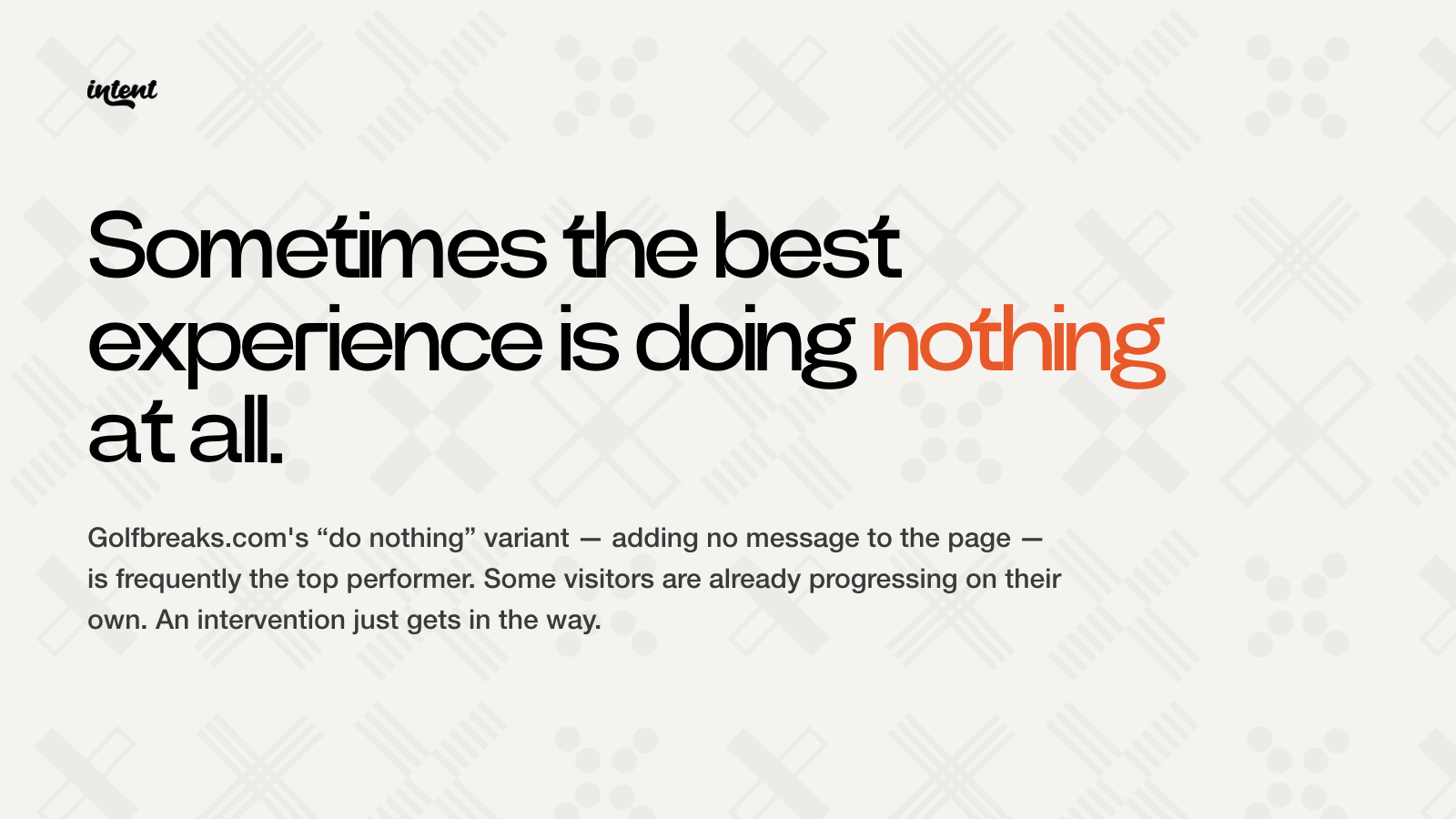
"In most experience it's always about adding things onto your site," Colin observed. "Having a version where actually sometimes the best thing is leaving the customer alone to progress, or even suppressing things on site, is a nice alternative to what we've experienced over the last 10, 20 years in experimentation." As the data below shows, it's frequently the top performer, because some visitors don't need an intervention. They're already progressing on their own, or they arrived with enough context that added messaging just gets in the way.
When the agent's early data looks wrong
Here's where the seven-day lesson from the top of this article comes back in. Jack's team built two welcome-visit experiences using the same messaging, one for the homepage, one for a location page such as a product discovery landing point for someone who searched "golf breaks in England."
The homepage experience delivered a 14% uplift in time on site. But conversion rate showed a negative trend for the first seven days. "With traditional AB testing, I would have perhaps turned it off," Jack said. "I would have panicked when I saw negative 14%, and I would have said, this isn't working."
He didn't, because the agent was still learning. That's consistent with what independent testing research shows more broadly: short test windows are more susceptible to random variation, and stopping early on interim results is one of the most common ways a genuinely winning test gets killed before it proves itself. Once the agent had enough data, performance turned around.
Same messaging, two different visitors
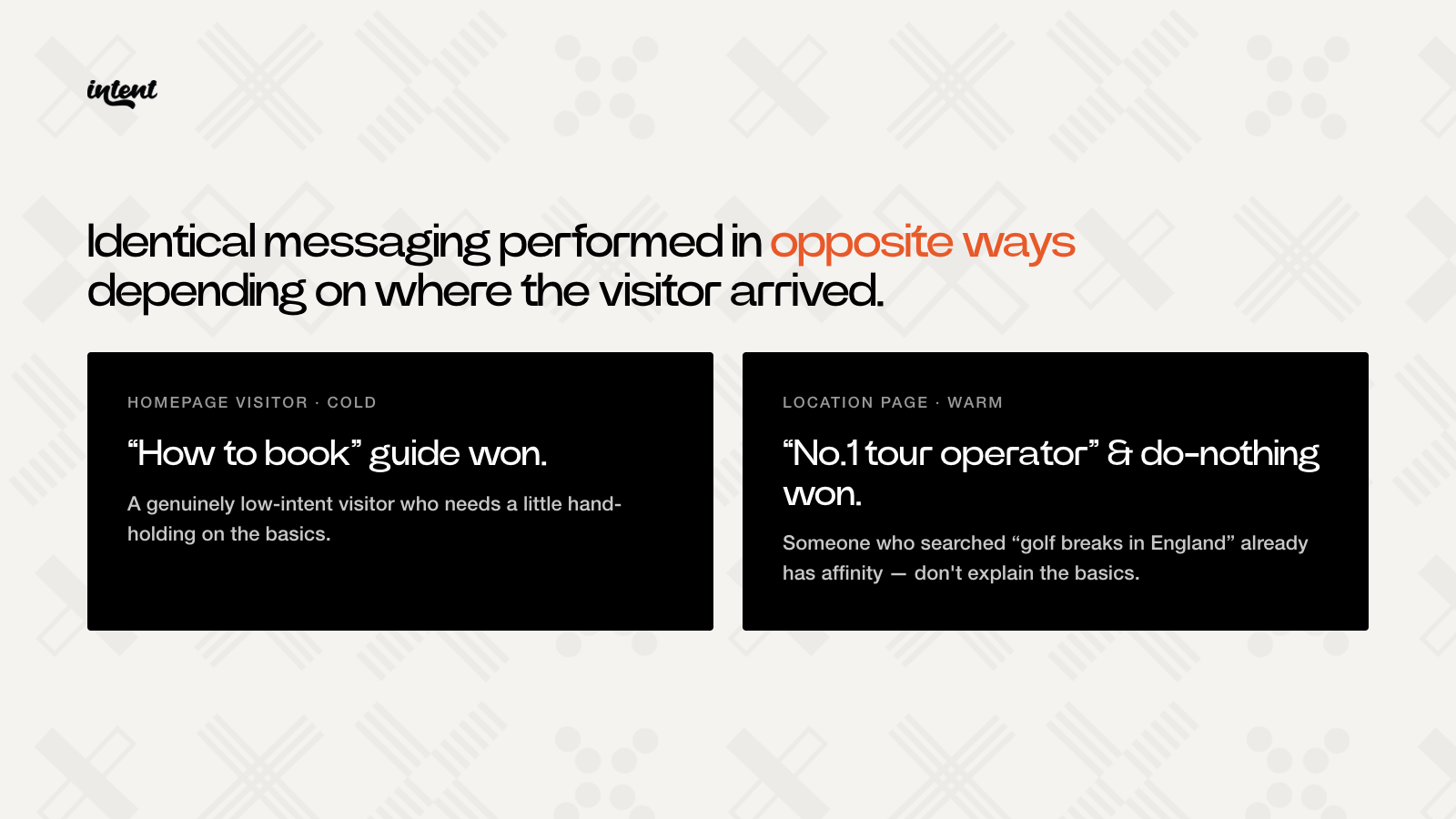
The location-page test surfaced something else: identical messaging performed in opposite ways depending on where a visitor arrived. On the homepage, a "how to book guide" message performed best, evidence of a genuinely low-intent visitor who needs some hand-holding.
On the location page, the top performer was a trust-building "number one tour operator" message and the do-nothing variant. Jack's take is that a visitor who searched "golf breaks in England" already has affinity toward the destination, closer to a returning visit mindset than a cold product visit. They don't need the basics explained.
A message about Golfbreaks.com's customisable packages underperformed with brand-new homepage visitors. It's true and important, but it's the wrong message at the wrong moment, the same lesson behind Made with Intent's discounting use case: showing a message before a visitor is ready for it does more harm than good.
The surprise that only showed up in the data
Asked what surprised him most, Jack pointed to something that had been sitting in plain sight. An early "ready to plan?" message aimed at brand-new visitors looked like a reasonable nudge. But in the data, it actually came across as overbearing.
"If you think about a new user landing on the site and asking, are you ready to plan? It's probably a bit overbearing," Jack said. "At the time, when you're setting up those tests, it's like, right, I'm going to use the same messages for the homepage, same message for the location page. They're surely going to work." They didn't, for every segment.
Colin's read: "The amount of times we see customers who have a predefined view of what will work, and it's completely different. That point around being subjective comes to life when you start to see the way the agent starts to make decisions." That tracks with the broader shift in shopper expectations, most consumers now expect a personalised experience and notice sharply when they don't get one, a generic message is no longer neutral, it actively reads as a miss.
When a message doesn't resonate with any segment, the fix is simple. Delete it, let the agent relearn, and add a new tactic later if needed. You don't need to manually re-segment.
Measure the journey, not just the moment
None of this is unique to golf holidays. Any purchase with a real consideration cycle shares the same shape, including B2B software, where roughly 70% of the buying journey typically happens before a buyer contacts a vendor at all. A first-time visitor is rarely the same as a returning, further-along one, and treating them identically wastes the message on the visitor least ready to act on it.
Three things carry over regardless of your industry. You don't need to be a developer to find early wins, a visual editor is enough to start. If your purchase journey has any real consideration cycle in it, top-of-funnel testing should measure more than conversion. And build a tactic sheet of messages at a global level, then let the data show which ones resonate with which visitors, rather than deciding that yourself up front.
If your own funnel has visitors who aren't ready to buy on visit one, the same logic applies. See the intent framework behind it. Or book a demo to see it against your own traffic.
If you've enjoyed this write up of our latest Intent Live session, why don't you join our next one?

Why standard advice on eCommerce bounce rate might not be enough
In 2023, Google Analytics 4 replaced Universal Analytics (UA) as the default, shifting the definition of bounce rate entirely. Under UA, any single-page session counted as a bounce, regardless of how long the visitor stayed or what they did. Under GA4, a "bounce" is a session with no meaningful engagement in the first ten seconds (Google Analytics Help, 2023).
Most published advice on reducing eCommerce bounce rate, including almost everything ranking on the first page of Google right now, predates that change. The benchmarks cited, the comparisons drawn, the thresholds used to define a "good" or "bad" rate: much of it is calibrated to a metric that no longer exists in its original form. It's worth bearing in mind before treating a published figure as a reliable signal that something is broken.
There's a connection here to the intent signals argument. GA4 defines a bounce as a session with no meaningful engagement, which is itself the absence of any intent signal. However, the metric has quietly moved closer to what we're suggesting: that what matters is whether a visitor showed signs of engagement and intent, not simply whether they viewed more than one page.
The standard fixes aren't useless. A page that takes four seconds to load on mobile will lose shoppers. Navigation that buries products three levels deep creates friction. These are real problems. But they're also largely table stakes. Most mid-market eCommerce teams have addressed them, or at least know they need to.
What the generic checklist rarely asks is: why did this particular visitor leave this particular page? Speed explains some of it. Confusing navigation explains more. But there's a third explanation that gets far less attention: the visitor arrived with a specific intent, and the experience they landed on didn't reflect it.
What on-site intent signals actually are
Intent signals aren't abstract. They're specific, observable events already firing on your site every day, most of them visible in your analytics if you know where to look.
Consider what happens in the first thirty seconds of a session. A visitor lands on a product detail page. Do they scroll past the first image, or stop there? Do they interact with the size selector, or skip straight past it? Do they hover over the "Add to Basket" button without clicking? Do they navigate to a second product, return to the category page, or leave entirely?
Each of those micro-behaviours carries a signal. Taken individually, they don't mean anything. Taken together, they start to suggest something about intent: whether the visitor is browsing loosely, comparing seriously, or hitting a wall they can't get past.
Some of the most informative on-site signals include:
- Scroll depth: how far down the page a visitor gets before stopping or leaving
- Hover behaviour: where the cursor lingers without a click (interest that didn't convert to action)
- On-site search queries: what visitors type into the search bar, and crucially, what they do next
- Dwell time relative to site average: a visitor spending significantly longer on a PDP than average may be closer to buying than the raw bounce metric suggests
- Variant and size selection: engaging with product options is a meaningful buying signal, regardless of whether a purchase follows
- Back-navigation patterns: returning from a PDP to the same category page repeatedly often indicates comparison behaviour, not disinterest
None of these signals individually tells you what a visitor intends to do. But patterns across them might tell you something useful about why they're not finding what they came for, and whether the bounce that follows is a genuine commercial loss or an inevitable one.
For a deeper look at why behavioural signals tend to outperform the proxy metrics most teams rely on, Predictions Not Proxies, our blog post, is worth a read.
The signals worth watching by page type
One limitation of tracking bounce rate as a single site-wide number is that it flattens very different problems into one metric. A visitor who bounces from the homepage is probably experiencing something quite different from one who bounces from a product detail page after two minutes of engagement. The signals worth reading, and the interventions that might help, differ depending on where the bounce is happening.
Homepage
Homepage bounces are often about relevance at first impression. Was the visitor expecting something the page doesn't immediately surface? Traffic source matters here. A visitor arriving from a paid social ad promoting a specific sale and landing on a generic homepage is likely to read that as a mismatch before they've even scrolled.
You should, instead, consider time to first scroll, engagement with any navigation element, and click-through to any product page. A visitor who lands and never scrolls is usually gone for reasons that faster load times can't fully address.
Category pages
Bounce from a category page often points to a discovery problem. Either the product range isn't what the visitor expected, or the tools for narrowing it down (filters, sorting, on-site search) aren't doing their job.
You could monitor for filter use, scroll depth through the product grid, and whether visitors click through to multiple PDPs or just one (or none). A visitor who opens the filter panel but doesn't apply anything may be signalling that the available options don't map to what they had in mind.
Product detail pages
PDP bounce is the most commercially sensitive, because this is where visitors are closest to a decision and where intent signals tend to be richest. Image engagement, variant selection, and dwell time relative to site average can all suggest whether a visitor is actively evaluating or has already decided the product isn't right.
A visitor who spends three minutes on a PDP, selects a size, and then leaves is a very different prospect from one who bounced in under ten seconds. Treating both as equivalent in a site-wide bounce metric misses that distinction entirely, and probably points the subsequent analysis in the wrong direction.
Paid landing pages
For pages receiving meaningful paid traffic, the most important signal is often the simplest: does the message on the page match the ad that brought the visitor here? Post-click relevance is frequently the first place to look when bounce rate on paid traffic is elevated, before speed or UX enter the conversation.
Consider a fashion retailer seeing high PDP bounce from paid social. You may think audience mismatch or slow load times. But scroll depth data tells a different story. Visitors are reaching the size selector and stopping, not scrolling away. The real problem is out-of-stock variants being featured in the ad creative. Shoppers arrive, find their size unavailable, and leave. This is nothing to do with a UX fix, simply a case of reading the right signal, the right context.
Acting on intent signals before the bounce happens
Reading these signals is useful. Responding to them is where it gets more interesting.
The standard eCommerce pop-up is a useful counterexample. A blanket overlay triggered by exit intent, offering a discount to everyone regardless of what they've been doing, ignores every signal the visitor has sent. A visitor who spent four minutes on a PDP, selected a variant, and then paused receives the same intervention as one who arrived and left in eight seconds. So, really, you're not delivering a proper personalised experience that's appropriate to your customers' different needs.
A more considered approach starts with the signal, instead of the user navigating away. A visitor showing strong PDP engagement (extended dwell time, variant selection, multiple image views) is telling you something. The right response is probably social proof surfaced at that moment: stock scarcity, recent purchase activity, a well-timed review. Not a discount. A visitor who used the search bar, found no useful results, and is now leaving needs a different intervention entirely: a related product suggestion, or a prompt to browse a relevant category.
The interventions don't have to be complex to be more relevant. Start with your highest-bounce page type, identify which signals are already firing there, and ask whether your current exit triggers reflect any of them. That's a reasonable first step, and it costs nothing to consider.
If you're looking at how this kind of approach works for browse abandonment specifically, our browse abandonment use case walks through one way to think about it.
What a bounce means for your CRM, and why it matters
Bounce rate is typically discussed as a traffic or UX problem. It's less often discussed as a CRM problem. But there's an argument that it should be.
Every visitor who leaves without converting, subscribing, or taking any traceable action represents not just a lost session, but a lost contact. For a brand spending meaningfully on paid acquisition, that loss isn't only the missed immediate sale. It's the absence of any first-party data to re-engage with later. The CAC clock is ticking whether or not the visit converts.
The intent signals that might help reduce bounce in the moment are the same signals that could inform a more relevant recovery sequence when the bounce does happen. A visitor who engaged with a specific category, hovered on a product, and then left is a different re-engagement prospect from one who arrived on the homepage and bounced immediately. Where that behavioural data is captured, it can feed a browse abandonment email or SMS that speaks to what the visitor was actually looking at, not a generic "you left something behind" message.
Most browse abandonment recovery today operates on a relatively simple trigger. The visitor viewed a product and left. Intent signals could make that logic more nuanced, and the message that follows more relevant to where the visitor actually was in their decision.
How to read bounce rate differently
Bounce rate, as a metric, doesn't tell you very much on its own. It tells you someone left. It doesn't tell you why, which page type to prioritise, or whether the bounce represents a genuine commercial loss or a session that was never going to convert.
On-site intent signals can't answer all of those questions. But they might answer more of them than page speed tests and navigation audits typically do. For eCommerce teams who've already done the basics and are still looking for what to try next, it's worth examining what visitors are doing before they leave, not just that they left.
That shift in framing, from "how do we stop bounces?" to "what are bounces telling us?", might be where the more useful work sits.
If you want to see how Made With Intent reads on-site intent signals across eCommerce traffic, book a demo and we'll walk through it with your site.

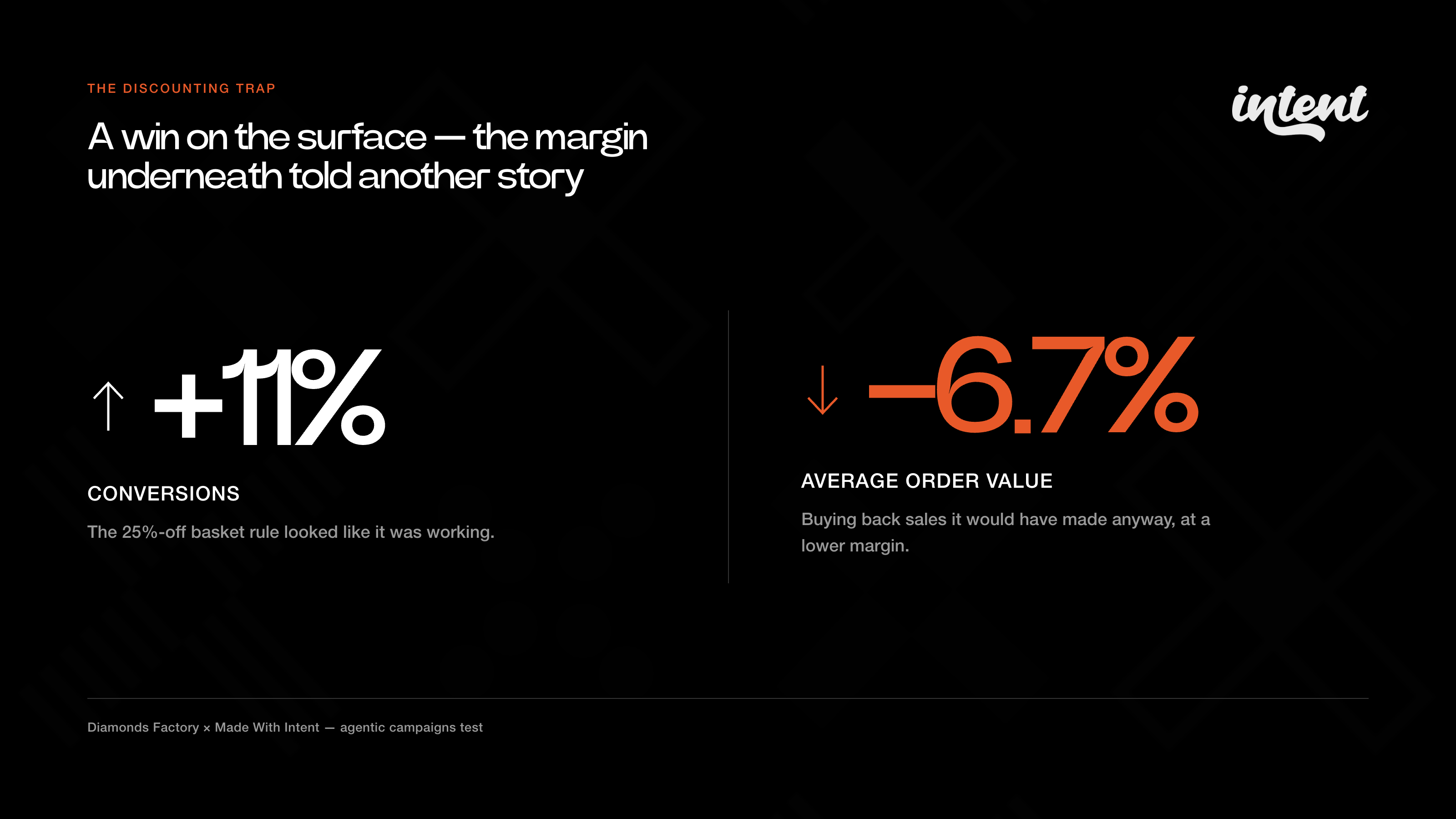
Diamonds Factory ran a basket abandonment discount and watched conversions climb 11%. On paper, it looked like a win, right?
It wasn't. Average order value fell 6.7% in the same period, and once the discount depth was accounted for, the "win" was worth barely £8k a month.
So, the luxury jewellery brand tried something different. It handed the decision to our agentic campaigns, told it to optimise for revenue per customer instead of conversion rate, and gave it the option to do nothing at all.
Our model decided that for 52% of customers, nothing was exactly the right call. That decision alone was worth £1.6m in incremental annual revenue.
Editor's note: This post is a write-up of an Intent Live session featuring Jo Homer, Director of CX at Neve Jewels Group, the parent company of Diamonds Factory. Jo walked through a real, live test of Made With Intent's agentic campaigns, hosted by Charley Bader, VP Strategy & Ops, and Colin Spooner, Principal Value Consultant, both at Made With Intent.
Diamonds Factory is a made-to-order luxury jewellery brand, one of the brands under Neve Jewels Group. Jo was upfront that this wasn't automation for automation's sake. It was a genuine test of what happens when a business gives an AI the ability to make real commercial decisions, and watches closely what it actually decides.
Agentic campaigns, Made With Intent's most recent product launch, replace the old manual approach (build a segment, write a rule, set it live, hope the hypothesis was right). You stay in control of the strategy, the moment being targeted, and the goal being optimised for. But the moment-to-moment decision, based on real-time visitor intent, who sees what and when, goes to an AI agent that keeps learning and reallocating traffic as it goes.
The discounting trap that feels like a win
The original brief was simple: catch basket abandonment before a customer leaves, offer 25% off, and recover the sale. It's the default move for most eCommerce brands, and doubly so in a vertical as competitive as jewellery, where discounting is normal.
The first-pass numbers looked good. Conversions were up 11%. However, the problem is what sat underneath it. Average order value dropped 6.7% over the same period. Diamonds Factory wasn't gaining new revenue so much as buying back sales it would likely have made anyway, at a lower margin.
As Jo Homer, Director of CX at Neve Jewels Group, put it:
"We were basically training the customer to wait for a deal, which in return was affecting margin."
Diamonds Factory fell into a similar trap many retailers fall into. A single rule applied to everyone optimises for the metric that's easiest to see (conversions) while diminishing the one that matters (margin).
For a luxury brand, the cost isn't only the discount itself. It's what the discount teaches the customer to expect next time. Train customers to wait for 25% off, and full price starts to look like a mistake they'd be silly to make.
It's a familiar story for anyone who has run basket abandonment campaigns before. A rule fires the same offer at every visitor who matches a condition, regardless of why they left.
Some were genuinely price-sensitive and needed the nudge. Others were already going to buy and simply hadn't checked out yet. Blanket rules can't tell the difference, so it pays the same discount for both.
Changing the question the model was answering
The shift that mattered wasn't really about AI. It was about changing what "success" meant.
Diamonds Factory moved from a single rule (25% off, applied to everyone) to an agentic campaign with four possible responses: a 25% discount, a 15% discount, a trust-building message, or no intervention at all. Crucially, the goal changed too, from conversion rate to revenue per customer.
That distinction is easy to state and hard to act on, because it means giving up control over exactly which lever gets pulled and letting the model decide, case by case, based on what it observes. As Jo describes it:
"The tool didn't change. The objective did. And that's the real unlock in some cases."
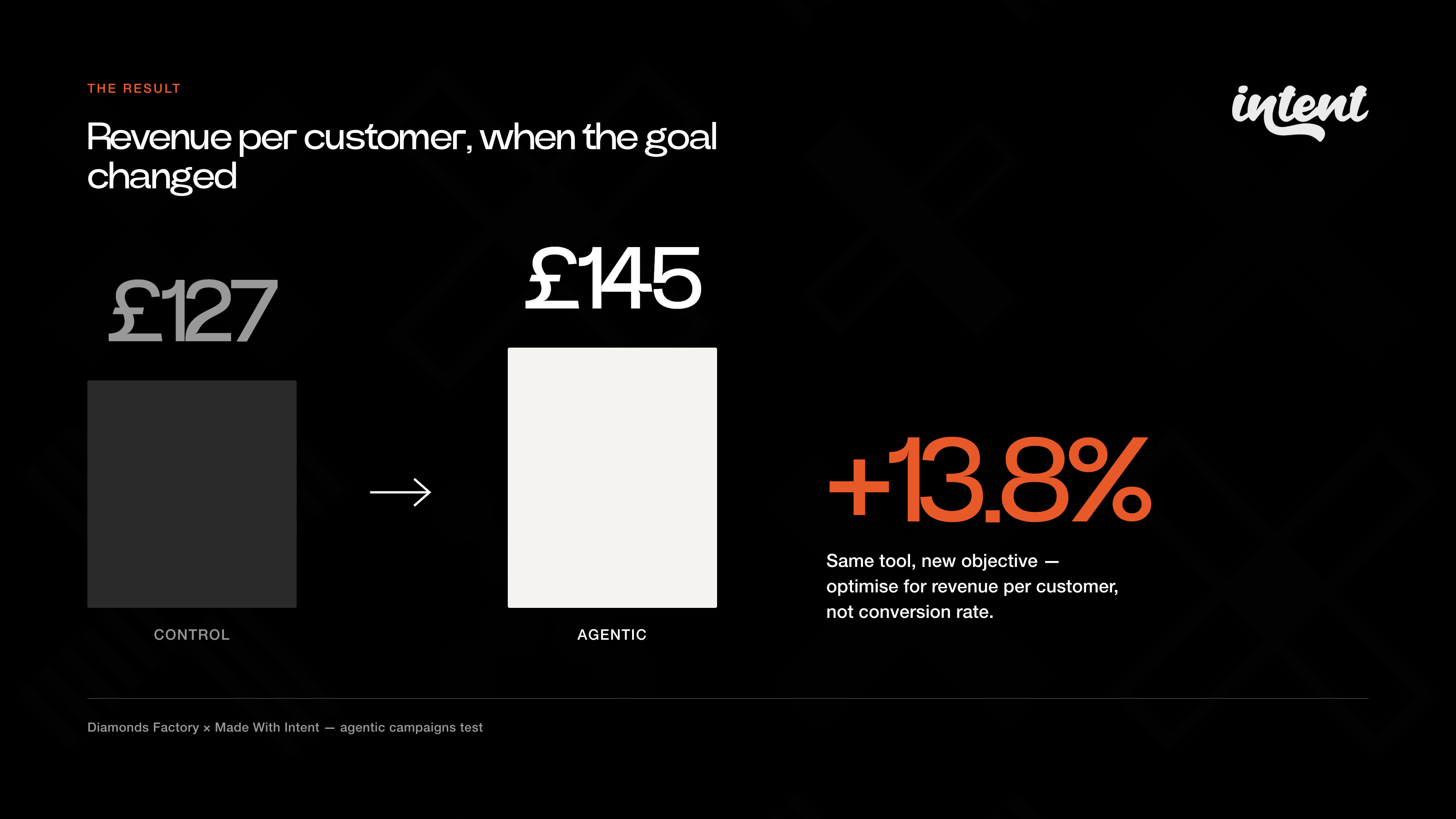
The model started with no historical or behavioural data. It had to learn the pattern from scratch, in real time. The result: revenue per customer rose from £127 in the control group to £145 in the agentic group. A 13.8% uplift.
"It didn't come from offering more," Jo said. "It was offering much smarter."
Jo frames the difference as hiring someone and handing them a script to read, versus hiring someone and trusting them to think on their feet. A script covers the cases you anticipated. Under the agentic model, the system sets its own rules based on what it actually observes in customer behaviour, and updates them continuously rather than waiting for the next quarterly review.
What our agentic model found without being told
Neither Jo nor anyone on her team instructed our AI model to look for a basket-value threshold.
It found one anyway, identifying a specific value point below which doing nothing consistently maximised revenue, and above which a discount or message made more sense.
It also separated customers by where they sat in the buying journey, not just by what was in their basket. Shoppers who looked like they were still comparing options, still in a research mindset rather than a checkout mindset, were shown trust messaging instead. So, things like craftsmanship, heritage, and guarantees.
A discount at that stage would have read as pushy. The model inferred that without being told what a "research mindset" should look like.
"The model basically developed a theory of buyer psychology without being given one," Jo said. "No human would take months, sometimes years, to get to that kind of analysis."
Device behaviour told a similarly specific story. On desktop, 79% of customers were offered some form of discount. On mobile, 96% were shown nothing. The model had, in effect, worked out that mobile sessions were browsing sessions rather than buying sessions, and treated them accordingly, without anyone telling it.
The value of restraint
Marketers are trained to intervene. Numbers dip, and the instinct in the room is always "what should we do about this," never "should we do anything at all." Jo made the point that in a hundred trading meetings, that second question rarely gets asked, let alone answered with "nothing."
In this case, the model decided that 52% of customers were best served by being left alone entirely.
"The highest value of action really was the restraint," Jo said. "The agent knew when to get out of the way."
That restraint was worth £1.6m in annual incremental revenue. Not because doing nothing is inherently valuable, but because for those customers, any intervention would have either converted someone who was already going to buy (at a needlessly reduced margin) or interrupted someone who wasn't ready to be nudged.
This figure is the outcome of testing across three separate markets, over more than a hundred individual tests.
Turning Made With Intent into a trading lever
Beyond the topline number, the agentic model isn't a fixed campaign. It's something Diamonds Factory can turn on and off in step with its trading calendar.
Around Black Friday, for example, the team pauses the agent so customers already in a high-intent buying mode aren't shown a discount they didn't need. When trading returns to business as usual in January, the campaign flips back on, and the model picks up its learning from where it left off.
"It's a lever we can control," Jo said, describing how the model compounds its learning across each on/off cycle rather than resetting.
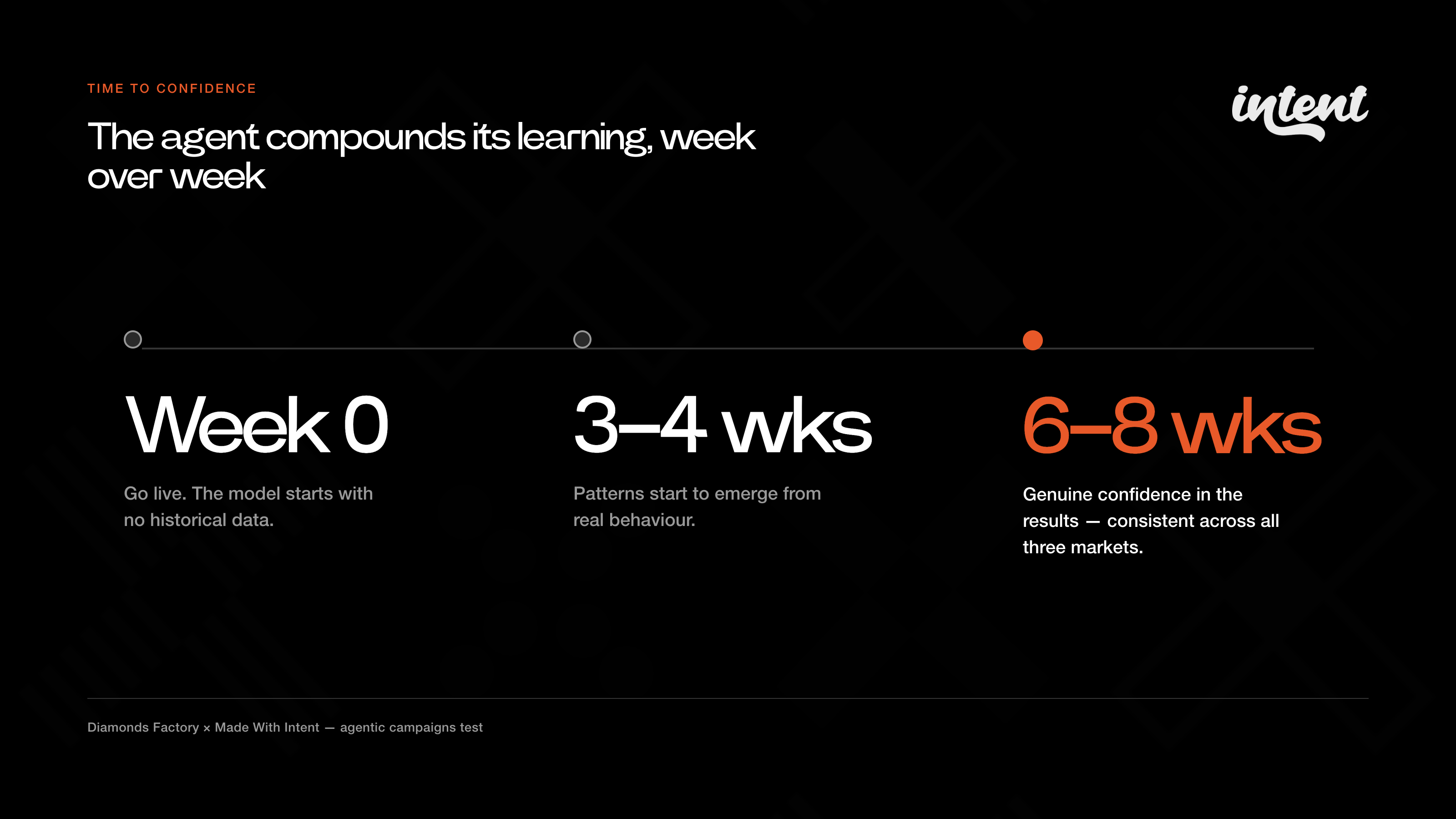
That reframes the agent from a one-off experiment into infrastructure. It’s something that learns continuously and can be dialled up or down around known peaks and troughs. Jo's team started seeing patterns emerge after three to four weeks, and reached genuine confidence in the results within six weeks to two months, consistent across all three markets tested.
What setting up agentic campaigns looks like
Colin Spooner, Principal Value Consultant at Made With Intent, walked through the mechanics live during the session, because "agentic" can sound more abstract than it actually is.
Setting up a campaign starts with choosing the moment it targets (new customer arrival, returning visitor, browse or basket abandonment), then the goal it optimises for, revenue per customer, conversions, or something custom like a credit application.
From there, you build the toolkit of possible responses: a discount at whatever depth makes sense, a trust message, a finance nudge for customers who might be mid-month on cash flow, and, deliberately, a do-nothing option.
The agent then goes into a learning phase, typically two to four weeks, working out which response suits which individual, before it starts compounding that performance over time.
What this doesn't mean
The point that came out from the session is that a single discount applied to everyone, regardless of where they are in the journey, is a blunt instrument in a world that calls for something more precise.
It also doesn't mean every brand will find that 52% of its customers are best left alone. That figure is specific to Diamonds Factory's price points and customer base, and a mass-market retailer with a lower average order value would likely see a different split.
What should generalise is the method, not the exact number: test more than one response, optimise for a metric that reflects margin as well as conversion, and make "do nothing" a genuine option rather than an assumption nobody checks.
In conclusion: From what rule should we apply, to what does this customer need
The shift Jo describes isn't really technical, even though the mechanism is AI. It's a change in the question being asked. Diamonds Factory moved from "what rule should we apply" and "what do we think will work" to "what does this specific customer need right now."
Sometimes, as this blog post shows, the right answer to that question is nothing at all. That's a harder thing for a marketing team to sit with than a 25% discount, but it's the one that protected both the brand's margin and its positioning as a luxury retailer, while still growing revenue per customer by double digits.
If you're running basket abandonment campaigns on a single blanket rule, the question worth asking isn't whether your discount converts. It's whether it's the right decision for the customer in front of you, or just the easiest one to set and forget.
Not every abandoned basket is a fire to put out. Some are customers who are always going to come back, and every discount you throw at them is a margin you don't need to give away.
Curious what an agentic approach could do in your own basket abandonment process? Book a demo with Made With Intent to see it in action.
If you liked this article and want to join our next webinar, follow the link to join our next Intent Live session.
.jpg)
MandM, a British online fashion retailer, captured 88% more email signups from their popups. They didn't rewrite the copy. They didn't redesign their site. They just changed when their message appeared.
How did they manage this? Simply, they made the switch from rule-based experience delivery, to an intent-based approach.
And the results across email capture and product recommendations tell a consistent story: rule-based experience delivery forces a single answer on a question that has many right answers.
Rigid, predefined rules can't answer those questions. Intent signals can. Improving the impact of your onsite experiences is all about sending the right message, at the right time to your customers. We'll show you how Ollie Wilson, Insights Activation Manager at MandM does this with Made With Intent.
Editor's note: This blog post is a write up based on our first Intent Live: How MandM maximise revenue per user with personalised experiences. The session was hosted by Ollie Wilson, Insights Activation Manager at MandM. He showed how Made With Intent helped deliver better, more appropriate experiences to his customers, getting 88% more email signups.
The problem with rules-based personalisation
Most eCommerce personalisation sits on top of a set of rules. A customer views a Product Landing Page (PLP), then two Product Display Pages (PDPs), then gets hit with an email capture popup.
Or they get served "last viewed" recommendations based on browsing history. Or a basket abandonment email fires after 10 minutes of leaving the site.
These rules work to a point. Delivering the same experiences to every visitor using predefined rules, based on what they've done before gives you a critical foundation, but it puts a ceiling on growth.
They treat the journey as a sequence rather than a state. And a customer's state when they trigger your rules can be completely different depending on who they are, why they're there, and what they're about to do.
MandM saw this clearly in their email capture data. Their rule-based popup was capturing emails, but they were seeing broken journeys. The pop-up was technically firing at the right moment in the sequence. It wasn't firing at the right moment for the person and their intent.
As Ollie Wilson, Insights Activation Manager at MandM, puts it:
"It's not necessarily specific things a customer does in the journey. It's more so the timing and intent really helped us leverage this in a more efficient way."
The argument we're making here is that it's key to make this distinction. Rules track what a customer has done. The moment for you to intervene has gone. Intent-based experience delivery is issued in real time, predicts what they're about to do, and allows you to take appropriate action.
Pop ups delivered at the right time
The email capture popup is one of the highest-value tools in eCommerce, but also one of the most frequently misused. Use it too early and you interrupt a customer who hasn't found a reason to stay yet. Fire it according to a fixed rule and you'll hit some customers at the peak of their interest, but most others at exactly the wrong moment.
Ollie and his team tested a different approach. Instead of triggering the popup after a visitor hit a fixed sequence of pages, they introduced intent signals to identify when a customer was building meaningful engagement.
When those signals crossed a threshold, the popup fired. Exactly at the moment the customer was most receptive.
When talking about this, Ollie said: "We were hitting them at the right time because we knew they were building intent. They were right at the peak of their journey. Whereas before we were very much relying on this rule-based system which potentially wasn't the right time."
The results across three metrics tell the story. And these figures are lifted directly from the numbers Ollie shared during Intent Live:
- 55% increase in email sign-up rate, the rate at which people served the popup chose to subscribe
- 88% uplift in total emails captured, the volume consequence of that improved rate
- 15% resubscription rate among previously unsubscribed customers
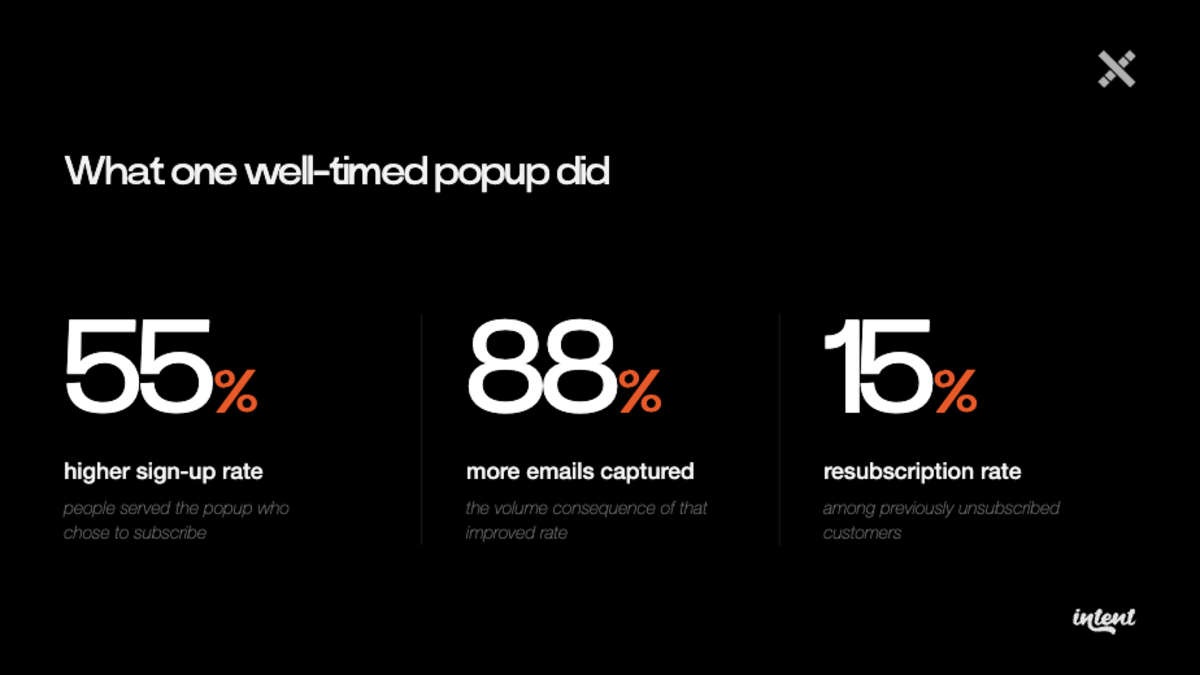
That last number is particularly significant. Lapsed customers don't re-subscribe because of a well-timed popup by accident. They re-subscribe because they were caught at a moment of genuine brand or product affinity, at the right time. This simply isn't possible with rules-based personalisation.
What MandM actually changed
What's actually surprising is how little MandM had to do to arrive at these results.
They were already using Bloomreach for their on-site experiences, including the consent popup. The popup itself, design, copy, offer, stayed exactly the same.
On changes, Ollie says: "To be honest, it was so easy. We already had our consent popup in Bloomreach as a web layer. It was just a trigger we had to change. With Made with Intent's integration being so easy, we could just feed all of the data into Bloomreach and then use that as the trigger for the popup rather than those stringent rule bases."
Agentic campaigns: testing 157 segment combinations at once
The email capture result came from MandM's first phase of work with intent signals. Their second phase went further, introducing a different kind of challenge.
MandM runs an active personalisation testing programme. At any given point, they're running recommendation strategy tests: last viewed versus category affinity versus the Bloomreach Loomi engine versus most popular, and so on.
Each test runs for roughly two weeks, produces results for a specific segment or device type, and then the cycle starts again.
The problem isn't that the testing doesn't work. It's that it's slow. Each test answers one question, for one segment, in one context. And by the time you've worked through a few cycles, the results of the first test may not apply to the next season, the next acquisition cohort, or mobile versus desktop. And not to mention how resource intensive this all is.
Agentic campaigns changed this by running multiple recommendation strategies in parallel, doing the segmentation work automatically.
MandM tested five homepage recommendation strategies simultaneously. Rather than splitting traffic across two variants and waiting two weeks per test, Made With Intent's optimisation agent tested all five, across 157 unique segment combinations, and allocated each visitor to the strategy most likely to drive Ollie's defined commercial goal; revenue per user.
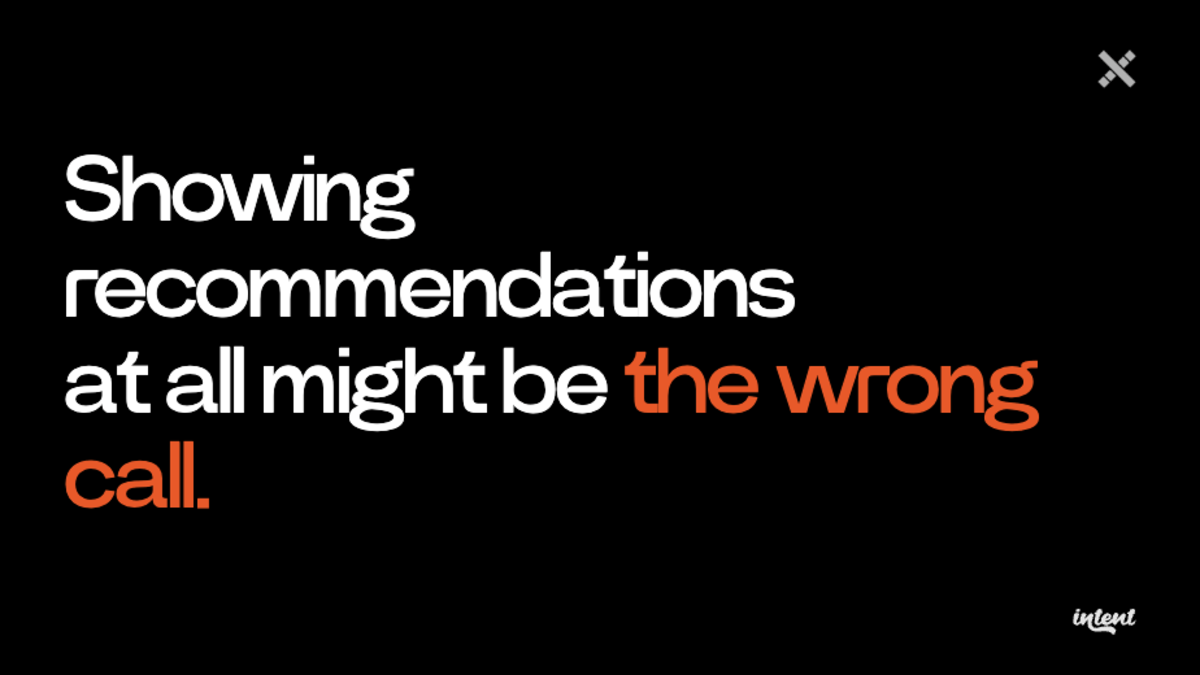
The result was a 2% increase in revenue per user. But the more valuable output was just how granular MandM could get. Not just "strategy X wins." For MandM it was strategy X wins for loyal mobile customers, strategy Y wins for new desktop visitors, and for your most engaged customers, showing recommendations at all might be the wrong call.
Let that sink in: showing recommendations at all might be the wrong call.
On the PDP, where new customers arriving from paid search land and recommendations have some of the most direct commercial impact, MandM ran a similar test with five strategies including a "hidden" variant (no recommendations shown at all). The result: 4% increase in revenue per user, from 130 unique segment combinations tested.
On the webinar, Colin Spooner, Principal Value Consultant, at Made With Intent, describes what this looks like inside the platform:
"There's kind of no winners or losers anymore. It just is the best experience to give that visitor at the right time."
Sometimes, doing nothing is the best strategy
In MandM's PDP test, 14% of visitors were allocated to seeing no recommendations at all, and for that segment, it was the highest-performing option.
That segment, as Ollie describes it, is your most loyal customers. The ones who know the site, know what they want, and don't need or want a carousel of "You might also like" items interrupting their path to purchase.
Ollie says: "For a certain subset of customers, your very loyal customers, the ones that know the site, they know what they want, removing recommendations is actually beneficial. Sometimes it can be a bit of a loop for a customer."
The PDP recommendation loop is a real issue. A customer lands on a PDP, clicks a recommendation to another PDP, clicks another, and ends up in a browse abandonment spiral that started as a purchase intent session. It's almost like you're giving them too much to navigate through.
Removing the recommendations breaks the loop and lets the customer do what they came to do.
This can be uncomfortable for personalisation teams to hear whose KPI is coverage, ensuring every visitor gets served something. But it reflects a more mature way of thinking about personalisation: not "show more" but "show what's right, when it's right."
For some customers in some moments, the right thing is nothing.
What MandM's results point to
MandM's results across two distinct experiments expose the same fundamental flaw in how most onsite experiences are built. They're designed to give every customer an answer at predefined moments, when real impact is about giving each customer the right answer for their specific moment.
Rule-based email capture fires at step three of the journey regardless of whether the customer is engaged or about to leave. Sequential recommendation testing finds one winning strategy for one segment, then starts over.
Ollie used intent signals and agentic campaigns both push against that. One changes when you fire an experience based on real-time behavioural signals. The other changes what you show based on continuous, parallel testing across hundreds of segment combinations. The outcome, in both cases, is the same — fewer experiences wasted on the wrong customer in the wrong moment.
For MandM, the next step is applying agentic testing to placement-level messaging. So, buy now pay later, delivery propositions, app downloads, and letting our agent match messages to customer segments in real time across the same placements.
If you enjoyed this blog post, why don't you watch our Intent Live series over on YouTube? Failing that, we're going to be running these sessions frequently, so you can sign up here for our next session.
While we're doing CTAs, here's another one: If this has piqued your interest, why don't you book a demo with our team?
Promotional pricing is the practice of temporarily reducing prices to drive a specific commercial outcome. In eCommerce, it covers everything from percentage-off codes and flash sales to BOGO deals, loyalty tiers, and seasonal campaigns. Used right, it drives genuine revenue. Used badly, you'll trash your margin and train your best customers to wait for discounts.
What is promotional pricing?
Promotional pricing is a temporary reduction in the standard selling price, applied to drive a defined commercial goal. Typically these are: clearing inventory, acquiring new customers, reactivating lapsed buyers, or responding to a competitor's move. It is distinct from permanent price changes and from dynamic pricing, which adjusts in real time based on demand signals.
In eCommerce, the term covers a wider set of mechanics than in traditional retail. A promotional price can be a publicly visible markdown, a personalised discount code delivered by email, a segment-specific offer triggered on-site, a loyalty tier reward, or a bundle price. The delivery mechanism matters as much as the discount depth, because it determines who sees the offer and what behavioural context they bring to it.
Editor's note: This guide is written specifically for online retailers. B2B SaaS, subscription, and industrial pricing follow different mechanics and aren't covered here.
The seven types of promotional pricing (and when each actually works)
The taxonomy of promotional pricing is broadly consistent across the industry. What isn't consistent is an honest assessment of when each type actually delivers incremental revenue versus when it simply moves it.
Percentage discount
The most common format in eCommerce: 10%, 20%, 30% off a product or category. It's universally understood, easy to execute across email and on-site, and straightforward to calculate. The risk is anchoring. Once a customer has bought at 20% off, their willingness to pay the full price decreases. A portion of comparison shoppers will hold out, waiting for the same discount to return.
BOGO (buy one get one)
BOGO and its variants (buy two get one free, spend X get Y) increase average order value and can move inventory efficiently. The catch is unit margin. A buy-one-get-one-free on a product with a 40% gross margin isn't a 50% discount from a financial standpoint. It wipes out margin on the second unit entirely.
Flash sales
Short-duration, high-discount events — typically 24 to 48 hours — that create urgency and can generate significant revenue very quickly. They work well for clearance. The problem is audience conditioning. Customers who've seen three or four flash sales start to learn the pattern: wait, and then the price drops. Used too frequently, flash sales train a comparison-shopping segment rather than converting a high-intent one.
Loyalty pricing
Tiered discounts awarded through a loyalty or membership programme: early access, exclusive pricing, free shipping thresholds for members. This is the most margin-efficient form of promotional pricing because the discount is earned, not freely given. It also builds switching cost, which percentage discounts and flash sales don't. If you're choosing between loyalty pricing and blanket discounting as a long-term retention mechanic, loyalty pricing is almost always the better investment. Research drawing on Bain & Company data found that repeat customers spend 67% more than new buyers by their third year of shopping with a brand. The economics of building loyalty compound in ways that a one-time discount can't replicate.
Seasonal promotions
Black Friday, Cyber Monday, January sales, end-of-summer. These events carry genuine demand spikes and everyone knows what they are. They're also where the incrementality question is hardest to answer, because so much demand is pulled forward from adjacent weeks. Research by Recast found that brands consistently see customers delaying purchases in anticipation of sales, with a revenue hangover in the weeks immediately after — the promotional spike comes partly at the expense of the periods surrounding it. The danger is running the same depth of discount in the same window year after year. The month before and after will see predictable drops.
Coupons and vouchers
Digital codes distributed via email, affiliate, or influencer channels. They're great because they're easy to trace where they've been used. Each code can be attributed to a channel and a campaign, which makes them more measurable than sitewide promotions. However, their risk is leakage. Codes circulate beyond their intended audience via cashback sites and discount aggregators, frequently discounting customers who would have purchased at full price. According to data from Ad Exchanger, for large brands, a single leaked code can generate six figures in unintended discount spend within days.
Segment promotions
These are typically offers built for a specific, defined customer segment. A re-engagement discount for customers lapsed 90 days. A new-product preview for your top 5% by LTV. A post-first-purchase offer designed to drive a second order within the critical 30-day window. Segment promotions require CRM infrastructure to execute properly, but they have the highest ratio of incremental revenue to margin cost. They put discount spend where the behavioural data says it's needed, rather than distributing it uniformly.
Why most eCommerce promotions don't actually drive growth (they just move it)
Of the revenue you generated during your last campaign, how much of it would have happened anyway?
The concept we're talking about here is promotional incrementality. Incremental revenue is revenue that occurred because of the promotion — a purchase from a customer who wouldn't have bought without the discount, at that price, in that session. Non-incremental revenue is revenue that happened during the promotion but was going to happen anyway. The discount ended up just being a freebie, and not the thing that drove conversion.
Most eCommerce teams have no idea what their ratio is. They measure revenue during the promotional window, compare it to the prior week's baseline, and call the difference "promo lift." That calculation doesn't account for demand pulled forward from the week after the campaign, or existing purchase intent that happened to coincide with the discount window.
The evidence from retail analytics is stark. McKinsey research found that 59% of trade promotions lose money globally, with that figure rising to 72% in the United States. NielsenIQ analysis corroborates this. Over half of all trade promotions result in little to no sales lift once proper measurement is applied. Both datasets come from Consumer Packaged Goods (CPG) and physical retail rather than pure-play eCommerce, and the dynamics differ in some ways.
But the underlying mechanism is the same: promotions reaching customers who were already going to buy. Made With Intent's own analysis, drawn from conversations with leading eCommerce practitioners, found that 83% of shoppers would have purchased without a discount code — the discount was given to customers who had already decided.
The dynamic in eCommerce is likely bigger. Price-sensitive audiences can find and act on promotions within minutes, and your highest-intent visitors can be the first to convert at a discount they didn't need.
Now, we're not saying you should stop doing promotions. Far from it. All we're saying is that you should understand which promotions are doing real work and which are transferring margin to customers who had already decided to buy. Doing that determines whether your promotional calendar actually drives growth, or just results in margin loss.
The four hidden costs of promotional pricing in eCommerce
Margin erosion from discount depth is visible on a profit and loss sheet (P&L). These four costs aren't — and they compound over time in ways that you don't see until it's too late.
1. Margin give-away to customers who would have bought anyway
This is the incrementality cost, and it's almost certainly the largest single hidden cost in any promotional pricing programme. Every time a customer who was already in the purchase funnel redeems a discount, the difference between what they paid and what they would have paid at full price is a direct transfer to them. At scale across a full promotional calendar, this represents margin erosion that never appears in the "promo lift" calculation, because the headline revenue number looks fine.
2. Price-anchor erosion
Behavioural economics is consistent on this: repeated exposure to a discounted price lowers willingness-to-pay for the full-price experience. Research by Ariely, Loewenstein, and Prelec at Stanford shows that numerical anchors — even arbitrary ones — significantly and durably shift consumers' stated willingness to pay, with effects that persist even when participants are told the anchor is irrelevant to the product's value.
Customers who have bought from you three or four times at a discounted price don't experience your full price as normal; they think it's expensive. The more publicly and frequently you discount, the more you move your comparison-shopping audience into that anchored state.
3. Subsidising competitor retargeting
When you run a public flash sale or sitewide discount, you generate a cohort of price-sensitive customers who engage specifically because of the price signal. Many of them are likely already present in competitors' retargeting audiences. Your promotion has demonstrated to them, and to the ad algorithms tracking their behaviour, that price is a primary factor in their purchase decision. Whether that meaningfully increases their value to competitors is hard to isolate, but it's a mechanism worth thinking about when considering your promotional tactics.
4. CRM dependency
Every promotional send trains subscribers to expect a discount before they purchase. Repeat that pattern often enough, and your non-promotional lifecycle emails — welcome series, post-purchase flows, browse abandonment, replenishment triggers — start to underperform. Customers have learnt to wait. The incremental cost isn't visible in any single campaign; it accrues across your entire email programme. And by the time it shows up in open rate and conversion data, it's too late.
Promotional pricing as implicit CAC
Consider this example. A retailer sends a 20% off email to 50,000 subscribers. 3,000 purchase at an average order value of £85. That's £255,000 in revenue — but at 20% discount, the full-price equivalent was £318,750. The brand has surrendered £63,750 in margin to drive those 3,000 conversions.
Let's assume 40% of those purchases were incremental — buyers who would not have converted without the discount. Real-world holdout data on promotional email incrementality varies substantially across list quality, promo frequency, and audience conditioning; practitioners report wide ranges, with heavily conditioned promotional lists often showing much lower incremental lift than teams expect.
Replace 40% with the result of your own holdout test. On that assumption, the brand paid roughly £63,750 in foregone margin to drive approximately 1,200 genuinely new transactions. That's an effective CAC of around £53 per incremental conversion. [Illustrative example: all figures are hypothetical.]
Whether £53 is a good or bad CAC depends entirely on LTV, category margins, and what that retailer is paying to acquire comparable customers through other channels. That £53 figure belongs alongside your paid social CPA, your Google Shopping CPA, and your other acquisition costs. Most of the time, it doesn't. The discount email lives in the CRM budget and gets measured on revenue. Paid acquisition lives in the performance budget and gets measured on Return On Ad Spend (ROAS). Both are measuring the same thing — the cost to acquire a transaction. But do they share an analysis?
Reading this, you might push back. Promotional emails don't only acquire; they also reactivate lapsed customers whose acquisition cost is already sunk, and they drive AOV expansion for customers who were going to buy anyway. Both are fair points. The CAC framing is most useful when applied to net-new incremental conversions and to lapsed reactivation, where the counterfactual — no purchase without the discount — is clearest. For those specific segments, it's a better lens than overall promotional revenue.
Who should never see your discounts: a rough framework
Full-price loyalists. Customers who have purchased from you three or more times, always at full price, in the last 12 months. Sometimes sending them a discount offer can be a loyalty play. But it invites negotiation on your margins. They already think your product is worth its full price. Don't change that.
Recent first-time buyers. Customers in the 0 to 30-day window after their first purchase are in the honeymoon period: they've just made a considered decision to buy from you. A discount email in that window could drive a second purchase, sure. But it could also plant a thought. "I paid full price, but I should've waited." The post-first-purchase flow should focus on product education, social proof, and cross-category discovery.
Customers acquired at full price in the last 30 days. Similar rationale: these buyers are happy to pay your full prices.
Here's where to use discounts
- Lapsed customers at 90 to 180 days since last purchase. The cost of re-acquiring these via paid media almost certainly exceeds the margin cost of a well-targeted win-back offer.
- Browse-abandonment segments with high-intent signals and no purchase conversion. Deep product page engagement, multiple return visits, comparison behaviour: these signals justify a targeted intervention.
- Price-sensitive new visitors identified by behavioural signals (time spent on sale pages, price filter usage, sorting by price). These visitors have already told you price a key factor
Some of this segmentation logic can be built in Klaviyo using event-triggered flows and list properties. The suppression side — protecting full-price buyers from promotional flows — is as important as the targeting side, and it's the part that typically goes unbuilt. For a practical framework on building intent-aware segments in your ESP, see Email Segments Ready to Buy.
The harder problem is identifying, in real time and on-site, which visitors are genuinely price-sensitive and which would convert at full price with the right experience. Static Klaviyo segments give you that signal at the email layer, but they don't capture what's happening on-site in the moment. That's the gap that intent-based discount targeting is designed to fill: triggering a discount offer only for visitors whose browsing behaviour signals price sensitivity, while letting high-intent visitors reach checkout at full price. Appliances Direct applied this approach and saved 42% of margin that would otherwise have been given to visitors who didn't need a discount to convert. Read our full case study.
How to measure promotional incrementality (without a data science team)
Most eCommerce teams assume that measuring true promotional incrementality requires a data science capability they don't have. It doesn't. There are three practical methods you can implement with existing tools, in order of rigour and complexity.
Method 1: Geo or list holdout
Before your next promotional email, suppress a random 10% of eligible recipients. Call this the holdout group. After the campaign window closes — including a seven-day tail to capture any demand-pull effect — compare revenue per recipient between the promoted group and the holdout group. The difference, adjusted for the margin cost of the discount, is your incremental return.
The holdout must be randomly assigned. Don't use a geographic split if your list has geographic bias. Most ESPs, including Klaviyo, allow you to create a random-sample suppression list at campaign setup. It takes around 10 minutes and gives you a genuine counterfactual for the first time.
For the best results, use personalised single-use codes rather than a broadcast code. Broadcast codes (e.g. "SUMMER20") leak to cashback sites and discount aggregators, meaning some holdout recipients will redeem the code via a third-party channel, which deflates your measured incrementality and makes the promotion look more incremental than it is.
Method 2: Pre/post baseline with control
For sitewide promotions where list suppression isn't practical, build a revenue baseline from the prior eight weeks and the equivalent period in the prior year. Model expected revenue for the promotional window without the discount. Compare actual revenue to the model, then subtract the margin cost of the discount across all transactions to calculate net contribution margin.
This method doesn't control well for seasonal and macro variation, but it's substantially more rigorous than comparing the promotional window to the prior week.
Method 3: Contribution margin per cohort
The most sophisticated and most durable method. Segment promotional purchasers by their first-purchase channel — promo-acquired versus organic-acquired — and track their purchase behaviour at 90 and 180 days. Calculate LTV for each cohort. Promo-acquired customers with lower 180-day LTV represent a structural cost that never appears in any single campaign's P&L. The discount didn't just reduce margin on the first transaction: it acquired a lower-value customer at a structurally elevated cost per order. That said, this pattern isn't universal. Common Thread Co's analysis found cases — particularly in consumable categories — where sampling-led promotional acquisition outperformed full-price acquisition on long-term repeat behaviour. The point isn't to assume promo-acquired customers are always less valuable. It's to measure your specific cohorts rather than letting the assumption go untested in either direction.
This method is not achievable with basic Shopify or Klaviyo reporting alone. You'll need either a dedicated retention analytics tool (Triple Whale, Polar Analytics, and Glew all support cohort-level LTV views for mid-market Shopify merchants) or a manual export into a spreadsheet, which is achievable but requires a dedicated afternoon and some comfort with pivot tables.
Running any one of these methods will tell you more about your promotional programme's actual ROI than years of before/after revenue comparisons.
When promotional pricing is the right answer
To reiterate, we're not saying promotional pricing is bad. It clearly isn't. The challenge is when promotional pricing is used as a primary growth lever without incrementality measurement or segmentation discipline — it's an expensive habit that erodes both margin and customer quality over time.
Here are three legitimate use cases for promotional pricing in eCommerce:
Clearance: When inventory needs to be whittled down, price reductions are the correct tool. The economics stack up clearly. The margin cost of the discount is weighed against the carrying cost of the stock and the cost of a write-down. Done properly, clearance promotions don't carry the dependency risk of a recurring promotional programme because they're specific to an event and a product set, not to a calendar slot.
Genuine product launch: Introductory pricing for a new product functions as acquisition pricing. You're buying trial at a known cost per unit, with the expectation of building a full-price repeat purchase base from that cohort. The key constraint is that "introductory" must be time-limited and clearly communicated. If customers anchor to the launch price as the normal price, the discount has done too much.
Defensive parity: If a close competitor is running a promotional campaign and your price differential is generating measurable abandonment at key points in the funnel, a targeted promotional response is the right choice. What you should watch is whether this is genuine demand-retention or a ratchet. Once you respond to a competitor's discount with your own, the floor has moved for both parties, and it's difficult to claw that back.
A promotional pricing audit you can run this quarter
The following six questions use data most eCommerce teams already have:
1. What percentage of your revenue in the last 12 months came from promoted transactions?
Export all your orders. Identify those where a discount code was applied or where the order was placed during a promotional window. Calculate that as a percentage of total revenue. Nebulab's analysis found that brands with discount penetration above 40% face structural dependency requiring 12 to 18 months to unwind without damaging revenue. Companies below 40% can reduce promotional reliance within a single quarter.
2. What is the 180-day repeat purchase rate for customers acquired in your last three major campaigns, compared to customers acquired at full price in the same periods?
If your promo-acquired cohorts are returning at materially lower rates, you're acquiring a weaker customer base at a discount. That LTV gap is the true long-term cost of the promotion, and it should be in your campaign P&L.
3. What is the average discount depth per category compared to that category's gross margin?
A 25% discount on a product with a 30% gross margin leaves 5% contribution before overheads. Run this calculation across your promotional calendar. There will almost certainly be categories where promotional depth is eating margin on a meaningful share of volume.
4. How many promotional emails does your average subscriber receive per month?
Divide your total monthly promotional sends by your active list size. If the answer is above 2 to 3 per month, your list could be conditioned to expect promotional emails. Track open rate and conversion rate on non-promotional lifecycle emails over the same period. If those are declining while promotional rates hold, there's your issue.
5. What is the contribution margin per promotional campaign, not the revenue?
Revenue minus cost of goods minus the discount cost minus fulfilment and return costs for promotional orders. Run this calculation for your last five campaigns.
6. What percentage of your promotional revenue came from customers already in the purchase funnel at the time of the promotion?
Look at customers who converted during a promotional window but had already visited the product page or added to basket in the prior 7 days. That is your minimum-estimate incrementality floor. If the discount reached them and they were already close to buying, those conversions were probably going to happen without it.
Wrapping up our promotional pricing guide
Promotional pricing will always be part of the eCommerce toolkit. Clearance, launch, reactivation, competitive response: there are always times where a well-targeted discount does good work. The question is whether your promotional programme is built primarily around those situations, or primarily around habit.
The goal of a disciplined promotional pricing strategy isn't to run more profitable promotions. It's to need them less. Because your retention mechanics, lifecycle CRM, and on-site experience are doing enough of the work that you can afford to protect your margins and your price anchors.
The first step isn't rebuilding your CRM programme or overhauling your calendar. It's suppressing 10% of your next campaign list and measuring the result. That single number will tell you more about your promotional programme than 12 months of revenue reporting.
If reducing your promotional dependency without sacrificing revenue is on your roadmap this year, see how our intent-based discount targeting works in practice.
For a demo of Made With Intent, book a demo.

Most brands only respond to cart abandonment after it's happened. That's like fitting a smoke alarm and calling it fire prevention.
Seven out of ten online shopping carts are abandoned before checkout. That number hasn't meaningfully shifted in a decade.
Not because the industry hasn't tried. Cart abandonment emails are everywhere. Retargeting ads chase shoppers across the internet for days. Brands have invested millions in user recovery, the machinery that kicks in after someone walks away.
And it works. Abandoned cart emails recover between 3% and 5% of lost baskets on a good day. But the thing about existing cart abandonment strategies is that they treat the problem after it has already happened.
What if there was a way to intervene before someone dumps their cart of goods? How would you get this visibility? In this blog post, we explore cart abandonment, discuss existing strategies and how new technology can provide timely interventions to stop basket abandonment in the moment.
What is cart abandonment? And why does it still matter?
Cart abandonment happens when a shopper adds items to their basket but leaves the site before completing a purchase. The global cart abandonment rate sits at roughly 70%, according to Baymard Institute's aggregated research across 49 studies — and it's been stubbornly consistent for years. For UK ecommerce brands doing millions in online revenue, that 70% represents an enormous amount of commercial value slipping away every single day.
The industry has treated this as a recovery problem. It's actually a visibility problem. Brands can't see why or, specifically, when shoppers hesitate, so they can't respond until it's too late.
The abandoned cart email: Essential, but not enough on its own
A well-built abandonment flow is one of the highest-ROI programmes in ecommerce, and the brands doing it well deserve credit for that.
But the returns are diminishing, and the reason is structural, not tactical.
A decade ago, a well-timed abandoned cart email felt personal. Now it's expected. Shoppers know the email is coming. Some even use it as a strategy: abandon the basket, wait for the discount code, complete the purchase at a lower price. If you always send these emails to every cart abandonment, you've trained consumers to do this.
The average abandoned cart email open rate is around 40%. That sounds impressive until you realise that fewer than half of those opens result in a click, and fewer than half of those clicks result in a purchase. You're recovering a fraction of a fraction.
The email programme isn't the problem. The problem is that it's the only thing working on abandonment. Everything that happens before the email. The entire session where the shopper was actually on your site is a gap.
Why shoppers abandon baskets (and why most brands get the diagnosis wrong)
Ask any ecommerce team why shoppers abandon baskets and you'll hear the same list: unexpected shipping costs, complicated checkout, required account creation, security concerns. Baymard Institute's checkout usability research has documented these friction points extensively, and they're real.
But they're also the easy answers. The ones that show up in surveys and exit polls because they're concrete and simple to articulate.
The harder truth is that most basket abandonment isn't caused by a single friction point. It's caused by unresolved hesitation.
A shopper adds something to their basket. They're interested, clearly — but they're not convinced.
Maybe they're comparing prices elsewhere. Maybe they're not sure about sizing. Maybe they need to check with a partner. Maybe they're thinking about considered purchase and this is visit two of five. Maybe they’re just building a wishlist, and were never going to buy anyway?
None of these shoppers have a checkout problem. They have a confidence problem. And no amount of checkout optimisation or recovery email will fix that — because by the time the checkout loads or the email arrives, the moment has passed.
The real gap: what happens during the session
Let’s try a thought experiment. Let’s categorise ecommerce into black and white terms. On one end: acquisition, getting shoppers to the site. On the other: recovery, trying to win them back after they've left. The bit in the middle, the actual shopping session, is where you have the least visibility and the fewest tools at your disposal,.
Think about what a good shop assistant does in a physical store. They don't wait until you've put something down and walked out, then chase you into the car park with a voucher. They read the room. They notice when you're browsing versus when you're comparing. They step in when you look uncertain and step back when you're clearly decided.
Online, we do the opposite. We show everyone the same experience — same pop-ups, same messaging, same urgency banners — regardless of whether they arrived 10 seconds ago or have been comparing products across three sessions over two weeks. Then, when they leave, we send the email.
The gap isn't in recovery. It's in the session itself. The question isn't "how do we get them back?" it's "why didn't we respond to what they were telling us while they were still here?"
What in-session card abandonment intervention actually looks like
In-session intervention means responding to shopper behaviour during the visit, not after it. But (and this is the critical part) it doesn't mean bombarding people with more pop-ups and discount codes.
The problem with most "onsite intervention" is that it's based on static rules, and doesn’t interject at the moment. It’s usually after the moment has passed. Show a pop-up after 30 seconds. Trigger an exit-intent overlay when the cursor moves toward the tab. Offer 10% off to everyone who has items in their basket.
These rules treat every shopper the same. A first-time visitor browsing casually gets the same intervention as a returning visitor who's viewed the same product four times and is clearly ready to buy. That's not intervention. That's bad manners.
Real in-session intervention requires knowing where a shopper is in their buying journey — right now, in this session, and responding appropriately.
For a visitor who's browsing early in their journey: don't push. Show them content. Help them discover products. Surface reviews, comparisons, and reasons to believe. The worst thing you can do is ask for a commitment before they’re ready.
For a visitor who's been comparing across multiple sessions and has returned to a specific product: they don't need a discount. They need reassurance. Delivery information. Stock availability. Social proof that others bought and loved this item. Remove the doubt, and they'll convert without a price incentive.
For a visitor showing every signal of purchase intent but hesitating at the basket: now a small nudge might help. Free delivery. A modest discount. A reminder that the item is selling fast. But even here, the intervention should match the hesitation, not just throw money at it.
This requires intent data, the ability to model behavioural signals within a session and predict where a shopper is in their buying journey before they abandon.
Full disclosure: this is what we do at Made With Intent. But the principle holds regardless of how you implement it. If you can see where a visitor is in their buying journey, you can respond before they leave. Whether you build that capability internally, stitch it together from your existing stack, or use a dedicated tool, the strategic point is the same.
The economics of basket abandonment prevention versus recovery
Let's put some numbers on this.
A mid-market ecommerce brand with 500,000 monthly sessions, a 3% conversion rate, and a £75 average order value generates roughly £1.1M per month. At a 70% cart abandonment rate, shoppers are adding items to baskets in around 50,000 sessions but only completing 15,000 of those purchases. Roughly 35,000 baskets are abandoned every month.
A strong abandoned cart email programme recovers 3–5% of those, say 1,400 orders, worth around £105,000 per month. That's meaningful revenue, and it should absolutely keep running.
Now consider what happens if you can prevent even a small percentage of those 35,000 abandonments from happening in the first place. A 5% reduction in abandonment just by delivering better in-session experience would save 1,750 baskets. At £75 AOV, that's £131,000 per month in revenue that was never lost and never needed recovering.
Prevention requires investment, tooling, configuration, and ongoing optimisation. It isn't free. But here's where the margin argument gets interesting.
Recovery emails frequently include a 10% discount as the incentive. On £105,000 of recovered revenue, that's £10,500 in margin given away every month. Not because every one of those 1,400 shoppers needed a discount to convert, but because, without real-time intent data, you have no way to know which ones did.
This is exactly the problem Better Bathrooms faced. Without visibility into visitor intent, they were stuck in a choice most ecommerce teams know well: discount broadly and erode margin, or do nothing and accept the exit rate. Neither option was good enough.
By activating in-session intent signals to target discounts only at visitors who had built purchase intent but were showing signs of dropping off, they broke out of that trade-off entirely, lifting conversion rate by 26% while protecting the margin they'd previously been leaking. The discount didn't change. The targeting did.
Over a year, that margin difference compounds significantly, often enough to fund the prevention capability several times over.
The two approaches aren't in competition. They're complementary layers. But most brands have invested heavily in recovery and barely at all in prevention. The opportunity is in rebalancing that investment.
Why brands haven't done this already
If in-session intervention is so effective, why isn't everyone doing it?
Because until recently, brands couldn't see what was happening during the session in a meaningful way.
Most ecommerce teams work with two types of visitor data. Historical data tells you what someone did last time, with things like their purchase history, their email engagement, their lifetime value segment. Page-level data tells you what page they're on right now. Neither tells you where they are in their buying journey in this session.
Are they browsing or buying? Are they comparing options or ready to commit? How likely are they to buy or abandon their purchase ?
Without answers to these questions, every visitor with items in their basket looks the same. You can't intervene differently because you can't see differently. So you wait until they leave, and you send the email.
Intent data changes this equation. By modelling hundreds of behavioural signals within a session — scroll depth, navigation patterns, time on page, return visit frequency, basket interaction, comparison behaviour — it becomes possible to predict where a shopper is in their buying journey before they abandon. Not after.
What this means for your abandonment strategy
If your entire cart abandonment strategy is a post-session email flow, you've built one layer of a two-layer system. The email works. The question is what sits alongside it.
Here's what an intent-based abandonment strategy looks like:
During the session: Use intent signals to identify visitors who are showing signs of hesitation. Respond with the right experience, reassurance for the nearly-convinced, content for the still-exploring, and targeted incentives only where they're genuinely needed.
At the point of exit: If a visitor does move to leave, your exit-intent experience should be informed by their session behaviour, not a one-size-fits-all overlay. A returning high-intent visitor doesn't need 10% off. They need a reason to buy now.
After the session: Continue running your abandoned cart email programme. But let it be the safety net beneath a more complete strategy, not the whole strategy. And personalise those emails with intent data from the session — a shopper who was comparing options needs different messaging than one who got to the payment page and stopped. For instance, if someone has multiple items in their basket, which item did they have a real preference for if any?
In addition, because you’ll be sending fewer cart abandonment emails, and only sending them to the visitors with appropriate intent, your number of sends and unsubscribes will naturally go down.
Across sessions: Recognise returning visitors who previously abandoned baskets. Their second visit is the highest-value moment in the entire journey — they came back because they're still interested. Don't waste it by showing them the same generic experience they saw last time.
The 70% isn't going away. Your response to it should evolve.
Cart abandonment isn't a problem to solve. A 70% abandonment rate reflects the reality of how people shop online — browsing, comparing, considering, returning, and eventually buying. Fighting that reality is a losing game.
What you can change is how completely you respond to it. Most brands have built strong recovery programmes. That's the foundation. The next step is building the capability that sits before recovery — the in-session layer that catches hesitation while it's still happening, responds to what each visitor actually needs, and prevents a portion of those abandonments from ever reaching the email queue.
The brands that build both layers don't just reduce their abandonment rate. They reduce their dependency on discounts to recover lost revenue. They protect their margins. And they build a better experience for their shoppers — one that responds to what visitors need in the moment, rather than chasing them after the moment has passed.
Your abandoned cart email is the safety net. It should stay. But the real opportunity sits earlier — in the session, in the signals, in the moments where the right experience could have kept that shopper moving forward.
Made With Intent helps ecommerce brands see where every visitor is in their buying journey and respond in the moments that matter, reducing cart abandonment. If you want to add the in-session layer to your abandonment strategy, book a demo.
.png)
You've done the work. You've split your lapsed customers from your actives, your high-AOV buyers from your one-time purchasers, your engaged openers from the dormant half of your list. You've built the flows and set the rules. And your recovery rates are still flat.
The problem is your email segmentation tells you who's on your list and what they've done. They don't tell you who's in a buying moment right now. That's not a gap in your execution, it's merely a limitation of how segmentation works. And until you see it clearly, you'll keep optimising the wrong thing.
Email segmentation is built on historical data. Purchase history, past engagement, demographic profile. It tells you who someone was. But, it doesn't tell you what they're about to do. The signal that tells you whether someone is actively considering a purchase right now is a different kind of data entirely and it lives somewhere most email strategies never look.
What email segmentation actually tells you
Standard email segmentation is genuinely useful. Don't let the argument of this article dispel this notion.
When you split your list by purchase history, you're identifying category affinity and buying patterns. When you score subscribers by recency, frequency, and monetary value, the classic RFM model, you're surfacing the customers most likely to respond to an offer at a population level. When you tag customers by product category or browsing history, you can send more relevant messages than a broadcast to everyone.
These are real improvements. A CRM manager who has moved from bulk email to properly structured behavioural segmentation has genuinely raised their ceiling. Open rates improve. Revenue per send goes up. Unsubscribe rates come down.
However, segmentation is a map of things that have already happened. It's also focused on past behaviours, i.e. when someone has already signed up for an email. The ability to act immediately simply isn't there.
Your post-purchase segment tells you someone bought. Your lapsed segment tells you they haven't bought recently. Your engagement segment tells you who opened your last campaign. None of it tells you which of those subscribers is actively considering a purchase right now, in this session, having visited your site three times this week to look at the same product.
That's the gap. And it's why flat recovery rates survive even well-built segments.
The gap: why past behaviour isn't the same as present intent
To understand why this matters practically, you need to separate two things that email marketing tends to conflate: who someone is on your list and where they are in their buying journey right now.
There are two dimensions to this: the in-session signal (what this person is doing right now) and the broader buying window (are they actively in the market at all?). Standard segments miss both.
The historical data problem
Think about RFM. A customer in your "champions" segment (high recency, high frequency, high value) is someone you'd rightly treat as a priority. But their segment tells you they've bought before and bought recently. It doesn't tell you whether they're actively considering a purchase today. They might be. They might also have bought what they needed last month and have no intention of buying again for six weeks.
RFM is excellent at predicting which customers are likely to respond to a campaign over time, at a population level. It isn't designed to tell you which specific customer is in an active buying moment right now. Those are different questions, and treating the first as a proxy for the second is where the gap opens.
The engagement data problem
The standard workaround is engagement-based segmentation: split your list into openers and non-openers, active and inactive, and weight your sends accordingly. The principle is sound. The inputs have a serious problem.
Since Apple introduced Mail Privacy Protection with iOS 15 in September 2021, a proportion of email opens have been pre-fetched by Apple's servers rather than triggered by a subscriber actually opening the email.
According to Litmus's email client market share data, over 50% of email opens now occur on devices with Apple's Mail Privacy Protection activated. For UK fashion, beauty, and home retailers, where iPhone dominates device usage, the proportion of affected opens on your list is likely significant.
If your engagement-based segments were built or last reviewed before late 2021, it's worth auditing what proportion of your "engaged subscriber" definition rests on open rate signals and whether click and conversion data could give you a more reliable proxy. However, this isn't us saying "abandon engagement segmentation". We're saying you've got a reason to check that your inputs still mean what you think they mean.
The timing problem
Even if your segment is perfectly accurate, it doesn't solve the timing problem.
Suppose you have a genuinely high-intent customer: they're in market, they've been browsing your site, they're ready to buy. If that customer is in your 60-day lapsed segment, they'll receive your win-back flow on whatever cadence that flow runs. If they're in your post-purchase segment, they'll receive your next post-purchase email at the point the flow schedules it.
Neither of those flows asks: is this person ready to buy today? The segments tell you who to send to. They don't tell you when that person is receptive, or when they're actively in the middle of a buying decision that the right message could tip.
What "ready to buy" actually looks like
Buying intent doesn't show up in your CRM. It shows up in behaviour, but not in the way most email strategies assume.
The instinct is to look for observable signals: a customer who's visited the site twice this week, spent time on the outerwear category, or added something to their basket and removed it again.
These patterns feel meaningful, and they are. But they're proxies. They approximate intent rather than measure it. And proxies are very good at generalising.
Return visits to the same category could mean active consideration. It could also mean idle browsing, research with no near-term purchase plan, or a customer who's decided not to buy and is still processing why. Two customers can leave identical behavioural footprints with completely different intent trajectories.
The distinction that matters here is between an intent proxy and an intent prediction.
A proxy uses a single observable signal. So, page views, return visits, time on site, as a way to characterise specific behaviours.
A prediction uses hundreds of behavioural signals together. Things like scroll patterns, hesitation, comparison behaviour, click timing, revisit frequency, and models the probability that a specific visitor, right now, is likely to purchase.
That difference matters for email specifically because your flows are triggered on schedule, not on signal.
Consider a customer in your 90-day lapsed segment. Their segment says win-back flow, probably with a discount. But a real-time intent prediction across their session behaviour might tell a different story: they returned twice this week, built strong product affinity for outerwear without adding to cart — affinity that was visible well before any CTA click — and their intent has been rising, not falling, across the session.
That isn't a lapsed customer who needs persuading. Instead, it's someone ready to buy. They don't need a discount at all.
If you're offering discounts to people like that, all you're doing is eroding your margin. And let's just play with some numbers for a second. If you have a £120 average order value, a 20% discount on sale you would've made anyway costs you £24 pounds for that one sale. But it also costs for every single customer you've offered the same discount to.
Your email strategy can see who someone is and what they've done before. It can't see the modelled probability that they will purchase today. That requires a different layer of data entirely. (Spoiler: It's Made With Intent)
How to close the gap between your CRM and what's happening on-site
There are three ways to close it, and it's worth being honest about what each one costs.
1. Layer session behaviour onto send triggers — trigger sends based on a real-time on-site event rather than a profile segment on a schedule. If your ESP is Klaviyo, the ActiveOnSite flow trigger gets you closer. You're still dependent on session-entry events rather than continuous in-session behavioural signals, but it's a step in the right direction.
2. Prioritise timeliness over segment precision — tighten the timing of your event-based flows. Klaviyo's 2024 abandoned cart benchmark report, covering more than 143,000 flows, recommends sending the first recovery email within 2-4 hours of abandonment. Most brands set this window far wider. The window of peak intent closes faster than most email schedules assume.
3. Use intent-based scoring to qualify your existing segments — add a signal layer on top of your CRM segments that identifies which subscribers are currently showing on-site behaviour indicating an active buying moment. Platforms like Made with Intent analyse hundreds of behavioural signals in real time: return visit frequency, product page depth, comparison behaviour, session patterns. The result is a send informed by both who the customer is and where they are right now.
What this means for how you build segments
Audit your current flows against three questions:
- What is the trigger? Profile rule, onsite event or intent prediction?
- Does it rely on open rate engagement? If built before 2021, review whether click/conversion data could replace open rate as the proxy.
- Is it event-led? Tighten the send window to match the actual window of intent.
The question your segments can't answer
The most commercially important question: is this person ready to buy right now, isn't answered by a session behaviour alone. It's answered by a prediction built across hundreds of behavioural signals in that session, continuously updated as the customer moves.
That's not something a segment can produce. And it's not something a single observable proxy can substitute for.
Want to learn more about intent-based selling? Grab yourself a demo.