We're in 2026 and everything we still see on a website is static and generic. It's a single thing that's designed to meet everyone's needs and doesn't change.
Think about how crazy that sounds.
Here is the problem, stated as plainly as it can be.
A visitor loads a page and that page is fixed. It doesn't move. It doesn't change. Whatever happens over the next four minutes (and by the way, a great deal happens) the page has already made all the decisions it's going to make. It doesn't respond. It's as simple as that.
Which is a slightly silly way to run a shop, online or not, in today's day and age.
The alternative? Dynamic and individualised content.
And it's worth being precise about what that does and doesn't mean, because the phrase invites the wrong picture. This isn't about dynamic pages. Nobody wants components flying around mid-scroll, or a homepage that reassembles itself while you're reading it. It's about components. Messaging. A USP bar. A reassurance line. A recommendation strip. The small, movable furniture of a page, arranged for the person actually standing in front of it.
If that is both dynamic and suited towards the individual user, i.e. their needs at that particular time, then, ladies and gentlemen, that is personalisation: marketing's long-lost, unachievable treasure.
The problem with static and generic
From static-to-dynamic and from generic-to-individualised sound like one idea. Actually, they're two, and they're independent from each other. But combined they form the idea of what personalisation should be.
• Static to dynamic asks: does what I show change in time?
• Generic to individualised asks: does what I show change by person?
Put them together and you get four possibilities, where, rather humorously, almost everything built in the last decade sits in one of the first three.
| Generic: the same for everybody | Individualised: differs by person | |
|---|---|---|
| Static: decided once | Examples include a fixed USP bar scrolling through three messages on every page for every visitor, forever. Absurd. | A segment rule. "Returning visitors see X." It differs by person segment, but it was decided at page load and it's frozen for the rest of the visit. |
| Dynamic: keeps deciding | Like a rotating homepage carousel. Sure, it changes over time, but it changes identically for everybody, and on a timer rather than for a reason. | This is the one where you want to be. Which of the things you already have suits this person, at this moment, re-decided as the moment changes. |
That top-right box is where most personalisation programmes stopped, and it's why so many of them disappointed. A segment rule is sort-of-individualised. To a segment at least. That segment is usually:
1. rules-based (if user is in this segment, show this thing)
2. based on website attributes, a proxy for real intent, e.g., "users who land on PDP pages"
Neither of those two things is scalable, nor do they feel genuine. It's guesswork, assumptions up front. A genuine reason why the only form of personalisation we see nowadays is recommendations. A great example of dynamic content that's individualised to the user.
Most importantly, though, the reason why personalisation for an individual (that famed "121 personalisation" we heard so much about) didn't become the golden goose is because our websites don't respond. They're static entities. The decision is taken the instant the page renders, from whatever was knowable at that instant, and then it holds, no matter what the person does next.
Enter Made With Intent from stage left.
"So what?" I hear you ask. Besides being archaic, there are two problems with this approach.
1. The cost of generic is that averages hide losers.
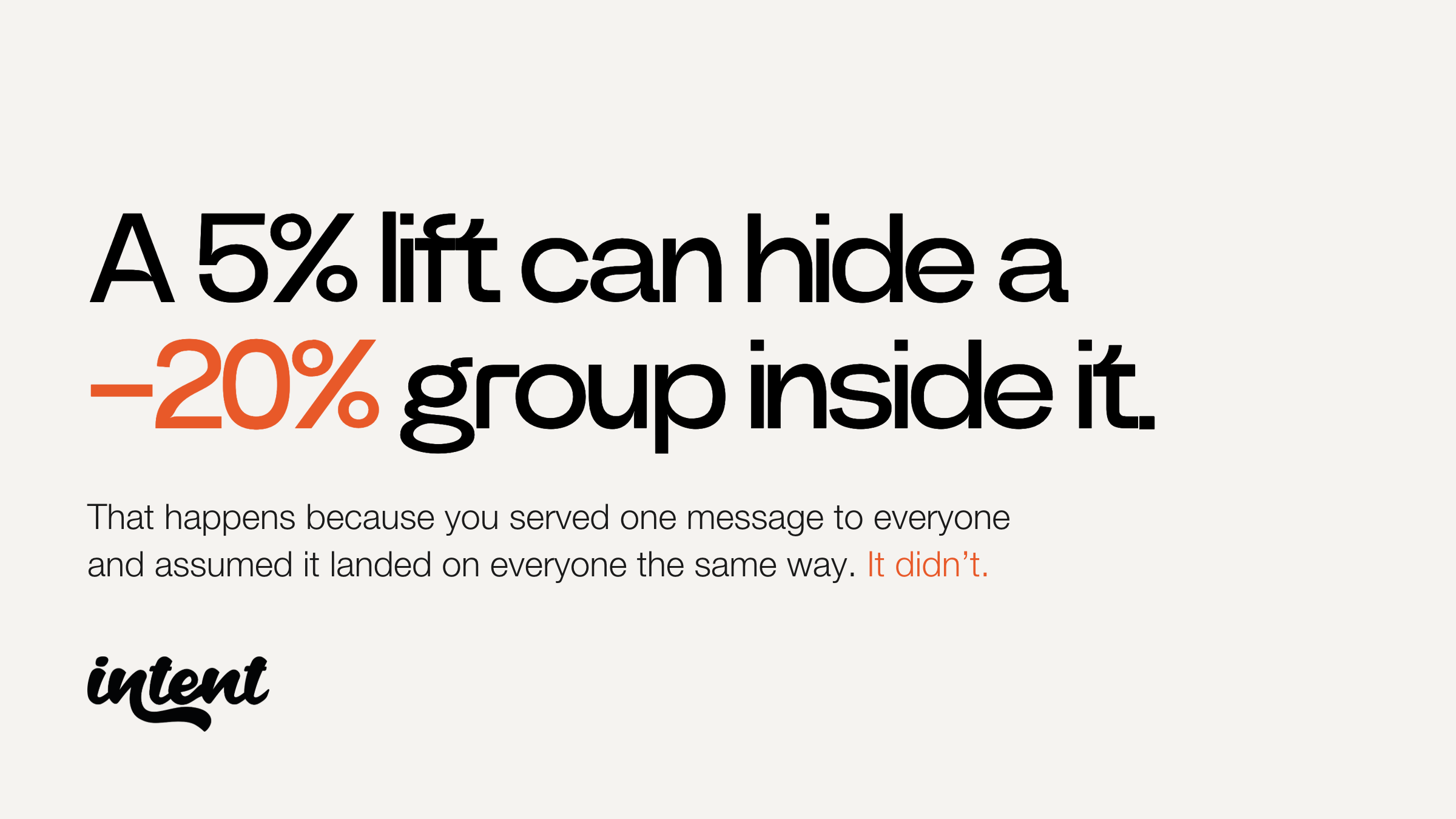
Say you add social proof and it lifts conversion 5%. Good result, ship it. But inside that 5% are hidden segments: one group at −3%, another at −10%, another at −20%, all quietly subsidised by a bigger positive somewhere else. That happens because you served one message to everyone and assumed it landed on everyone the same way. It didn't. People arrive at different stages of a buying journey, holding very different levels of intent, with different jobs to be done.
The fix isn't a better aggregated message, but it's serving the same message to fewer, better-chosen people, which sometimes means not serving it at all, because for that person, at that moment, it isn't right. It's what we call "inappropriate" at Made With Intent.
Therefore the cost is not amplifying existing messaging or features.
2. The cost of static is that the decision gets made before the moment that mattered.
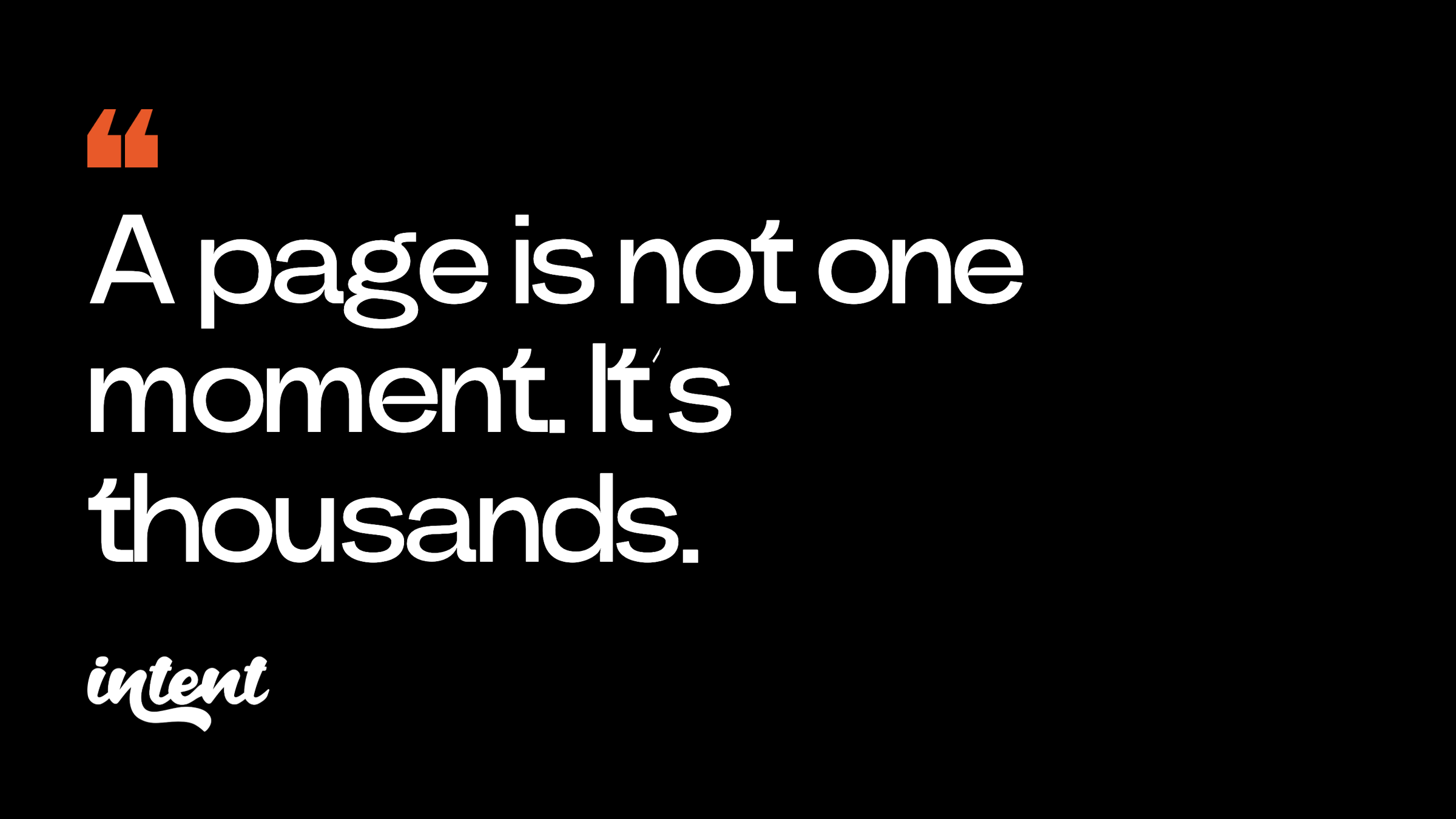
A page is not one moment. It's thousands. Someone lands on a product page with real intent and loses it without ever leaving. They scroll to the reviews, pause, open the size guide, back up to the images, sit still for ninety seconds, drift toward the browser bar, come back, re-read the delivery copy. Every one of those changes what they need next. Not one of them is a new page load. How many single page views do you have?
Decisions are made in between the pages. In between the events on the pages. The signals. That's where moments occur and hesitation lies, doesn't it? But our websites are so static they can't respond to those moments.
Therefore the cost is missed opportunity.
What actually moves each axis
1. You need a personal attribute
This is the part the industry got wrong for a decade. Personalisation was built on attributes like device, traffic source, returning versus new, pageview count. Those describe the circumstances someone arrived in. Spoiler alert: they aren't the person. They're website attributes disguised as aggregated proxies.
Pageview count is the clearest example of the problem. It's used as a proxy for engagement, when a confused shopper racks up far more pageviews than a decisive one. The proxy points the wrong way, and vice versa.
The most personal attribute available isn't who somebody appears to be based on their device, iOS, traffic source or what page they landed on. It's what they're trying to do: whether they're discovering or considering, confident or hesitating, likely to buy, likely to leave. Their intent.
That is a description of a person rather than a description of a session. There's a reason why personalisation is a noun person-alisation: the act of being personal.
2. You need a decision engine to scale delivery
A mechanism that serves content at the time that it's needed for the user. A delivery system that recognises that intent, serves content, re-recognises it, serves different content and evolves as such.
This means reading behaviour continuously rather than sampling it once at, say, page load. This is where you get to true two way communication between user and brand. In our case, at Made With Intent, that's around 800 signals per interaction, returned as predictions every few seconds. The decision travels with the visitor instead of being stamped at the door.
And it means something is allowed to keep re-deciding. Not a rule that fires once, but an allocation that gets revisited: which of your experiences is working, for whom, and when. Continuously, rather than as a verdict reached once and then defended. An agentic delivery system that responds at the time that it decides, on your guidance and guardrails, for true scalability.
These two things combined are what we do at Made With Intent and why we exist.
Examples
The shift sounds large. People often asked about the explosion of content that's required. In practice, it's usually the same asset you already own, just triggered differently.
Think about your email capture pop-up.
Nearly every site has one, and nearly every one fires on something arbitrary: one pageview, three pageviews, ten seconds. Static and generic. So a visitor arrives and is immediately interrupted by a request for their email, before they've been given a single reason to care.
With Intent: change nothing about the pop-up (the same design, same offer, same copy) and change only when it appears, to the moment each individual visitor is actually receptive. Dynamic and individualised. Submission rates tend to move sharply. Why? Because it's more appropriate at the time the user needs it.
Your USP bar.
Often three messages, shown to everybody, on every page, all of the time. Static and generic. The instinct is that more messages mean more coverage. We've all been there. "We must show this message because that's what users care about".
With Intent: focus creates impact: one message, chosen for the person, beats three competing for attention. Give the system the three you already have and let it decide which one this visitor needs, and which page, and after how long. Dynamic and individualised.
Your "You may also like" recommendations.
Without intent, it's static and generic, stuck at the bottom of the page serving everyone all of the time, assuming it impacts everyone the same.
With Intent: for example, to someone in a high-intent, ready-to-buy state, a strip of alternative products can be a distraction from the thing they'd already decided on. To someone in a low-intent, still-exploring state, it might be the most useful thing on the page and belong further up it. Dynamic and individualised. Let the agent decide who is what and let it serve that content.
Notice what none of these require. No new content. No redesign. No new journey. The content already exists. What changes is the who and the when — which is why this is a smaller programme of work than it sounds, and why it doesn't add much to anybody's workload. It's largely the same things the team was doing anyway, with different logic deciding how they're displayed.
Your personal shop assistant
There's an analogy we use at Made With Intent, a lot.
A good shop assistant doesn't decide how to help you based on which door you came through, or what you were wearing when you arrived. They watch. They listen. They read whether you're browsing or hunting, whether you look stuck, whether you're about to give up and leave. Then they respond, and if you clearly want to be left alone, they leave you alone.
They have intuition.
That's two-way communication, and it's what a static page can't do, because the page decided everything before you'd done anything. The ability to respond appropriately is where impact comes from.
Book a demo to see how Made With Intent can help you move from static and generic content to dynamic and individualised experiences.

Become an Intent Insider
Get subscriber-only insights we don't publish anywhere else and event invites before anyone else.
By submitting this form you agree to our (more than fair) terms.