
Dynamic pricing is one of those vaguely-defined-but-often-used terms that mean different things to different people and industries. If you ask five people what it means, you'll likely get six answers, and three of them from the same person.
We think that most discussions around dynamic pricing get it backwards. These strategies focus on changing what the price says, for everyone. We look at dynamic pricing differently, because the more useful move for most ecommerce businesses is changing who gets a lower one.
What is dynamic pricing?
Dynamic pricing is when a business adjusts its prices rapidly and frequently in response to changing demand. Or, at least, that's the working definition the UK's Competition and Markets Authority (CMA) uses.
Under their definition, dynamic pricing covers things like airline fares that change by the hour, hotel rooms that cost more the night before a bank holiday, and Uber ride fares that rise during rush hour. The price moves, and every visitor sees the new one.
While that's the basic mechanism of dynamic pricing, the definition is much narrower than it should be. Many pricing strategies get filed under dynamic pricing even though they don't move the sticker price at all.
The confusion of dynamic pricing in ecommerce starts because it's not built around ecommerce. The CMA's definition was shaped by focusing on passenger air travel and rail, ride hailing and hotels. Each of the CMA's four named sectors sell a fixed, time-bound slot or item rather than a restockable product.
An ecommerce retailer reading that definition and asking "should we be doing this" is trying to apply a (primarily) transportation or hospitality-industry answer to a catalogue business. And because of that, the fit is much looser than it first appears.
Where regulation actually stands when it comes to pricing
You wouldn't be the first to wonder whether dynamic pricing is legal in the UK. To put it simply, using it isn't inherently unlawful. However, whether it's suitable for an ecommerce retailer like yours is another question entirely.
The CMA ran a dynamic pricing project through 2024 and into 2025 to study how digital markets treat consumers. It concluded that dynamic pricing, on its own definition, isn't inherently problematic when used transparently.
Now, the CMA wasn't trying to enforce anything. Instead, they were trying to understand who is using dynamic pricing, how they're using it, and if any action is needed. But if you read the update itself, the scope is largely limited to the previously mentioned four industries.
They did add that the live events sector is seeing increasing use of dynamic pricing, too. In fact, the CMA opened its own investigation into Ticketmaster's use of dynamic pricing for Oasis's 2025 reunion tour, and concluded that Ticketmaster may have misled fans about how ticket prices were set.
Ecommerce doesn't appear in that list at all. This means the regulator hasn't examined the sector the way it examined some of the other industries. That gap, of course, doesn't mean pricing in ecommerce sits outside the law. The consumer protection provisions of the Digital Markets, Competition and Consumers Act came into force in 2025, giving the CMA the power to enforce consumer law directly.
Those provisions cover any business setting a price, dynamic or otherwise. They require that a discount or urgency message you show a shopper is genuine, that a claimed saving is real, and that you can explain how a price was arrived at if a regulator asks.
The three things people call "dynamic pricing"
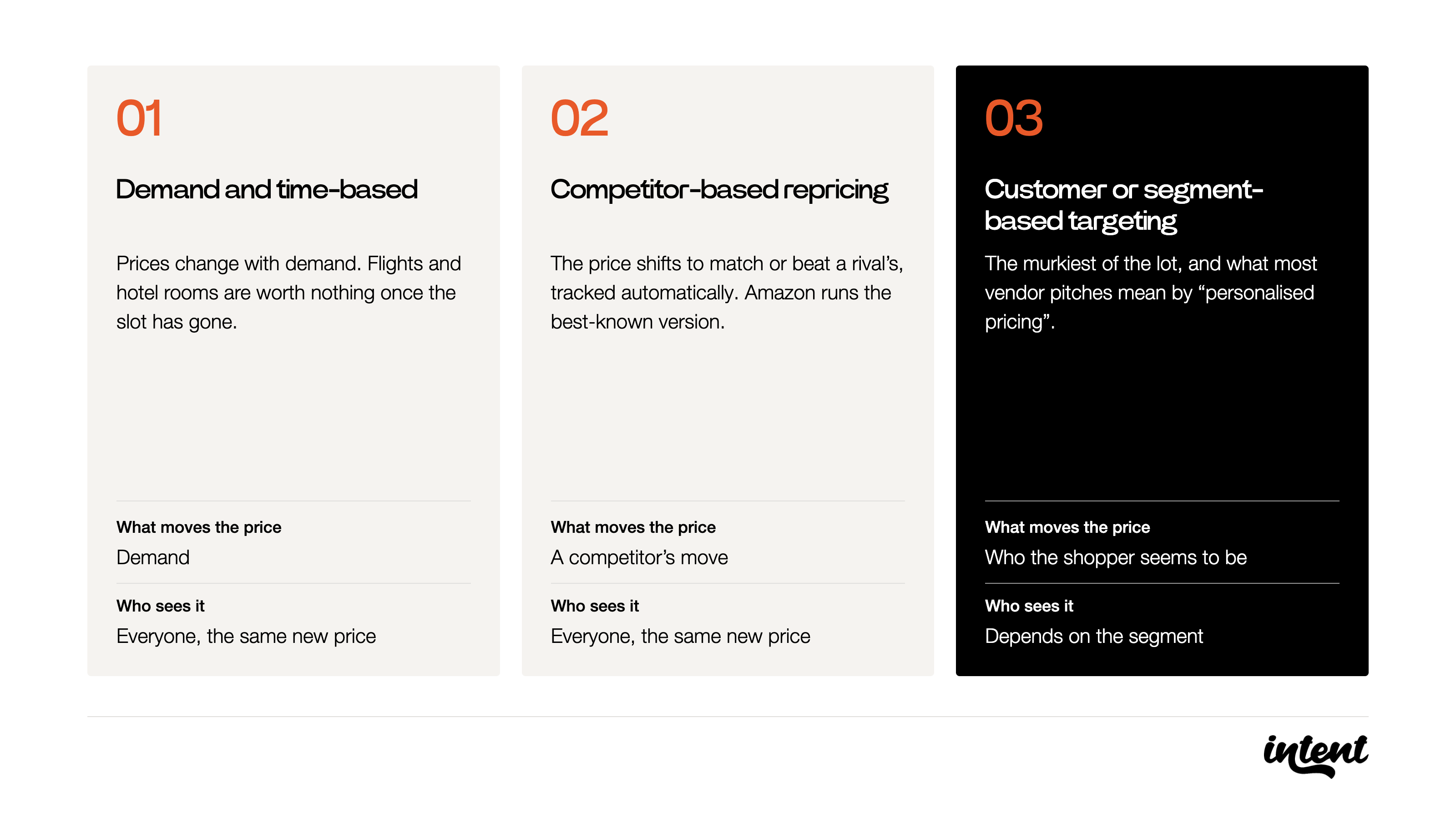
There are three primary categories for dynamic pricing:
- Demand and time-based price-setting. Prices change with demand, and every shopper sees the same new price. Flights and hotel rooms are the classic examples, because both are time-bound and worth nothing once the slot is gone.
- Competitor-based repricing. The price shifts to match or beat a rival's, tracked and updated automatically. Amazon runs the best-known version. Still one price for everyone, but the trigger is a competitor's move rather than demand.
- Customer or segment-based targeting. The murkiest of the three, and what most vendor pitches mean by "personalised pricing." Much of what gets called this is actually a fourth mechanism, which we explore next.
Where dynamic pricing and personalisation get confused
Personalisation and dynamic pricing are two different things. Dynamic pricing moves the price everyone sees, triggered by demand or a competitor. Personalisation, when done properly, changes who gets an exception to that price, while the sticker price itself never moves.
But the lack of a clear definition for either means the two get confused easily. Vendor language like "customer-based dynamic pricing" or "segmented pricing" gestures at personalisation, but also highlights the moving price as a mechanism. The other common driver of confusion relates to the risks of segmented dynamic pricing. This refers to a seller using behavioural data to spot who's likely to buy, and then raising the price for that person.
If someone has only ever seen dynamic pricing framed as either surge pricing or a manipulation risk, they'll bring both connotations into pricing strategy conversations. However, with intent-based discounting, nobody pays more than the list price.
So, here's the fourth category, defined properly: the sticker price never moves. What changes is who gets offered a lower one, and when.
That isn't dynamic pricing by the CMA's definition, because the price on the page doesn't change. But for most ecommerce retailers, it's the practice that actually solves their problem.
Why we don't do dynamic pricing (in the traditional sense)
We're not arguing that demand or competitor-based dynamic pricing is a mistake for every business. Event ticketing platforms, for example, have a genuine reason to move the price everyone sees. A ticket to a show is worth very little as soon as the show has started, so pricing to capture demand while it exists can be the right response to a real constraint.
As such, dynamic pricing solves a capacity problem. But most ecommerce retailers, selling a catalogue that restocks and doesn't expire overnight, don't have one. A jumper unsold today is still a jumper tomorrow.
What they have instead is a discounting problem. Some proportion of people getting a blanket promotion would have bought at full price anyway. Offering them a discount ends up giving away margin for nothing.
That's a different problem, and it needs a different fix. The sticker price stays the same. What changes is knowing, per visitor and in the moment, whether a discount is actually what's standing between them and a purchase.
This is where our framework does the work. It reads over 800 behavioural signals in real time, for every visitor, and infers how close they are to converting without a discount. Two visitors who look identical on paper can get different treatment, because their actual behaviour tells a different story.
We think that's the more useful pricing strategy for most ecommerce sites because most ecommerce retailers were never trying to solve the problem traditional dynamic pricing focuses on.
Dynamic pricing vs intent-based discounting, side by side examples
If we put the two strategies next to each other, the difference is concrete.
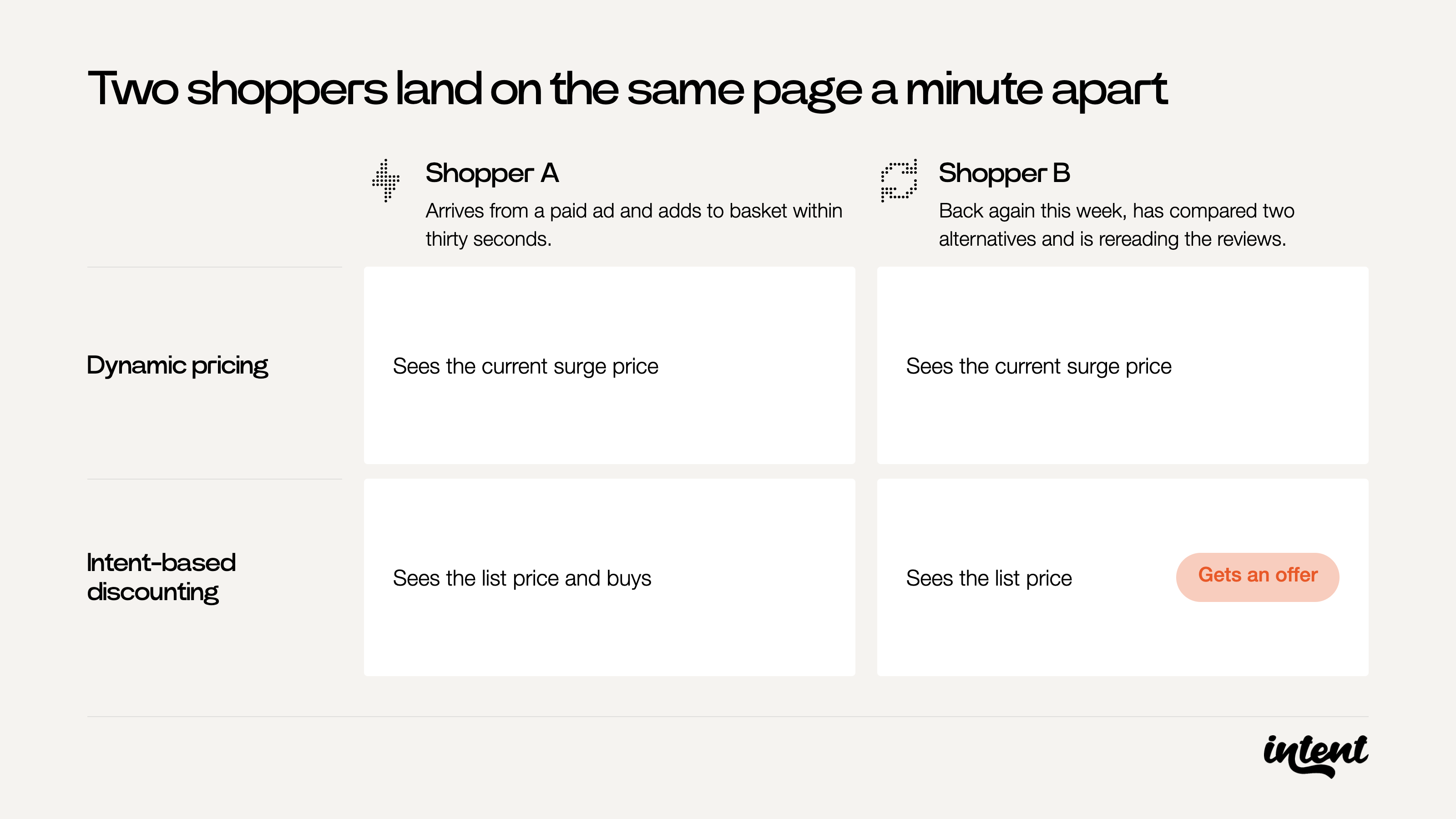
Picture a flash sale weekend and two shoppers arriving on the same product page within a minute of each other. The first lands from a paid ad, opens the page, and adds to the basket within thirty seconds. The second has been back multiple times this week, has compared the same product against two others, and is now scrolling reviews for the third time.
Under demand-based dynamic pricing, both would see whatever the current surge price is. That’s because the mechanism doesn't look at either of them individually. Under intent-based discounting, both still see the same list price as each other. What differs is what happens next. The second visitor, whose session is showing more hesitancy, is the one who sees an offer.
That's the whole distinction. Dynamic pricing changes the number while intent-based discounting changes who gets an exception to the number.
Where the real margin opportunity is hiding
Every pros and cons list written about dynamic pricing frames the benefit as capturing more revenue when demand spikes. That's a real benefit for businesses with genuinely time-bound inventory. While there are seasonal exceptions like Christmas decorations, Valentine's Day flowers, Easter treats and Halloween costumes, it's not the opportunity most ecommerce retailers are sitting on day to day.
The bigger and more controllable leak for a fixed-price retailer is the discount they're giving to someone who would have bought anyway. Voucher code sharing makes it worse. As soon as your discount gets posted to a public code-sharing site, the eligibility rule you wrote for a specific audience stops applying to that audience at all.
And let's be real, most of us have, at some point, Googled a brand name plus 'discount code' thirty seconds before checking out. If that's you, no judgement. Intent-based discounting doesn't solve voucher leakage on its own, but it removes the incentive, since there's no static code to leak.
Diamonds Factory, a luxury jewellery retailer under Neve Jewels Group, found this out directly. Their basket abandonment discount lifted conversion 11%, but average order value fell 6.7% over the same period.
They handed the decision to an agentic model instead and told it to optimise for revenue per customer rather than conversion rate. It decided 52% of visitors didn’t need a discount at all. And that was the right move. Letting the agent decide per visitor was worth £1.6m in incremental annual revenue.
So, dynamic pricing: yes or no?
The honest answer depends on what you're selling.
If your inventory is genuinely time-bound, like tickets to a fixed number of seats or a limited-run drop with no restock, traditional dynamic pricing can be a good fit.
If you're selling a fixed-price catalogue that restocks and doesn't lose value overnight, the question changes. It's no longer about moving the price with demand. It's about whether your discounts are reaching the people who actually need them to convert, which is the bigger margin opportunity for most ecommerce retailers.
There's one more factor you should consider. Price stability is part of what a shopper trusts you on, especially if you sell items or experiences that need more consideration. If your price moves visibly with demand, you risk looking opportunistic.
Intent-based discounting doesn't carry that risk, because the price on the page doesn't change. What that shopper sees stays consistent, and the only thing changing behind the scenes is whether they're personally offered a reason to act sooner.
So, for many, the fix isn't a different price but a different question. Ask "does this specific visitor need a reason to buy today, and what is it" rather than "what should this cost right now". If you answer that per visitor instead of per segment, your sticker price can stay exactly where it is.
If you want to see the possibilities of intent-based strategy, book a walkthrough and we will show you.

Become an Intent Insider
Get subscriber-only insights we don't publish anywhere else and event invites before anyone else.
By submitting this form you agree to our (more than fair) terms.