Ecommerce expertise


Most lists of abandoned cart emails are judged by the wrong criteria. Subject line cleverness. Clean design. Brand-consistent copy. None of that tells you whether the email should have been sent at all, or whether it was built for the type of shopper who actually received it.
What makes an abandoned cart email effective is how well it matches the reason the customer left — not the subject line, the discount, or the design. The 10 examples below are organised by the abandonment scenario each one is built for, so you can borrow the right approach for the right situation rather than copying whichever email looks most impressive.
Editor's note: All examples are sourced from Really Good Emails (reallygoodemails.com), an independent email archive you've probably used at some point. I had Claude have a good peruse through it before deciding on which ones I'd write into the piece.
The one question every abandoned cart email list skips
Before the examples, let's just contextualise why people abandon carts.
There isn't one type of cart abandoner. There are at four (probably more), and the email that works for one will actively backfire for another:
- Interrupted shoppers: got distracted by life, had no real objection, often come back on their own
- Price-sensitive shoppers: saw the total at checkout (including shipping), did the maths, and thought: “Right, I’m off”
- Hesitant shoppers: browsed carefully, read reviews, maybe checked the returns page, still couldn't commit
- Indecisive shoppers: liked the brand but couldn't choose the right item, or weren't ready to decide
Sending a 20% discount to an interrupted shopper doesn't recover a sale. It gives margin away to someone who was already coming back. Sending a playful nudge to a shopper who couldn't verify your returns policy doesn't help them really. It's a case of wrong message at the wrong time.
Segmenting abandoners by type isn't a new idea. ConvertCart and others have proposed versions of this framework. What most implementations miss is applying it to real, named brand examples rather than wireframes, and being honest about when each approach goes wrong. In this blog post, we'll analyse each abandoned cart email example, pick out the pros and cons and do some commentary on them.
Abandoned cart emails for interrupted shoppers
These shoppers had no objection. Something pulled their attention away mid-session, and the purchase didn't complete. They're the most likely to come back without any email at all. That's exactly why this is the category where discounting causes the most damage. You're giving margin to a customer who was ready to buy.
The right email for an interrupted shopper is a clean, low-pressure reminder.
Casper — "Come Back to Bed"
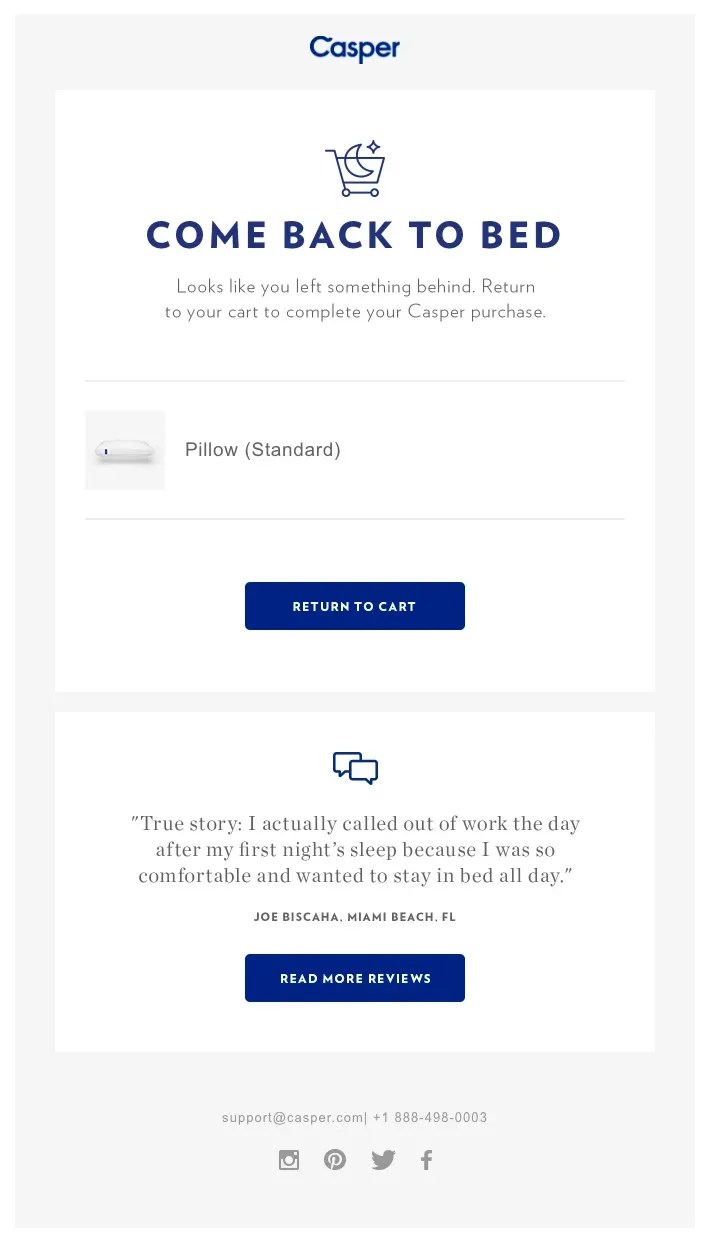
Casper's cart recovery email is clean and minimalist. Product image front and centre, a single CTA, social proof embedded lightly without being pushed. The copy is warm and brand-consistent without being clever for its own sake.
What it does well: the email assumes the shopper liked the product. Its only job is to put it back in front of them. It doesn't introduce urgency or price pressure that wasn't there before. We like the playfulness of the headline.
The assumption: the shopper was interrupted, not objecting. Is that assumption right often enough to make this format successful?
When it backfires: if Casper's flow also sends a discount to the same segment a day later, what about those that are ready to buy, forgot to do it, and they've earned themselves a nice discount for doing nothing?
Harry's — "So Close to the Finish Line"
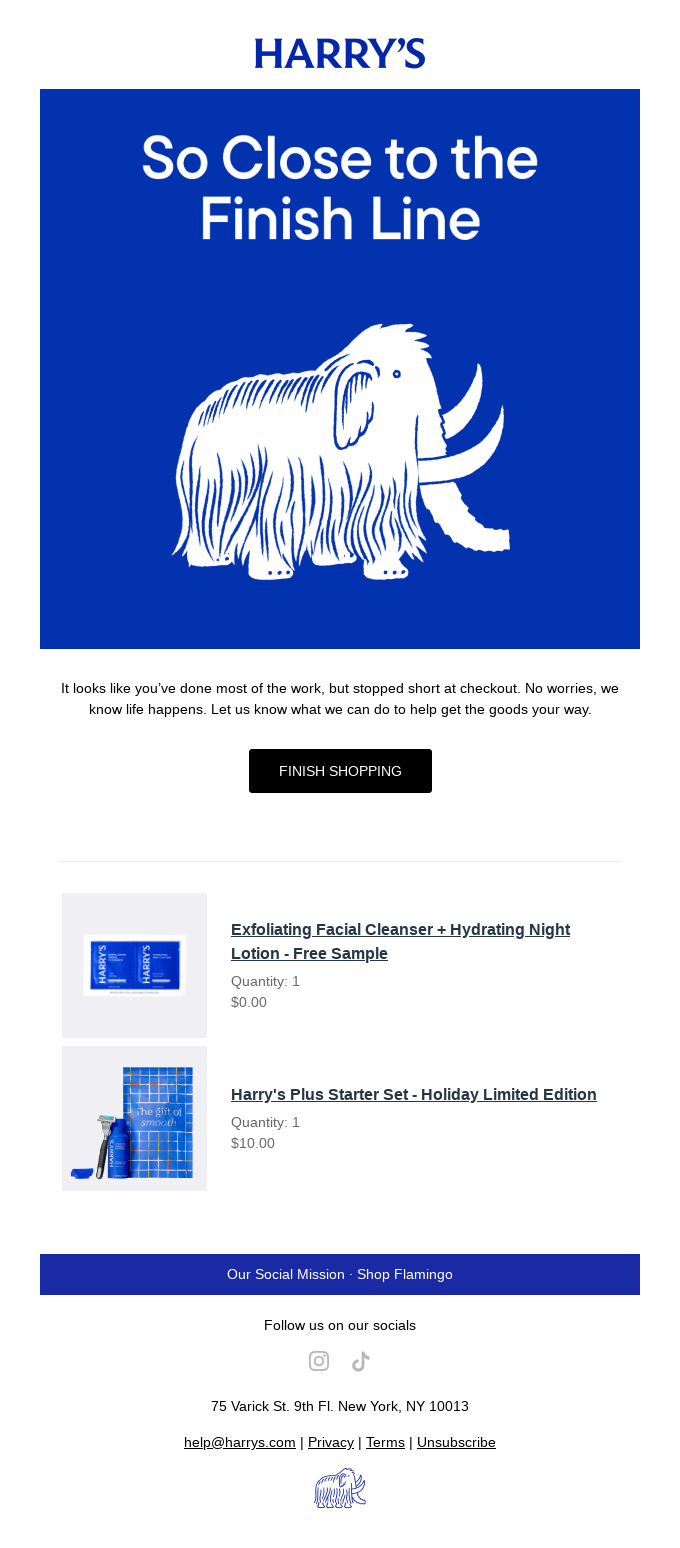
Harry's abandoned cart email doesn't try to be clever. The headline uses the brand's woolly mammoth mascot against a bold blue background: "So Close to the Finish Line." The copy: "It looks like you've done most of the work, but stopped short at checkout. No worries, we know life happens. Let us know what we can do to help get the goods your way."
What it does well: it treats the shopper as an adult. The tone assumes good faith on both sides. It's not manufacturing pressure or guilting the buyer. Worth noting that the abandoned cart here is a free sample and a $10 starter kit, a genuinely low-friction entry to the brand. The email is built for a purchase with almost no real barrier.
When it backfires: for a high-consideration or high-price product, empathy alone won't do it. The shopper needs a reason to come back, not just a reminder that they nearly did.
Pestie — "Did a bug crash your order?"
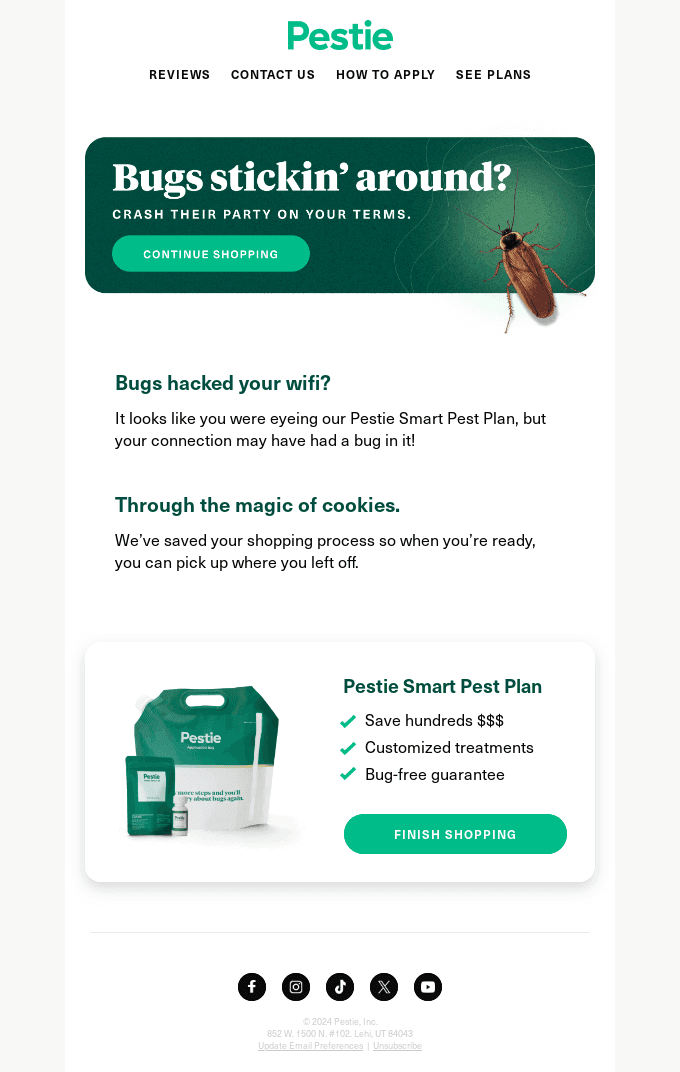
Pestie sells a subscription pest control plan. Their abandoned cart email is written entirely in pest puns: "Bugs hacked your wifi? It looks like you were eyeing our Pestie Smart Pest Plan, but your connection may have had a bug in it. Through the magic of cookies — we've saved your shopping process so when you're ready, you can pick up where you left off."
We're all about puns at Made With Intent. Especially in the marketing team. So, in our esteemed view this is already a 10/10 email.
What it does well: the puns are there for a reason. For a brand whose product is literally about bugs, the email signals that they don't take themselves too seriously. That's quite endearing for someone looking to build a long-term relationship with a brand.
When it backfires: for a first-time visitor who hasn't yet bought into the brand's personality, the jokes don't remove any real barrier. A shopper with a genuine price or trust objection gets pest puns. Bugger.
Wondering how to prevent your abandoned baskets before they happen? See how Made With Intent does it.
Abandoned cart emails for price-sensitive shoppers
These shoppers reached the checkout, saw the full total, and left. Extra costs at checkout, shipping, tax, unexpected fees, are the single biggest reasons shoppers abandon, cited by 39% of abandoners in Baymard Institute's latest quantitative study. It's why this is the category where price incentives are utilised.
There's two things that spring out here. First, not every discount is the right discount. There's a significant difference between a shipping waiver and a 25% reduction in product price. Second, financing is sometimes a more effective tool than a discount, particularly for high-consideration purchases where the monthly payment is more psychologically viable than the total cost.
Levi's — 25% off
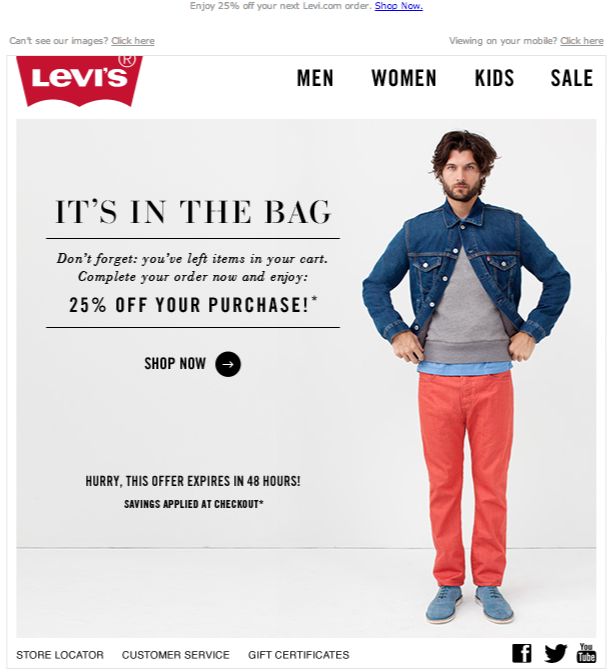
Levi's cart recovery email is bold and short. Big headline, big number: 25% off. One product image and a single CTA. It directly addresses the price barrier without ambiguity.
What it doesn't do: it has no mechanism to distinguish who actually needed the discount. The interrupted shopper gets 25% off alongside the price-sensitive shopper. That's the fundamental problem with blanket discount recovery flows. The discount is the easiest lever to pull, but it's applied without any understanding of whether it was needed.
Let's do some numbers on the back of a napkin. If 30% of your recoveries would have happened without the email, you've just cut margin on 30% of your "recovered" revenue for no commercial reason. No published figure exists for this across the industry. That's itself the problem. Many brands don't run a holdout test to find out.
What good looks like: a recovery flow that sends no discount in the first email, and only introduces one if the shopper didn't convert, reserved for segments whose behaviour suggests price was the actual barrier.
Slight Made With Intent-shaped sidebar: Appliances Direct ran exactly this approach and saved 42% of the margin they'd previously given away.
Aventon — "Need more time? Your ebike is still here (for now.)"
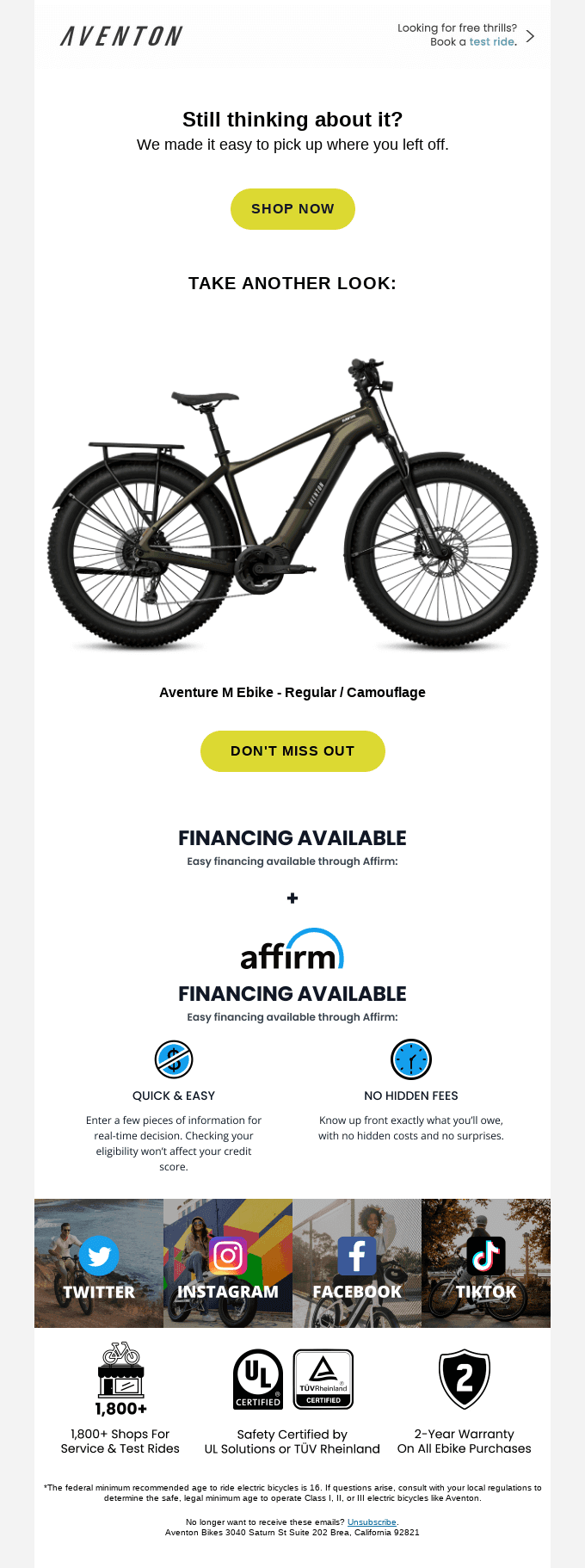
Aventon sells electric bikes. The subject line soft-pedals urgency; the email body leans almost entirely on financing. A prominent "FINANCING AVAILABLE via Affirm" section sits above the product image, with payment options broken down by monthly instalment. There's also a header CTA: "Book a test ride."
What it does well: it removes the price barrier without touching the headline price. Affirm installments reframe affordability: the shopper isn't being asked to find the full cost upfront, they're being asked to consider a monthly figure instead. It breaks down the £1,000+ cost in a manageable way.
The test ride CTA is smart. For a high-consideration purchase where the shopper has never experienced the product, a physical touchpoint is good way of getting people invested in the product beyond the digital experience.
The assumption: the shopper wants the product but the upfront cost is the specific barrier. If their hesitation is about product quality or brand trust, installments don't resolve it. Should there be more social proof to help people understand how the product helps them?
MasterClass — "HEY, WHAT HAPPENED?" + up to 50% off

MasterClass runs a subscription service for online courses instead of physical products. The headline is conversational and comes across slightly startled: "HEY, WHAT HAPPENED?" — before offering a deep discount and showcasing celebrity instructors.
What's interesting is the trust signals they have in play. Below the discount, MasterClass includes trust logos from companies including Deloitte and PayPal, and a section showing which type of learner (A, B, or C) might use the platform. Essentially, it segments the hesitant shopper by use case in the email itself.
What it does well: the social proof addresses a different objection from the price cut. The shopper may have left because of cost, or because they weren't sure the product was legitimate. The email handles both simultaneously.
The issue: a 50% off discount on a subscription product teaches the same lesson product discounting teaches in retail. Abandoners learn that waiting is rewarded. MasterClass should be asking how many of its subscribers will only ever subscribe when a 50% promotion is running, and whether that margin is sustainable.
Abandoned cart emails for hesitant or shoppers with trust issues
Blueland — "We love it, too. Then again... we might be biased."

Blueland sells eco-friendly cleaning products, specifically dissolvable tablets that replace single-use plastic bottles. Their cart recovery headline is confident, and maybe a little self-aware: "We love it, too. Then again... we might be biased." Below it: product image, price ($25), and a product performance claim: "Little tablet, big clean. Our tablets have all the power, without any of the plastic." No discount.
What it does well: the product's differentiation is the trust signal. A shopper who abandoned their cart because they weren't convinced eco tablets actually work gets the product's performance claim restated clearly. The "we might be biased" line signals confidence rather than desperation. The brand isn't worried you're about to leave.
When it doesn't work: a shopper whose hesitation was "but does it clean as well as a conventional product?" gets a value message. The email doesn't resolve that specific doubt. Blueland's email works for shoppers already aligned with eco values. It doesn't do much for the unconvinced.
IMBODHI — "Pieces You'll Regret Leaving Behind"

IMBODHI is a sustainable activewear brand. Their cart recovery email layers three distinct trust mechanisms without a single discount code. It has a FOMO headline ("Pieces You'll Regret Leaving Behind"), a Shop Pay financing section (buy now, pay in installments), and a grid of UGC customer photos under the hashtag #LiveEmbodied.
What it does well: it addresses both price hesitation (Shop Pay installments) and the social legitimacy question (real customers using the product) in a single email, without reducing the product price.
Why this may not work: "Pieces You'll Regret Leaving Behind" sets a slightly pressured tone for a first-time buyer who hasn't yet committed to the brand. FOMO framing works on a shopper who's close to being convinced. For someone who's genuinely struggling to build trust with your business, it can feel like the wrong kind of push.
Abandoned cart emails for indecisive shoppers
These shoppers want something but couldn't commit. They may be comparing options within the brand, unsure which variant or style to choose, or simply not ready to make the decision. The barrier isn't price or trust — it's the decision itself.
These emails solve a different problem: they simplify or reframe the choice, rather than removing a specific barrier. The risk is that showing more options can increase rather than reduce decision paralysis.
Lamborghini — "Can't Decide?"

Yes, Lamborghini makes wine. Their abandoned cart email doesn't reference the specific item left in the cart at all. The subject line is "Can't Decide?" The body opens with "Still thinking?" and pivots immediately to "Here's Some of Our Best Sellers," presenting four product recommendations.
What it does well: it treats indecision as a discovery problem. If you couldn't choose the item you had in your cart, perhaps a different set of options helps. The email resets the shopper's choice rather than pushing them back to a single item they couldn't commit to.
The risk: if the shopper had a specific item they definitely wanted and simply got distracted, showing four alternatives signals the brand wasn't paying attention. This email makes a particular bet about why the shopper left. It won't always be right.
Abandoned cart emails that use urgency and scarcity
Urgency in cart recovery works when it's true. Manufactured scarcity — "only 3 left!" when the warehouse holds 300 — erodes trust with shoppers who notice, and increasingly, shoppers notice.
The most credible urgency email in this list earns its subject line through genuine stock constraint, not a copywriting trick.
Alo Yoga — "The Airlift 7/8 Decadent Bodysuit in your cart sold out"
![Test] The Airlift 7/8 Decadent Bodysuit in your cart sold out from Alo Yoga - Desktop Email View | Really Good Emails](https://cdn.prod.website-files.com/683359648c5bfdeb492e5edc/6a4447b61cc56f8865d08dc8_image.png)
The subject line is the entire email. Alo Yoga's abandoned item is genuinely sold out. No manufactured pressure, just a fact. The headline inside: "YOUR MISSED CONNECTION." The email then pivots: a section shows the shopper's remaining cart items ("YOUR CART IS STILL WAITING") alongside alternative products in the same category.
What it does well: the scarcity is real. The brand doesn't need to claim urgency. It's already true. And the pivot to alternatives turns what could be a dead end into a continued shopping opportunity.
When it backfires: if the shopper wants only that specific item and no alternative will do, the email confirms the purchase is no longer possible. It won't convert in that scenario. But there was nothing to convert. The email's job shifts from recovery to brand experience.
The broader lesson: a brand that saves urgency emails for when the urgency is actually real builds more long-term credibility than one that manufactures it in every third recovery email.
The question these examples can't answer for you
There's a limit to what a "best abandoned cart email" list tells you.
I can't tell you what the recovery rates are for them. I can only offer you my opinion. Really Good Emails is an archive, not a performance tracker. The examples in this piece were chosen because they illustrate distinct strategic logic, not because any of them are proven to outperform the alternatives. "Best" here means "most instructive," not "highest converting."
The metric that actually matters is incremental recovery: the sales that happened because of the email, not alongside it. A shopper who abandons at 9pm, receives an automated reminder at 9:01pm, and buys at 9:15pm may have bought at 9:05pm without the email. That recovery appears in your platform's dashboard but contributes nothing incremental to revenue, and if it includes a discount, it actively costs you margin.
Measuring it properly requires a holdout group, a segment of abandoners who receive no email at all, used as a baseline against those who do. Most ESPs support suppression lists. The simplest test is withholding the first email from 10% of abandoners for 30 days and comparing purchase rates. Rejoiner has a good primer on the methodology if you want to set one up. Few brands run this. The ones that do are often surprised by how much of their "recovered" revenue would have happened regardless.
This is the honest limit of any examples-based approach to cart abandonment. The best use of a list like this isn't to copy the email that looks most impressive. It's to use the framework — which type of abandoner is this built for, and what does this email assume about why they left? — to evaluate the emails already in your own flow.
The most effective recovery strategies don't wait for abandonment at all. They identify visitors whose intent signals suggest they're at risk and intervene before the cart is left behind. That's a fundamentally different problem from choosing the right email to send after the fact. See how it works.
What makes an abandoned cart email work
Knowing which email to send requires knowing something about why the shopper left. Most brands don't know that. They send the same recovery sequence to every abandoner. And they wonder why their discount bill keeps rising while incremental recovery stays flat.
The brands that recover more tend to discount less. Not because they're precious about margin, but because they understand that not every abandoned cart is a lost sale in need of a coupon. Some abandoners need a simple reminder. Some need reassurance about the brand. Some need to know the financing option exists. And some were never going to buy in that session regardless of what was sent.
If you want to prevent basket abandons instead of just trying to recover them after they've happened, here's how intent-based cart recovery works.
Two visitors land on the same product page. One is browsing for the first time, casually curious. The other has returned four times this week, lingered on the size guide, and added the item to their basket twice without checking out.
Both see the same testimonial: "Life-changing product! Five stars!"
For most ecommerce brands, the bottleneck isn't the testimonial bank. The bottleneck is matching the right testimonial to the right visitor at the right moment in their journey. Your reviews database is probably already deep enough. What's missing is the logic on top of it.
So we're on the same page, what are customer testimonials? They're endorsements from real customers that serve as social proof to reduce purchase risk for new visitors. Used strategically, they are one of the most effective tools in ecommerce conversion, but only when matched to the right visitor at the right point in their buying journey.
That latter bit is where most brands lose the plot.
What customer testimonials actually do
Let's go back to basics and define customer testimonials.
Customer testimonials reduce perceived risk. When someone is about to spend £80 on a jumper they can't touch, £200 on a skincare set they can't smell, or £600 on a sofa they can't sit on, they are buying on faith. A testimonial transfers a small amount of trust from a stranger who has already taken that risk.
The numbers back this up. A product with five reviews is 270% more likely to be purchased than one with none (Medill Spiegel Research Center). Reviews flip the equation from "I hope this is good" to "other people like me said it's good."
So far, so good? Most ecommerce teams have internalised this for a decade. They have collected reviews. They have stars on PDPs. They have widgets pulling in the latest five-star quote. The job, on paper, is done.
Or is it? Conversion rates haven't moved much. Bounce rates on PDPs haven't dropped. The reviews are present, the trust signals are loud, and yet visitors still leave.
The question worth asking isn't whether customer testimonials work. They do. The more interesting question is: whose trust do they transfer, and when?
A first-time visitor doesn't need the same reassurance as someone who has been comparing brands for a fortnight. A price-sensitive shopper doesn't need the same nudge as someone who has already decided this is the brand. The same testimonial cannot do all of those jobs at once.
The next section is where the dominant approach starts to break down.
Why the same social proof examples don't convert every visitor
Brands built the dominant social proof playbook for a world with no reviews.
Collect them, display them prominently, serve them to everyone who lands on the site. That advice made sense in 2012. It made sense for brands going from zero to ten reviews. It does not make sense for an established retailer with 50,000 product reviews and millions of sessions a year, in 2026.
But the playbook hasn't been updated. So most brands keep adding more. Louder banners, "327 people are viewing this", scrolling testimonial carousels, urgency timers that reset every visit. More signals, served identically to every visitor. It's overwhelming.
David Mannheim, our CEO, puts it bluntly:
"Social proof nowadays is basically the same message to everyone. The urgency, the review snippets, the scarcity. It's a belief that more is more, that everything serves everyone. But really, social proof should only appear to those users at the right moment. It's a persuasive methodology; a nudge or a tactic at the right time. Suppress your social proof. Don't serve it to those that are just browsing, give them a different message. And don't serve it to those that are ready to buy, give them a different message. It's those just in the middle that need a nudge over the fence." — David Mannheim, CEO, Made With Intent
This reframes social proof examples from "always-on trust signals" to "situational nudges". And once you accept that frame, undifferentiated testimonials look less like a neutral baseline and more like an active risk.
Consider the mismatch scenario. Imagine a visitor who has never shown a price signal. They came in via a brand search, went straight to a hero product, and showed no comparison behaviour. You serve them a testimonial that says "great value for money". They were thinking about whether the product was right. Now there's a price question in the frame that wasn't there before.
Or take a returning visitor who has bought from you twice before. You show them a quote that says "perfect for beginners". The implicit message is: this isn't really for someone like you.
Neither of these social proof examples is wrong on its own. Both are wrong for that visitor at that moment. Whether the mismatch actively depresses conversion or simply fails to help, the outcome is the same: the testimonial isn't working. The fix isn't the testimonial. It's how the testimonial is delivered and when.
The ecommerce social proof gap: one buying journey, three different trust needs
A buying journey is not one job. It is at least three jobs, each requiring a different kind of trust.
This is the Made With Intent framework: the three intent stages we use operationally with clients. Other segmentation models exist, but this is the one we've found most actionable. You can read more about how we define and detect these stages here.
But if you're new here, briefly, this is what they are:
Discovery (first visit). The visitor needs category credibility. "I didn't know this kind of product could do X." They are not yet evaluating brands; they are evaluating whether the category is worth their attention at all. Generic enthusiasm ("I love it!") works here, because novelty is the barrier they need to clear. They don't need specifics. They need to get interested.
Consideration (comparing options). The visitor needs differentiation. "I compared three brands and chose this one because the fabric held up after 30 washes." They have already accepted the category. Now they're choosing between you and two others. Generic praise is useless because every competitor has it. What they need is a reason to prefer you, not just a reason to trust you.
High intent (near add-to-cart). The visitor needs hesitation removal. There is one specific objection holding them back, usually sizing, delivery timing, returns policy, or quality longevity. A five-star quote does nothing for this. A testimonial that opens "I was worried about the fit but..." is the right…fit (if you pardon the pun)
You might read this and think, "Oh boy, it's another SaaS blog saying really great things about their product." But, let's see some proof. David talks about a specific example from one of our clients:
"We had a customer and they have social proof on their site. It increased conversion by 3.2%. Great. However, once they analysed what that social proof was actually impacting, they found it worked quite well for those with a medium level of intent that needed a nudge. But really poorly — minus 2.2% — for those with low intent: their browsing, discovering visitors. By just suppressing it to those low-intent users and only showing it to high and building intent, their conversion rate jumped up by 20%." — David Mannheim, CEO, Made With Intent
To be clear on what that 20% represents: it is not an absolute conversion rate. It is the lift attributed to the social proof tactic itself. Previously, the tactic produced a +3.2% improvement to their overall conversion rate. After suppressing it for low-intent visitors, the same tactic produced a +20% improvement, because they had stopped letting one cohort cancel out the gains from another. The drag was hiding inside the aggregate.
We can't always prove that mismatched social proof actively causes harm, rather than simply missing its mark. In this case, suppression alone drove the improvement, which means at minimum the testimonial wasn't right for that particular audience.
Charley Bader, our VP Strategy & Ops, sees the same pattern in the building-intent stage:
"For those building intent it really worked. The people who have shown that intent to purchase and just need that slight push to tip into high intent and go through with the purchase." — Charley Bader, VP Strategy & Ops, Made With Intent
The bottom line is that discovery, consideration, and high intent are not three flavours of the same job. They are three different jobs entirely. Serving a discovery-stage testimonial to a high-intent visitor doesn't simply underperform. It interrupts a decision that was already in progress.
That's the ecommerce social proof gap. Most brands have built one trust layer for three trust problems.
You already have the ecommerce reviews. What's missing is the routing logic
Whenever we talk about this with retail teams, the first reaction is often: "We need more reviews."
Almost never true. For a retailer doing millions in online revenue, the reviews database is already enormous. Thousands of products, tens of thousands of reviews, often hundreds of millions of words of customer voice already collected and sitting in a Yotpo or Trustpilot export.
The gap is not volume. The gap is the logic that sits on top of your review database.
There are two distinct layers most teams conflate:
Tagging: Categorise existing ecommerce reviews by the objection they address, not just by star rating or recency. A five-star review that says "arrived in 24 hours, beautifully packaged" is a delivery-objection review. A four-star review that says "took me two tries to find the right size but the second one is perfect" is a fit-objection review. These two reviews do completely different jobs even though they look similar in a database.
Routing. Once tagged, assign reviews to the pages or visitor stages where the matching objection is most likely active. Delivery-objection reviews belong in the basket and checkout. Fit-objection reviews belong on PDPs, especially for visitors who have viewed the size guide. Differentiation reviews belong in front of returning visitors. Generic enthusiasm reviews belong on category pages and discovery surfaces.
We've found this is the structural gap in nearly every retailer we work with. Almost every ecommerce team has spent years optimising review collection: incentives, post-purchase emails, photo prompts, NPS triggers. Almost none have spent equivalent effort on categorising their reviews based on intent.
If you've heard enough and would like to know more about Made With Intent, why do you book a demo?
Social proof website examples: matching testimonial type to visitor signal
If you're looking to serve more appropriate testimonials to your prospective customers, here's some tips on how to begin categorising them:
1. PDP for a considered-purchase item: Replace the generic five-star quote at the top of the page with a hesitation-removal testimonial. If you're in fashion, it could be something like: "I was unsure about sizing because I'm between a 10 and a 12, but the fit guide was right. The 12 sits perfectly." That single change reframes the page from "people like this product" to "people like you bought this product and it was a great service".
2. Returning visitor on their second or third visit to the same product: This visitor has moved past discovery. Showing them another "Wow, amazing!" quote tells them nothing they don't already feel. Show them a differentiation testimonial instead: "I'd looked at three other brands and this was the only one that didn't fall apart after a month." They're likely to be sizing you up versus the competition, so give them what they want.
3. Basket or checkout page: A visitor at checkout has cleared the product question; they're now resolving logistics. Replace the enthusiasm testimonial with logistics and trust testimonials: delivery speed, returns experience, customer service responsiveness. "Returned a dress and the refund hit my account in 48 hours" closes a real objection at the moment that objection is live.
If you want a starting point for next week, here's our suggested approach:
- Pull a sample of 200 of your most-used reviews. Tag them by primary objection: delivery, quality, fit, price, trust/brand, generic enthusiasm.
- Pick one high-traffic PDP where you currently serve a generic testimonial. Start with one: this will likely mean a CMS change or an override on your testimonial widget.
- Swap the generic testimonial for an objection-specific one that matches the likely hesitation on that page.
- Run it as a 50/50 split test against the original, minimum two weeks or until statistical significance.
You don't need new tooling for that test. You need a spreadsheet, a CMS edit, and a desire to use testimonials differently.
If you'd like to see an example of this in practice, Hunter & Gather achieved a 14% conversion uplift by showing social proof only to the visitors who needed it — the same targeting logic, applied to a real catalogue.
What intent-aware customer testimonials look like at scale
Manual matching gets you a long way. It does not get you all the way.
And that's because visitor intent shifts in real time, and it shifts based on signals you can't see in a tagged-review spreadsheet. Return visit frequency. Product page depth. Comparison behaviour across categories. Dwell time on size guides. Whether they've abandoned a basket before. Whether they're price-checking or feature-checking.
When customer testimonials are connected to those real-time signals, the right trust signal surfaces automatically. A visitor showing price-sensitivity behaviour gets a value-validation testimonial. A visitor at high intent with no price signal gets a quality or delivery testimonial, because price isn't the unresolved objection for them.
This is where intent-aware serving moves from a quarterly project to a continuous capability. If you're thinking about how this fits into a broader on-site personalisation strategy, Made With Intent analyses hundreds of behavioural signals in real time to score where each visitor is in their buying journey: the input that makes intent-aware testimonial serving possible at scale. You can see exactly how we apply this to social proof on the platform use case page.
If you're ready to see how Made With Intent identifies where each visitor is in their buying journey, book a demo.


Scroll depth, traffic source, repeat visits. These have become shorthand for understanding online shoppers. We’ve optimised around them, targeted with them, and built personalisation strategies on top of them.
But here’s the problem. These signals weren’t designed to explain why people act the way they do. They just approximate it. They’re proxies, not predictions. And while they’ve been useful, they’ve also locked us into a static view of behaviour that’s long out of date.
It’s time to stop treating assumptions as insights. And to start acting on what people are actually doing in the moment. In this article I hope to clear up the distinction, and explain why. Let’s start with a definition.
Intent Proxies vs Intent Predictions
Intent proxies are overly broad signals that assume what a customer might do (like traffic source or a number of product views). Intent predictions are modelled probabilities based on all the behavioural data you have on them.
Ecommerce professionals have long relied on proxies like "repeat visits," "add-to-carts," or "time on site" as shorthand for intent. These are useful, but they're still indirect and quickly diminish in predictive power over the course of a user journey.
Intent prediction uses data models, like deep learning, that can interpret hundreds or thousands of behavioural signals at once (from click patterns to scroll depth to timing) and predict a customer’s likely next action, such as whether they’ll purchase or exit.

In practice, this shift helps you move from generalising ("social traffic converts at 1%") to acting on individuals ("this user, right now, has high purchase intent. Show them free shipping").
Why have ecommerce teams relied on proxies for so long?
Ecommerce professionals have relied on proxies for so long because they’ve been accessible, understandable, and actionable.
Historically, these were the signals that were easy to measure: traffic source, device type, funnel stage, and page views. They were available out-of-the-box in analytics tools and they told a story. One that felt close enough to intent to be useful. If email traffic converted better than social, it made sense to optimise for that. If users who viewed three or more products tended to buy, that felt like a good signal to lean into.
And to be fair, it worked to a degree. When you don’t have the tools or data to see deeper into user behaviour, proxies are the next best thing. They helped teams move fast and optimise what they could see.
The challenge now is that customer behaviour is more complex and the tools available have evolved. However, the old mental models are still familiar and baked into how teams report, target, and personalise. It's not that proxies were wrong. They were just the best option at the time.
Too often, proxies became the default not because they offered true insight, but because they were simply the easiest thing to measure. That convenience shaped strategies more than accuracy ever did.
The limitations of personalising using intent proxies
Personalising with intent proxies has a few key limitations, especially regarding accuracy, scale, and timing.
They generalise instead of personalise
Proxies treat users as groups. For example, "people on mobile convert less" or "email traffic is higher intent." However, not every mobile visitor has low intent and not every email clicker is ready to buy. You end up personalising for segments, not people. This misses the nuance in individual behaviour.
They can be misleading
More product views might suggest interest, or it might mean the user can’t find what they want. Longer time on site might mean they’re engaged, or it might mean they’re lost. Without context, proxies can be easily misinterpreted. This can lead to actions that feel off-base to the customer.
They’re static in a dynamic journey
Intent shifts from moment to moment. Users might start browsing casually, but after a few clicks and filters, their behaviour signals strong purchase intent. Proxies often rely on entry-level signals like traffic source or device type. These lose relevance quickly as the session unfolds.
They limit real-time responsiveness
Because proxies are often lagging indicators, they’re not great for adapting experiences in real-time. For example, you can’t adjust messaging during a session based on a proxy like "returning visitor." Intent predictions, on the other hand, can respond instantly to user behaviour.
The inform strategy and tactics
Worse, many experiences are now designed to maximise engagement for its own sake. When clicks, views, and dwell time become the KPIs, teams start optimising for behaviours that might actually signal friction. We reward the very signals that should raise concern.
How can we shift thinking away from proxies?
Shifting thinking away from proxies starts with changing how we view user behaviour. We need to move from static snapshots to dynamic journeys. Here’s how to encourage that mindset shift:
Start with empathy for the customer journey
Help teams see that proxies often flatten behaviour into categories like "mobile users don’t convert" or "email traffic is high intent." But customers are individuals, and their intent evolves. Encouraging teams to think about what this person is trying to do right now creates the foundation for moving beyond fixed labels.
Highlight the blind spots of proxies (without blame)
Instead of saying “proxies are wrong,” reframe it: “Proxies were useful when we didn’t have better tools.” Then, show where they fall short. For example, assuming more clicks always mean higher intent when they could mean confusion. This builds curiosity, not defensiveness.
Reframe success metrics
Encourage teams to go beyond segment-level metrics like “conversion by channel” and look at micro-conversions through user intent stages. This creates space to ask: Did we engage this user enough? How can we build intent? Do we nurture our prospects? Are high-intent users converting?
Introduce examples of predictive signals
Show how small behavioural patterns like scroll speed, click timing, or product revisits can be stronger indicators of intent than traditional proxies. This helps build trust in the value of prediction.
Position AI as a partner, not a replacement
Let people know they’re still in control. Their expertise sets the strategy. Prediction-enabling AI just gives them more accurate, real-time insights on which to act. That framing reduces resistance and opens the door to new thinking.
Pilot and prove
Start with one area, such as predicting exit intent or surfacing high-intent users mid-session, and show how acting on predictions outperforms proxies. Once teams see better outcomes, the shift happens naturally.
Common mistakes when approximating visitor intent
“High engagement = high intent”
It’s easy to assume that more clicks, time on the site, or pages viewed means a user is ready to buy. But sometimes, high engagement means they’re struggling. They can’t find the right product, are unsure about sizing, or get lost in filters. Without context, engagement alone can be misleading. And we optimise for these same engagement metrics. So even when they’re misleading, we treat them as wins.
“Intent is fixed at the start of the session."
Many teams look at early signals like the traffic source or device and treat that as a proxy for intent throughout the visit. But intent is dynamic. Someone who arrives from a casual source can quickly become highly intent based on what they see, click, and do. Behaviour during the session tells a richer story than how they arrived.
“We know intent because we know our funnel.”
There’s an assumption that where someone is in the funnel (homepage vs. product page vs. checkout) is their intent. However, two users on the same page can have completely different goals. One might be ready to buy, and the other may just browse or price-check. Funnel logic reflects how your site is structured, not how your customer thinks. Two people in the same place are rarely on the same path. That difference matters.
“It’s all or nothing.”
Intent is a mental state that reflects a purpose or determination. It isn’t binary. It’s a spectrum. A user might be five percent likely to convert. That doesn’t mean ignoring them. It means nurturing them. Treating intent as a sliding scale lets you personalise the experience in a way that matches where they are, not where you wish they were.
Why proxies prevent 1-to-1 scalable personalisation
Proxies force everyone into buckets. They’re coarse by nature, designed to simplify. A proxy says, “Mobile users don’t convert well,” or “Returning visitors are higher intent.” But in reality, not all mobile users behave the same. Not all returning visitors are ready to buy. These buckets blur the nuance between individuals, and that’s where personalisation breaks down.
You can’t scale one-to-one personalisation if your inputs are averages.
Let’s say your strategy is to show a promotion to users with high intent. If you're relying on proxies, you're basically saying, “Show the promo to everyone from email, on desktop, who’s viewed three or more products.” But in that group, maybe only a fraction are actually ready to convert. Others might just be browsing, or worse, stuck.
Now multiply that logic across your site. You end up serving the wrong message to the wrong people in the name of personalisation. It's segmentation dressed up as relevance.
True one-to-one requires a signal that’s individual, real-time, and predictive. Proxies are none of those. They’re static and based on assumptions. They don’t adapt as a user’s behaviour evolves. This means your personalisation, no matter how clever, can’t actually match the customer's intent at the moment.
So proxies hold us back. Not because they’re bad. They’re inherently not designed for individual-level decisions. They're shortcuts, not signals. Scaling personalisation on top of shortcuts just doesn't work.
How AI drives the shift from proxies to predictions
Historically, personalisation was limited by human capacity. You could track a few signals like channel, device, or funnel stage, and build rules around them. But the truth is, humans can only hold a handful of variables in their heads at once. That’s why proxies became the default. They were simple enough to manage, and they sort of worked.
But true intent is messy. It's fluid. It changes moment by moment. And it’s made up of hundreds of small behavioural signals that don’t fit into neat boxes. No human team can look at all those signals across thousands or millions of users and make smart, real-time decisions for each one.
That’s the reason. AI can process what humans can’t. It doesn't rely on a predefined playbook. It learns patterns from behaviour itself and sees nuance at a scale that would be invisible otherwise.
Deep learning models don’t need to predetermine what matters. They look at raw behaviour like scroll speed, hover patterns, revisit frequency, and hesitation before clicking. Then they learn what combinations of signals typically indicate interest, confusion, or high intent. They do this across millions of examples, constantly adjusting in real-time.
This means that instead of relying on assumptions like "email traffic converts better," AI can say that this user shows high purchase intent based on the last 12 seconds of behaviour, even if they came from a low-converting channel. A proxy would miss that completely.
So AI enables this shift not just because it's faster or more powerful. It unlocks a level of behavioural understanding that was never accessible before. It sees the nuance at scale and surfaces it so you can act.
Critically, you still define what "acting" looks like. AI doesn't replace that judgment. It removes the barrier between what you want to do and your ability to do it for every customer.
Ecommerce growth has always relied on reading signals.
For years, attribute data and intent proxies have helped teams move faster, personalise better, and optimise what they could see. These inputs weren’t perfect, but they were accessible, and they worked, up to a point.
That point is now.
What’s changed isn’t just the technology. It’s the opportunity. When you can see not just who someone is, or what they’ve done, but what they’re likely to do next, everything shifts. You can adapt experiences in real time, match the message to the moment, and unlock new growth that static segmentation could never reach.
Proxies will still have their place. But they’re no longer the ceiling.
Individual, real-time intent predictions are the next layer of advantage. And for teams looking for smarter, more sustainable ways to grow, that’s not just a technical shift. It’s a strategic one.
It’s also what Made With Intent makes possible for ecommerce teams.


Discounting is one of ecommerce’s oldest tactics. A proven lever for driving conversions, boosting AOV, and enticing new customer sign-ups. It’s a simple, effective value exchange. But it’s also safe to say many retailers often over-rely on it.
Our Intent Gap report added another statistic to support this. In a OnePoll survey of online shoppers, 83% said they use discount codes when they would have bought at full price.
83%. That’s a staggering amount of lost margin. And all without any measurable benefit.
Of course, we have our view on the problem with the status quo of discount codes. But putting aside the strategic choice of whether or not to offer promotions, it’s our stance that retailers aren’t wrong to lean on discount codes. It’s one of the few trading levers that delivers both speed and impact.
The real issue isn’t that they are being used. It’s how they’re being used.
We wanted to understand how retailers think about this. Is this just the price of doing business? Do they see a way out? To explore this, we spoke with seven ecommerce experts about how discount codes work today, what’s broken, and what they wish they could do differently.
The status quo of discount codes
“Marketers congratulate themselves that their discount code campaign hit all the right KPIs when the reality is that many (all?) of those customers might just have converted without it. They’ve become a drug we can’t wean ourselves off.”
Marty Hayes, Senior Manager, Ecommerce Specialist
For many teams, discounting feels like second nature. The campaign goes out. The numbers tick up. Everyone breathes a little easier. But Marty’s observation challenges the feel-good metrics. When discounts are applied by default, without knowing who genuinely needs them, they risk being a comfort blanket for the brand more than a value-add for the customer.
“In my experience, today’s retailers have transformed discount codes from occasional promotions into permanent fixtures.”
Emma Olliff, Head of Digital and eCommerce
Emma highlights the same trend through a different lens. What began as a tool to incentivise behaviour has become hardcoded into the purchase journey. If a tactic is always on, it stops being a lever. It becomes the environment. That shift affects not just performance, but perception.
“We use pre-determined discount codes to get customers across the finish line. Our codes are $50 for $1000 or more, $100 for $4500 or more, and $200 for $7500 or more.”
Forrest Webber, Owner
Forrest's experience shows a different side of the same issue. His discount strategy is measured, value-tied, and deliberately structured. And yet, if given the choice, he wouldn't offer them at all.
“To be frank, I would not offer them. But in the competitive ecommerce landscape, sometimes you have to give something up to get something in return.”
Forrest Webber, Owner
That tension is telling. It reflects a broader discomfort that many ecommerce leaders feel: not that discounting doesn't work, but that it often doesn't feel right.
Discounting has moved from a considered lever to a habitual tactic. And when something becomes automatic, it stops being strategic.
The cost of blanket discounting
“We’ve always known there was an opportunity to improve our checkout conversion. We’ve tried offering discount codes and free delivery to everyone, but it comes at a huge cost, impacting profitability too much.”
Jay Shufflebottom, Trading Manager
Jay calls out the trade-off directly. Discounts may move the needle on conversion, but they can quietly crush profitability in the process. For teams under pressure to hit targets, it's easy to chase uplift without accounting for margin.
It’s a pattern familiar to many. The default, sitewide offer applied in the absence of context. In contrast to the automated, habitual discounting described earlier, Jay points to a more deliberate path. One that balances cost with confidence, rather than urgency with erosion.
“We want less compromise. We want to give customers more of what they need, the experience they want, and everything that will help them make a decision. We want to give discounts to customers when they need them the most.”
Jay Shufflebottom, Trading Manager
Jay isn’t just asking for better targeting. He’s pointing toward a deeper rethink - one where discounts become a relevant, timely nudge instead of a catch-all incentive. It’s not about discounting less. It’s about discounting with purpose. That purpose is as commercial as it is customer-centric: fewer wasted incentives, more protected margin, and stronger relevance in the moments that matter.
The message here isn't anti-discount. It's pro-precision. Jay wants to swap broad strokes for sharper tools. That means timing, not just triggers.
“It can be tough to track whether discounts are actually boosting long-term customer value or just attracting deal-seekers.”
Tom Armenante, Ecommerce Director
Tom raises the performance measurement problem. Without a clear view of incrementality, teams risk giving away margin to customers who never needed the extra push. In those moments, discounting becomes a tax on conversion, not a driver of it.
The costs of blanket discounting run deeper than most metrics can show. It may lift the top line, but often erodes everything underneath.
Customers come to expect discounts
“Retailers have created a dependency cycle where customers won’t buy without feeling like they’ve ‘won’ a deal. This addiction to discounting erodes brand value and trains shoppers to wait for sales rather than recognising true worth.”Emma Olliff, Head of Digital and eCommerce
Emma brings the brand lens. Performance isn’t just about the transaction. It’s about perception, loyalty, and price integrity. When your audience expects a deal, your full price loses credibility.
And this doesn’t just happen in-session. Ecommerce discounting has created a self-reinforcing problem. Retailers rely on always-on discounts, and in turn, shoppers have learned to search for discount codes before checking out.
“It’s become second nature once customers have added their chosen product to cart, to open up that new tab and search for ‘XXX discount codes’.”
Marty Hayes, Senior Manager, Ecommerce Specialist
We’ve all done it. That reflex to check for a code before checking out isn’t a fringe behaviour. It’s the new norm. And it’s not just driven by price sensitivity. It’s driven by pattern recognition. Shoppers have learned the rules.
In our Intent Gap report, we also learned 85% of shoppers search for codes before buying. Yet 83% would have purchased without one.
“Customers become conditioned to expect discounts, reducing their willingness to buy at full price.”
Mathew Vermilyer, Senior Director of eCommerce Analytics and Optimisation
Mathew takes it a step further. Conditioning doesn't just shape behaviour. It reshapes value. The more shoppers wait for a deal, the less urgency – and perceived worth – the product holds.
“Codes are often leaked on coupon sites or found by AI chatbots.”
Niklas Bräutigam, Digital CRO Manager
Niklas highlights a structural flaw. Even when brands try to be selective, discount codes are rarely contained. They escape. They get scraped, shared, reused. That leakage doesn’t just undermine margin. It breaks the intended value exchange.
Customer behaviour isn’t fixed. But it’s shaped by what they see. And right now, they’re being trained to expect discounts by default. Smarter alternatives have to break that pattern.
So, what’s the alternative?
“It would also be great to test different discount structures like tiered offers or exclusive perks to see what actually works best. Discounts are a great tool, but they need to be used strategically.”
Tom Armenante, Ecommerce Director
There’s no call here to abandon discounting. But Tom makes the case for rebuilding it. The answer isn’t fewer offers. It’s smarter ones. Tiered incentives, exclusives and thresholds aren’t new ideas, but they are rarely tested with rigour.
If default discounting has created dependence, it’s in retailers’ interests to break it. Both in the timing and the nature of the offer.
“If we could offer free delivery only to people showing hesitancy or a high likelihood of abandoning the journey, that would be a game changer.”Jay Shufflebottom, Trading Manager
“What we need isn’t more codes, but smarter personalisation that rewards genuine loyalty instead of bargain-hunting behaviour.”
Emma Olliff, Head of Digital and eCommerce
Emma and Jay make the distinction clear. Targeting by context or real-time behaviour is better than targeting by default or simple rules. If a well-timed discount could be the difference between a sale or not, wouldn’t you want to offer it? Similarly, you may feel a loyal buyer deserves a reward, but not want to incentivise a one-time deal hunter.
“One idea might be to display a discount if a customer is really struggling at checkout, entering expired coupons, incorrect codes, rage clicking, showing exit intent, or spending an abnormal amount of time in checkout.”
Mathew Vermilyer, Senior Director of eCommerce Analytics and Optimisation
Mathew suggests one of the most practical shifts: linking offers to friction. A well-timed discount isn’t just persuasive. It’s supportive. It helps the customer keep going, rather than feeling pushed.
“Instead of offering the same code to everyone, retailers should provide personalised discounts only when necessary. I wish there was more use of Multi-Armed Bandits to continuously adjust discount offers based on real-time customer behaviour for better results.”
Niklas Bräutigam, Digital CRO Manager
Niklas brings in the optimisation layer. In other words, letting the algorithm run smarter tests by responding to customer behaviour, not just rules.
Personalisation doesn’t have to mean more segmentation. It can mean better responsiveness. When the system adapts based on what it sees, offers can stop being guesses.
All this hints that the future of discounting isn’t catch-all. It’s adaptive, behavioural, and already being tested by the brands getting it right.
Approaching discounts with intent
“We had one test with different variants. A showed everyone a delivery discount code, while B, C, and D only offered discount codes to those showing certain intent signals like hesitancy or abandonment.
As expected, both showed an uplift in sales, but the intent-based variants (B, C, D) delivered a much more profitable overall result with only a small difference to the top line uplift, which was a surprise.”
Jay Shufflebottom, Trading Manager
This is where the theory meets the real world. Jay ran the test on an alternative approach. And Intent-based discounting didn’t just work. It got more from less. The business gained almost the same conversion uplift, but with significantly more profit.
And this doesn’t just apply to discount codes. Delivery incentives, reassurance messaging and urgency prompts all become more effective when triggered by behaviour, not assumptions. Two recent plays from Buy It Direct Group bring this idea to life:
Better Bathrooms increased conversion rate by 8% by focusing on visitors who had built purchase intent but were showing signals of abandonment. Offering discounts only when behaviour signalled uncertainty.
Appliances Direct saved 42% margin (with only a minimal drop-off in orders) by only discounting visitors with high intent to purchase who were displaying clear exit signals.
These plays proved that relevance, not reach, is what makes a discount powerful. Intent-led discounting isn’t about doing more or less. It’s about doing what’s needed, only when it’s needed. The retailers doing this are seeing the impact where it counts.
Mathew neatly summarises the potential future of discount codes:
“Ideally, I would like retailers to have more dynamic and personalised discounting strategies, adjusting offers based on real-time customer intent, loyalty, and profitability.”
Mathew Vermilyer, Senior Director of eCommerce Analytics and Optimisation
Retailers aren’t turning their backs on discount codes though. Not yet. Even if they do see the cost of blanket offers, the risk of conditioning shoppers, and the danger of mistaking uplift for impact. Even if they are starting to call time on indiscriminate, always-on offers.
But while they are questioning how discounting is being used, they don’t see themselves completely abandoning it. Even if they want to. Instead, they want to redeem it. With smarter timing. With real relevance. With intent.
Want to protect your margin and personalise discounts at scale? Explore Discounting with Intent.
Thanks again to all the ecommerce experts who shared their thoughts with us:
Marty Hayes, Senior Manager, Ecommerce Specialist
Jay Shufflebottom, Trading Manager at Buy It Direct Ltd.
Tom Armenante, Ecommerce Director at GTSE
Emma Olliff, Head of Digital & eCommerce at W-Wellness
Niklas Bräutigam, Digital CRO Manager
Mathew Vermilyer, Sr. Director of eCommerce Analytics and Optimization
Forrest Webber, Owner at fireplacedistributor.com


"Data is the new oil," Clive Humby famously said, and in ecommerce, the importance of real-time analytics cannot be overstated.
Ecommerce operates at lightning speed. It's a competitive arena where every moment counts.
Real-time analytics is not just a trend but a transformative capability, potentially boosting sales by up to 30% and enhancing customer retention rates by 20%.
In today’s fast-paced landscape, relying on delayed insights from traditional analytics is simply insufficient. Real-time analytics provides immediate feedback on critical metrics such as customer behaviour, order trends, and emerging market shifts. This capability empowers businesses to make agile, data-driven decisions in real time, ensuring they stay ahead of the curve.
This article explores the strategic importance of real-time analytics in ecommerce, illustrating how it revolutionises customer engagement and operational efficiency. It will help you understand how integrating real-time analytics can elevate your ecommerce strategy and equip you to thrive in a dynamic marketplace.
Comparing analytics
Real-time vs Traditional methods
In the world of ecommerce, the battle between real-time and traditional analytics shapes how businesses navigate data-driven decision-making.
Real-time analytics operates on swift intervals—seconds to minutes—providing immediate insights into vital metrics like sales performance and website activity. While it may require robust infrastructure and investment, the payoff is clear: a decisive edge in responding to real-time market shifts and customer behaviours.
On the flip side, traditional analytics spans longer durations, capturing historical trends and enabling strategic forecasts. This method, cost-effective for handling vast data volumes, excels in unveiling broader patterns but lacks the agility demanded by today's dynamic markets.
Key metrics to track
Essential real-time Indicators in ecommerce
For ecommerce enterprises, harnessing real-time analytics hinges on monitoring a spectrum of critical metrics:
- Visitors Right Now: Live data on active visitors provides a pulse on site traffic and engagement levels at any moment.
- Total Sales: Instant updates on sales figures in your preferred currency offer a snapshot of revenue streams.
- Total Sessions: Tracking daily visitor sessions reveals trends in site traffic and engagement patterns.
- Total Orders: Monitoring daily order volumes helps gauge transactional activities and revenue generation.
- Top Locations by Sales: Identifying regions driving the highest sales aids in regional targeting and marketing strategies.
- Top Products by Sales: Real-time insights into best-selling items empower agile inventory management and promotional tactics.
- Active Carts, Checking Out, Purchased: Visualising customer progress through the sales funnel facilitates conversion rate optimisation.
- First-Time vs. Returning Customer Sales: Distinguishing between new and repeat customer sales illuminates loyalty trends and customer acquisition strategies.
- Click-Through Rates: Assessing campaign effectiveness through real-time click-through data guides ongoing marketing adjustments.
- Visitor Engagement: Measuring visitor interaction levels informs site content and layout refinements to enhance user experience.
- Bounce Rates: Monitoring bounce rates pinpoint pages needing improvement to reduce visitor exits without engagement.
- Cart Abandonment: Real-time data on abandonment rates aids in timely recovery strategies to boost conversions.
- Site Performance: Metrics like load times and payment system reliability are vital for maintaining a smooth user experience and reducing churn.
Ecommerce businesses gain actionable insights to optimise operations, enhance customer experiences, and drive sustained growth by actively tracking these metrics in real time. Whether adjusting marketing strategies on the fly or fine-tuning website functionalities based on live user data, real-time analytics empowers businesses to stay agile and responsive in today's competitive landscape.
Strategic benefits
Advantages of real-time analytics for ecommerce businesses
Real-time analytics empowers ecommerce businesses with immediate insights into customer behaviour and real-time market conditions. It's more than just reacting; it's about staying ahead of competitors. Businesses maintain a proactive edge in a dynamic marketplace by swiftly adjusting marketing strategies and website offerings based on real-time data.
Understanding customer behaviour through real-time analytics allows businesses to make informed decisions instantly. Whether optimising ad spending or tailoring promotions, this agility distinguishes successful ecommerce ventures, ensuring continuous relevance and customer satisfaction.
Working towards a mindset shift
Real-time analytics isn't merely about crunching numbers; it's about deeply understanding and enhancing your ecommerce operations. Imagine detecting emerging customer trends as they unfold or promptly assessing the effectiveness of your latest marketing campaign.
The true advantage lies in never being caught off guard. Instead of discovering problems after the fact, real-time analytics lets you tackle them head-on as soon as they pop up. For example, if a sudden spike in cart abandonment occurs, you can pinpoint exactly where visitors are dropping off and take action immediately, such as refining the checkout process or offering targeted incentives.
Catching and fixing issues like checkout glitches promptly can save you from losing out on sales. It's all about staying informed and proactive in the fast-paced world of ecommerce. Real-time analytics isn't just a tool; it's a mindset shift towards agility and putting your customers at the heart of everything you do.
Enhance decision-making
Immediate actions with real-time data
Real-time analytics transforms decision-making by providing immediate insights for both tactical and strategic actions. While historical data informs long-term planning and evaluates past strategies, real-time data adds critical immediacy to address current challenges effectively.
Examples of immediate actions
We can apply real-time analytics immediately, let’s explore how:
- Managing Experiences and Personalisation: Adjust content and offers in real-time based on user interactions to enhance conversion rates precisely when it matters.
- Dynamic Ad Spending: Scale advertising investments dynamically based on real-time user engagement to maximise return on investment.
- Dynamic Pricing: Adjust prices in real-time based on user behaviour and purchase rates to optimise sales performance and competitiveness.
- Stock-Level Alerts: Notify customers promptly about low stock levels on popular items to drive immediate purchases and prevent stockouts.
- Personalised Deals: To increase engagement and loyalty, send tailored offers based on the real-time browsing behaviour of specific customer segments.
Best practices
Implementing real-time analytics
- Decide on Strategic Objectives:
- Identify opportunities for immediate impact, such as optimising marketing campaigns or improving website performance.
- Enhance the buyer journey with better personalisation, smoother navigation, and quicker response times.
- Develop deeper relationships with customers through targeted marketing and personalised content.
- Focus on high-margin items, popular brands, or key customer segments that offer the highest ROI.
- Define Key Metrics:
- Revenue, conversion rates, and average order value.
- Inventory turnover rates, fulfilment speed, and shipping times.
- Click-through rates, promotional redemption rates, and campaign metrics.
- Response time, return rates, and live chat utilisation rates.
- Customer interaction with products and brands, engagement levels, sales volumes, and affinities.
- Understand Appropriate Frequency:some text
- Determine if the data requires immediate action or periodic review. High-frequency data (e.g., stock levels and web traffic during campaigns) needs real-time alerts.
- Assess the relevance of data processing speeds for decision-making. Real-time adjustments are crucial for pricing and stock management.
- Evaluate the cost-benefit ratio of real-time monitoring—reserve high-frequency monitoring for critical areas like revenue or customer experience.
- Implement a tiered approach to data frequency:some text
- Immediate action (e.g., fraud detection, checkout issues): second or minute intervals.
- Quick needs (e.g., hourly sales, user engagement): minute-to-hour intervals.
- Strategic insights (e.g., weekly performance reviews): daily or extended intervals.
Effective integration
Real-time analytics tools & techniques
- Select Appropriate Tools: Choose analytics tools that can handle real-time data at scale and integrate seamlessly with the existing tech stack.
- Integrate Data Sources: Connect all data sources to the analytics platform, including web traffic, transactions, customer interactions, and inventory levels.
- Develop Data Visualization: Create dashboards and visualisations that update in real-time for quick stakeholder understanding and action.
- Automate Decision Processes: Implement automated decisions based on real-time data, such as dynamic pricing, personalised content, and user segment activation.
No longer optional
Real-time analytics is transformative
Throughout this article, we've delved into real-time analytics' profound impact and undeniable benefits, contrasting it with slower traditional methods. It's clear: real-time analytics isn't just a choice anymore; it's a lifeline for ecommerce businesses aiming to thrive.
The ability to act swiftly on real-time data isn't just advantageous—it's imperative for staying ahead. Customer behaviour shifts rapidly, and those who lag behind in adopting real-time analytics risk losing relevance.
Real-time insights empower proactive decision-making, which is essential for optimising customer experiences, streamlining operations, and boosting sales and loyalty rates. It's about transforming reactive responses into strategic advantages, offering unparalleled agility in the competitive ecommerce arena.
Practical steps
Harness the full potential of real-time analytics
- Identify Strategic Objectives: Define clear goals for leveraging real-time analytics, whether it's enhancing marketing effectiveness, refining user experiences, or improving operational efficiencies.
- Define Key Metrics: Focus on metrics that directly impact your business goals—monitor real-time data on sales trends, customer behaviours, website performance, and campaign outcomes.
- Select the Right Tools: Choose robust analytics solutions capable of handling real-time data effectively, ensuring seamless integration with your existing tech infrastructure.
- Integrate Data Sources: Connect all relevant data streams to your analytics platform to gain comprehensive insights across your business operations.
- Develop Real-Time Visualisations: Create dynamic dashboards and visualisations that update in real time, enabling quick, data-driven decision-making across your organisation.
- Automate Decisions: Implement automated processes for actions like dynamic pricing adjustments, personalised content delivery, and targeted marketing based on real-time insights.
- Ensure Data Quality: Regularly audit and maintain data accuracy to uphold the reliability of your real-time insights.
Now is the time to embrace the transformative power of real-time analytics in shaping your ecommerce strategy.
Get started with strategies and ideas here, and explore how conversion rate needs an update here.


93% of communication is nonverbal.
That’s a big and heavy statistic when you think about it. When we talk to each other, our posture, facial expressions, and all the other little nuanced details that make up our body language give context that helps communicate what we’re saying.
Your body language is a series of signals the person you’re speaking to picks up automatically.
The same is true online.
We stand by a strong statement:
Retailers communicate inappropriately with their customers.
And that’s because retailers aren’t listening.
In ecommerce, we design our communications and websites for the 2% of customers ready to buy. We treat all customers like they’ve arrived onsite with their cards in their hands.
This isn’t completely your fault. Ecommerce solutions are designed for all, with an obsessive focus on conversion rate.
That obsession leads to a page template focus, meaning you’re missing out on what your customers actually want to do. Hitting a product detail page doesn’t mean they’re ready to buy; we lose sight and context of what they need because we aren’t listening to what they’re telling us.

By over-indexing the importance of Product Listing Pages (PLPs) and Product Detail Pages (PDPs), we miss out on providing a huge chunk of our customers with what they need because we lose focus. Ultimately, this leads to poor performance in what we’re trying so hard to get them to do: convert.
Alas, a lot of this is old hat. Retailers have known for years that we need to personalise, but how do you do that in a scalable way? How do you actually understand where your customers are and what they need? And how do you help or intervene appropriately?
This deep dive into intent-based predictive segmentation will answer all those questions and more because, conveniently, your customers are broadcasting signals about where they are and what they need. You’re just not picking them up.
When we pick up these signals, we can understand where customers are in their buying stage. We can predict their likelihood to purchase, leave, or return. We can appropriately adapt their experience in real-time, in-session, or post-visit. And voila: personalisation - at scale.
So, let's examine our current strategies before considering a new approach to intent.
Stages, not pages
The key to personalisation at scale is segmentation. Segmentation is supposed to be a lever that helps marketers carve up customer types and serve more targeted and appropriate messaging.
Traditional segmentation is a sales-first approach. You have an objective: conversion. The journey you build is reverse-engineered to get to that point in the most effective way possible. Naturally, you’ll group parts of your customers to make communicating and selling easier.
It’s a process that works—to an extent. The problem lies in the opportunity cost.
Focusing only on sales interactions often means obsessing over specific pages—especially PLPs and PDPs. This hyper-narrow view overlooks the broader customer journey, missing critical touchpoints and potential opportunities.
Customers don't make decisions in a vacuum. Their buying journey is a fluid progression through multiple stages, each with unique interactions. Adopting a "Stages, Not Pages" mindset shifts your focus from isolated web pages to the entire customer journey.
By examining the buying process holistically, you can identify weak spots, uncover new opportunities, and direct your efforts where they matter most. This approach not only enhances customer experience but also maximises your potential for conversion.
Customers go through 5 easy to identify stages:

Browsing
Browsing is the initial stage in which customers are casually exploring products or services without a strong intent to purchase. They typically gather information, compare options, and familiarise themselves with what is available.
Refining
In the refining stage, customers start to narrow down their options based on their preferences, requirements, or specific criteria. They might filter their searches, read reviews, and compare detailed features of the products they are interested in.
Evaluating
During the evaluating stage, customers actively consider their options and weigh the pros and cons of each. They may research more in-depth details, seek opinions, and assess the value or benefits each option offers. This stage involves a more critical analysis of the choices available.
Deciding
The deciding stage is when customers are ready to make a final decision on their purchase. They have evaluated their options and are now choosing the product or service that best meets their needs. This stage might involve looking for final assurances, such as return policies or customer support information.
Committing
Committing is the stage where the customer completes the purchase process. They have made their decision and are taking the necessary steps to buy the product or service. This includes adding items to their cart, entering payment information, and finalising the transaction.
By recognising and addressing these stages, you can create a seamless and engaging customer journey that meets their needs at every step, guiding your customers from casual browsing to committed buying with ease.
Stages, and Intent
Buying stages let you understand where a customer is in their purchase journey, but they still miss context.
The stages covered above can tell you how far along a customer is. From this, we can infer how close they are to converting, what information they need to see, and where they might need to go next.
Stages help you understand the journey your customer has to go through before they buy.
A customer in the browsing stage has a very different intent (and, therefore, purpose) than one in the committing stage.

However, coming back to our earlier point on signals, you could have three customers in the same stage with very different intentions. One could be getting ready to move to the next stage, one could be wavering and unsure, and the other could be about to abandon their journey.
The signals they give off let us know whether we should get out of their way and let them continue on their journey, help them get to the next stage, or intervene to stop the abandonment. They infer intent.
This is invaluable context.
Context - definition: the situation within which something exists or happens and can help explain it
Aligning how people buy with how you sell
If I’m jumping from one Nike PDP to another, you might be able to say that I’m refining my options. But is that jumping good or bad? Does it mean I’ll progress to the next buying stage?
Intent and buying stages are context. Context can't be "averaged" or "summarised" easily. They miss an objective.
An objective is a specific, measurable goal that follows a linear path to completion that can be broken down into smaller “goals.”
When you know your objective, you can classify your intent. This gives you the insight to act upon.

For example, you can layer the following objectives onto a standard buying journey:
Browsing:
Objective = Engage. Get your visitors to progress from this stage and initiate their journey.
Our focus here is on getting people to start their journey on a website and move out of the browsing-buying phase.
Refining/Evaluating:
Objective = Build. Build intent and get visitors interacting more meaningfully.
Our focus here is on getting people to 5x their original expected conversion, suggesting a positive shift in intent.
Deciding:
Objective = Maintain. Maintain intent and get your visitors to choose their options and move into committing on their choices.
Our focus here is on getting people to add to baskets and show positive purchase intent, moving them into the "committing” buying stage. We also want to prevent or recover from intent drops and finalise basket contents.
Commit:
Objective = Convert. Now that their choice is made, get the customer across the line and finish the purchase.
Our focus here is getting people to complete the checkout.
The objectives don’t always need to overlay onto the buying stages in this manner. But the four objectives allow you to be really precise as to “what” you should be doing with customers based on their intent.
It's possible that a customer could have gone all the way through the purchase process where our objective should be to convert them, but they've moved back into a refining state as they look at validating their decision by revisiting product discovery.
The objective we have gives us the insight as to whether the intent is good or bad, based on their behaviour.

Understanding the actual intent being displayed helps you tailor interactions and interventions more effectively to meet customer needs and expectations. It’s marketing and personalisation that is more appropriate, matching the specific mindset and behaviours displayed. Always relevant and timely.
So, we have clarity on buying stages and the intent being displayed. Now, we’re ready to get some insights. Intent can now be broadly categorised into three states. This is what their intent tells us they are likely to do.
Focus, struggle and abandon states
People show different momentum throughout a purchase journey - intent can grow and drop at varying speeds. The signals are different, but they exist - just like how body language and behaviours communicate a positive or negative shift in a person.

Online, we can group them, if we listen:
Focus
Visitors in a focus state are showing positive signals. Their intent is increasing, and they will likely progress to the next buying stage.
We don’t need to get in this user’s way. Let them be; or do something that continues to promote this positive behaviour. Let them progress through their journey to conversion, however long or short that may be.
Struggle
These visitors are slowing in their journey. Their intent isn’t changing, and they’re showing signs they may not achieve the objective we’re looking for, suggesting that they’re moving towards a state of abandonment.
They’re having difficulty, and with context, we can meet them where they are now and help them become more focused.
Abandon
This is the bad stuff. Your user is showing negative behaviours. Their intent is decreasing, and they are unlikely to achieve the desired objective, suggesting they’re likely to leave soon.
We need to intervene here. This is the place to take specific, contextual actions to engage the user again.
With each of these categories, we can respond more appropriately. We have quite a bit of insight that helps us understand where a user is, what they should be doing, and how we can respond appropriately.
To target customers more effectively, we now have the following:

Behavioural context
What are they trying to do, where are they (i.e. page) etc?
Objective
What should you be trying to get them to do?
Journey context
Are they moving in a positive or negative direction? What’s the severity of this?
With this in mind, we can look at how this leads to better segmentation. When you pick up on the signals your audience is broadcasting, you’re responding behaviourally to the context you’re being given. You can use this to get insights about your audience and where the problem areas are, diagnose issues, respond in-session to changes in intent, and adapt journeys post-visit to enhance conversion.
More appropriate. More effective. More meaningful.

The intent-based segmentation framework
We’re going to take a look at segments for each of the objectives you may have. They are split by their state—whether they are focused, struggling, or abandoning. We’ve given a little bit of context for each of the segments and an objective you may want to consider.
Each of these segments can be targeted and dealt with differently. This is a far cry from the static, persona-based, and retroactive segmentation ecommerce currently struggles with.
Welcome to a new approach: Predictive segmentation aligned to objectives, behavioural and journey contexts.

Engage
Focus
Focused Browsers
- Context: Positive movement/progression
- Summary: These customers are in the early stages of their shopping journey. They have initiated their journey and are showing positive intent to progress.
- Objective: Engage. Keep these customers on track (you should probably just leave them alone) and, if needed, help move them into a refinement journey.
Struggle
Struggling Browsers
- Context: Struggle behaviour with little engagement in browsing
- Summary: These customers are engaging, but only a little. They aren’t looking likely to progress from Browsing.
- Objective: Engaging this segment means understanding why they’re hesitating, piquing interest, and encouraging a deeper exploration of your site. Inspire these customers with categories/products to help them progress in their journey. They aren’t really interacting with your website.
Unengaged Browsers
- Context: Struggle Behaviour with active events in Browsing (min. 10 events)
- Summary: These customers are starting to interact with the website and passing events to MWI, but they’re not progressing from browsing and actively engaging in product discovery (yet). Unengaged Browsers are characterised by their lack of interaction beyond basic page views.
- Objective: Engaging this segment means understanding why they’re hesitating, piquing interest and encouraging a deeper exploration of your site. Inspire these customers with categories/products to help progress them in their journey. They interact with the website but haven’t moved into a Refining Buying Stage.
Abandon
First-Time Bouncers
- Context: First session, likely to abandon
- Summary: These customers are in their first session and are likely to abandon without taking any meaningful action
- Objective: Engage. The goal is not just to reduce bounce rates but to lay the groundwork for a lasting relationship that grows over time. That requires appreciating any context and introducing yourselves and/or welcoming visitors. Your aim is to generate curiosity to elicit engagement.
First-Time Abandoners
- Context: First-time bouncers with low expected return
- Summary: These customers are in their first session and are likely to abandon without taking any meaningful action and are unlikely to return
- Objective: Engage. This is likely your last chance to generate curiosity and elicit engagement with this customer group before they abandon their shopping journey.
Build Intent
Focus
Focused Refiners
- Context: Positive movement with expected progression
- Summary: These customers have initiated their journey, are actively engaging with the website, and should be growing their intent. They are refining products and finding the right ones to match their requirements.
- Objective: Build Intent. Keep these customers on track (probably just leave them alone or use subtle enhancements to the journey, e.g. hero filters, helpful content, etc.) and, if needed, help move them into evaluating product(s).
Focused Evaluators
- Context: Positive engagement in the evaluating stage, but have not yet built an affinity to a product
- Summary: These customers are positively evaluating products but have not yet built an affinity to any items
- Objective: Build Intent. How can these customers be convinced about the products they’re shopping for? Consider product-specific anxieties and motivators that can be used to influence them. They need just the right nudge to transition from interest to action. The challenge lies in identifying and addressing the factors that can convert this hesitation into decisive action.
Basket Convincers
- Context: On a PDP with a high affinity for the current product but has not yet added to the basket
- Summary: These customers are on a PDP, with a strong affinity for the product they’re looking at and high Add to Basket activity, but they have not yet added any items to the basket
- Objective: Build Intent. How can these customers be convinced to Add to Basket? Consider product-specific anxieties and motivators that can be used to influence them. They need just the right nudge to transition from interest to action. The challenge lies in identifying and addressing the factors that can convert this hesitation into decisive action.
Struggle
Struggling Refiners
- Context: Struggle behaviour with high engagement in the *Refining* stage. Expected progression is not high.
- Summary: These customers are in the refining stage and have high engagement. They have not been on a product page in the last 10 events and are not likely to progress to the evaluating stage.
- Objective: Build Intent. Their behaviour displays the need for guidance and clarity in their shopping journey, from broad exploration to focused decision-making. Your job is to help them make a decision. This segment often suffers from the paradox of choice. People could be overwhelmed by options and underwhelmed by their ability to decide. The goal is to streamline their decision-making process by making product discovery more intuitive and less daunting. How can you help them make a decision?
Struggling Evaluators
- Context: Customers who haven’t added a product to the basket, have viewed multiple PDPs and haven’t built an affinity for any products
- Summary: Broad Evaluators are the *tire-kickers*. They are shoppers immersed in the evaluation stage, showing an interest in what your brand offers but without any clear direction or behaviour towards purchase.
- Objective: Build Intent. The objective is to guide deeper engagement with your brand first and then your products, not the other way around. They need help finding the right product. They need ease of comparison but also content to help them understand what product is right for their needs.
Product Persuaders
- Context: Showing struggle behaviours, haven’t added any products to cart, have built product affinity/affinities but are losing momentum
- Summary: Customers who have built a product affinity but have not added any items to the basket and whose journey is showing signs of slowing down / heading in the wrong direction
- Objective: Build Intent. Their behaviour suggests a moment of hesitation or reconsideration. They have potential interest in specific products or categories but also need further persuasion or reassurance. How can you help these customers get back to a product and persuade them to actually add to basket?
Abandon
Abandoning Refiners
- Context: In Refining, Likely to Abandon
- Summary: Customers in the Refining Stage who are highly likely to abandon
- Objective: Build Intent. These customers have shown enough engagement to suggest they were/are looking for a product but are now likely to leave. Did they not find what they were looking for? Was there a problem with the product(s) they found? How can you uncover this insight and respond appropriately?
Abandoning Evaluators
- Context: In Evaluating, Likely to Abandon and unlikely to return
- Summary: Customers in the Evaluating Stage who are highly likely to abandon their session
- Objective: Build Intent. These customers have reached the Evaluating stage but are now showing signs they’re about to abandon and are unlikely to return. Likely, they’ve not been “sold” on any products they’ve viewed or believe they don’t fit their needs. How can you engage this customer to try to help change their mind?
Maintain Intent
Focus
Focused Shoppers
- Context: Positive behaviours
- Summary: These shoppers are on the cusp of conversion, are progressing nicely and are making their final decision(s) before moving to checkout
- Objective: Maintain Intent. Keep these customers on track (probably just leave them alone or use subtle enhancements to the journey), and if needed, help move them into checkout. Make things more accessible, and gently persuade them over the finish line.
Ready Returners
- Context: Landed back on site (at least 2nd session) and have a high likelihood of committing
- Summary: Landing page customers who have returned to the site and, after showing high intent to purchase, are likely back to purchase again.
- Objective: Maintain Intent. Their behaviour is a testament to their previous unresolved actions. Having already shown high levels of engagement, the challenge now lies in nudging them over the final hurdle to complete their purchase. Try to understand why this behaviour exists. How can you get these customers back into their product purchase journey without distracting them when they return?
Basket Builders
- Context: Have added two or more products to basket, are likely to add more products and are progressing well
- Summary: Typical “basket builder” behaviour. Either these customers are building a list to compare, or they’re adding multiple items to their basket to purchase
- Objective: Maintain Intent. How can we help these customers compare and decide which of their wish-listed products is right for them? They need a final nudge while being supportive in a product decision process. Your job is to consider how to retain as much basket value as possible while being wary of signs of exiting. If they show exit intent, how can we save their basket to re-engage them?
Struggle
Stalled Shoppers
- Context: Struggle behaviour with significant intent drop
- Summary: These customers are in the committing stage and were showing good intent to purchase but have just seen a significant drop in intent
- Objective: Maintain Intent. These customers have high potential, as they’ve shown all the right signs before their intent has dropped. Why? Have they seen something they don’t like (delivery date, delivery cost, ineligible voucher code, etc.) or has something else stopped them in their tracks (e.g. waiting for payday, etc.)? Your job is to understand this context and respond appropriately.
Abandon
Basket Abandoners
- Context: Abandon behaviour and unlikely to return
- Summary: These customers have built up a basket and are now showing signs that they’re likely to leave and not return
- Objective: Maintain Intent. This is likely one of the last chances you have to persuade these customers; think about appropriate messaging that can reduce their likelihood of exit. This is the perfect segment for you to highlight immediate value. It’s extra time, and it's probably your last-ditch attempt to keep them and persuade them to convert.
Basket Pauser
- Context: Abandon behaviour
- Summary: These customers have built up a basket and are now showing signs that they’re likely to leave and may return
- Objective: Maintain Intent. What can you do to encourage this behaviour, e.g., save items for later (with email), sign up for payday reminders, etc., or convince these customers that now is the right time to purchase?
Convert
Focus
Focused Committers
- Context: Positive behaviours
- Summary: These shoppers are on the cusp of conversion, progressing nicely
- Objective: Convert. Keep these customers on track (probably just leave them alone), and if needed, nudge them to convert.
Checkout Revivers
- Context: Landing on site after previously abandoning
- Summary: Landing page customers who have returned to the site with positive intent after abandoning their order
- Objective: Convert. These customers were about to convert and didn’t, but they returned to the website. How can you make it easy for these customers to get the order over the line? Do they need one final push to convince them they’re buying the right product?
Struggle
Struggling Buyers
- Context: Struggle
- Summary: Customers likely on the checkout who are showing struggle behaviours
- Objective: Convert. They're struggling and not checking out. Why? Are they checking discounts? Rather than push them through a checkout when you know this journey isn't typical, how can you allow for the fact that they don't seem ready to buy? Without cutting the checkout off, of course. Understanding and addressing this hesitancy is key to converting stalled checkouts into successful transactions.
Hesitant Buyers
- Context: Struggling, not in Committing
- Summary: Customers who showed they are ready to convert but are no longer on the checkout and who are showing struggling behaviours
- Objective: Convert. The challenge with this segment is understanding and addressing the underlying anxieties that hold them back. That can be a set of questions you’re not answering effectively enough, concerns about the product, price, and trust in the brand. How can you influence their experience to remove any anxieties causing hesitation and promote motivating factors?
Abandon
Last Chancers
- Context: Abandon, low expected return
- Summary: Customers who showed signs they wanted to convert but are now abandoning the journey and are unlikely to return
- Objective: Convert. These customers have demonstrated high levels of intent but are unlikely to return and are predicted to exit soon. This is likely one of the last chances you have to persuade these customers; think about appropriate messaging that can be used to reduce their likelihood of exiting. This is the perfect segment for you to highlight immediate value. It’s extra time and probably your last-ditch attempt to keep them and persuade them to convert.

And there we have it. An intent-based predictive segmentation. A new method for understanding your audience, optimising how you sell with how people really buy.
These segments were derived from analysing millions of sessions, examining over 250+ intent signals, and modelling their behaviour with our proprietary LLM.
We take the data from the intent signals your audience is displaying, listen to them, and feed them into our model. We provide intent metrics and match these prebuilt segments to enrich your current marketing with intent. You can check out some of the ways retailers are using this in our playbook.
What to do now
Now that you’ve considered some of the ways you should segment your audience and what intent can help you do, it’s time to take action.
Our advice is:
Understand Intent, get insight, take action.
Use your intent data to gain insights into your audience. For example, drill down into your cart abandoners. What sub-segments do they fit into? Where are your areas of opportunity?
What can you do in session as part of your in-flight targeting? How can you adapt and intervene, and how can you nudge strugglers along? You can find some great concepts here.
What can you do post-visit? What areas of opportunity do you have once customers have left the site? Can you reduce your retargeting ads to only those that have high intent? What about your CRM and Experience platforms? More ideas can be found here.
Use the insights to help you choose your objective. What do you want people to do at various stages? What’s stopping them? What can you test to fix problem areas or enhance performance?
Intent-based predictive segmentation helps you convert more customers by being more appropriate. It’s a step away from aggregated, retroactive and short-term segmentation.
It’s time for more human, more effective marketing.

We know you’re clued up, but just to recap so we are all on the same page. In marketing, segmentation means dividing your target market and customer base into actionable groups based on similar needs, characteristics, and behaviours.
In ecommerce, segmentation is broadly grouped into market segmentation and customer segmentation. Market segmentation usually deals with pre-sale groupings, and customer segmentation deals with post-sale.
However, despite the technological revolution in marketing, segmentation strategies have fallen behind. As marketing technology (MarTech) has rapidly evolved, the strategies underpinning its usage have struggled to keep up; they’re no longer fit for modern consumers.
Segmentation: The practice of dividing your target market and customer base into actionable groups based on similar needs, characteristics and behaviours.
When actioning segmentation, ecommerce businesses usually determine the segments to focus on in one of two ways:
- Marketing Personas
- Data-Driven Audience Groupings
Personas & segmentation
Turning people into numbers
As it says on the tin, marketing persona segmentation centres around a persona.
We gather insights through market research (think focus groups and nationally representative sample surveys). Then, we weave those details into clustered audience groupings, character crafting to create vibrant representations of real people so they are more than just names on a page.
From here, audience groupings are clustered from the research, and a persona document is created.
The output is often:
“This is Sarah. Sarah is 35 years old, has a busy life, doesn’t have time to think about her purchases…”
But how do we turn Sarah's story into something tangible? We dive deep into her world, ascertaining what she'd love to see in our marketing. With that base work, our job is to find others who mirror Sarah's interests and bundle them into the 'Sarah' bucket.
Yet, bridging the gap between this research and real user behaviour data on our site is no small feat. (Even for the most adept marketer.)
Personas aren't just labels—they're rich portraits of our customers' attitudes and lifestyles. The real challenge is figuring out how to draw in more customers like Sarah, both in numbers and value.
Personas provide a more holistic view of the customer, shaping how we tackle problem-solving and connect with our audience. But they fail to translate into meaningful segments that provide actionable insights.
Data-driven segmentation
Turning numbers into people
The second kind of segmentation is a more data-centric approach, where we dig into our customers' digital footprints and online buying habits.
Here, your data or data science team employ clustering techniques to group numbers, looking at data like user journey touchpoints, keyword alignment, and specific online behaviours.
This might translate into "Nike Aficionado": someone who consistently purchases Nike products and demonstrates a strong brand affinity without requiring additional contextual information. They don’t need help progressing through the buyer journey; they are confident and take charge.
In cases where businesses have achieved a high level of data maturity, these data-driven segments may be enriched with detailed behavioural insights. Yet, achieving such sophistication requires significant investment in data tagging and meticulous tracking.
For many businesses, this can be out of reach. Even for those who attain it, challenges often lurk beneath the surface.
The state of segmentation
People, numbers and problems
Both traditional forms of segmenting pose significant challenges for ecommerce. There are some major challenges at play:
Creating self-fulfilling prophecies
When embarking on the journey of segmenting specific groups, there's a curious phenomenon at play: you tend to see what you seek. For instance, if you say, "We're targeting the Sarah’s, not the Betty’s, because that's our brand vibe," you narrow your vision, missing out on valuable insights and untapped opportunities—often pigeonholing the answers you’re looking for.
But imagine flipping the script: prioritising volumes and value first, then sculpting strategies based on newfound insights. It's like shifting from tunnel vision to panoramic view.
Marketing persona segmentation presents a huge challenge, which is exacerbated by one of data-driven segmentation’s biggest challenges: hard bucketing.
Hard bucketing of customers
Hard bucking adds customers into neatly packed, rigid, overly defined segments.
What is the trouble with this approach? Surely that’s just how segmentation works? Well, customers aren't static beings; their habits can change depending on where they are in their journey. Segments need fluidity to cope with changes in behaviour.
For example, just because I’m a “Nike Aficionado” doesn’t mean I can’t and won’t deviate from this when gift shopping for my Adidas-obsessed friend.
Additionally, hard buckets overlook the nuances of multi-person households. Imagine two people, one website, and completely different shopping behaviours. Treating them both the same is like trying to fit a square peg into a round hole—it just doesn't work.
While seemingly sensible, this overly rigid approach can sabotage your marketing efforts. You miss the nuances needed for true personalisation at scale. It goes hand in hand with our next challenge: unoptimised segmentation.
Unoptimised segments
Businesses often neglect to revisit their segments, even when the economic climate shifts, new products are introduced, or a fierce competitor enters the fold. The result? Stale segments that fail to capture the pulse of the present moment.
By sticking to the same old segments, businesses miss out on vital insights into how these groups evolve over time and the fluctuations in volume.
Volume change is crucial for providing strong marketing insights and creating a blueprint for where your marketing efforts should focus. Just imagine the questions when discovering a 10% drop in the Sarah demographic—cue the detective hats.
Ultimately, it all boils down to one thing: inflexible segments that fail to adapt to changing behaviours, volumes, or market dynamics. This leaves businesses pulling insights and taking action based on partially flawed information.
Retroactive vs predictive segmentation
In the realm of segmentation woes—hard bucketing, optimisation, and self-fulfilling prophecies—another villain lurks:
Traditional Segmentation, the time traveller stuck in the past.
These methods have a shared fatal flaw—they're retroactive, relying on data and events from the past.
This backwards-looking approach means serving customers' experiences based on past actions—imagine showing someone running shoes because they bought a pair last week. It's throwing money out the window and bombarding your audience with irrelevant ads.
So, how do we pivot from retrograde to progressive?
"Good" segmentation is actionable, insightful, responsive and adaptable.
With all fluff removed, we can boil segmentation back down to the core concept of making marketing more efficient and effective by dividing your audience.
Retroactive segmentation is a relic in the age of modern ecommerce. It struggles to be what good looks like.
This is where predictive segmentation steps up to the plate.
Predictive segmentation involves creating segments based on the probability of future behaviours, events, or conditions.
But predictive segmentation alone lacks a crucial ingredient: context. As any good marketer knows, context is king.
Let’s take a breather for a moment.
What have we learned?
We've learned from the limitations of outdated personas (RIP Sarah, gone too soon) and the constraints of rigid categorisation. Today, success hinges on data-driven insights that empower us to predict customer behaviours and personalise at scale.
Where do we go from here?
Intent-based segmentation
Intent is the driving force behind every click, every scroll, every purchase. It relates to the behaviour that underpins a user’s actions and motivations regarding purchasing.
By tracking intent signals, you can identify where a user is in their buying journey and how likely they are to seal the deal.
It's all about context—understanding the user's current needs, what they are trying to do and providing timely solutions. When you can read the signs, you're better equipped to respond to positive or negative behaviours with precision.
Combining intent with predictive segmentation allows you to bring a retail sales process to ecommerce. You can be adaptive and respond appropriately.
Unlike marketing personas or data-only segmentation, it’s less about holistic customer behaviours and attitudes and more about the here and now—right now.
But hold on. Predictive segmentation isn't just about real-time; it's also a guidebook for the entire customer journey.
Good intent-based segmentation has predefined variables for customer journey segments that customers can move between at the end of their session and/or journey. It's like having a GPS for customer satisfaction—always guiding, always relevant.
There are 25 intent-based segments you should be looking at, across 3 stages of intent based momentum. Check out our Intent-based predictive segmentation framework and bring your segmentation out of the dark ages.

CRO is a process, not an event
Do you know how the term “conversion rate” came to be? Like most things, it has an origin.
Bryan and Jeffery Eisenberg coined the term “conversion rate optimisation” in 1998, partly by serendipity, partly through intent.
Back in those days, it was a pre-problem, and so the category didn’t exist. The term “conversion rate” didn’t even exist, let alone optimise something that was non-existent. In fact, the only reason the search term even remotely appeared in Google was because people were searching for currency conversion rate, not website conversion rate.
“We knew conversion rate from sales was an important metric. We were always doing optimization and search optimization was growing as well. Conversion rate was a ranking term so we combined the two. We were writing about this and similar terms for years before anyone else was even talking about it” said Bryan, and so, they chose to rank for this - “conversion rate optimisation”. But, wrongly, with a Z instead of an S. Not using proper Queens English, I see.
Some say creating this term was nothing more than gaming the Google algorithm designed to create a business. But they were, rightly, trying to assimilate a term that described their efforts to grow businesses and support user experiences while doing so. Yet, their intent had an unexpected outcome.
Despite Bryan always citing that “conversion is a process, not an event,” the term conversion rate optimisation has since stuck. It has become popular amongst brands for its outcome and simplicity—too simple perhaps. It’s not just about optimising a single conversion rate, but the process of improving customer experience iteratively, ideally with validation.
CRO is an event, not a process
Yet, that’s not how people see it. Society sees the event, not the process. They see the 2% that converts, not the 98% that doesn’t. If you optimise the conversion rate, you inherently ignore the needs of the majority.
Is there a blame here? Most tend to lie fault with the definition, but I blame the metric. Seeing conversion rate as a metric or a measure of success is why it has failed us.
Fast-forward fifteen years from Bryan and Jeffery’s digital Frankenstein. In 2013, the confusion of optimising a conversion rate was evangelised further. Dan Barker wrote for Smart Insights on why conversion rate is a—quote—“horrible” metric to focus on. Horrible is an intense term, Dan.
The reasons are obvious: it’s aggregated, not controllable, and does not reflect true performance.
That won’t stop the blog posts from peddling conversion rate as an event with the likes of “What is the average conversion rate?” - the answer being 1.4% for all Shopify stores apparently [-]. Or “What is a good conversion rate? Lo and behold, it’s above 3.3%. Such irreverent content that lacks context; trying to aggregate a measure that varys from product, to device, to source, to demographic, to gender, to weather, to pay day to hour per day.
While conversion rate optimisation might be seen as an event, if you asked any conversion rate optimiser, no one will say they optimise conversion rates. They will talk about the process not the measure of success.
This is because today, experts and practitioners know that conversion rate optimisation involves what Bryan and Jeffery designed it to be, unfortunately, warped by the simplicity of society. For years, there have been movements in the CRO industry to reinvent the term. I’ve heard it all, from CX (customer experience), to GO (growth optimisation) to BGO (business growth optimisation). These calls are cries for help and this has been going on at conferences, in blogs, and podcasts for a long time yet never quite landed.
The common denominator? The removal of the term “conversion rate” and the disassociation of the event from the process.
Beyond conversion rates: Fostering genuine customer experience
Conversion rate optimisation fails us because it focuses on a metric—one that is, as Dan described it all those years ago, an aggregated, macro, uncontrollable, retrospective, binary measure of success that can easily be gamed.
Sure, we can increase a conversion rate - we could:
- just reduce all prices by 10% or give free shipping for our first 5 orders. Done.
- stop sending paid traffic to the website so that only those who know about us will visit. Completed.
- only send desktop traffic to the site, never mobile. Obviously.
- prioritise search results for our cheapest items. Next challenge.
See? Easy.
But can you grow something more meaningful? Something related to average order value? Dare I say, to customer satisfaction? To returning? To loyalty? Something that moves away from being a business KPI, a target to work towards, and more towards a genuine reflection of good user experience? This is what conversion rate optimisation should be.
The cobra effect
Pitfalls of conversion rate targeting: Lessons from Goodhart's Law
Instead of what it should be, and what is seen by experts all around the world, conversion rate optimisation’s success has morphed it into something else. It’s moved down the dwindling haunted road from a process to an event to a target.
When a measure becomes a target, it ceases to be a good measure
This is Goodhart’s Law.
It was a term coined in 1975 by none other than Mr. Goodhart suggesting that “Any observed statistical regularity will tend to collapse once pressure is placed upon it for control purposes” [-]. Fun fact: it was later built upon to inform AI development in the Machine Intelligence Research Institute by a certain David Manheim. No relation [-].
This law is everywhere. In politics, if success is measured by approval ratings, it becomes a popularity contest rather than driving meaningful results. In GP patient admissions, success is determined by the number of appointments completed in a day; the quality of patient care might decrease as a result.
Yet there is no better reflection than the anecdotal and questionable validity of the “Cobra Effect” story.
Under British rule, the government was concerned about the number of venomous cobras in Delhi. So, they offered a bounty for every dead cobra, where large numbers of snakes were killed for the reward. Eventually, however, enterprising people began to breed cobras for the income. When the reward program was scrapped, cobra breeders set their now-worthless snakes free, the wild cobra population further increased [-].
Conversion rates are our cobras. Where, instead of cobra-breeders, we have pop-up breeders.
Continuous optimisation towards a single measure - sorry, target - pushing users down a cul-de-sac of “please convert today”. Don’t lie, we’ve all experienced the “10% off now” pop-up shoved in our face as soon as we land on most sites. Inappropriate behaviours caused by inappropriate targets creating this myopic form of digital directness.
In short, how brands measure directly reflects how they sell. And currently, they sell to do nothing but convert.
How do we solve this?
If the problems of conversion rate optimisation, are that it aims towards a target of something that is macro, binary and out of your control, it makes sense to focus on a measure of success that is micro, scaleable, and controllable.
Towards metrics that are micro, yet specific.
The concept of treating every customer the same is silly. It sounds silly. It feels silly. Everything becomes the same because brands treat everyone the same. This manifests itself in how brands currently measure success on websites: using conversion rate.
The metric used to understand success is highly aggregated at a macro level. It’s an average of averages of averages. It’s made up of so many conversion rates (plural) that trying to shift that behemoth metric is akin to pulling a U-turn on the Titanic – it’s going to take a lot more than a boatload of topless coal trimmers.
The result of optimising for an averaged metric is an averaged approach. The result of optimising with an averaged approach is an average result. Homogenisation begets homogenisation.
Much to Goodhart’s law, by optimising metrics that are aggregated, the output, too, becomes aggregated. It is why in ecommerce that we see page template optimisation based on the homepage, the product listing page, followed by the product detailed page, then the basket and finally the checkout.
A true enemy of personalisation.
The king of which, Netflix, announced as of 2024, they will no longer report on its average revenue per member (ARM), believing this is an irrelevant statistic to measure success. [-] They cite it being an irrelevant measure due to its macro view of what it indicates; the clue is in the name average revenue per member, one that holds so much volatility over a period of time
It’s also a measure of success that’s indicative of business performance, not necessarily customer performance. Sorry, averaged business performance, not average customer performance. And so, moving towards something more symbolic of customer satisfaction, like viewing time, is a movement towards a move away from the macro aggregation of a one-way business metric and towards a measure that highlights the specificity of the business model.
Towards metrics that demonstrate scale and momentum
Conversion is not a binary point of success or failure. It is a progression of performance. A momentum.
As a brand, my job is to build customer momentum, persuade, create desire and elicit these emotions to allow you, the user, to take action. It’s not to just go straight for the jugular or to flip a switch.
And yet - why is it measured as such? There’s a reason why the majority of marketing models have a funnel usually in the form of four letters that tenuously spell out a loosely put-together acronym: the AIDAs, REANs, ACCAs all stand up.
Put somewhat more succinctly, the process of buying online is about an upward trajectory not an end outcome. Translated into KPIs, it’s about scalable performance, not a binary result.
Looking at a not-so-similar industry, we can see what changing the success metric did for the world of football (he writes as Germany are battering Scotland in the Euros). Expected Goals (xG) was a stat created by Opta for use in football. A metric that indicates the quality and performance of the game based on a series of attributes fused together. These might include the angle of a shot, possession of play beforehand, the distance of a shot, and; less so who is taking the shot. It “provides an antidote to the disease of randomness which permeates football” (Tippett). Sounds familiar. In other words, it’s a statistic that is better representative of 90 minutes of a game than just what might be a lucky 5-1 win (granted, Germany isn’t lucky in this game). It’s a statistic that helps understand the performance of the game, not the end result.
Like ecommerce - still, unfortunately - football is built on opinion. OK, that’s what makes it fun. But, the data revolution requires more rigour when commercials are at stake.
Online needs to move towards something more indicative of movement, momentum, performance, quality, and play, less so the binary outcome of whether someone did or didn’t do something. This metric should be one that scales as behaviour does.
Towards metrics that are within your control
Conversion rate is not entirely within your control. If you’re selling umbrellas and it’s sunny, guess what will happen to your conversion rate? It’ll get rained on. The adverse, too, if it rains, the sun will ironically shine on sales.
There are far too many uncontrollable factors to determine whether someone will or will not do something online. When you put it like that, it makes it kind of silly that we look at conversion rate as a measure of success for websites now, doesn’t it?
In the 90s, Donald Wheeler wrote about “the key to managing chaos” and spoke directly about casual relationships. Specifically, “You cannot improve by listening to the voice of the customer. You can only improve a process by listening to the voice of the process”[-].
These are fancy terms to suggest that focusing on the result—a demand from the customer or management—is not nearly as impactful as understanding how the process actually works: casual relationships.
Losing weight is a great example. You are in control of the inputs or calories in and calories out. If you understand how those inputs impact the result, your weight loss process, you will lose more weight. Of course, there are plenty of inputs within each primary input—the balance of carbohydrates, protein and fats, water intake, type of calorie—I could go on, but I’ve clearly not lost much weight in over 12 months.
This is a reason why Amazon only measures success on what they can control, and what they input; something talked about in great detail under Working Backwards [-]. The calories in and the calories out of ecommerce—not the weight loss. This might look like (and does in accordance with Amazon’s WBRs - Weekly Business Review):
- An increase in the number of detail pages, while seeming to improve selection, did not produce a rise in sales; the output metric
- the percentage of detail page views where the products were in stock and immediately ready for two-day shipping, which ended up being called Fast Track In Stock, did produce a rise in sales, the output metric
These are written as hypothesis in alignment with their ruthless test and learn culture at Amazon, but the principle remains: Focus on the input, not the output. This will prevent a Goodhart’s Law type of situation.
Towards intent metrics
If the micro beats macro.
If the demonstration of measures that scale beats an outcome that is binary.
If controllable inputs beats uncontrollable outputs.
We need a measure that is reflective of the nuances (micro measures of success) of the performance (the scaleable momentum shifts) of a user (not the business); not just the end outcome.
We took great inspiration from the Germany-Scotland game and created a measure that helps understand the quality of the play as opposed to the quantity of the outcome. A sentence that permeates the world in “quality beats quantity,” which, if you stand behind, will almost certainly have you sitting on the edge of your seat for this one.
Introducing Intent.
We collect 250x different intent signals—the nuanced behaviour of what users do online—and model those together, outputting them in a series of predictive metrics.
Breaking these metrics down into the known metrics with a predictive layer, we find:
- expected conversion (xC) - the likelihood that a user will convert
- expected add to cart (xATB) - the likelihood that a user will add to their cart.
From there, at Made With Intent, we utilise metrics indicative of behaviour that are more brought forward than the macro level.
- expected exit (xE) - the likelihood that a user will exit their session
- expected return(xR) - the likelihood that a user will return to the site.
And finally, we land on a measure that helps understand the core of what selling is all about: nurturing.
- expected progression (xP) - the likelihood that users will progress to the next stage of the buying journey. We call these “buying stages” and identify them as browsing, refining, evaluating, deciding and committing. They are also similar to those 4-letter, 1980s acronyms thought up by genius marketers.
Not to mention in all of these, the benefit of these being expected measures. One of the consistent flaws of conversion rate is that it is a retrospective target. A measure that’s already happened, and so, not something that you can influence there and then. Intent metrics have the added benefit of being predictive. They highlight what a customer might do, not something they’ve just done, meaning you can intervene in real time. Whilst predictive analytics was on the rise - at the peak of expectations in 2018 [-]- their use cases in ecommerce have been limited. The introduction of real-time analytics has brought this somewhat to life, in combination with using first-principle thinking (thank you, Germany vs Scotland).
Conclusion & next steps
When Netflix announced a move away from reporting on subscriber growth to something more indicative of success, they used two words in their shareholder letter that were the most vital of the announcement: “We’ve evolved”.
Ecommerce needs to evolve.
The flaws within conversion rate are evident for all to see. It is an aggregated, macro, uncontrollable, retrospective, binary measure of success that can easily be gamed, where optimising reflects how you will sell. Cue the 10% off popups as soon as someone lands on your site.
The introduction of Intent metrics is a movement towards the opposite. It is a reflection of the performance, not just the result. An appreciation of the progression and momentum build of prospects, not just a binary outcome. A systematic approach to identifying controllable inputs as opposed to reviewing the uncontrollable outputs. Most of all, it is a focus on the predictive, not the retrospective.