Your Black Friday offer might already be signed off. The emails are in production, the ads are booked, and the trading team has worked out how much margin you can afford to give away.
Then come the extras. An exit pop-up with another 10% off. A basket abandonment code. Free delivery to help someone over the line. Each has a cost, including when it reaches someone who was going to buy anyway.
Our Intent Gap research, a survey of 2,000 UK shoppers, found that 83% use discount codes when they would have bought at full price. During Black Friday, those unnecessary discounts sit on top of an already reduced price.
A profitable Black Friday ecommerce strategy needs to account for those additional offers. Before adding another incentive, establish who needs it and whether the extra orders will cover its cost.
The question most Black Friday plans leave unanswered
A Black Friday ecommerce strategy has to turn peak traffic into profitable orders. There’s plenty of useful advice on how to do that: agree your discount depth early, prepare the site for traffic, and use bundles or spend thresholds where they make commercial sense. Follow-up campaigns can help retain the customers you paid to acquire.
The difficulty is knowing whether an offer adds enough sales to cover its cost. A gift-with-purchase might help an undecided shopper commit, but you also pay for the gift when someone was going to order anyway. The same applies to an extra code shown as a visitor leaves the site.
A public headline price gives shoppers a clear offer to respond to. The incentives added on top deserve their own review. If everyone who triggers an exit pop-up gets a code, the rule assumes they all need the same encouragement, regardless of what they were doing before it appeared.
That’s a recurring theme in the margin mistakes we hear about from trading teams, and one reason discounting can become a race to the bottom.
Black Friday trends: who’s really in your traffic
Over the last five years, Black Friday has stopped being a day. IMRG’s tracker found that 60% of retailers launched their 2025 campaign earlier than in 2024, and 58 had a campaign live on the first working day of November, up from 12 in 2021.
Shoppers have adjusted as a result. In November 2025, the BRC’s Helen Dickinson said “many delayed spending, waiting for Black Friday deals”, and a survey of 1,000 UK shoppers by agency Savvy found 40% had delayed purchases until Black Friday.
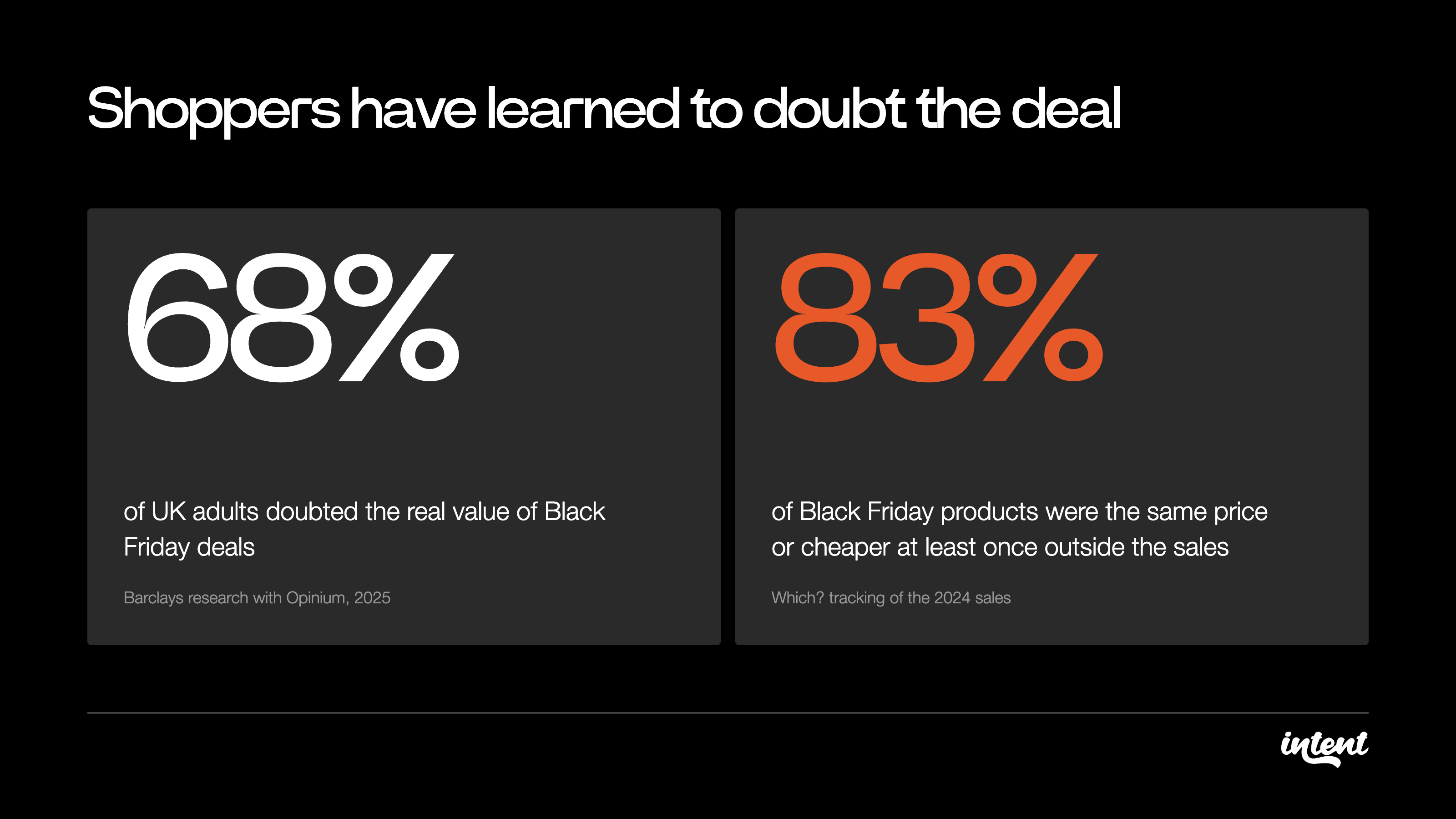
They’re also more sceptical. Barclays’ research with Opinium found 43% of UK adults were hunting for deals, up from 37% in 2024, while 68% doubted their real value.
So your Black Friday traffic is a mix of people who arrived for very different reasons. We don’t have a measured split for any one retailer, and yours will differ by category. But the types are recognisable to anyone who has watched a peak week unfold in their analytics:
These descriptions can help you understand your traffic, but they aren’t targeting rules. A loyal customer can still be undecided, and a comparison shopper may already be ready to buy. What someone does during the visit gives you more to work with than the label alone.
The margin maths of giving everyone the same offer
Here’s a hypothetical worked example. The numbers below are illustrative, so swap in your own.
Take an average order value of £120 before any additional code, with your headline Black Friday reduction already reflected in that price. Assume a 50% gross margin: £60 in product costs and £60 in gross profit per order. For simplicity, this example excludes VAT and other costs such as delivery and payment fees.
Add a 20% code for every visitor. The selling price drops to £96, but product costs stay at £60, leaving £36 in gross profit per order. The code takes 20% off the price and 40% off the gross profit.
To earn the same £60,000 of gross profit you made from 1,000 orders without the code, you now need 1,667 orders. That’s 67% more orders just to stand still.
In the middle row, a 30% lift in orders produces 4% more revenue, while gross profit falls 22%. Judged on orders or revenue alone, the promotion would look successful.
If 1,000 of those 1,300 orders would have happened without the extra code, you gave away £24 on each of them. That’s £24,000 in gross profit lost on existing demand, against £10,800 earned from 300 additional orders. In a real campaign, you would need a holdout group to estimate how many orders were additional.
The risk is particularly relevant during Black Friday, when some shoppers have already chosen what to buy and are waiting for the advertised offer.
What you can control when the headline offer is fixed
If your headline Black Friday offer is already in the ads, emails and price comparison feeds, keep it as the basis for these decisions. The question here is whether an additional incentive will improve the result once a shopper is on your site.
Review the offers and messages you add around that public price. These are some of the decisions worth testing:
New-customer codes, email-only codes and app-only prices already give retailers ways to set eligibility for additional offers. Make the terms clear, including how each offer works alongside the headline promotion.
Reviewing every visit by hand isn’t practical at peak. Broad segments such as new versus returning make the task manageable, but still group together shoppers with different needs. Intent’s Agentic Campaigns handle that layer. You set the goal, like revenue per visitor, and feed in the offers you already have. The agent decides who sees which offer, or nothing at all, in real time based on each visitor’s predicted intent. It doesn’t touch your sitewide price. That stays exactly where your trading team set it.
Planning your Black Friday marketing strategy by visitor
Most teams plan Black Friday as a calendar: a launch date, the peak day, Cyber Monday and last order date. Keeping the calendar makes sense. But add a second question to every stage of the golden quarter: who is shopping right now, and what do they need from you?
Shoppers ask whether it’s cheaper on Black Friday or Cyber Monday. For many retailers, it’s the same price on both, because the same promotion runs through the weekend. Often it isn’t cheaper than the rest of the year either. Which? tracked the 2024 sales and found that 83% of products on offer were cheaper or the same price at least once outside the Black Friday and Cyber Monday sales period. We're no longer surprised so many shoppers are sceptical about the deals.
In 2025, IMRG recorded Black Friday online revenue up 1.3% year on year, while Cyber Monday fell 3.2%. That was one year’s result across the market; it doesn’t establish what a deeper Monday discount would do for your business. Review the incremental sales and margin before assuming another reduction will pay for itself.
How to tell whether your Black Friday discount paid off
Your post-peak review needs to establish whether the offers paid for themselves. A discount can lift conversion without improving profitability, so conversion rate alone won’t answer that question. You need to account for what the additional orders earned and what the incentive cost across everyone who received it.
Diamonds Factory, part of Neve Jewels Group, saw this in a basket abandonment campaign outside Black Friday. A 25% code for every basket abandoner made conversions climb 11%. But average order value fell 6.7% over the same period, and once the discount depth was accounted for, the ‘win’ was worth barely £8k a month. As Jo Homer, Director of CX at Neve Jewels Group, put it: “We were basically training the customer to wait for a deal, which in return was affecting margin.”
When the team let the agent choose between 25% off, 15% off, a trust message or no intervention, it chose nothing for 52% of customers. Revenue per customer rose 13.8%, and the result was £1.6m in incremental annual revenue across three markets.
The team takes a different approach around Black Friday: it pauses the campaign to avoid adding discounts for shoppers already showing high purchase intent. For your own campaign, include no intervention among the responses you test.
For your own post-peak review, track these measures and compare them with a holdout:
- Revenue per visitor, which captures conversion and order value together, so a discount that lifts one by cutting the other shows up.
- Gross profit per visitor, which accounts for product costs as well as the reduced selling price. Include fulfilment and other variable costs too if you want to measure contribution profit per visitor.
- A holdout comparison. Keep a small, random group of visitors who don’t see a given incentive (like an exit code) and compare the two groups. Without one, you can’t separate the orders the offer created from the orders it merely discounted.
Before your next post-peak review
Where you’ve committed to a public headline offer, plan additional incentives around it. An exit code or abandonment discount needs to generate enough extra business to cover the margin given away to shoppers who would have bought anyway.
At this year’s post-peak review, ask for revenue per visitor and gross profit per visitor alongside conversion rates. Use the holdout comparison to estimate how many orders the extra incentive added. If you can’t answer that yet, build the comparison into your next campaign.

Become an Intent Insider
Get subscriber-only insights we don't publish anywhere else and event invites before anyone else.
By submitting this form you agree to our (more than fair) terms.