Most behavioural segmentation looks backwards. It sorts customers by what they bought, when they bought it and how often they come back, then hands those segments to the CRM team to fire emails.
That can work for email (though we’d argue there’s a better way, which you can read about here). It works far less well for whoever owns onsite revenue, because the behaviour that decides this visit is happening now, in this session, and most segments can’t see it.
We’ll cover the four classic types of behavioural segmentation, explore ecommerce examples and show why what happens during the current visit matters to onsite teams.
What is behavioural segmentation?
In ecommerce, behavioural segmentation is a way of grouping customers by their actions. Purchases, usage, timing, loyalty and the benefits people look for all count. Behavioural segmentation is one of the four classic segmentation types, alongside demographic, geographic and psychographic segmentation.
Marketers tend to rate it above demographics, and for a simple reason. Two 35-year-olds in Leeds can shop in completely different ways, so what they do tells you far more about what they’ll do next than their age or postcode.
A 2018 Stanford Social Innovation Review article by Sgaier, Engl and Kretschmer makes the same point about segmentation built on psychological and behavioural data, which “has been shown to be superior to demographic segmentation at creating distinct, meaningful segments.”
Behavioural vs psychographic segmentation
Psychographic segmentation groups people by why they buy: their values, attitudes, interests and lifestyle. Behavioural segmentation groups them by what they do. A psychographic segment might be “lifelong Disney devotees who see a park trip as a family tradition” (like our CEO David, who is at Disney as I write this). A behavioural one might be “has booked a Disney break every year for 5 years and buys merch before every trip” (again, David).
Psychographic data mostly comes from surveys and research, so it’s typically slower to collect and harder to act on at scale. Behavioural data comes from what people do on your site, in your app and in your inbox. This makes it much easier to analyse and act on it directly.
The two work well together. Essentially, behaviour tells you what is happening, and psychographics help explain why.
The 4 types of behavioural segmentation
The four types below each have their own variables and uses in ecommerce.
1. Purchase and usage behaviour
The variables here are purchase frequency, recency, average order value, categories bought and how heavily someone uses a product. A skincare brand might spot customers who reorder moisturiser every 6 weeks and time a replenishment email for week 5.
2. Occasion and timing
This covers seasonal events, life events, day of the week, time of day, and whether a purchase is routine or a one-off. A jewellery retailer might group everyone who bought in the 3 weeks before Valentine’s Day and bring them back for the same window next year.
3. Benefits sought
This is about what the customer values most, whether that’s price, speed, quality, convenience, sustainability, or something else. You measure it through the filters people use, the USPs they respond to and the products they choose. A furniture brand might notice a group that always filters by “in stock” and responds best to fast delivery messaging.
4. Loyalty and engagement
The variables are loyalty tier, repeat purchase rate, programme membership, email and app engagement, and reviews written. A fashion retailer might give its top tier early access to a sale.
These categories describe different aspects of behaviour, but they don’t tell you when that behaviour happened. A benefits-sought segment might draw on months of purchase history or the filters someone is using right now. The distinction that matters onsite is whether you’re using past actions or reading the current visit.
Historical vs in-session behaviour
Behavioural data comes in two kinds, and these two kinds answer different questions. Historical behaviour tells you what someone has done or who they’ve been. In-session behaviour tells you what they’re doing or about to do.
Historical behaviour can be the right input for CRM, lifecycle and merchandising. It tells you things like which lines to stock more and who has earned a loyalty reward. But as mentioned, it has limits even there, because even in email, past behaviour doesn’t mean present intent.
In-session behaviour is what answers the onsite question. Does this visitor need a nudge, some reassurance, a discount, or nothing at all? You have to make that call while they’re still on the page, and it depends on what they’re doing right now.
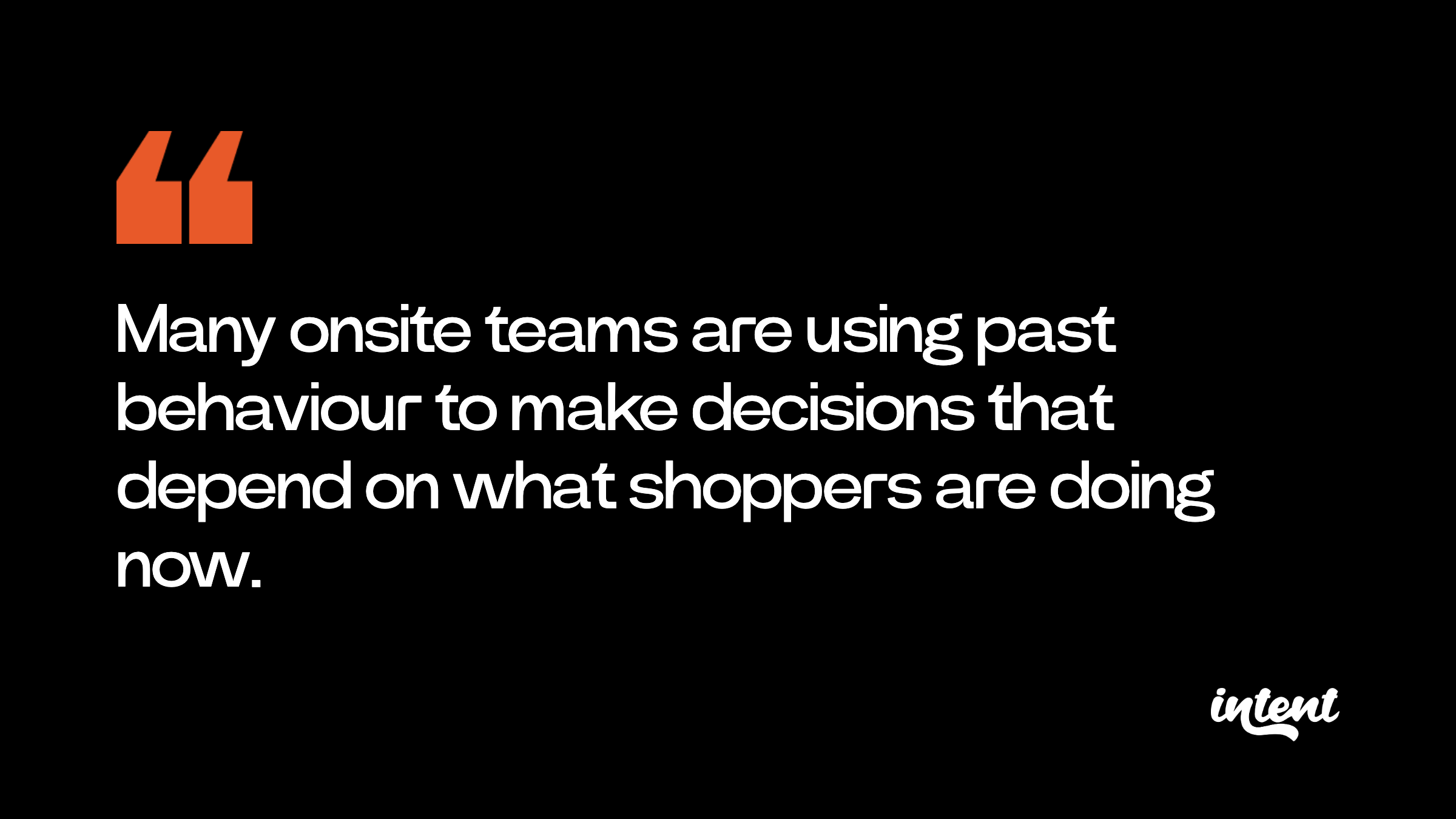
Many onsite teams are using past behaviour to make decisions that depend on what shoppers are doing now.
Why historical behaviour struggles onsite
- Most visitors arrive anonymous. Bluecore’s 2024 benchmark of more than 100 retailers found they identify only 15 to 27% of site visitors, “leaving up to 85% unknown” (MarTech). With no history, there’s nothing to segment on. Refreshing your segments every hour instead of every week doesn’t change that, because there’s still nothing to refresh.
- The same customer can make two very different visits. A loyal customer researching sofas on Tuesday and the same customer ready to buy on Saturday sit in exactly the same historical segment, because nothing in their history has changed.
- Segments harden into rules. A segment built on past behaviour turns into a rule like “show lapsed customers the 10% offer”. Then, someone has to maintain it. Multiply that by every tactic and every segment and you get the stale personalisation programme most ecommerce teams know well.
None of these arguments make historical data useless. When you know who someone is, their history adds context. It just can’t make the onsite decision on its own.
How much is your site leaving on the table? The gap between what visitors need and what they're shown has a price. Work out yours with the Intent Gap Calculator.
Behavioural segmentation examples in ecommerce
The table mixes both kinds of behaviour. The in-session rows are the ones most onsite teams don’t act on yet.
Nike is a familiar historical example. According to The Decision Lab, Nike uses the miles logged in its running app to send runners a reminder or new shoe recommendations as they near a shoe’s limit. It works well, and it all happens after the run, away from the site.
The in-session rows are where onsite revenue moves. For example, Cotswold Outdoor showed a “fits small, try a size up” tip, based on reviews, only to high-intent visitors at the moment they picked a size. Returns on the targeted products fell by 83%. Jacamo surfaced an existing free returns message to shoppers whose behaviour said they were about to drop off. Without changing its returns policy or product page, it drove £2.2m in annual incremental revenue.
From behavioural proxies to behavioural predictions
If you run exit-intent pop-ups, time-on-page triggers or basket abandonment flows, you already react to in-session behaviour. Each of those fires on something the visitor did during this session. Each also fires the same response for everyone who triggers it.
That’s because a single behaviour is a proxy. “Viewed 3 products” or “spent 2 minutes on the page” stands in for the thing you really want to know, and proxies are noisy. Two minutes on a page might mean deep interest. Or it might mean someone went to put the kettle on and left the tab open. The same trap shows up in affinity, where “most viewed” and “last viewed” get treated as interest, when engagement isn’t the same as affinity.
A prediction reads hundreds of signals together and estimates what this visitor is likely to do next. That’s the idea behind segmenting by buying stage and state. Visitors move through five stages, from browsing and refining to evaluating, deciding and committing. At any stage they can be focused, struggling or about to abandon. The useful segment here is the combination. A struggling evaluator needs something quite different from a focused one.
Hand-writing rules for every combination of stage, state and tactic becomes difficult to maintain as a programme grows. That’s the job Intent does. Our Agentic Decisioning Engine reads 800+ in-session behavioural signals to predict each visitor’s intent, then decides which of your existing tactics each visitor sees, or whether to show them nothing at all. The model behind it is trained on 50bn+ ecommerce events across 100+ retailers. See how it works.
How to start segmenting on in-session behaviour
You don’t need to tear anything up to start. Most of the work is in looking at the tactics you already run, but with a different question in mind.
- Keep your historical segments. They still do the job they were built for.
- List every onsite tactic you run today, from pop-ups and social proof to delivery messaging, returns messaging, discounts and sizing guidance.
- For each tactic, write down which in-session state it’s for, and which it’s wrong for. A discount might rescue an abandoning basket and give margin away to a focused buyer who was going to convert anyway.
- Measure by revenue per visitor as well as conversion. A tactic that lifts conversion by handing out margin can still lose you money.
- Be realistic about building it. A handful of tag manager triggers gets you proxies. Reading hundreds of signals together for every visitor takes a model, and that’s hard to build in-house.
Choosing which behaviour to segment on
Behavioural segmentation is still one of the most useful ways to group customers. Historical behaviour provides valuable context for email, CRM and merchandising. Onsite, the decision is about what this visitor is likely to do next. Their history can add context, but understanding the current visit means reading what they’re doing in this session, while there’s still time to respond.
The most valuable behaviour you can segment on is the behaviour you can still act on.
See how Intent uses in-session behaviour to decide which of your existing tactics each visitor sees, and when to leave them to shop. Book a demo.

Become an Intent Insider
Get subscriber-only insights we don't publish anywhere else and event invites before anyone else.
By submitting this form you agree to our (more than fair) terms.