Intent is an agentic decision engine.
The decisions we make are experience delivery decisions. A mechanism that serves messages, components, experiences, content autonomously using agents, in accordance with the visitors context. That intent is at the absolute heart as to why those experiences are served there and then.
Some might call this personalisation. Right message at the right time for the right person. That wouldn’t be wrong, per se. It’s certainly an experience delivery system serving messaging at the right time for the right visitor. It just so happens to use the most personal attribute of all; intent. Predictive visitor context that determines the why, what, who, how and when.
That being said, we think our capabilities are unique and therefore non-comparable, which makes it difficult to place within the typical ecommerce stack itself. That’s changing month by month anyway, so there’s almost no such thing as “typical”.
Instead, think about the two core capabilities we offer:
- we give brands the ability to model intent continuously within page and session based on real-time behaviour and…
- then deliver experiences using an agent to where and when those experiences create the most impact.
At its lowest common denominator, this would sit in the experience layer part of the stack. More specifically, this is what’s known as a contextual bandit. A delivery mechanism that continuously learns which option works best for each visitor based on their context, balancing exploration with showing them the option most likely to succeed.
The outcome is what matters most: we are a platform designed to amplify the impact of your static, generic experiences, and turn them into dynamic, individual ones. Scalable personalisation, if you will. We’ll be the ones determining who gets what and when.
The four layers most ecommerce stacks have…today
Most ecommerce tech stacks have four layers (even though that’s changing rapidly).
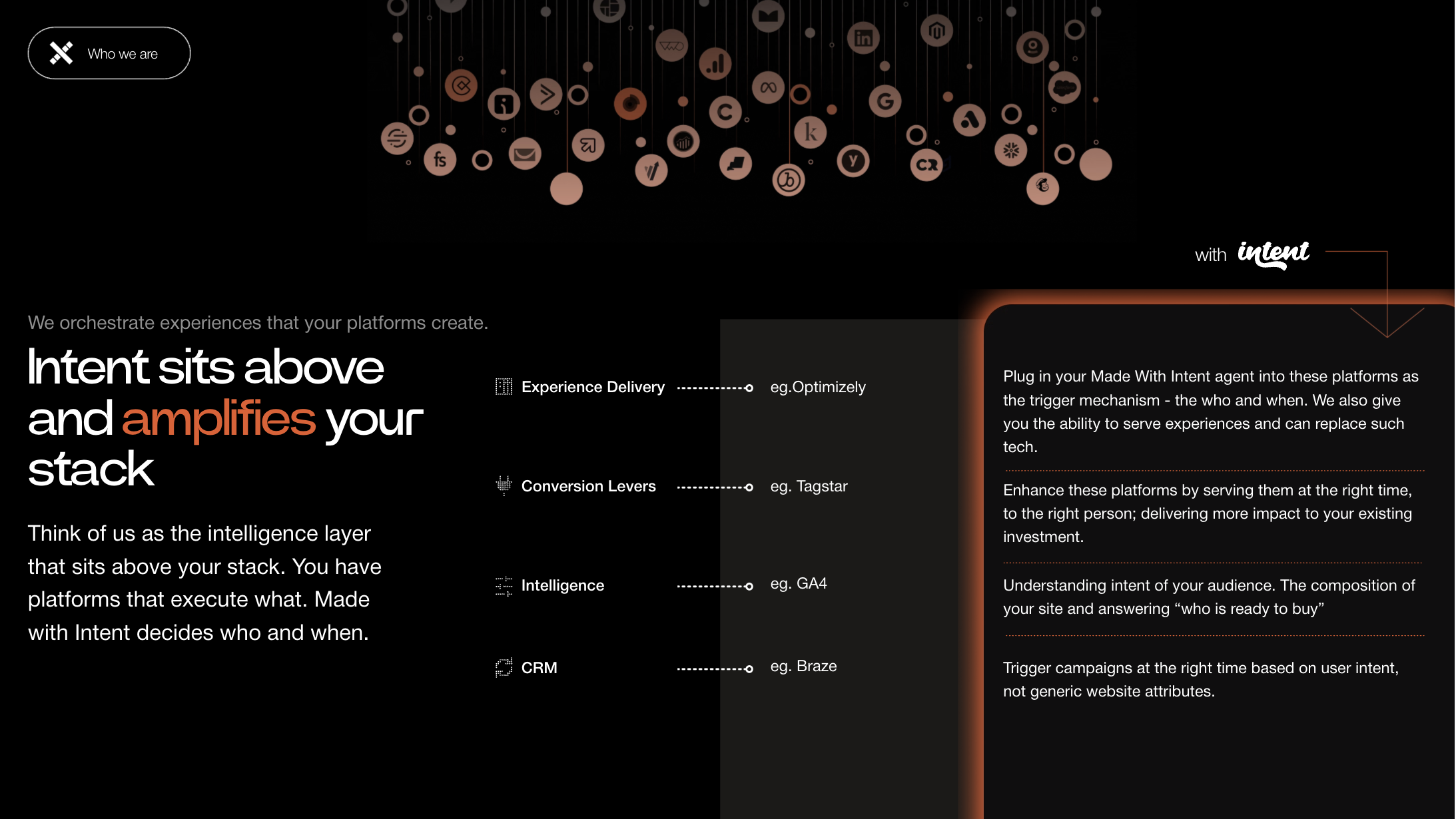
We sit above all four layers, between them and your site. Intent is the intelligence that sits above all the stack to get the most out of it.
Each layer decides what. What variant, what mechanic, what message, what send.
The thing sitting behind every one of them is a trigger, and the trigger is almost always static and generic. These are the two big problems that we fight against. Think of triggering on page load, or a rule someone wrote eight months ago, or a segment defined from historic website attributes. It’s the one variable in the entire stack that rarely gets analysed, despite being the one that determines relevancy.
Whether is the interesting one. It costs the most but gets asked the least. Does the user need to see that experience to convert? Is submission better than addition? In a world where our product pages are full to the brim, designed to give the user everything all of the time, how can the user have any level of focus?
Experience delivery
If we’re going to sit in any category, it’s here. Intent is primarily an experience delivery workflow. We aim to deliver more impactful site experiences.
We use the phrase agentic decision engine a) because it is and b) because it’s not just what experience but how that experience is served: the timing and the individual. The decision around the experience is sometimes more important than the experience itself. We commonly refer to this as the who, when and whether.
We sit alongside, sometimes replacing, your experimentation platform, like Optimizely, VWO, Wingify, Convert. And less commonly your personalisation engine if you have one. These are places where your hypotheses get tested. They support the process of split testing by determining whether a single change works, and what the winning version looks like for a specific snapshot in time across the average visitor.
Intent is fundamentally for a different purpose. Unlike us, these platforms don’t decide which visitor should see it, or at what point in their session. We work against the average to amplify the impact of experiences at points in time. The snappy version: experimentation answers does this work. Intent answers for whom, when, and whether they need it at all.
- Where your experimentation platform is built to find one answer for everybody, because that’s what statistical rigour is for. Call it 80% exploration, 20% exploitation.
- A personalisation engine varies that answer across segments you defined in advance, from attributes that were true about someone last Tuesday. Not scalable, often rules-based.
- Intent flips the experimentation ratio. 20% exploration, but 80% exploitation. It takes an answer or tactic you’ve already proven and works out who it’s actually for, at which moment, and who’s better off never seeing it.
That plays out in one of three ways, depending on what you already run.
- Enhance. Everything stays. Intent gets smarter about the trigger, so the experiences you’ve already built reach the people they were built for.
- Substitute. Intent takes over from the testing tool where the allocation matters more than the causal claim. Most commonly on tactics you proved years ago and have been firing flat ever since.
- Combine. Intent becomes the single brain across several experience tools, so they stop competing with each other for the same attention and the same real estate.
Conversion levers
Intent is designed for commercial gain. Where some might call experimentation “exploration”, Intent would largely be about “exploitation”. In other words, we are the amplification of what already works.
There are known conversion tactics on your site often operated by off-the-shelf, one point solutions doing one job each. Social proof provider, email capture provider, review widgets provider, sizing provider, basket recovery provider. Individual mechanics designed for everyone, but built with one job in mind.
These levers rarely answer who needs them. Most of these fire on page load, for everyone, often competing with each other for the same attention and the same real estate. A free shipping message is far more powerful served to someone with a specific level of intent (e.g., high intent, ready to buy, needs a nudge) than it is sitting permanently in a banner nobody reads. Focus creates impact.
Intent acts as a trigger mechanism above these tactics, sometimes replacing them altogether, to get the most out of the conversion levers. As a result, we’ve sometimes been called “dynamic conversion levers” (again, a move away from the static and generic).
Intelligence
Intent is designed to be additional to your intelligence stack, sitting above it, passing intent data into these platforms for enhanced analysis.
Your intelligence stack consists of behaviour analysis, journey flows, and quantitative funnels, often based on click events or page view analysis. These often sit within GA4, Contentsquare, Amplitude, Quantum Metric, or your BI stack. They are places where you go to find out what happened.
That’s the point. They are retrospective, reporting on the average based on website behaviour. They tell you how many people left your category pages without viewing a product, and they tell you a week on Tuesday.
Intent data is the opposite of those three components.
- It’s predictive in the session and retrospective after it. While someone is on site, every inference is forward-looking: what is this visitor likely to do next, scored continuously as they move rather than at page load. That’s the prediction that drives the decision in the moment. When the session closes, we condense the visit into a Session Summary, which is retrospective by definition, and that’s the version that flows into your CRM and BI tools. So we do both. Analytics only ever gives you the second kind.
- The unit is the visitor, not the visit. Every prediction is made about one person at one moment. You can aggregate those predictions afterwards, and you will, because that’s how anyone reports on anything. But the aggregation is something you do to the data, not something baked into it. Analytics works the other way round, aggregating first, so there’s no individual left to go back to.
- They look at genuine behaviour, not website attributes. “Visited PDP” is a page, not a person. Our own research puts 72% of visitors on a product page as still discovering rather than evaluating, while 27% of visitors on a listing page are already considering a product. Put the two views side by side and the gap gets embarrassing: we see 26% of visitors start building intent, you see 56% visit a PDP. Same traffic, different question.
Intent data, like users who hold high intent, who are ready to buy, who are likely to abandon, are compositional data points designed to enrich the type of audience your site is attracting. Of course, this can be broken up too: how did your experiment perform for low intent vs high intent users? What % of users from your paid media channel are in a ready to buy state? Of those who add an item to their basket, how many are actually likely to continue to purchase vs wishlisting?
CRM and lifecycle
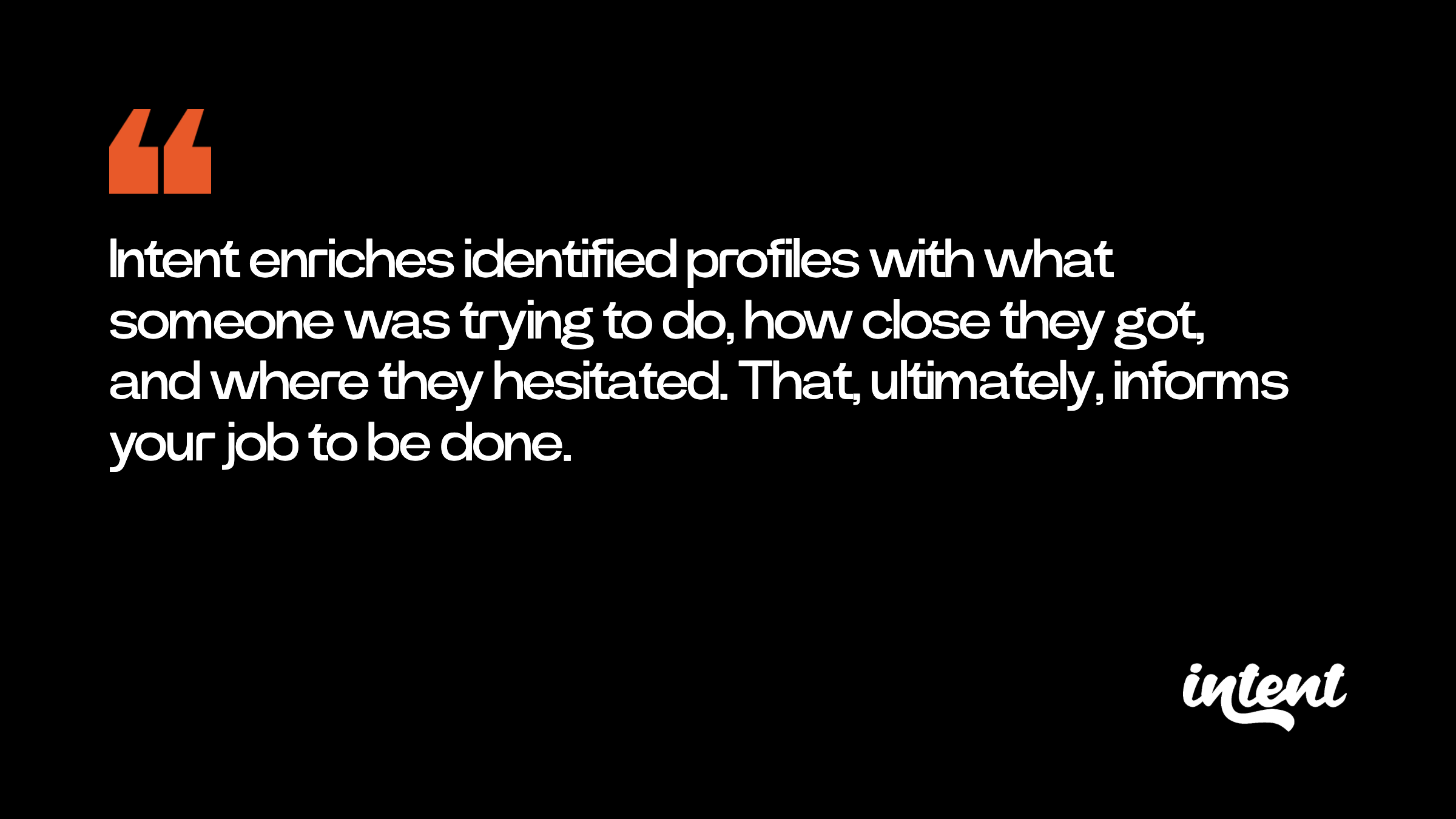
Intent enriches identified profiles with what someone was trying to do, how close they got, and where they hesitated. Think of this as “what was their state of mind when they left”. That, ultimately, informs your job to be done.
These platforms (like Braze, Klaviyo, Emarsys, Bloomreach) decide what to send and to which list. What they can’t decide is what happens when that person lands back on your site, or what state of mind they were in when they left it. Your ESP holds a rich picture of purchase history, email behaviour and sometimes site behaviour. But it’s not context about them. It’s all inferred.
We call these Session Summaries. When a session closes we condense the behavioural and intent signals of that visit into a single structured event and push it into the profile: final intent stage, purchase confidence and which direction it was moving, likelihood to return, shopper mindset, and the affinities they built while they were there. Product category, price point, the specific products.
What that means it that it turns a generic lifecycle campaign into a decision:
- Does this person need a discount at all, or were they one reassurance away from buying?
- If they do, how much, given how close they already were?
- Is there better content than the one we always send?
- Do we need to send anything?
It also separates people who look identical in your ESP. Two visitors both abandoned a basket, but one had high purchase confidence where the other never left the discovery stage. Behaviourally, they’re the same row in a segment, but enrich them with intent and you see they need opposite things.
Placing Intent against adjacent categories
Intent gets used loosely as a word, which is a shame (we think we invented it sometimes!). It’s not a feature or a propensity model within a platform, but it should be the very foundation of understanding human behaviour. It’s what intuition is built on. It’s how we remain relevant with our messaging. It’s the most personal (and human) attribute of personalisation.
The primary constituent parts of why you should consider Intent as your agentic decision engine are the combination of the intent modelling, mixed with the experience delivery (agentic decision engine). In four reasons:
- a. the level of depth of that intent analysis is best in class
b. our intent predictions are continuous and (really) real-time, continuously scored every few seconds - a. experiences are delivered autonomously via an agent, no human intervention is required in the delivery
b. experiences are for the individual, comprising hundreds of use cases
Despite that, there are several adjacent categories that look similar from a distance despite the above clarification of where we sit within a stack. We’d recommend asking two questions that can help here:
- Intent: How deep and how real time is your intelligence?
- Some intelligence is deep, but retrospective (e.g., most analytics platforms)
- Some intelligence is shallow, but real-time (e.g., predictive, often on identified users only (not anonymous))
- Experience Delivery: How much scope and autonomy does the delivery have?
- Some experiences are limited in their scope (e.g., one mechanism or tactic)
- Some experiences are limited in their autonomy (e.g., manually created content)
This outputs into a 2x2 axis focussing on these as core attributes for selection.
- Bottom left is where most experimentation and personalisation platforms sit. Generic, static experiences. High effort, low reach.
- Bottom right is the newer crowd, cheap to run and shallow by design.
- Top left is real intelligence pointed at a narrow channel, which is why your ESP knows more about a visitor than your website does.
- We sit in the top right
The short version
We think most people asking the question of “where does it sit” are actually asking a slightly different question: “what comes out to make room?”
The answer is nothing, really.
Also, given the uniqueness of what we do, no-one owns this layer. We’re not suggesting this is additive, nor is it substitutional. But because it’s new, it’s completely complementary, sitting above your stack acting as both the intelligent context that runs it, and autonomously making decisions for commercial impact.
If there’s any place that helps you with budgeting, we’d put it in the experience delivery stack. Given our agentic decision engine decides who, when, or whether (and sometimes the what), it’s not uncommon to call this personalisation despite the term itself being bastardised over the years.
If you want to learn how your tech stack could benefit from Intent, book a demo and we'll walk through it against your tools.

Become an Intent Insider
Get subscriber-only insights we don't publish anywhere else and event invites before anyone else.
By submitting this form you agree to our (more than fair) terms.