Comparisons

Made With Intent is an on-site intent engine for eCommerce businesses. It reads buying intent in real time and decides which experiences go to which visitors, and when.
Dynamic Yield is an experience optimization and personalization platform. It helps businesses tailor digital customer journeys across websites, mobile apps, and email.
This post explains where the two platforms work together, and where you'd still use Dynamic Yield instead.
If you can't wait until the end, here's a TLDR;
Pick Dynamic Yield if:
• Your priority is consistent personalisation across web, mobile app, email, and in-store kiosk
• You've got the team and budget to do a weeks long enterprise deployment
• Recommendation capabilities matters more than first-page view intent coverage.
Made With Intent is for you if:
• You want to read buying intent in real-time
◦ Then, serve the right content, the right experience at the appropriate moment
• Want to benefit from a 30-60 minute install time
And when we're thinking about Made With Intent and Dynamic Yield working together, here's how we recommend thinking about it:
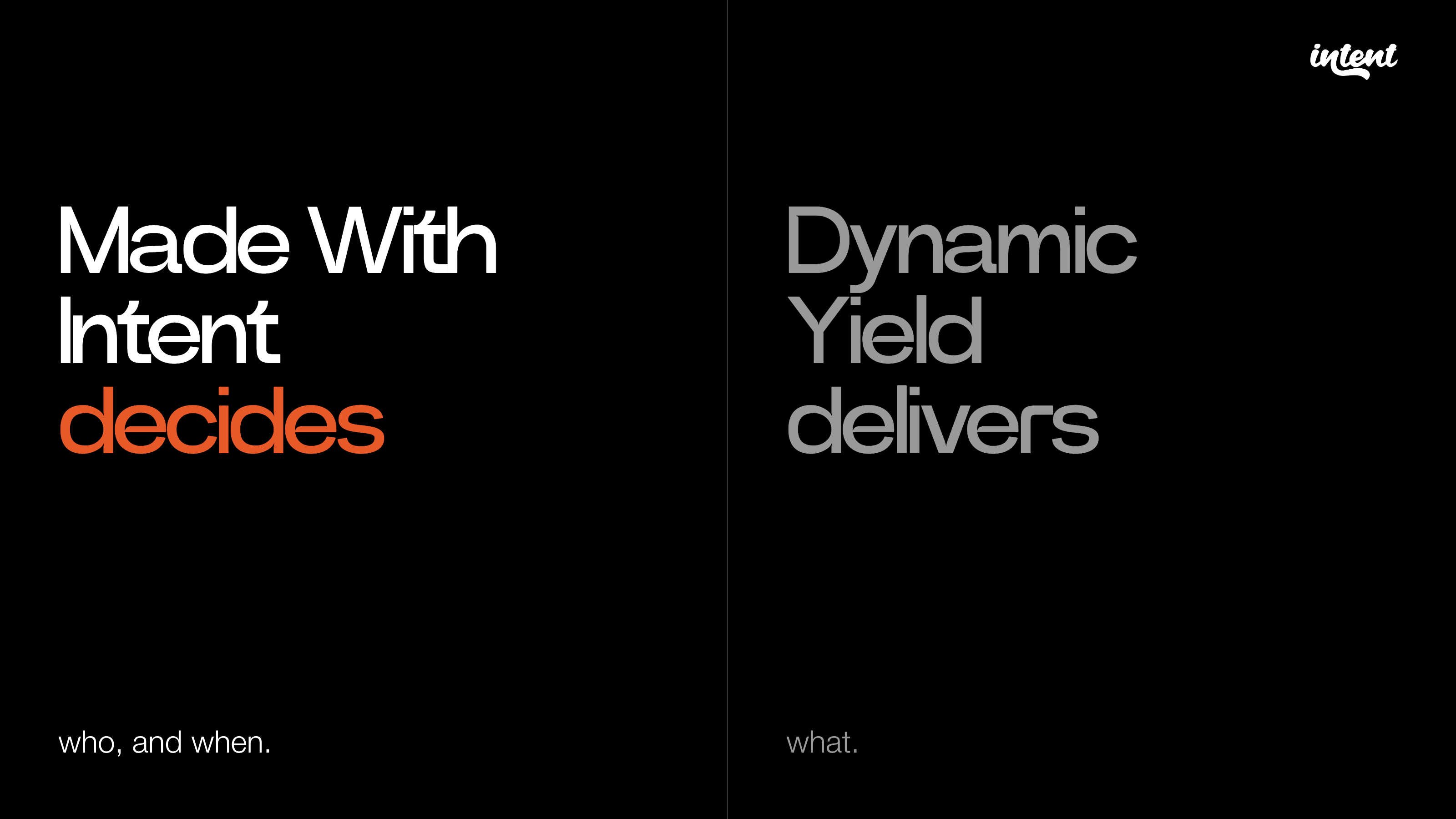
Made With Intent decides what experiences you should serve, to who and when, and Dynamic Yield delivers those experiences.
How Made With Intent is different to Dynamic Yield
There's three things that Made With Intent does different to Dynamic Yield. Let's dig into them below:
1. Made With Intent reads intent in real time
Dynamic Yield's intent workflow utilises two routes. First, Empathic Personalization classifies visitors into four inferred states, which are Curious, Interested, Focused and Satisfied.
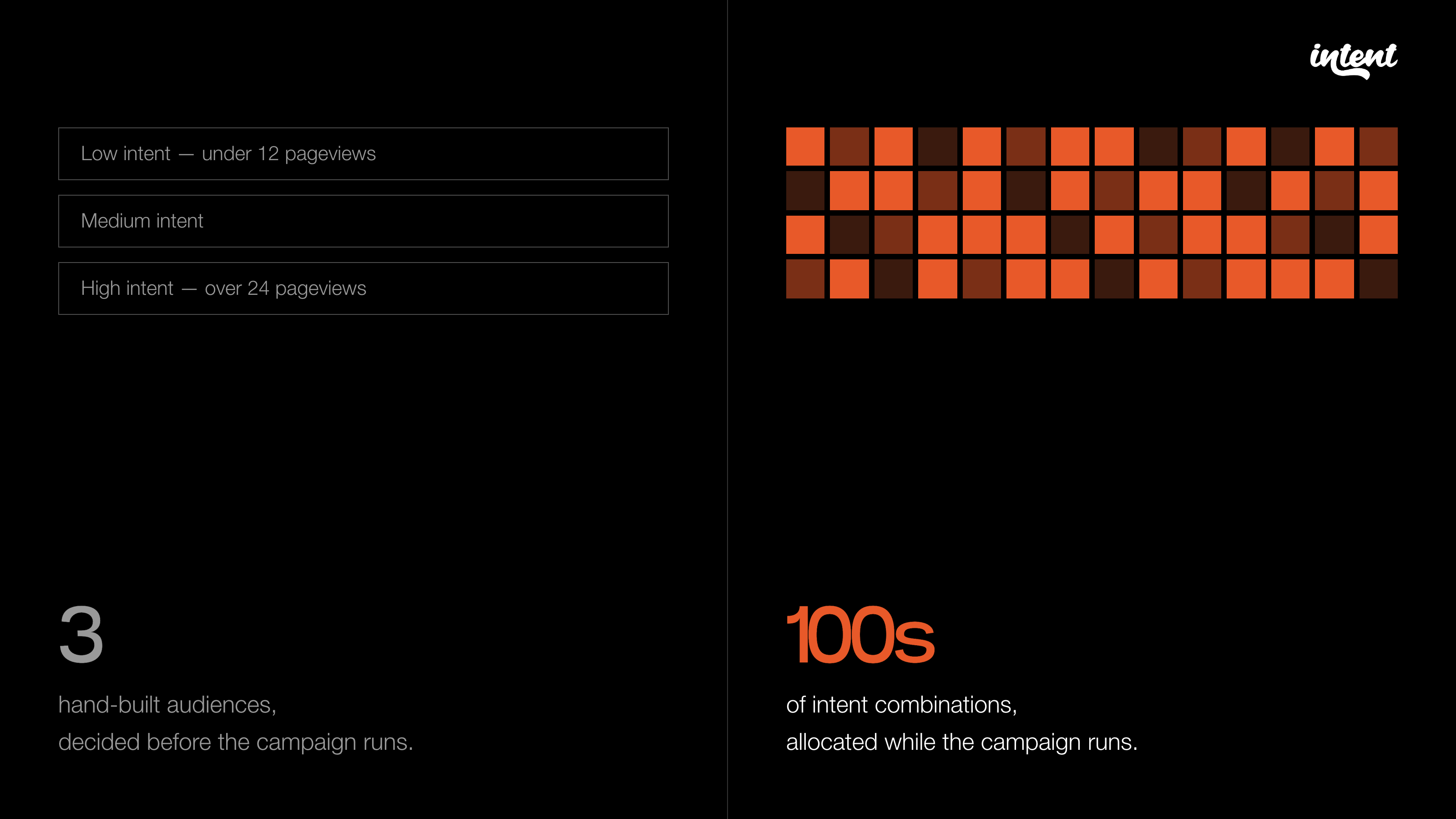
Its Audience Hub lets teams hand-build "low / medium / high intent" audiences from rules. Dynamic Yield's Primary Audiences framework shows a leading golf retailer defining low intent as fewer than 12 page views per session and high intent as more than 24.
That's a useful starting estimate, but page views aren't intent. A hesitant shopper racks up more pages than a decisive one. A high-intent visitor often converts inside three.
The more common version isn't pageview counts — it's event proxies. Add to cart equals high intent. Wishlist equals consideration. But an add to cart is as often a price check, a size comparison or a shipping-cost probe as it is a purchase signal. The event tells you what happened. It doesn't tell you what it meant.
Now, this is pretty fundamental: Dynamic Yield's model relies on behaviours your shoppers have already exhibited. It's a snapshot backwards in time, and like many what we call "rules-based" personalisation tools, you're reacting to things that have already have happened. Unlike Made With Intent.
Made With Intent reads buying intent directly — multi-dimensional, second-by-second signals predicting where the visitor is in their decision right now.
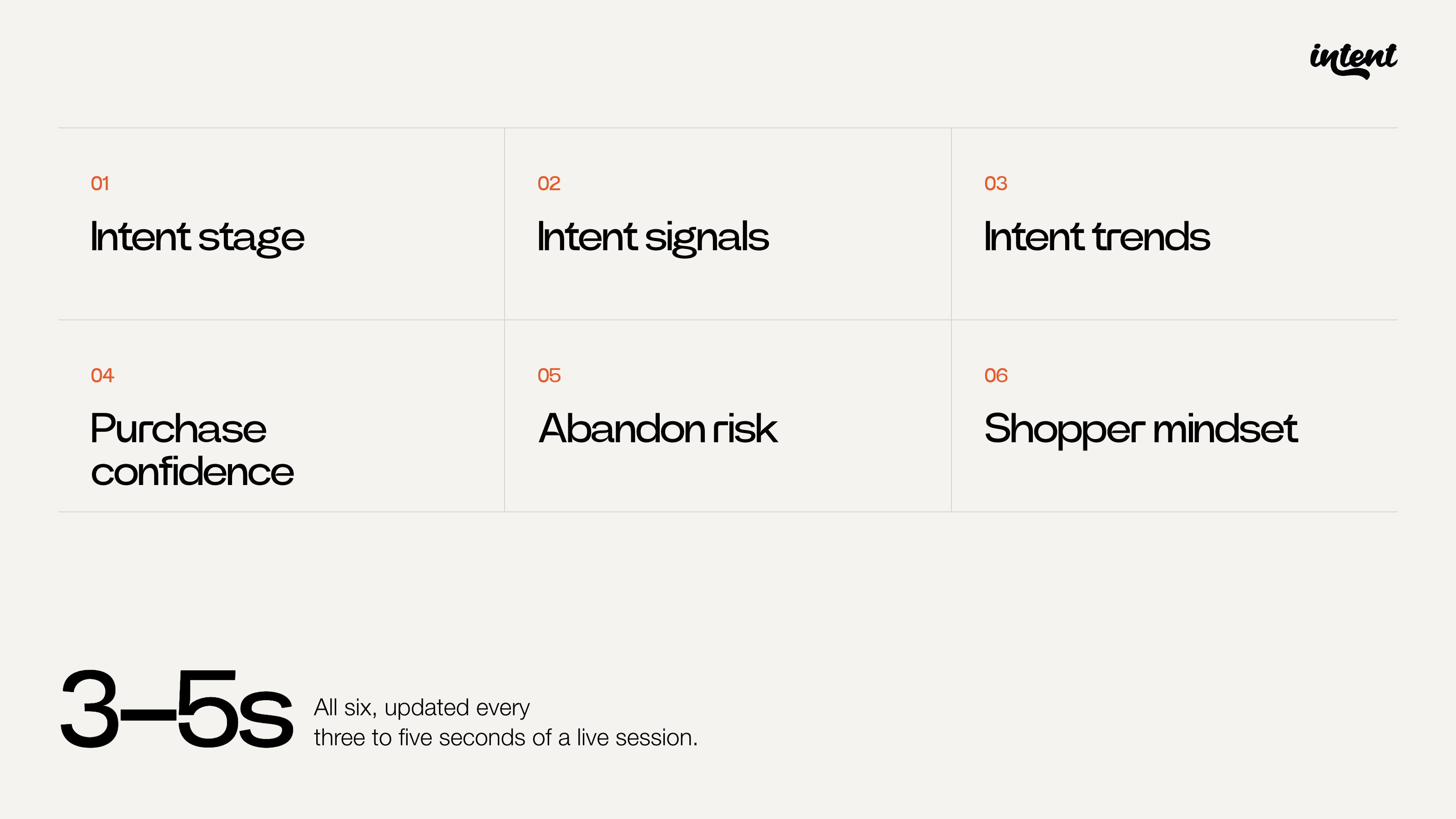
We break downs shopper behaviour into six stages, and these are: Intent stage. Intent signals. Intent trends. Purchase confidence. Abandon risk. Shopper mindset.
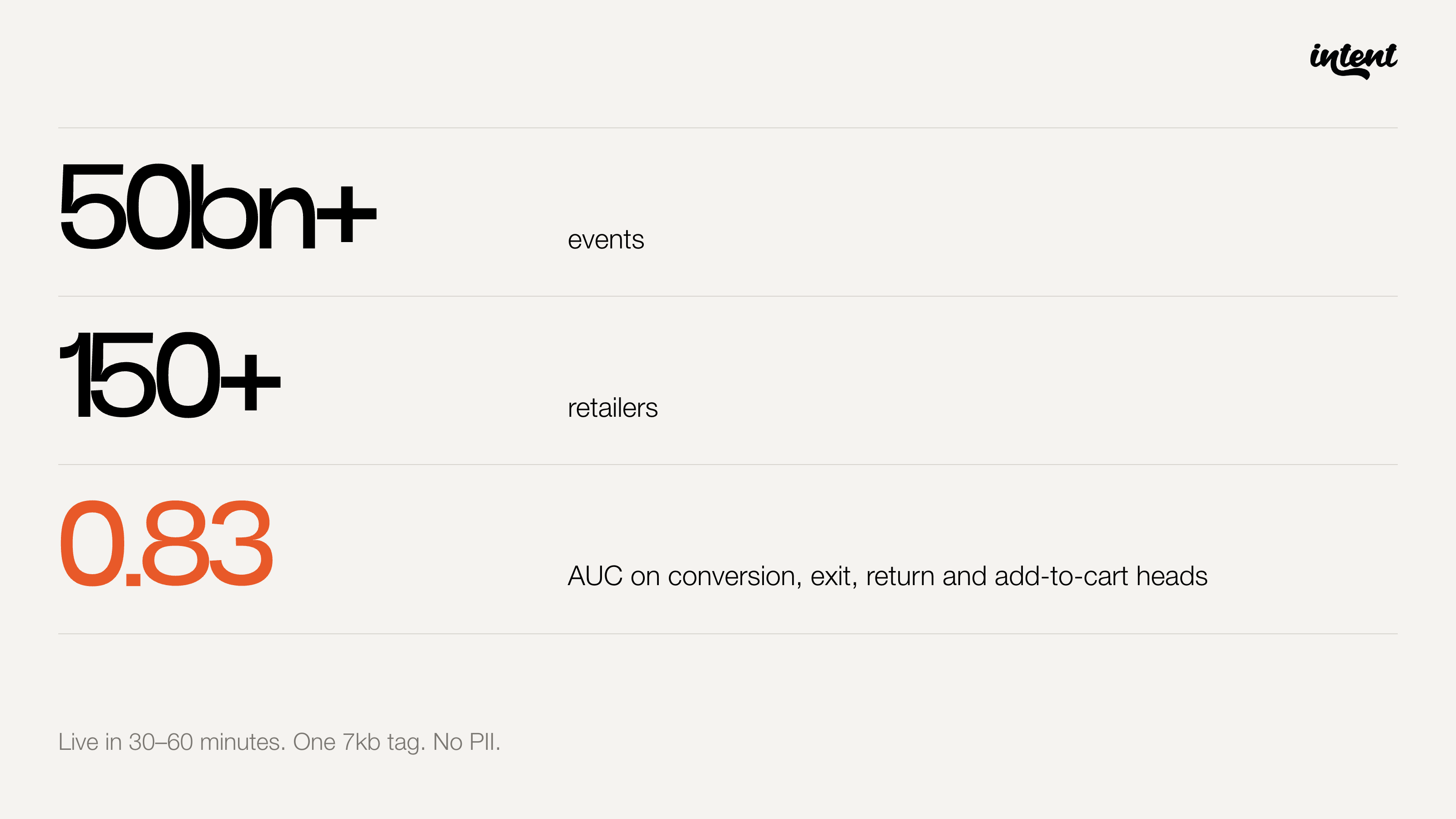
All updated every three–five seconds during a live session, on a model trained across 150+ retailers and 50 billion+ events.
2. Allocation across hundreds of intent combinations and not post-test segmentation
It takes eCommerce teams considerable time to build and maintain audience rules in Dynamic Yield. For instance, coding things such as "low intent equals fewer than 12 page views, high intent equals more than 24," then QA-ing those cohorts and redesigning them after each test.
Made With Intent replaces that with continuous intent prediction and delivery. The model decides who sees what, in real time, across hundreds of intent combinations. The actual grunt work is handled by our agent. Your team focuses on strategy, creative, and proof.
Our agent retrains daily, so the experience keeps allocating toward the intent combinations where impact is actually felt. Always on, always learning, always improving on where it started.
3. First-pageview coverage — no fallback needed
Behavioural data takes time to accrue; for anonymous or first-time visitors, Dynamic Yield falls back to geo-based predictive targeting and contextual signals.
Made With Intent has no fallback by design. It doesn't need one. We've trained it across 50bn+ events, in a range of contexts, giving the model day-one predictive power on every visitor, anonymous, identified, first-time, returning.
Made With Intent and Dynamic Yield: In depth
There are lots of areas of cross-over between Made With Intent and Dynamic Yield. The way our technologies work is similar in principle, but different in its practical implementation.
Let's start first with how Dynamic Yield's prediction capabilities work:
How Dynamic Yield's prediction works
While we're talking about AdaptML, we have to say, it's a really sophisticated bit of engineering. It utilises recurrent neural networks and NLP models to get smarter and smarter as it consume more data its got on a specific retailer's visitors.
However, it predicts what you'd expect (affinity and relevance), not what's happening in a visitor's decision right now.
Our model is a driven by a single purpose: it reads buying intent. Sure, it's a narrower job, but it's the one that determines whether a visitor converts, hesitates, or leaves.
Made With Intent vs Dynamic Yield
When you should pick Dynamic Yield
Hey, we're not here to blindly sell you Made With Intent. Sometimes, our tool just isn't right for your business. So, unlike loads of other SaaS vendors, let us tell you when we wouldn't be a good fit:
• If you're trying to do cross-channel, Dynamic Yield is the right choice versus Made With Intent. We're web-first, and for multi-channel personalisation programmes Dynamic Yield is the right option.
• Recommendations: NextML and AffinityML are purpose built models for product and content recommendations. Made With Intent adds an intent decison later but it is not a replacement for NextML or AffinityML.
• Sophisticated email personalisation: Klaviyo-grade dynamic content across email and ad placements out of the box. If email is a key part of what you do, Dynamic Yield is a top choice.
• Security of a big vendor: Dynamic Yield is an eight-time Gartner Magic Quadrant Leader for personalisation engines. If you're enterprise org and need to run a formal RFP, this helps your procurement team make a decision.
• Strong experience builder. Sections, Page Contexts, and Selectors give users very fine control. But only after you've climbed the initial learning curve.
Where Made With Intent wins
Of course, this is an article designed to help you pick between Dynamic Yield and Made With Intent. From our table above, it's clear there's plenty of areas of overlap, but there's some stuff we do that, we don't mind saying, makes us a better choice. Have a read:
• Acts on the anonymous majority: Every visitor gets a multi-dimensional intent read from the first pageview. No prior data, no behavioural accrual, no geo fallback.
• Multi-dimensional intent prediction: The way we predict intent is comprehensive. We use six measures: stage, signals, trends, purchase confidence, abandon risk and shopper mindset. These are all updated every three-five seconds, unlike Dynamic Yield.
• Autonomously runs campaigns and makes decisions under directives: Agentic Campaigns can dynamically allocate experiences across hundreds of intent combinations during a campaign you'll run. Dynamic Yields's models are sophisticated. The targeting layer above them is still rule-driven. That's simply how the tool is built. But it means what experiences are served is decided before the campaign runs, and not during it.
• Cross-merchant model: 50 billion+ events across 150+ retailers. Day-one predictive power for our customers.
• Start within 30 minutes: Single 7kb GTM tag, no PII and we're ISO 27001 accredited.
So, it's time to make a decision: Let's pick one. Or both?
It's crunch time. We've given you all the facts, but it's time to wrap up and make a judgment call.
Pick Dynamic Yield if the you want consistent cross-channel personalisation — content and recommendations spanning web, mobile app, email, and kiosk. And if you have the technical resources to operate it.
Dynamic Yield's breadth and recommendation algorithm depth is class-leading, and trying to replicate the scale of that capability with Made With intent, plus some integrations would be a worse outcome for you.
Choose Made With Intent if you want a on-site decisioning, intent-driven experiences, and proven incrementality. Our tool delivers experiences natively, allocates them dynamically across hundreds of intent combinations, and proves causal lift on every one.
Now, something to think about. If you're an enterprise customer, you actually could consider both. And here's why:
• Dynamic Yield gives you the breadth and means of channels and mediums to serve personalised content to
• Made With Intent helps you accurately decide who, and when that content should be served
That's brought us to the end of the comparison blog post. If you're still unsure of the differences between Dynamic Yield and Made With Intent, the best thing for you to do is talk with one of our team.
You can book a demo here.
Disclaimer: This comparison is based on publicly available information from Dynamic Yield's documentation, marketing site, and customer reviews as of April 2026. Both products evolve continuously. If anything looks out of date, get in touch and we'll sort it.
Made With Intent is an on-site decision engine for eCommerce businesses. It reads people's buying intent in real time and allocates experiences to the visitors most likely to respond to them
Optimizely is a digital experience platform. It does web and feature experimentation, rule-based personalisation, content recommendations. It's designed for teams running structured test-and-learn programmes at scale.
This blog post explains where the two platforms complement each other and when you would use both versus just one on its own. But if you're too impatient to read to the end, we've got you:
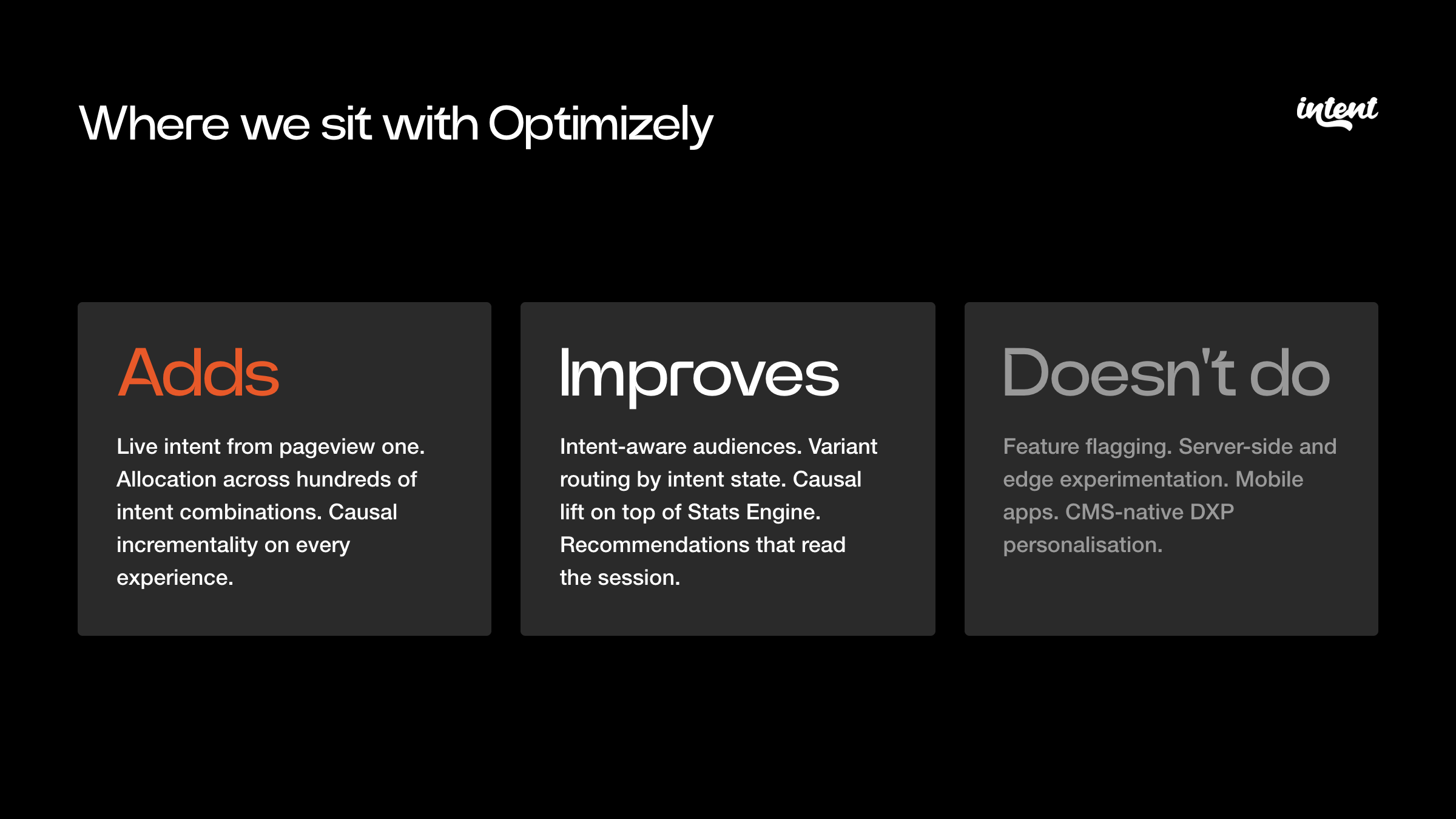
Made With Intent and Optimizely serve different functions. Optimizely handles experimentation and rule-based personalisation.
Made With Intent reads visitor intent in real time and decides who sees an experience and when. The two work really well together:
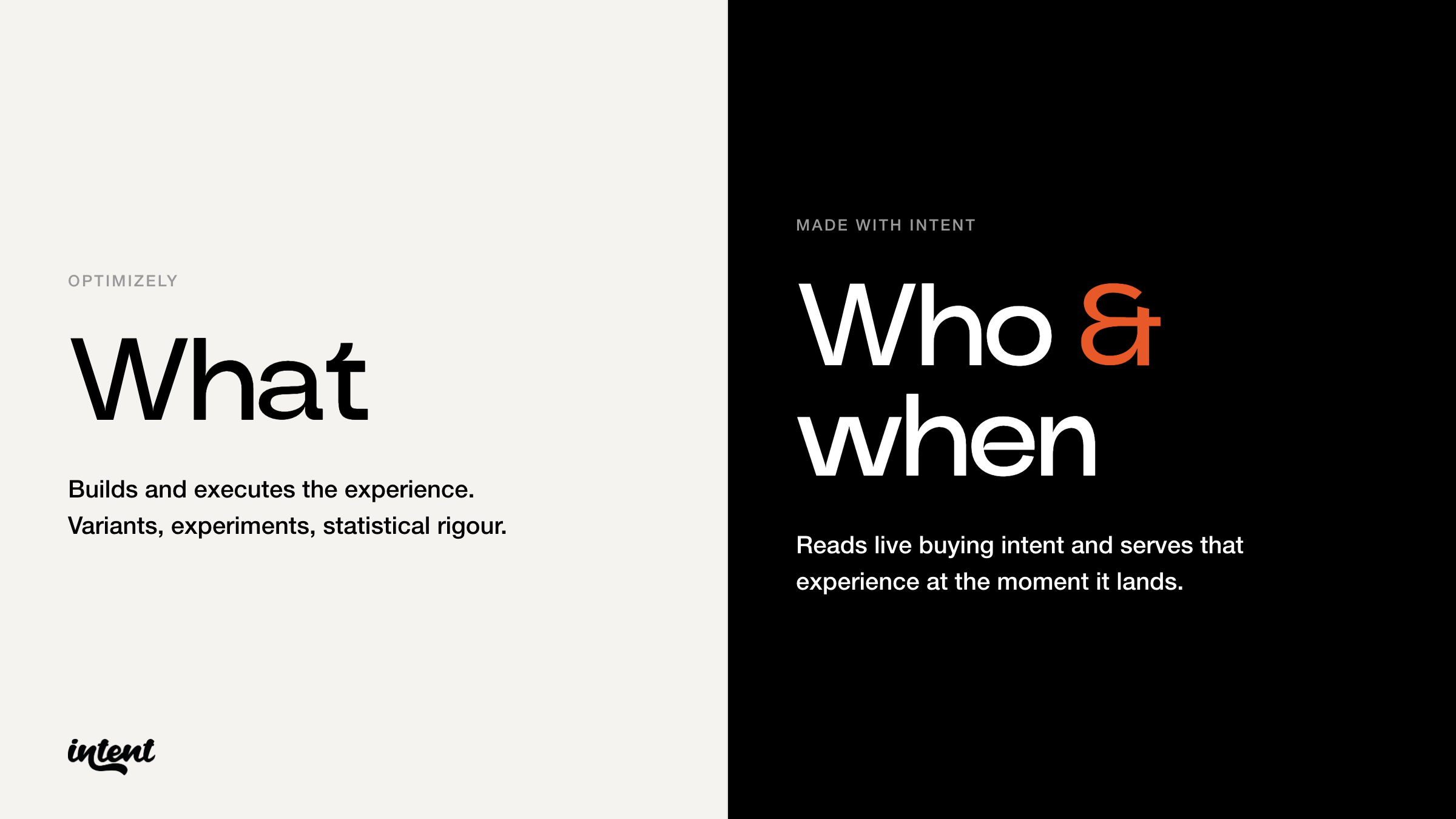
Optimizely executes what, Made with Intent decides who and when. We serve your Optimizely experiences when it matters (the right time within their session) and to whom, all based on what really matters; their intent.
How Made With Intent is different to Optimizely
1. Respond to users in real-time with experiences tailored to what their digital body language tells you
Optimizely's strongest targeting comes from rule-based audiences in Web Experimentation and Personalization, boolean logic on geo, device, behavioural events, URL targeting, and page Tags, plus optional machine learning (ML) layers:
- Adaptive Audiences (interest categories inferred from content engagement)
- Content Recommendations (NLP-driven topic affinity per visitor)
- Optimizely Data Platform (ODP) real-time audiences
The Stats Engine inside experiments is genuinely best-in-class — sequential testing with always-valid p-values — but the targeting decision still asks the marketer to define which audience rule a visitor fits into.
Made With Intent flips the model. It reads buying intent in real-time from the first pageview. Stage, signals, trends, purchase confidence, abandon risk, shopper mindset, and re-scores every three-five seconds.
Targeting is driven by what's happening now, in real-time, by a human, not by which rule-defined audience or topic interest a visitor has been mapped into. Nor by behaviour that's already happened. This means you can respond to the signals that sit between events and pageviews; what we call moments that matter.
You can read more about How Made With Intent Works, and the moments that matter, by clicking the link.
2. Segment the right experience to your customers automatically, without fiddling with rule trees manually
Your team currently builds and maintains audiences in Optimizely's Audience Builder, Dynamic Customer Profiles, Adaptive Audiences, and ODP. All with decision rule trees, content-tagging taxonomies, attribute conditions, event conditions.
Even with contextual bandits reallocating traffic within a defined audience, the audience definition itself stays manual: design the rules, QA the segments, redesign as the catalogue and content evolve. These segments are website-attributes, too. Not human attributes, not intent based (the most human of all attributes). That's where personalisation really succeeds.
Made With Intent replaces all of the above with continuous intent prediction and delivery.
Our agent decides who sees what, in real time, across hundreds of intent combinations. You'll focus on strategy, creative and proof, instead of tweaking and analysing rules or segments all the time.
The agent retrains daily, which means the experience compounds toward intent combinations where impact is seen and felt. In an always on state, always learning, always getting better.
Where Optimizely's multi-armed bandits (if used) allocate traffic across the variants of a single experiment to maximise one fixed metric within one defined audience, Made With Intent allocates across hundreds of audiences (intent combinations) — adding the layer of to whom and when an experience should be served, and measuring it against a holdback rather than just exploiting the winner.
Made With Intent and Optimizely: In depth
Here is how the two platforms compare on the things that matter most for eCommerce teams:
Where does Made With Intent integrate with Optimizely?
We've broken this section down into three parts. We want to be honest about where you'll gain functionality by utilising Made With Intent with Optimizely, where we augment it, and things we simply don't do, or Optimizely does better.
How Made With Intent adds new functionality to Optimizely
Understand and act on every visitor (including anonymous) from the first pageview. Optimizely's Personalization is rule-driven. It works once a visitor matches an audience rule. Content Recommendations builds a per-visitor interest profile from content engagement, which strengthens as the session progresses.
Made With Intent's model, which collates 50bn+ monthly events across 150+ retailers, reads continuous intent from pageview one, every few seconds. Anonymous, identified, first-time, returning. The opening moments of a session get the same intent read as the tenth pageview.
Automatically identify and serve the best experiences to people without guessing. Optimizely's contextual multi-armed bandit (CMAB, powered by Opal) is the closest thing in their stack, and it's genuinely good, so it's worth being precise about what it does.
A CMAB picks the best-performing variation for each visitor based on context (device, geo, behavioural history) to maximise one primary metric, within a single experiment.
Three design choices define it: the context attributes are declared up front and can't be added or removed once it starts (even paused); it optimises exclusively to a single primary metric fixed at launch; and it begins with a 100% exploration phase, randomly serving variations until it has gathered enough data before it shifts to exploiting the winner.
It's a smarter way to split traffic across the variations you built for the audience you defined.
But we'd like to go into detail on what that context is.
Device, geo and behavioural history are proxies for a person. They describe who a visitor appears to be, not what they want or how close they are to buying. They're arbitrary website attributes that correlate with conversion only loosely, and a bandit optimising over them is tuning against a weak signal.
Intent — buying stage, momentum, hesitation, purchase confidence — is the proximate driver of what a visitor actually does next. The proxies describe identity; intent describes decision, and decision is what moves the metric. Optimising the allocation over the wrong variable caps how much a CMAB can ever find.
Made With Intent's agentic campaigns work a level up.
Rather than splitting traffic across the variations of one experiment to maximise one metric, it allocates across hundreds of intent combinations.
Diamonds Factory, a Made With Intent customer, ran 560+ on a single abandonment use case, where the 'context' is live, multi-dimensional intent (stage, signal, trend, purchase confidence, abandon risk, mindset) that updates every 3–5 seconds and is discovered by the agent, not enumerated by the team upfront. Learn more about basket abandonment here.
There's no per-experiment exploration tax, because the model is trained across 50bn+ events, 150+ retailers and live from page view one.
And because a bandit is built to shift traffic toward winners, it has no standing no-treatment baseline — Made With Intent keeps a holdback on every experience, so it can answer "did this cause incremental orders," the question a metric-maximising bandit structurally can't.
Causal incrementality on every experience. Optimizely's Stats Engine reports variant lift with always-valid p-values; genuinely strong for variant comparison.
Made With Intent runs a holdback group on every experience by default and reports incremental orders against a no-intervention baseline.
The difference is between "variant A beat variant B" and "this experience caused X orders that wouldn't have happened otherwise."
Where Made With Intent improves Optimizely
These are things Optimizely does that get better with Made With Intent on top:
- Audience Builder and ODP audiences become intent-aware
Instead of boolean rules on attributes and events, or content-engagement interest categories, Optimizely audiences can take Made With Intent's live intent attributes and target on signals that actually predict conversion. ODP's segment builder picks these up as attribute conditions; Web Experimentation picks them up as Tags. - Personalization variants get the right routing
Made With Intent decides which Optimizely-created variant a visitor should see based on their current intent state, replacing rule-based audience routing. The marketer keeps the variant production; our agent handles the allocation. - Web Experimentation tests get causal lift on top of variant performance. Run Optimizely tests with Stats Engine as you do today. Add Made With Intent's holdback measurement on the experience itself to answer "would users have purchased regardless of any variant?"
- Content Recommendations recommend to live intent, not just topic affinity. Made With Intent lets Content Recommendations reflect what's happening in this session, not just historical topic engagement. Particularly useful for anonymous visitors where you’re not sure what their behaviour is telling you.
What Made With Intent doesn't do
- Feature flagging and server-side experimentation. Optimizely Feature Experimentation (SDKs in 19+ languages, Edge Workers, Agent microservice) is a category leader. We don’t offer anything here.
- Sequential testing methodology for variant comparison. The Stats Engine's mSPRT-based always-valid p-values are best-in-class for inferring variant winners under continuous monitoring. Made With Intent uses Bayesian A/B with holdback.
- CMS-native content personalisation across the wider DXP. Optimizely Content Cloud, Content Marketing Platform and the broader DXP integration are all things that are not within Made With Intent's scope.
- Made With Intent isn’t going to change your recommendations process Optimizely's NLP-driven content recommendations and ecommerce product recommendations are well-established. Made With Intent adds an intent layer; we don’t replace what’s powering your recommendations process.
- Mobile app personalisation. Optimizely Feature Experimentation has native SDKs for iOS, Android, React Native. Made With Intent is web-first.
- Edge experimentation. Optimizely's Edge Worker integrations (Cloudflare, Akamai, Fastly) sit outside Made With Intent's use case
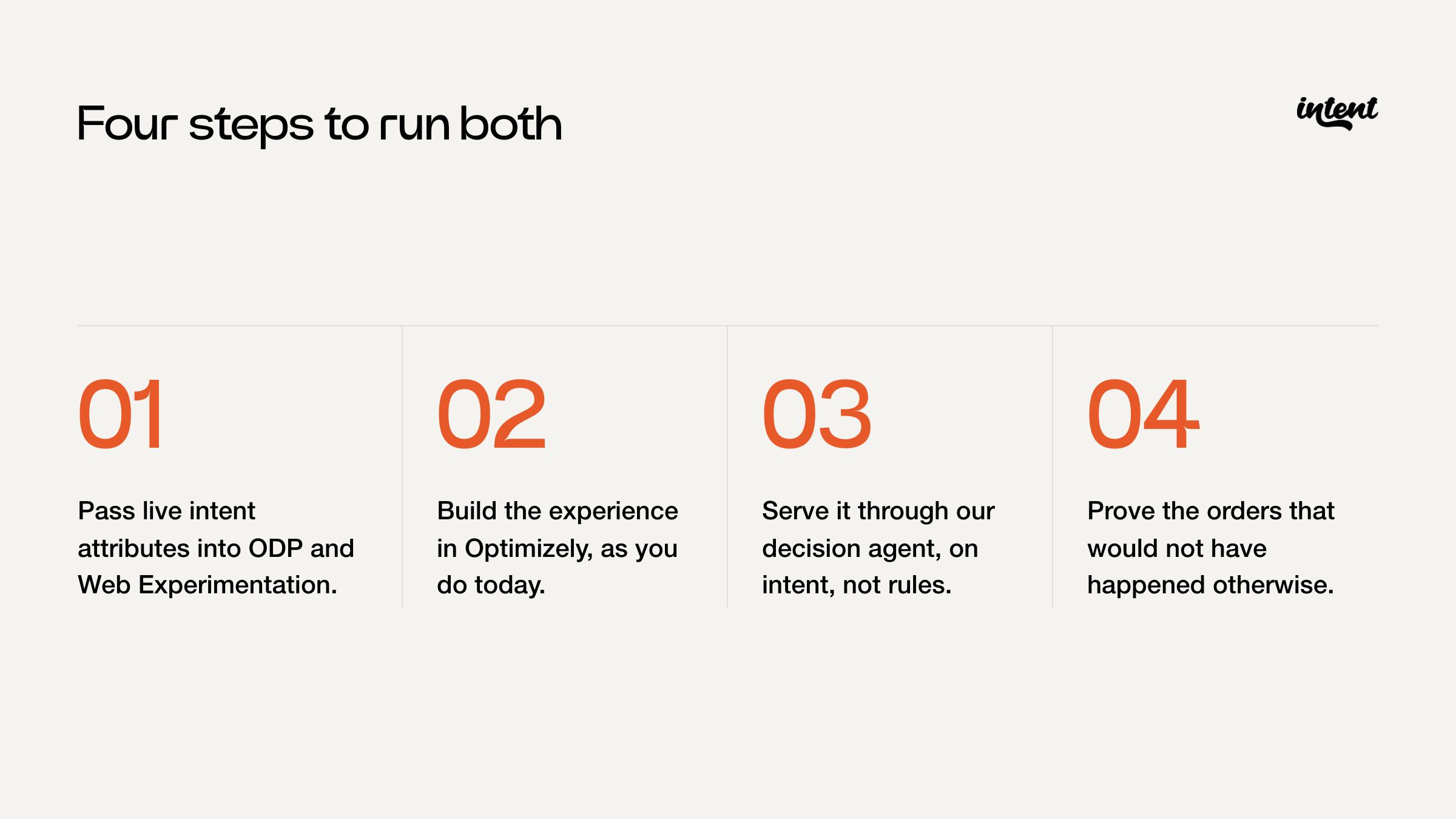
How to get started with Optimizely and Made With Intent
- Use Made With Intent to create intent-ready audiences in Optimizely: Pass Made With Intent's live intent attributes — purchase confidence, abandon risk, buying stage, intent trend — into ODP as attribute conditions, or into Web Experimentation as Tags.
Build audiences like "high purchase confidence + declining intent trend" (needs reassurance), "medium confidence + high abandon risk" (needs timely intervention), "low confidence + active comparison signals" (needs guidance, not a discount). - Execute experiences in Optimizely using those audiences. Use Web Experimentation and Personalization for what they do well, so things like variant production, Stats Engine analysis, content variations across the DXP.
- Serve the experience (or a variant) through Made With Intent's decision agent, where the experience is served based on visitor intent rather than rule-defined audiences.
- Use Made With Intent to prove the incrementality of "Optimizely + intent". Holdback groups on top of the Optimizely experience answer the CFO question: did this cause incremental orders, or did we just personalise for visitors who would have bought anyway? Particularly valuable for discounting — Made With Intent surfaces which high-intent visitors needed no incentive.
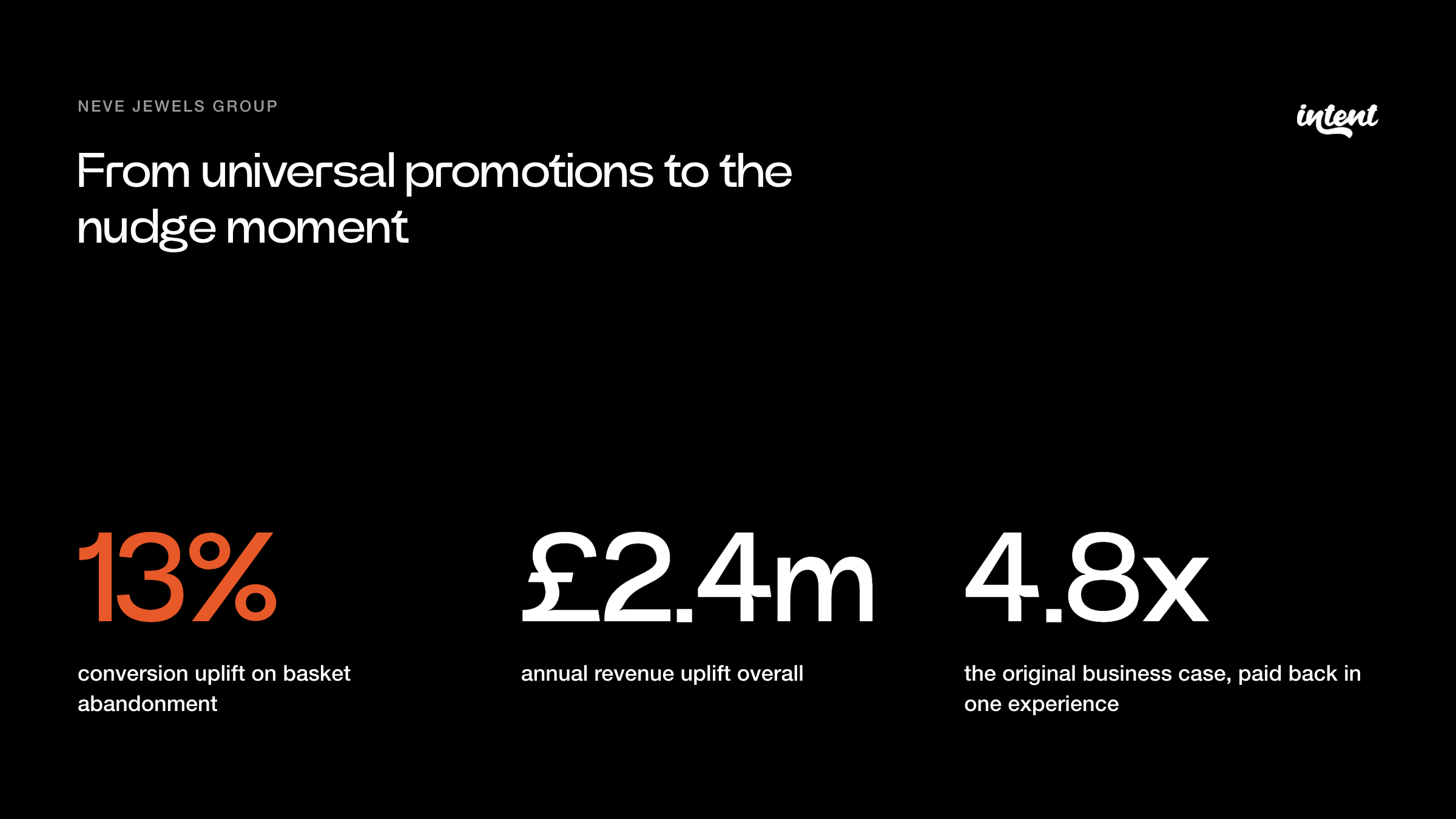
Neve Jewels Group, the luxury jewellery brands Austen Blake and Sacet, moved from universal promotions to intent-level targeting across their basket abandonment strategy.
Rather than applying the same discount to every abandoning visitor, Made With Intent segmented interventions across four intent levels, targeting what Director of Customer Experience Jo Homer described as "the nudge moment."
The result: 13% conversion uplift on basket abandonment, and £2.4m in annual revenue uplift overall, 4.8x the original business case, paid back within a single experience. You can learn more here.
What sort of businesses work best with Made With Intent?
This all depends on the size and structure of your eCommerce operation.
Mid-market retailers (£20m–£100m online revenue)
Made With Intent often leads here. Optimizely's Intelligence Cloud commonly lands at £50–80k+/year for this band, based on G2 reviews and procurement data. Made With Intent's session-based pricing, 30 to 60 minute install, and agentic layer fit eCommerce teams of two to ten people who need to ship and prove things quickly.
If you are running Optimizely for the Stats Engine and feature experimentation and those are load-bearing, keep them. Add Made With Intent for intent targeting and causal measurement of your on-site experiences.
Enterprise retailers with dedicated personalisation teams
Both, with clear role separation. Optimizely for the experimentation surface, Stats Engine credibility, server-side feature flagging, and DXP integration. Made With Intent for on-site intent-driven decisioning and causal measurement.
Try Made With Intent today
There you have it. Made With Intent and Optimizely are designed to complement one-another, not compete with one another. Many of our clients use Optimizely to continue A/B testing, while using Made With Intent to serve experience to customers on a 1:1 basis.
If you're interested in learning more about how Made With Intent works, and how you can use it in your tool stack, book a demo here.
Disclaimer: This comparison is based on publicly available information from Optimizely's documentation, marketing site, and customer reviews as of July 2026. Both products evolve continuously. If anything looks out of date, get in touch.