
Product news

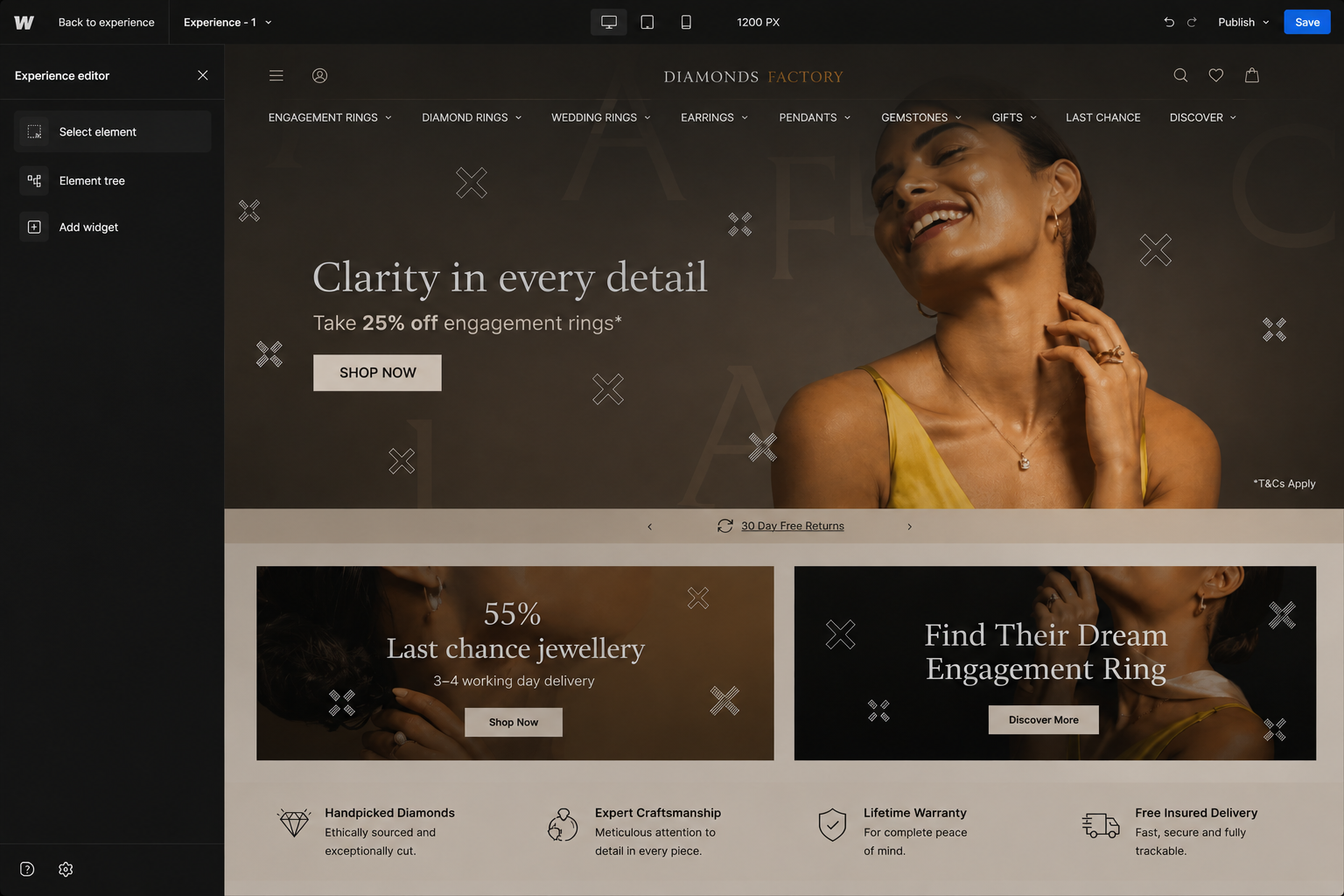
Visual Editor has just shipped. It's a brand new feature for Made With Intent.
Yes, we know this isn't something groundbreaking, and you've used something like Visual Editor before, with your favourite tools, but this is one of the most requested features from our customers.
It lets you create and preview on-site changes against your own live website. You'll have more flexibility and control over the kinds of experiences you'd like our tool to test and deliver to your customers.
It'll reduce the need for developers to get involved, and give you a familiar, visual way of editing experiences, directly within Made With Intent, that you can ship on your own.
So, that's the short version. Here's a bit more background on what it does, why we built it and a sneak preview of what's coming next.
What Visual Editor does
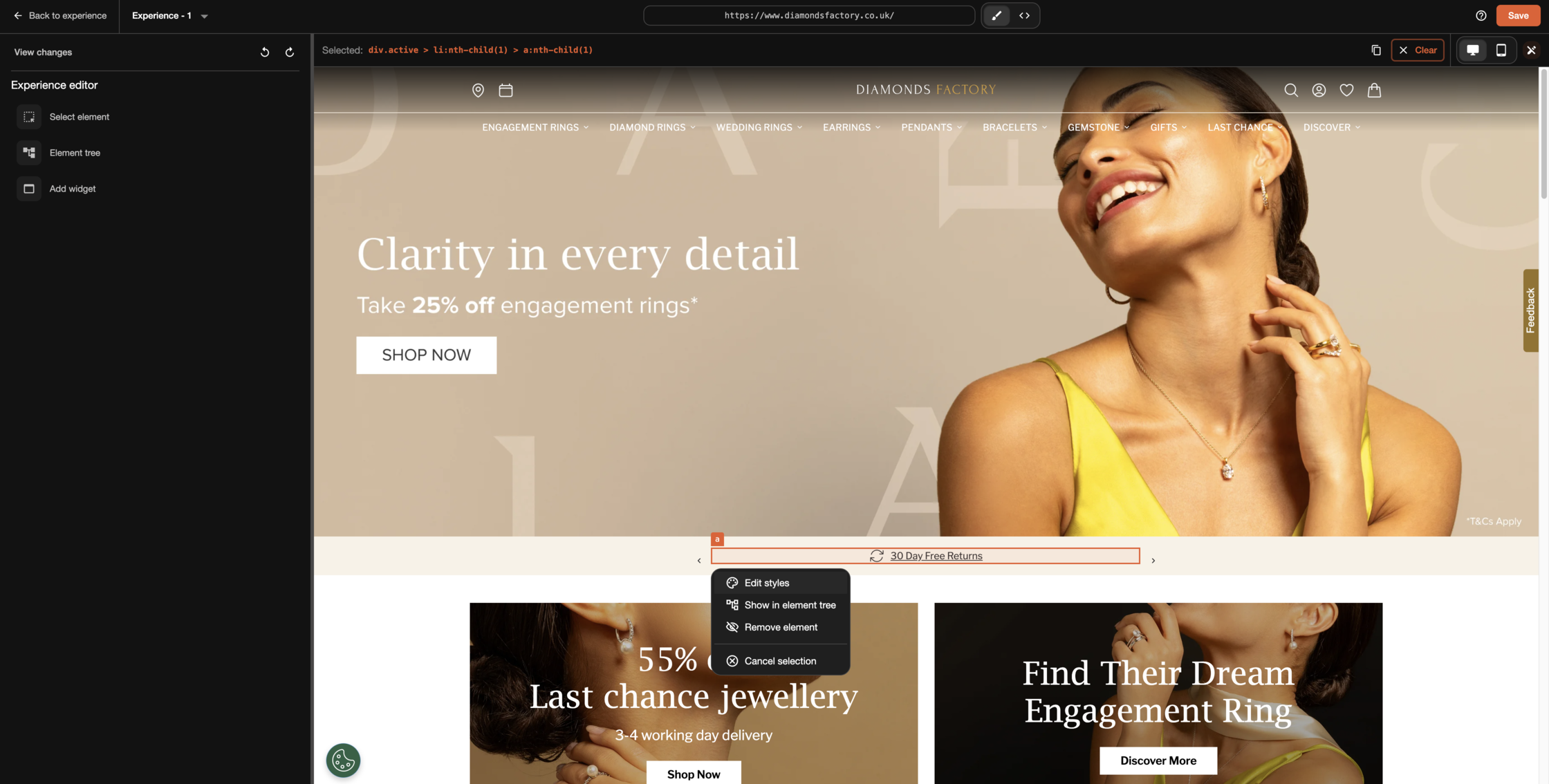
Visual Editor lets you create and preview on-site changes against your own live website, without developer support and without guessing how something will look once it's live.
It solves a familiar problem. The person responsible for the site experience is rarely the person who can build it. As Ryan Jordan, our CPO, puts it:
"The people that are using our product are generally those who are responsible for the site experience but not necessarily technically able to always build for the site experience."
Here's a list of of some of things you'll be able to do with this new feature:
- Change a banner
- Update, restyle, hide or show a specific element on a page
- Fully customisable overlays, built to cater for every moment
- Build and preview components on your live site before they go anywhere near a visitor.
You'll have, no doubt, used lots and lots of WYSIWYG tools before in your favourite A/B testing, experience and ecommerce tools. We've deliberately designed Visual Editor to be familiar, and work similar to the products you know and love, so you'll find it intuitive to use.
We built Visual Editor because it is the feature that was most requested by our customers. We feel it's a natural evolution of our well-loved template library. With the ability to essentially edit your site by clicking and typing, we think it'll be flexible enough for non-technical people to pick it up and build something quick and dirty.
But this new feature will also let you see the context of what you've built in-situ, perfect for your site and your context, instead of leaving it to imagination.
But Ryan reckons you'll go further: "Previously, campaigns delivered with Made With Intent were generally thought about from a \"template\" first approach, but the Visual Editor now allows you to think about how real-time moments of intent can change the page and its content"
Moving towards a goal-orientated mindset
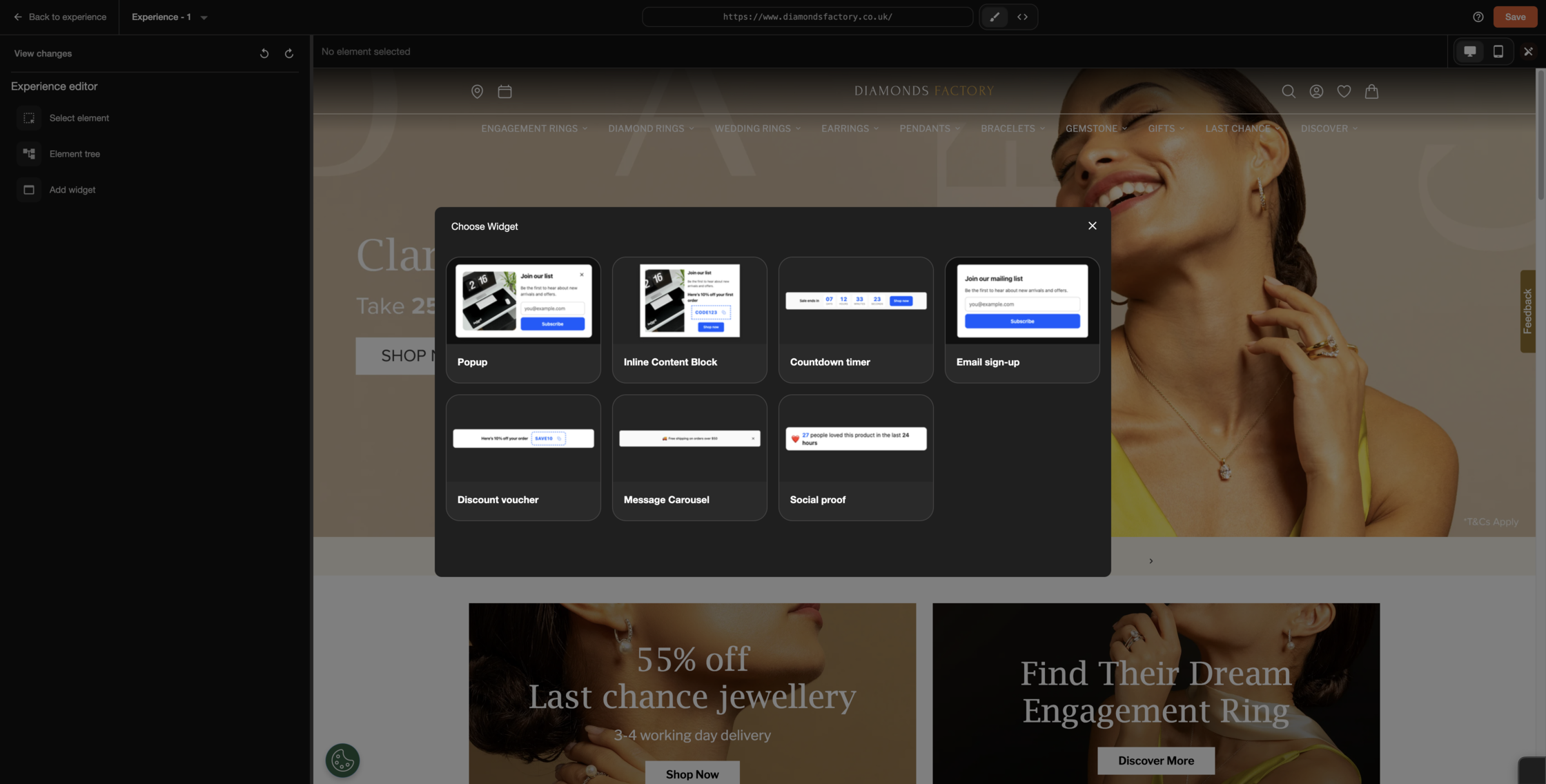
We reckon our Visual Editor will help you change your mindset. Most experience delivery tools tell you to pick a format first. You decide you want a pop-up, then you go and fill it with content. You decide you want a sticky banner, then you fill that with content. The format leads, and the goal follows.
But that's backwards for a lot of what teams are trying to do.
Let's take basket abandonment. One brand might come in knowing they want a pop-up. Fine, build the pop-up, fill it with content. But another brand comes in knowing only that they want to offer a 20% discount when someone's about to leave. They've got the goal. Why should we dictate how you deliver that discount?
So we've built Visual Editor to work from either end. Start with a format and add your content. Or start with your content: the discount, the message, the countdown timer. Then see how it looks as a sticky banner, a pop-up, a slide-in, or an in-page element.
"Most of the market always just goes format-into-content," Ryan explained. "What we're doing by flipping it and being able to go content-into-format is giving people the ability to play around."
On paper this might seem like a small thing. But we think this will give you different options to explore different solutions to the same problems you've been optimising and experimenting with for years. You'll be inspired to create different solutions to the same problems you've been having for years.
A quick note on CSP
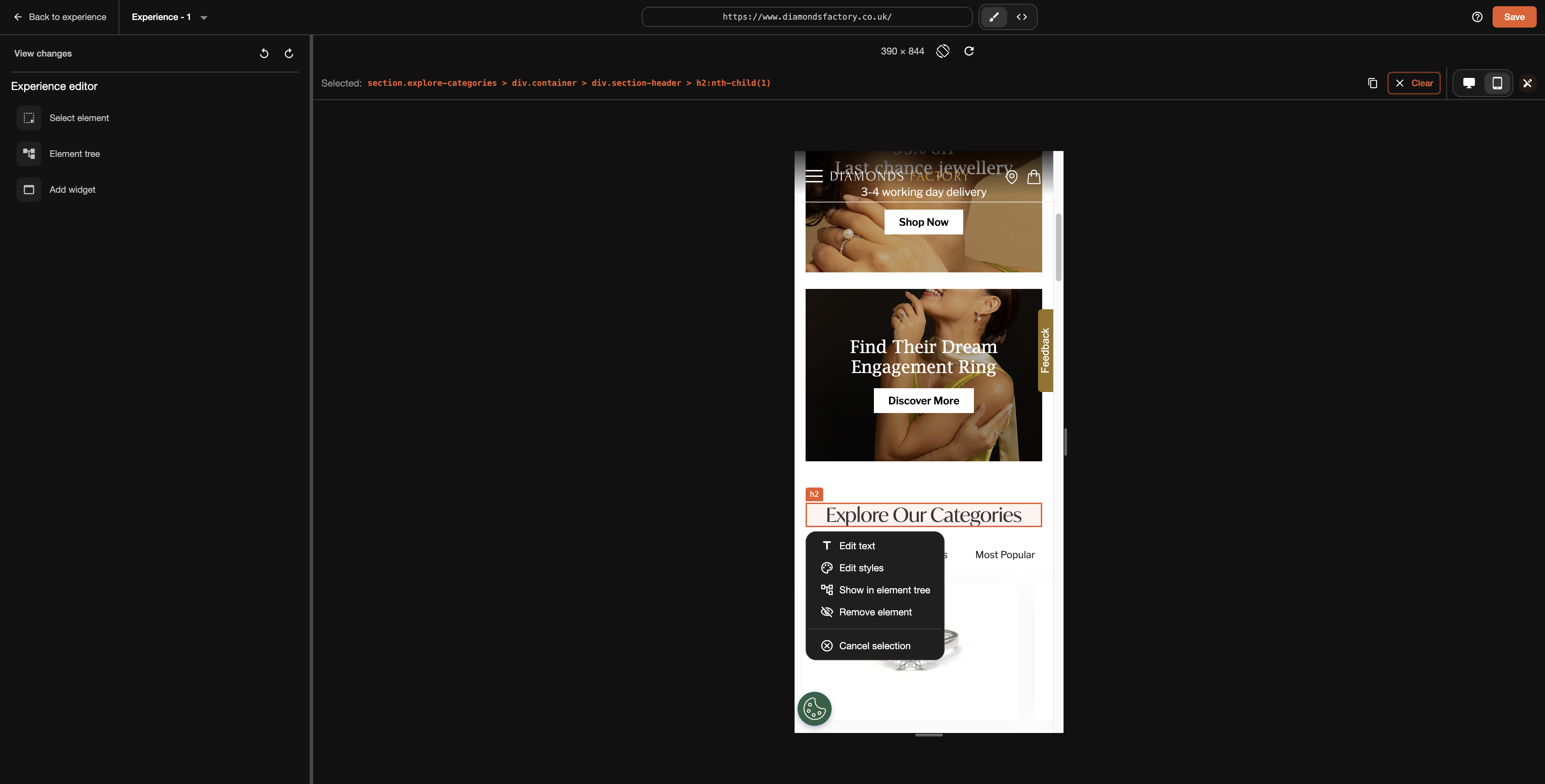
Some sites run Content Security Policy (CSP) rules that can stop a visual editor from working on the page. To help with that, we're rolling out a Chrome extension called Intent Studio that unblocks it.
If your site's CSP rules mean you can't use the editor on the page yet, nothing else changes, everything you could do yesterday, you can still do today. For sites that don't have CSP rules, you should be fine without Intent Studio.
So, what's coming next?
We'll be adding more templates. We've built Visual Editor to be flexible deliberately, so people get used to it and start asking "can it do this, can it do that," we'll keep adding to what's there.
Longer term, this is where things get a bit interesting. We're finding with tools like Claude Design, many, many people are designing experiences using prompts, instead of fiddling around manually.
Ryan says: "It's now no longer click on an element and change the background colour to blue. It's tell an AI, make this background blue, and it kind of just does it for you."
The widgets behind Visual Editor have been built so that AI can understand them and make changes to them. This is the groundwork for letting you describe the change you want and have it built for you.
There's no hard date on when this is coming, but Ryan said it's a matter of weeks, not quarters.
Made With Intent has always been about one thing: enabling you to respond to real-time intent on your ecommerce site. Everything we do is in service of making that easier and more effective.
For a long time, acting on intent meant working within the formats we gave you or dev resource. Visual Editor changes that. It lowers the barrier between knowing what you want a visitor to experience and actually building it — without waiting on someone else to do it for you.
The gap between who owns the site experience and who can build it just got a lot smaller.
And the next step, simply describing the change instead of building it manually, is next.
Login to Made With Intent to see Visual Editor in action. If you're not a customer yet, and are curious, why don't you book a demo?


Two visitors land on the same product page. One is browsing for the first time, casually curious. The other has returned four times this week, lingered on the size guide, and added the item to their basket twice without checking out.
Both see the same testimonial: "Life-changing product! Five stars!"
For most ecommerce brands, the bottleneck isn't the testimonial bank. The bottleneck is matching the right testimonial to the right visitor at the right moment in their journey. Your reviews database is probably already deep enough. What's missing is the logic on top of it.
So we're on the same page, what are customer testimonials? They're endorsements from real customers that serve as social proof to reduce purchase risk for new visitors. Used strategically, they are one of the most effective tools in ecommerce conversion, but only when matched to the right visitor at the right point in their buying journey.
That latter bit is where most brands lose the plot.
What customer testimonials actually do
Let's go back to basics and define customer testimonials.
Customer testimonials reduce perceived risk. When someone is about to spend £80 on a jumper they can't touch, £200 on a skincare set they can't smell, or £600 on a sofa they can't sit on, they are buying on faith. A testimonial transfers a small amount of trust from a stranger who has already taken that risk.
The numbers back this up. A product with five reviews is 270% more likely to be purchased than one with none (Medill Spiegel Research Center). Reviews flip the equation from "I hope this is good" to "other people like me said it's good."
So far, so good? Most ecommerce teams have internalised this for a decade. They have collected reviews. They have stars on PDPs. They have widgets pulling in the latest five-star quote. The job, on paper, is done.
Or is it? Conversion rates haven't moved much. Bounce rates on PDPs haven't dropped. The reviews are present, the trust signals are loud, and yet visitors still leave.
The question worth asking isn't whether customer testimonials work. They do. The more interesting question is: whose trust do they transfer, and when?
A first-time visitor doesn't need the same reassurance as someone who has been comparing brands for a fortnight. A price-sensitive shopper doesn't need the same nudge as someone who has already decided this is the brand. The same testimonial cannot do all of those jobs at once.
The next section is where the dominant approach starts to break down.
Why the same social proof examples don't convert every visitor
Brands built the dominant social proof playbook for a world with no reviews.
Collect them, display them prominently, serve them to everyone who lands on the site. That advice made sense in 2012. It made sense for brands going from zero to ten reviews. It does not make sense for an established retailer with 50,000 product reviews and millions of sessions a year, in 2026.
But the playbook hasn't been updated. So most brands keep adding more. Louder banners, "327 people are viewing this", scrolling testimonial carousels, urgency timers that reset every visit. More signals, served identically to every visitor. It's overwhelming.
David Mannheim, our CEO, puts it bluntly:
"Social proof nowadays is basically the same message to everyone. The urgency, the review snippets, the scarcity. It's a belief that more is more, that everything serves everyone. But really, social proof should only appear to those users at the right moment. It's a persuasive methodology; a nudge or a tactic at the right time. Suppress your social proof. Don't serve it to those that are just browsing, give them a different message. And don't serve it to those that are ready to buy, give them a different message. It's those just in the middle that need a nudge over the fence." — David Mannheim, CEO, Made With Intent
This reframes social proof examples from "always-on trust signals" to "situational nudges". And once you accept that frame, undifferentiated testimonials look less like a neutral baseline and more like an active risk.
Consider the mismatch scenario. Imagine a visitor who has never shown a price signal. They came in via a brand search, went straight to a hero product, and showed no comparison behaviour. You serve them a testimonial that says "great value for money". They were thinking about whether the product was right. Now there's a price question in the frame that wasn't there before.
Or take a returning visitor who has bought from you twice before. You show them a quote that says "perfect for beginners". The implicit message is: this isn't really for someone like you.
Neither of these social proof examples is wrong on its own. Both are wrong for that visitor at that moment. Whether the mismatch actively depresses conversion or simply fails to help, the outcome is the same: the testimonial isn't working. The fix isn't the testimonial. It's how the testimonial is delivered and when.
The ecommerce social proof gap: one buying journey, three different trust needs
A buying journey is not one job. It is at least three jobs, each requiring a different kind of trust.
This is the Made With Intent framework: the three intent stages we use operationally with clients. Other segmentation models exist, but this is the one we've found most actionable. You can read more about how we define and detect these stages here.
But if you're new here, briefly, this is what they are:
Discovery (first visit). The visitor needs category credibility. "I didn't know this kind of product could do X." They are not yet evaluating brands; they are evaluating whether the category is worth their attention at all. Generic enthusiasm ("I love it!") works here, because novelty is the barrier they need to clear. They don't need specifics. They need to get interested.
Consideration (comparing options). The visitor needs differentiation. "I compared three brands and chose this one because the fabric held up after 30 washes." They have already accepted the category. Now they're choosing between you and two others. Generic praise is useless because every competitor has it. What they need is a reason to prefer you, not just a reason to trust you.
High intent (near add-to-cart). The visitor needs hesitation removal. There is one specific objection holding them back, usually sizing, delivery timing, returns policy, or quality longevity. A five-star quote does nothing for this. A testimonial that opens "I was worried about the fit but..." is the right…fit (if you pardon the pun)
You might read this and think, "Oh boy, it's another SaaS blog saying really great things about their product." But, let's see some proof. David talks about a specific example from one of our clients:
"We had a customer and they have social proof on their site. It increased conversion by 3.2%. Great. However, once they analysed what that social proof was actually impacting, they found it worked quite well for those with a medium level of intent that needed a nudge. But really poorly — minus 2.2% — for those with low intent: their browsing, discovering visitors. By just suppressing it to those low-intent users and only showing it to high and building intent, their conversion rate jumped up by 20%." — David Mannheim, CEO, Made With Intent
To be clear on what that 20% represents: it is not an absolute conversion rate. It is the lift attributed to the social proof tactic itself. Previously, the tactic produced a +3.2% improvement to their overall conversion rate. After suppressing it for low-intent visitors, the same tactic produced a +20% improvement, because they had stopped letting one cohort cancel out the gains from another. The drag was hiding inside the aggregate.
We can't always prove that mismatched social proof actively causes harm, rather than simply missing its mark. In this case, suppression alone drove the improvement, which means at minimum the testimonial wasn't right for that particular audience.
Charley Bader, our VP Strategy & Ops, sees the same pattern in the building-intent stage:
"For those building intent it really worked. The people who have shown that intent to purchase and just need that slight push to tip into high intent and go through with the purchase." — Charley Bader, VP Strategy & Ops, Made With Intent
The bottom line is that discovery, consideration, and high intent are not three flavours of the same job. They are three different jobs entirely. Serving a discovery-stage testimonial to a high-intent visitor doesn't simply underperform. It interrupts a decision that was already in progress.
That's the ecommerce social proof gap. Most brands have built one trust layer for three trust problems.
You already have the ecommerce reviews. What's missing is the routing logic
Whenever we talk about this with retail teams, the first reaction is often: "We need more reviews."
Almost never true. For a retailer doing millions in online revenue, the reviews database is already enormous. Thousands of products, tens of thousands of reviews, often hundreds of millions of words of customer voice already collected and sitting in a Yotpo or Trustpilot export.
The gap is not volume. The gap is the logic that sits on top of your review database.
There are two distinct layers most teams conflate:
Tagging: Categorise existing ecommerce reviews by the objection they address, not just by star rating or recency. A five-star review that says "arrived in 24 hours, beautifully packaged" is a delivery-objection review. A four-star review that says "took me two tries to find the right size but the second one is perfect" is a fit-objection review. These two reviews do completely different jobs even though they look similar in a database.
Routing. Once tagged, assign reviews to the pages or visitor stages where the matching objection is most likely active. Delivery-objection reviews belong in the basket and checkout. Fit-objection reviews belong on PDPs, especially for visitors who have viewed the size guide. Differentiation reviews belong in front of returning visitors. Generic enthusiasm reviews belong on category pages and discovery surfaces.
We've found this is the structural gap in nearly every retailer we work with. Almost every ecommerce team has spent years optimising review collection: incentives, post-purchase emails, photo prompts, NPS triggers. Almost none have spent equivalent effort on categorising their reviews based on intent.
If you've heard enough and would like to know more about Made With Intent, why do you book a demo?
Social proof website examples: matching testimonial type to visitor signal
If you're looking to serve more appropriate testimonials to your prospective customers, here's some tips on how to begin categorising them:
1. PDP for a considered-purchase item: Replace the generic five-star quote at the top of the page with a hesitation-removal testimonial. If you're in fashion, it could be something like: "I was unsure about sizing because I'm between a 10 and a 12, but the fit guide was right. The 12 sits perfectly." That single change reframes the page from "people like this product" to "people like you bought this product and it was a great service".
2. Returning visitor on their second or third visit to the same product: This visitor has moved past discovery. Showing them another "Wow, amazing!" quote tells them nothing they don't already feel. Show them a differentiation testimonial instead: "I'd looked at three other brands and this was the only one that didn't fall apart after a month." They're likely to be sizing you up versus the competition, so give them what they want.
3. Basket or checkout page: A visitor at checkout has cleared the product question; they're now resolving logistics. Replace the enthusiasm testimonial with logistics and trust testimonials: delivery speed, returns experience, customer service responsiveness. "Returned a dress and the refund hit my account in 48 hours" closes a real objection at the moment that objection is live.
If you want a starting point for next week, here's our suggested approach:
- Pull a sample of 200 of your most-used reviews. Tag them by primary objection: delivery, quality, fit, price, trust/brand, generic enthusiasm.
- Pick one high-traffic PDP where you currently serve a generic testimonial. Start with one: this will likely mean a CMS change or an override on your testimonial widget.
- Swap the generic testimonial for an objection-specific one that matches the likely hesitation on that page.
- Run it as a 50/50 split test against the original, minimum two weeks or until statistical significance.
You don't need new tooling for that test. You need a spreadsheet, a CMS edit, and a desire to use testimonials differently.
If you'd like to see an example of this in practice, Hunter & Gather achieved a 14% conversion uplift by showing social proof only to the visitors who needed it — the same targeting logic, applied to a real catalogue.
What intent-aware customer testimonials look like at scale
Manual matching gets you a long way. It does not get you all the way.
And that's because visitor intent shifts in real time, and it shifts based on signals you can't see in a tagged-review spreadsheet. Return visit frequency. Product page depth. Comparison behaviour across categories. Dwell time on size guides. Whether they've abandoned a basket before. Whether they're price-checking or feature-checking.
When customer testimonials are connected to those real-time signals, the right trust signal surfaces automatically. A visitor showing price-sensitivity behaviour gets a value-validation testimonial. A visitor at high intent with no price signal gets a quality or delivery testimonial, because price isn't the unresolved objection for them.
This is where intent-aware serving moves from a quarterly project to a continuous capability. If you're thinking about how this fits into a broader on-site personalisation strategy, Made With Intent analyses hundreds of behavioural signals in real time to score where each visitor is in their buying journey: the input that makes intent-aware testimonial serving possible at scale. You can see exactly how we apply this to social proof on the platform use case page.
If you're ready to see how Made With Intent identifies where each visitor is in their buying journey, book a demo.

MANCHESTER, 02/05/24 - Made With Intent have raised £1.5m to bring their segmentation platform and their vision for more appropriate eCommerce to market. Led by Mercuri, with Portfolio Ventures and previous investors Haatch following, the seed funding will support the fully remote team of 15 with their product, marketing and partnership efforts.
The idea came after the founder, David Mannheim, recognised a fundamental flaw in online retail strategies. After 15 years of optimising conversion rates in eCommerce, he realised the industry’s fixation on conversion metrics was the very thing holding it back.
“The current measures of success are the problem. Metrics like conversion rate, and therefore the actions retailers take to improve them, are short-term, retrospective and aggregated,” David explains. “This creates a race to the bottom. A numbers game that forgets how people really buy.”
Made With Intent looks to change this by giving retailers two things—a more human, segmented perspective of their website performance and a predictive targeting mechanism that lets other marketing tech respond to customer needs in real time. The company reports this new intent-based approach creates a 9.4% average revenue uplift compared to generic optimisation.
“eCommerce is often guilty of trying to convert all customers at all times,” David states. “It focuses on the minority who are ready to buy, at the expense of those who are not. Our product helps retailers be appropriate for every customer. To progress both in-market and future buyers.”
The Beta launched in September has already helped customers like Ernest Jones, Bensons for Beds and Rapha align how they sell with actual buying behaviours. Nik Fletcher, Head of Digital Experience at Rapha, describes the product as “the closest we can get to understanding subconscious visitor signals, like we can in a physical store.”
The platform works by collecting data through an easy to implement script, modelling 250+ signals from online shoppers and returning predictive intent metrics in real time. Visitors are then automatically segmented based on their journey, momentum and how likely they are to buy, exit or return in the future.
This data and the targeting of segments are handled in platform, but the tool is designed to be complementary. With integrations to 40+ marketing tools, from ad networks to experience tools and CRMs, eCommerce teams can use Made With Intent to deliver more appropriate shopping experiences or reengagement tactics with the tools they already use.
“Made With Intent has embraced first-principle thinking and a decade of insights to shake up the vast eCommerce market,” comments Alan Hudson, Founding General Partner at Mercuri. “It empowers online commerce, making it more personal and focused on the quality of prospective customers. The product roadmap excites us and, importantly, those using it.”
“As a VC investor we look at a vast number of potential investments each year, however we only invest in less than a dozen. Made With Intent's strategy is similar for its customers - to focus on the quality of the prospect, not the number of prospects."
With an existing user base in the UK, Denmark, Germany and the USA, the company aims to reach 100 global customers within two years. David Mannheim adds, "Made With Intent is about more than a platform. It's about a movement to create a more personal, human eCommerce. This investment brings us closer to fulfilling our mission."
For media or product enquiries please contact Daniel Gripton, VP Marketing, on LinkedIn.

