It’s not a coincidence that most prices end in 9. Rather than selling their product for £2 or £10, retailers set the price to £1.99 or £9.99. And that’s because ending a price in 9 tends to sell more.
For example, Lyft tested fares on 21 million passengers. Across a $1 rise in a fare, Lyft lost riders gradually but about half of those lost went in one cent as soon as the price rose from $13.99 to $14.00.
The effect isn’t equal everywhere, though. Two marketing professionals tested it with a real US retailer back in 2003, and while the price ending in 9 won in all three of their experiments, it worked best on new items, where shoppers had no idea what the price should be.
That is a prime example of psychological pricing.
What is psychological pricing?
Psychological pricing is the practice of setting or presenting prices to change how shoppers perceive value, but without changing what they get. Common tactics include prices ending in 9, a higher reference price shown beside the selling price, a decoy option that makes another look like better value (a 400ml bottle at £13 beside a 500ml at £14, so the bigger one looks like a bargain), and deadlines or times that make the price feel scarce.
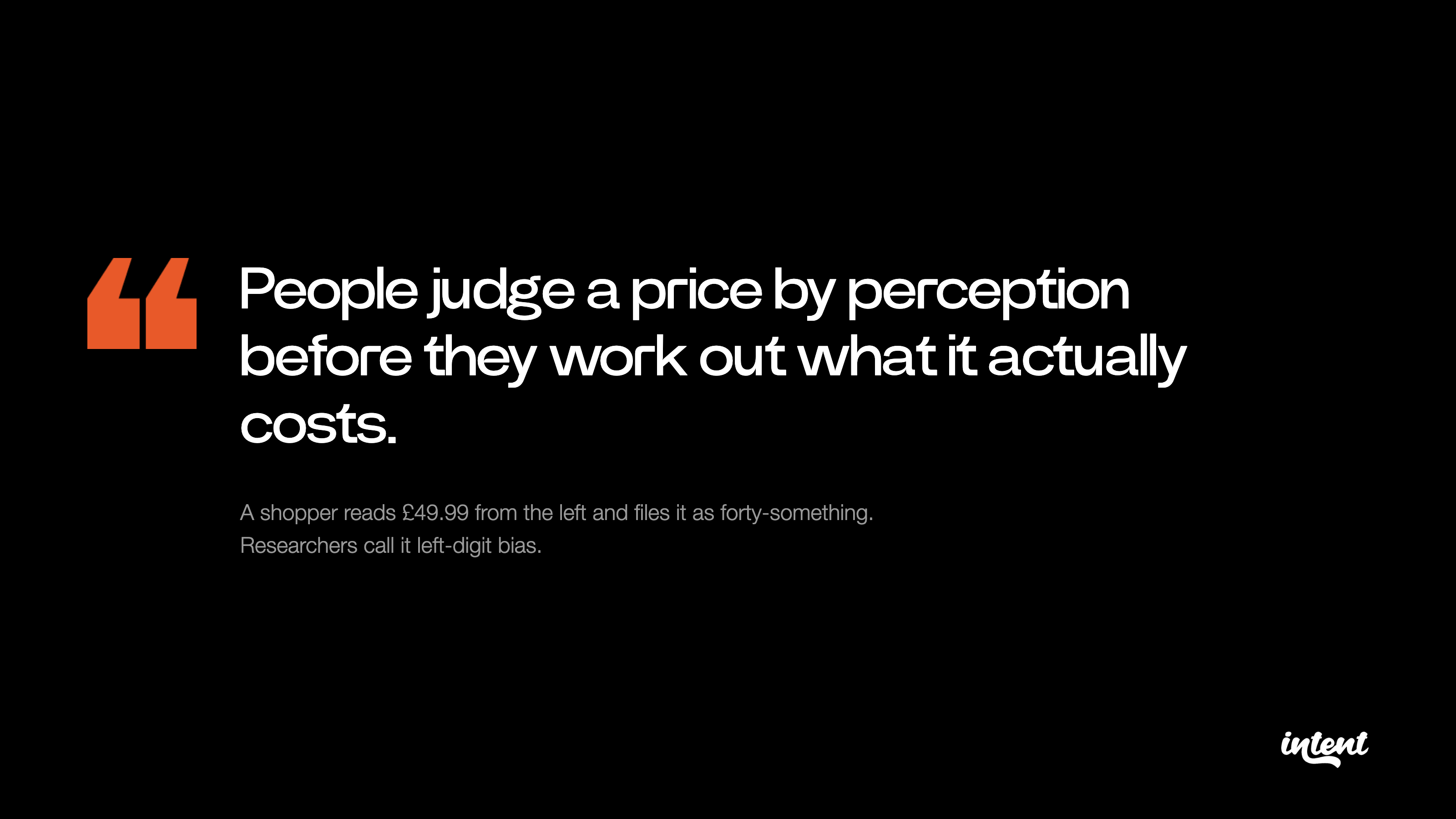
It works because people judge a price by perception before they work out what it actually costs. A shopper reads £49.99 from the left and files it as “forty-something” rather than just shy of fifty. Researchers call this left-digit bias. It’s one of several mental shortcuts psychological pricing tactics lean on.
Psychological pricing examples you’ll see in ecommerce
There are six pricing tactics that cover a lot of what you see on UK retail sites. They don’t all cost the same to you as a retailer. Let’s think about that ending-price-in-9 example again. Pricing something at £9.99 instead of £10 costs you a penny.
But other tactics can end up costing you, like a discount code or a free second item. That money goes to every shopper who sees the offer, including the ones who would have paid full price anyway.
That second group is large. In our Intent Gap research, 83% of online shoppers said they’d used a discount code when they would have bought at full price.
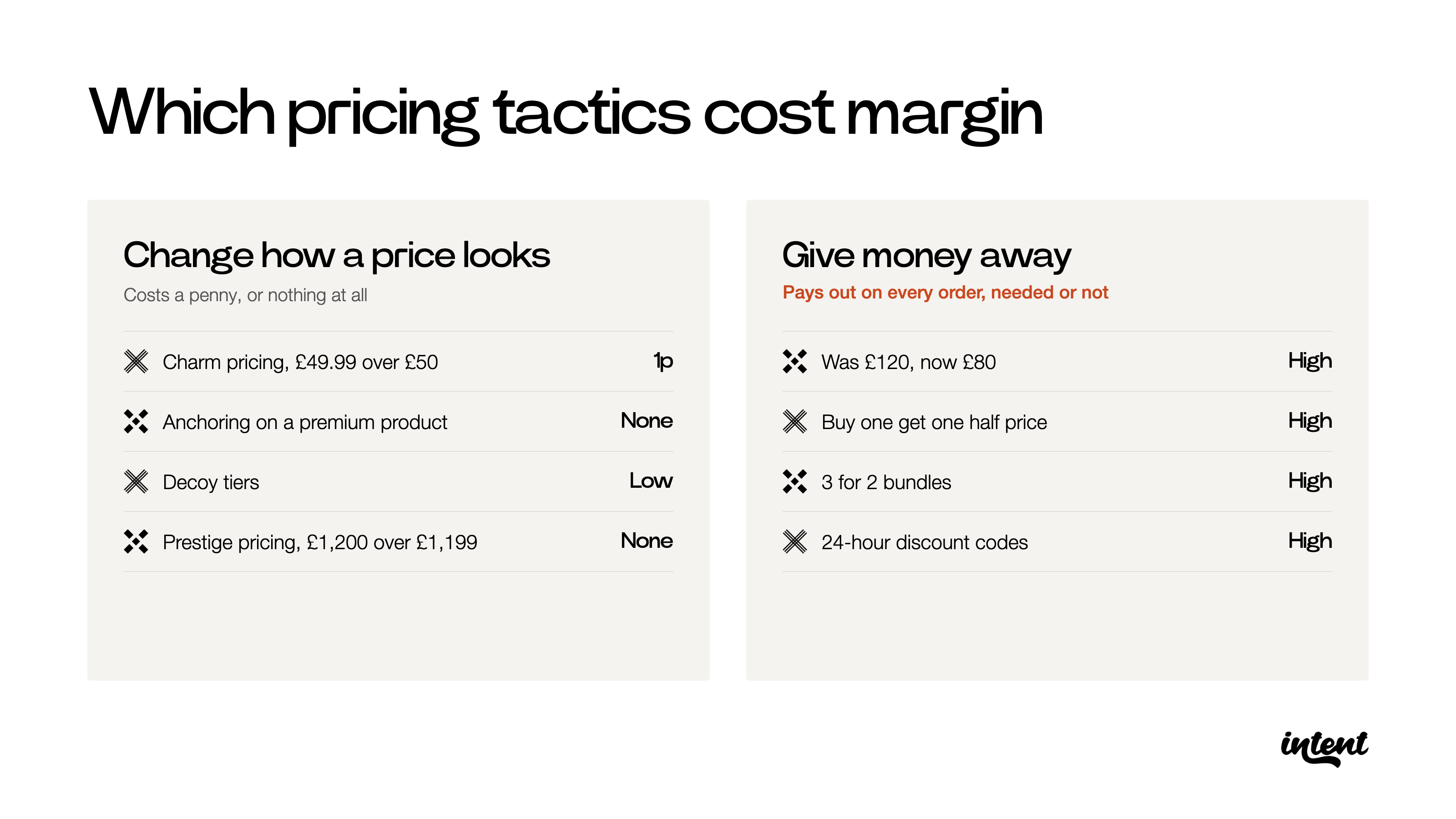
So the table below adds a column most retailers fail to consider: what each tactic costs you per order. It’s our judgement, based on one question: does the tactic change how a price looks, or does it give money away?
One of the best-known brand examples of psychological pricing is The Economist. Its subscription page once offered web-only for $59, print-only for $125, and print plus web for $125. Behavioural economist Dan Ariely tested that menu on students for his book Predictably Irrational, and 84% chose print plus web. When he removed the print-only decoy, 68% chose web-only instead. Nobody bought the decoy but it did its job anyway.
For discount anchors, look at shops like Temu and Shein. Both are big users of high reference prices that are then marked down, as explored by Harvard Business School professor Elie Ofek.
The problem with treating pricing psychology as universal
The tactics above have research behind them, otherwise retailers wouldn’t use them. Most of the research reports an average effect, and averages are useful. But they also hide the two groups of shoppers who matter most to your margin.
Go back to the charm pricing study from the intro. The price ending in a 9 did more for new items than familiar ones, and there was some evidence that it had less impact when prices already included “Sale” messaging. So the researchers’ own conclusion is that 9-endings may do most when shoppers know little about what the price should be.
These findings add context, and that applies to every tactic we’ve discussed. Every average includes shoppers for whom the cue made no difference. These shoppers
The same is true of every tactic in this guide. Say a price ending in 9 lifts sales by 4% in a test. That doesn’t mean every shopper bought a little more. Most of them would have bought at £50 anyway, and some wouldn’t have bought at any price. The 4% comes from a smaller group who were on the fence, where the cheaper-looking price tipped the decision. The test result alone can’t tell you which of those groups your next visitor is in.
Price elasticity belongs to visitors as well as products
Price elasticity measures how much demand changes when the price changes. If a 10% price cut lifts units sold by 20%, demand is elastic. If units barely move, it’s inelastic.
Trading teams often estimate price elasticity by product or category, and that’s the right unit for setting a shelf price. We’re not here to argue against. But the trouble starts when that same product-level number decides who sees a promotion.
Anderson and Simester (the ones behind the charm price study of 9-ending) tested this in a follow-up study. Some customers got a bigger discount, some a smaller one, and the researchers tracked what each group bought afterwards. New customers who got the bigger discount came back and bought more. Existing customers who got the same bigger discount bought less afterwards, and they showed signs of learning to wait for the next deal. Same products and same catalogue, but opposite results.
And we’d even argue that the variation runs finer still when online, and shifts within a single session. A returning visitor with a full basket and checking delivery dates, is close to inelastic at that moment. Meanwhile, a first-time visitor flicking between your and a competitor’s site may be the most price-sensitive shopper you see all day. A product-level elasticity treats both shoppers as one.
The evidence from live sites points the same way. Diamonds Factory let a decisioning agent choose who got a basket abandonment offer. It found a basket value below which doing nothing performed best (without being told to look for one). And if 83% of shoppers have used a code they didn’t need to complete the purchase, a big share of promotional spend aimed at “price-sensitive demand” lands on people who didn’t see price as a deciding factor.
Which psychological pricing tactics cost margin (and which don’t)
If we split the earlier table in two, the argument gets a bit simpler.
The cheap tactics essentially change how a price looks. Charm pricing, for example, costs a penny. A decoy tier is priced to look like poor value, so anyone who does pick it still pays full price, often more than for the “better deal”, and prestige pricing costs nothing at all. Showing these to everyone still works because a shopper who didn’t need a nudge doesn’t really cost you anything.
The costly tactics work by giving money away. A discount anchor with a real “was” price, a BOGOF, a bundle discount and a time-limited code each pay out on every order, including orders that would have happened at full price. That’s where the 83% hurts. And it’s also why your promotion can look good on sales uplift but still lose you money once you net off the margin. We cover the wider maths in the hidden costs of promotional pricing, including who should never see a discount at all. And if your discount anchors are the habit worth breaking, start with why blanket codes stop working.
Diamonds Factory found this out with basket abandonment. A blanket 25% code for every abandoner lifted conversions by 11%. Average order value fell 6.7% over the same period, and once the discount was netted off, the gain was worth barely £8k a month.
Setting a psychological pricing strategy per visitor
The shelf price is your pricing team’s call, and it stays the same for every visitor. The cheap-to-run tactics can stay on for everyone too. The costly ones are promotions, which your trading and onsite teams already own. So they’re the ones worth aiming for. Essentially, what changes is which visitors see a discount anchor, a bundle offer or a time-limited code, and which see reassurance or nothing.
Picture four visitors on the same product page, all looking at the same £180 price.
- A returning customer with a built basket, checking delivery options. Show nothing. They’re buying, and a code here is a refund on a sale you’d already made.
- A first-time visitor from a price comparison site, flicking between sizes and the returns page. This is where a time-limited code or a bundle offer can earn its cost.
- A visitor deep in research, reading reviews and specs across several sessions. A discount is premature. Reviews, a delivery promise and a clear returns policy often do more.
- A high-value basket showing exit signals. A modest, targeted offer. For example, Chillblast reserved a £100 discount for high-value visitors who were showing abandonment signals but kept it from visitors who were going to buy anyway. It resulted in a 9% conversion uplift.
Doing this by hand means writing rules for every combination of visitor and moment, then maintaining them through every promo calendar change. That’s the job Intent does. It decides (per visitor and in real time) whether to show a discount, a different offer, reassurance or nothing. That decision is based on what that visitor is likely to do next. See how discounting with Intent works.
So… why not personalise the price itself?
Because shoppers compare notes, and a price that changes depending on who’s looking is a very quick way to lose their trust. From April 2025, the CMA can also fine retailers directly for consumer law breaches. Its price transparency guidance describes how reference prices and drip pricing are judged. And it’s much harder to defend a “was” price if it moves per shopper.
Giving some shoppers an offer is different, and you already do it. For instance, a new-customer code, a discount for email subscribers and a student discount all go to some people, but not everyone. That also means the price on your product page can stay the same for all shoppers. Choosing who gets an offer based on what they’re doing on your site right now works the same way, but with better information.
Advantages and disadvantages of psychological pricing
The cheap tactics have almost no downside. Nearly all the risk sits with the ones that can cost you margin.
Advantages:
- They’re cheap to implement. The presentation tactics cost little beyond a template change.
- They’re well evidenced on average, from field experiments like Anderson and Simester’s to decades of lab work on anchoring and decoys.
- They’re easy to test. A price ending or a tier layout makes a nice and clean A/B test.
Disadvantages:
- The costly tactics leak margin on every order that would have happened anyway.
- Overuse trains shoppers to wait for the next deal. Anderson and Simester saw established customers buy less after deep discounts, and Diamonds Factory’s team saw the same pattern on their own site.
- Misleading versions can break consumer law. Falsely stating that a product will only be available for a limited time is a banned practice under the Digital Markets, Competition and Consumers Act 2024 (CMA207). And inflated “was” prices are covered by the CMA’s price transparency guidance.
- A winning test can still overpay most of the shoppers who saw it, because it also looks into averages. And we know averages hide those who the tactic moved.
Aim psychological pricing at the shoppers who need it
Pricing psychology works. The research is solid, and the cheap tactics deserve a place on every product page.
Discounts are different. A 20% code gives money to everyone who uses it, including people who would have paid full price. A test result won’t tell you who those people are.
So before you run an offer, ask one question: who actually needs this to buy? Keep the price the same for everyone, and show the offer only to those shoppers.
If you want to see how that decision gets made per visitor, take a look at discounting with Intent. Or even better, book a demo and we’ll show you what it looks like on your own traffic.

Become an Intent Insider
Get subscriber-only insights we don't publish anywhere else and event invites before anyone else.
By submitting this form you agree to our (more than fair) terms.