Most ecommerce brands interrupt shoppers with email capture pop-ups too soon, hurting trust, margins and conversion. But an intent-led approach to email capture can prioritise timing, relevance and long-term value.
We need to talk about how ecommerce brands collect emails.
Pop-ups demanding your email the second you land on a site? We've all seen them. We've all clicked the 'X'.
Yet this is still ecommerce’s default behaviour. A visitor hasn’t scrolled, clicked or even looked around, and already the brand is asking for their data. Sometimes dangling a discount. Sometimes just promising to keep them "in the loop." But always interrupting. Always assuming.
It’s digital directness at its most extreme. And the numbers show it is doing more harm than good.
As we found in The Intent Gap report, 55% of shoppers dislike pop-ups that appear early in a session. 45% say those pop-ups make them less likely to buy. And one in five say they would leave a site altogether if interrupted too soon.
Yet 79% of the leading retail sites we analysed fire pop-ups within the first 30 seconds.
Brands might think they are winning because the database grows. But what they are really doing is playing a game of short-term gain, long-term pain.
The people and teams at these brands are aware of this. We know because we asked them for an article on ecommerce’s email capture issue. But despite knowing it, most don’t have an easy way of changing their behaviour.
This is one of the biggest blindspots in ecommerce. It’s time to rethink the entire logic of email capture.
Email capture works...But at what cost?
For CRM teams, email capture is a KPI. The more addresses in the database, the better.
But the real question is not whether these pop-ups collect emails. They do. Some of the time. Around 2% of the time, in fact.
The question is whether they should.
Because when you look closer, that growth comes with a hidden cost. And it is more than just a momentary annoyance.
Shoppers are irritated. Journeys are disrupted. Trust is eroded.
And perhaps worst of all, most email capture pop-ups offer a discount as the incentive. Usually 10%. It feels easy. It feels like a win. But the truth is, you’re not just interrupting a visitor. You’re also handing out margin you never needed to give away.
Yet inside ecommerce teams, nobody measures the downstream impact. Very few ask how those emails perform once collected. Whether they open the emails. Whether they engage. Whether they unsubscribe immediately or, worse, mark it as spam.
Because the metric is the email captured. Not the value of that email.
It is the lazy default. A blunt trade-off between quantity and quality. And it only survives because brands never step back to challenge the assumption that capturing an email is always better than not.
But is it?
Imagine this offline. A shopper walks into a store, takes two steps past the entrance, and a salesperson jumps in front of them demanding their contact details in exchange for 10% off. It would be absurd. Yet online, it is the norm.
We measure the upside. We ignore the downside.
Why do brands still do this?
Because it is easy.
Because the tools make it easy.
Because the KPI is set. Grow the database at all costs.
The truth is, the tools most ecommerce teams rely on aren’t built to do anything else. They only support rigid, rule-based triggers. You can fire a pop-up after a set time, after a certain number of pages, or when a mouse scrolls to the top of the screen. Blunt instruments that don't adapt to what the visitor is actually doing.
Because the tools are so limited, teams don’t have to think strategically. They pick one of the arbitrary options, turn it on, and move on to the next task. When platforms lead with convenience over context, strategy suffers. The tech shapes the behaviour.
But it is not just the tools. Organisational silos compound the problem. Email capture, discounting and experience are often owned by three different teams. Each has valid goals, but they are pulling in different directions.
CRM teams want emails. UX teams want less friction. Trading teams want conversions.
And no one asks the simple question: at what point would you be comfortable giving your email address to a retailer?
The anonymity of ecommerce only deepens the problem. I call this the veil of anonymity. Because shoppers can’t push back or protest, teams feel detached. When you remove human connection from the buying experience, it becomes easier to justify inappropriate interruptions. It becomes easy to forget that shoppers are real people.
How intent changes the game
This is not an argument against email capture. It is an argument for more appropriate email capture.
Not based on arbitrary page views or timers. Based on real behaviour. Real signals. Real moments of relevance.
You need to wait for the right time when the visitor has committed something towards that relationship before you ask that question.
And those moments will vary. There is no single 'right' page or second. Instead, teams should look at the journey through the lens of the visitor. Not the website.
For example:
Browsing content? Offer to send more, like recipes or inspiration.
Comparing products? Offer to save favourites to their inbox.
At the basket, but hesitating? Offer to email them the basket or send price alerts.
Showing signs of exit? Use that as the trigger to invite them to continue the conversation.
This is exactly what brands like Le Chameau and On The Beach have done by adding real-time intent to their email capture tactics.
Le Chameau used intent signals to show email capture only to disengaging visitors, not those in a focused, progressing journey. You can read the full play here.
The result:
3% more sign-ups.
24% incremental revenue from that segment.
On The Beach used exit signals to trigger email capture earlier in the session, before visitors had fully disengaged. Explore their play here.
The result:
28% more email captures.
Not more pop-ups. Not more impressions. Just better timing. Better targeting. And better outcomes.
A more considered playbook for email capture
Want to do the same? Here’s how to rethink your approach:
When should you ask?
Not on entry
When visitors show signs of struggle, hesitation or exit
When they have built some product affinity or journey progression
Who should you ask?
Not everyone.
Exclude visitors in a Focus state, who are progressing naturally
Target those most at risk of leaving or showing hesitation
What should the offer be?
Not always a discount
Offer content, save-for-later prompts, alerts, or softer relationship-building asks
And above all: stop thinking of email capture as a one-shot pop-up. Think of it as a sequence of opportunities to connect, at the right moment for the right customers.
You get a pop-up demanding your email before you’ve even looked around. How does that make you feel?
That is the question we should be asking of every tactic, every journey, every decision.
Because this is not just about collecting more emails. Or it shouldn’t be. It is about thinking in terms of value as much as volume. From interruptions to relationships. From blunt force to appropriate timing.
It is always better to start a relationship with respect than to do a fast grab for 10%.
Want to see how others are using intent to grow email lists without hurting experience? Read up on Email Capture with Intent.
We need to talk about how ecommerce brands collect emails.
Pop-ups demanding your email the second you land on a site? We've all seen them. We've all clicked the 'X'.
Yet this is still ecommerce’s default behaviour. A visitor hasn’t scrolled, clicked or even looked around, and already the brand is asking for their data. Sometimes dangling a discount. Sometimes just promising to keep them "in the loop." But always interrupting. Always assuming.
It’s digital directness at its most extreme. And the numbers show it is doing more harm than good.
As we found in The Intent Gap report, 55% of shoppers dislike pop-ups that appear early in a session. 45% say those pop-ups make them less likely to buy. And one in five say they would leave a site altogether if interrupted too soon.
Yet 79% of the leading retail sites we analysed fire pop-ups within the first 30 seconds.
Brands might think they are winning because the database grows. But what they are really doing is playing a game of short-term gain, long-term pain.
The people and teams at these brands are aware of this. We know because we asked them for an article on ecommerce’s email capture issue. But despite knowing it, most don’t have an easy way of changing their behaviour.
This is one of the biggest blindspots in ecommerce. It’s time to rethink the entire logic of email capture.
Email capture works...But at what cost?
For CRM teams, email capture is a KPI. The more addresses in the database, the better.
But the real question is not whether these pop-ups collect emails. They do. Some of the time. Around 2% of the time, in fact.
The question is whether they should.
Because when you look closer, that growth comes with a hidden cost. And it is more than just a momentary annoyance.
Shoppers are irritated. Journeys are disrupted. Trust is eroded.
And perhaps worst of all, most email capture pop-ups offer a discount as the incentive. Usually 10%. It feels easy. It feels like a win. But the truth is, you’re not just interrupting a visitor. You’re also handing out margin you never needed to give away.
Yet inside ecommerce teams, nobody measures the downstream impact. Very few ask how those emails perform once collected. Whether they open the emails. Whether they engage. Whether they unsubscribe immediately or, worse, mark it as spam.
Because the metric is the email captured. Not the value of that email.
It is the lazy default. A blunt trade-off between quantity and quality. And it only survives because brands never step back to challenge the assumption that capturing an email is always better than not.
But is it?
Imagine this offline. A shopper walks into a store, takes two steps past the entrance, and a salesperson jumps in front of them demanding their contact details in exchange for 10% off. It would be absurd. Yet online, it is the norm.
We measure the upside. We ignore the downside.
Why do brands still do this?
Because it is easy.
Because the tools make it easy.
Because the KPI is set. Grow the database at all costs.
The truth is, the tools most ecommerce teams rely on aren’t built to do anything else. They only support rigid, rule-based triggers. You can fire a pop-up after a set time, after a certain number of pages, or when a mouse scrolls to the top of the screen. Blunt instruments that don't adapt to what the visitor is actually doing.
Because the tools are so limited, teams don’t have to think strategically. They pick one of the arbitrary options, turn it on, and move on to the next task. When platforms lead with convenience over context, strategy suffers. The tech shapes the behaviour.
But it is not just the tools. Organisational silos compound the problem. Email capture, discounting and experience are often owned by three different teams. Each has valid goals, but they are pulling in different directions.
CRM teams want emails. UX teams want less friction. Trading teams want conversions.
And no one asks the simple question: at what point would you be comfortable giving your email address to a retailer?
The anonymity of ecommerce only deepens the problem. I call this the veil of anonymity. Because shoppers can’t push back or protest, teams feel detached. When you remove human connection from the buying experience, it becomes easier to justify inappropriate interruptions. It becomes easy to forget that shoppers are real people.
How intent changes the game
This is not an argument against email capture. It is an argument for more appropriate email capture.
Not based on arbitrary page views or timers. Based on real behaviour. Real signals. Real moments of relevance.
You need to wait for the right time when the visitor has committed something towards that relationship before you ask that question.
And those moments will vary. There is no single 'right' page or second. Instead, teams should look at the journey through the lens of the visitor. Not the website.
For example:
Browsing content? Offer to send more, like recipes or inspiration.
Comparing products? Offer to save favourites to their inbox.
At the basket, but hesitating? Offer to email them the basket or send price alerts.
Showing signs of exit? Use that as the trigger to invite them to continue the conversation.
This is exactly what brands like Le Chameau and On The Beach have done by adding real-time intent to their email capture tactics.
Le Chameau used intent signals to show email capture only to disengaging visitors, not those in a focused, progressing journey. You can read the full play here.
The result:
3% more sign-ups.
24% incremental revenue from that segment.
On The Beach used exit signals to trigger email capture earlier in the session, before visitors had fully disengaged. Explore their play here.
The result:
28% more email captures.
Not more pop-ups. Not more impressions. Just better timing. Better targeting. And better outcomes.
A more considered playbook for email capture
Want to do the same? Here’s how to rethink your approach:
When should you ask?
Not on entry
When visitors show signs of struggle, hesitation or exit
When they have built some product affinity or journey progression
Who should you ask?
Not everyone.
Exclude visitors in a Focus state, who are progressing naturally
Target those most at risk of leaving or showing hesitation
What should the offer be?
Not always a discount
Offer content, save-for-later prompts, alerts, or softer relationship-building asks
And above all: stop thinking of email capture as a one-shot pop-up. Think of it as a sequence of opportunities to connect, at the right moment for the right customers.
You get a pop-up demanding your email before you’ve even looked around. How does that make you feel?
That is the question we should be asking of every tactic, every journey, every decision.
Because this is not just about collecting more emails. Or it shouldn’t be. It is about thinking in terms of value as much as volume. From interruptions to relationships. From blunt force to appropriate timing.
It is always better to start a relationship with respect than to do a fast grab for 10%.
Want to see how others are using intent to grow email lists without hurting experience? Read up on Email Capture with Intent.
// the intent insider
Become an Intent Insider
Get subscriber-only insights we don't publish anywhere else and event invites before anyone else.
You're in. Welcome. Expect an insider-only email soon.
Oops. Looks like Something went wrong. Try again?
No spam No inappropriateness Unsubscribe anytime
By submitting this form you agree to our (more than fair) terms.
See how brands are finding new growth with intent
Check your email. The playbook is on its way.
Oops! Something went wrong while submitting the form.
We're in 2026 and everything we still see on a website is static and generic. It's a single thing that's designed to meet everyone's needs and doesn't change.
Think about how crazy that sounds.
Here is the problem, stated as plainly as it can be.
A visitor loads a page and that page is fixed. It doesn't move. It doesn't change. Whatever happens over the next four minutes (and by the way, a great deal happens) the page has already made all the decisions it's going to make. It doesn't respond. It's as simple as that.
Which is a slightly silly way to run a shop, online or not, in today's day and age.
The alternative? Dynamic and individualised content.
And it's worth being precise about what that does and doesn't mean, because the phrase invites the wrong picture. This isn't about dynamic pages. Nobody wants components flying around mid-scroll, or a homepage that reassembles itself while you're reading it. It's about components. Messaging. A USP bar. A reassurance line. A recommendation strip. The small, movable furniture of a page, arranged for the person actually standing in front of it.
If that is both dynamic and suited towards the individual user, i.e. their needs at that particular time, then, ladies and gentlemen, that is personalisation: marketing's long-lost, unachievable treasure.
The problem with static and generic
From static-to-dynamic and from generic-to-individualised sound like one idea. Actually, they're two, and they're independent from each other. But combined they form the idea of what personalisation should be.
• Static to dynamic asks: does what I show change in time?
• Generic to individualised asks: does what I show change by person?
Put them together and you get four possibilities, where, rather humorously, almost everything built in the last decade sits in one of the first three.
Generic: the same for everybody
Individualised: differs by person
Static: decided once
Examples include a fixed USP bar scrolling through three messages on every page for every visitor, forever. Absurd.
A segment rule. "Returning visitors see X." It differs by person segment, but it was decided at page load and it's frozen for the rest of the visit.
Dynamic: keeps deciding
Like a rotating homepage carousel. Sure, it changes over time, but it changes identically for everybody, and on a timer rather than for a reason.
This is the one where you want to be. Which of the things you already have suits this person, at this moment, re-decided as the moment changes.
That top-right box is where most personalisation programmes stopped, and it's why so many of them disappointed. A segment rule is sort-of-individualised. To a segment at least. That segment is usually:
1. rules-based (if user is in this segment, show this thing)
2. based on website attributes, a proxy for real intent, e.g., "users who land on PDP pages"
Neither of those two things is scalable, nor do they feel genuine. It's guesswork, assumptions up front. A genuine reason why the only form of personalisation we see nowadays is recommendations. A great example of dynamic content that's individualised to the user.
Most importantly, though, the reason why personalisation for an individual (that famed "121 personalisation" we heard so much about) didn't become the golden goose is because our websites don't respond. They're static entities. The decision is taken the instant the page renders, from whatever was knowable at that instant, and then it holds, no matter what the person does next.
Enter Made With Intent from stage left.
"So what?" I hear you ask. Besides being archaic, there are two problems with this approach.
1. The cost of generic is that averages hide losers.
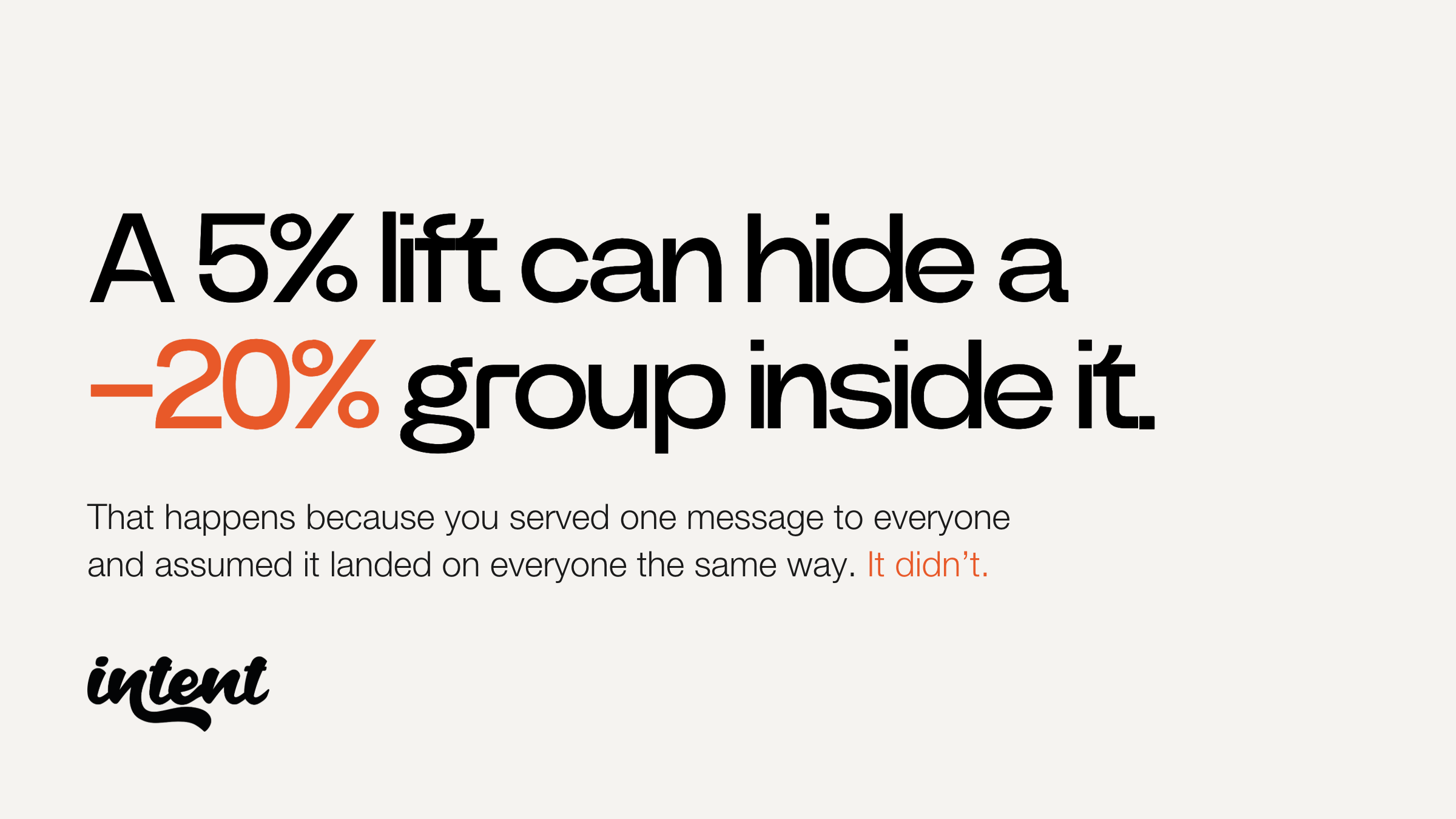
Say you add social proof and it lifts conversion 5%. Good result, ship it. But inside that 5% are hidden segments: one group at −3%, another at −10%, another at −20%, all quietly subsidised by a bigger positive somewhere else. That happens because you served one message to everyone and assumed it landed on everyone the same way. It didn't. People arrive at different stages of a buying journey, holding very different levels of intent, with different jobs to be done.
The fix isn't a better aggregated message, but it's serving the same message to fewer, better-chosen people, which sometimes means not serving it at all, because for that person, at that moment, it isn't right. It's what we call "inappropriate" at Made With Intent.
Therefore the cost is not amplifying existing messaging or features.
2. The cost of static is that the decision gets made before the moment that mattered.
A page is not one moment. It's thousands. Someone lands on a product page with real intent and loses it without ever leaving. They scroll to the reviews, pause, open the size guide, back up to the images, sit still for ninety seconds, drift toward the browser bar, come back, re-read the delivery copy. Every one of those changes what they need next. Not one of them is a new page load. How many single page views do you have?
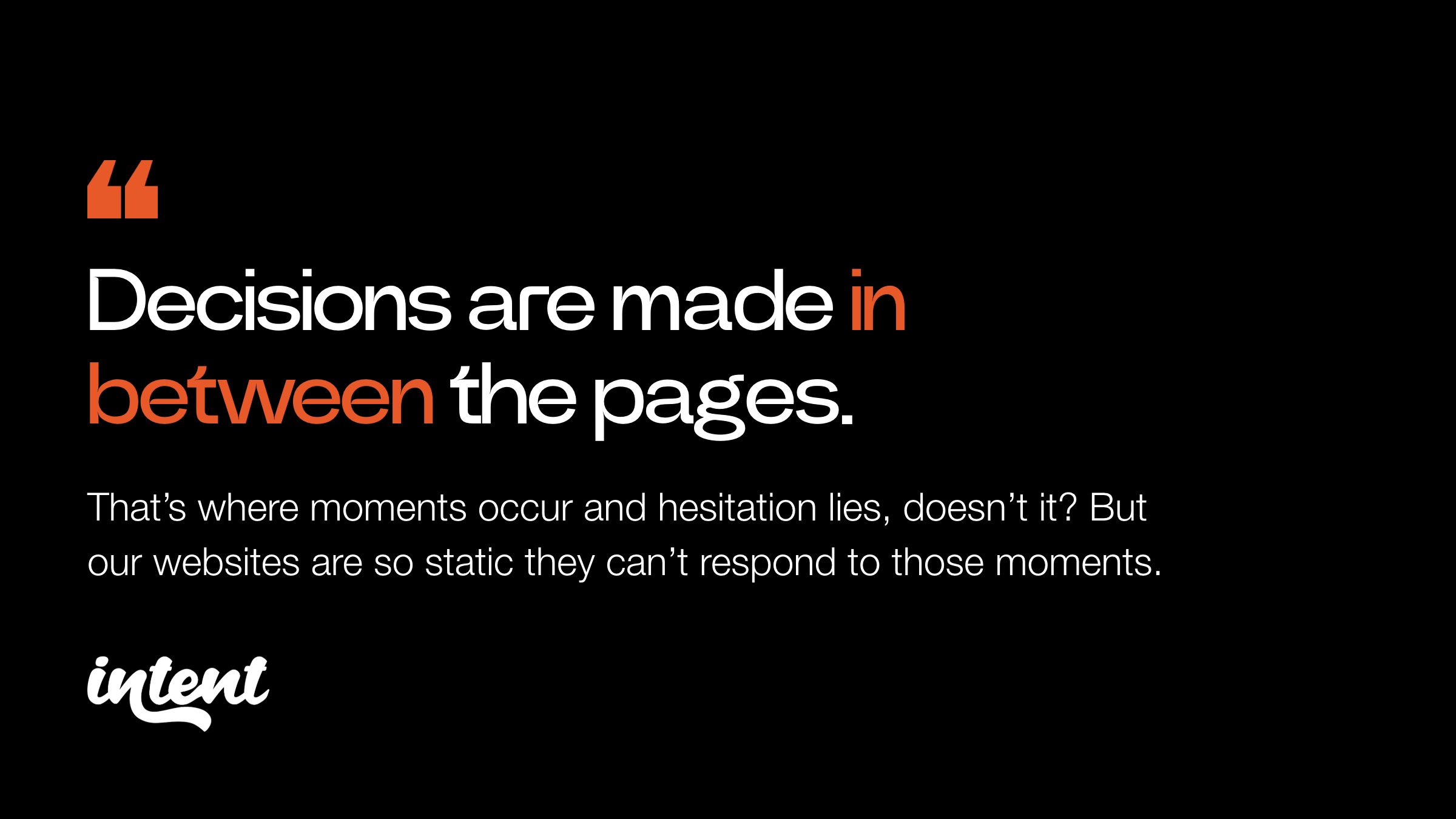
Decisions are made in between the pages. In between the events on the pages. The signals. That's where moments occur and hesitation lies, doesn't it? But our websites are so static they can't respond to those moments.
Therefore the cost is missed opportunity.
What actually moves each axis
1. You need a personal attribute
This is the part the industry got wrong for a decade. Personalisation was built on attributes like device, traffic source, returning versus new, pageview count. Those describe the circumstances someone arrived in. Spoiler alert: they aren't the person. They're website attributes disguised as aggregated proxies.
Pageview count is the clearest example of the problem. It's used as a proxy for engagement, when a confused shopper racks up far more pageviews than a decisive one. The proxy points the wrong way, and vice versa.
The most personal attribute available isn't who somebody appears to be based on their device, iOS, traffic source or what page they landed on. It's what they're trying to do: whether they're discovering or considering, confident or hesitating, likely to buy, likely to leave. Their intent.
That is a description of a person rather than a description of a session. There's a reason why personalisation is a noun person-alisation: the act of being personal.
2. You need a decision engine to scale delivery
A mechanism that serves content at the time that it's needed for the user. A delivery system that recognises that intent, serves content, re-recognises it, serves different content and evolves as such.
This means reading behaviour continuously rather than sampling it once at, say, page load. This is where you get to true two way communication between user and brand. In our case, at Made With Intent, that's around 800 signals per interaction, returned as predictions every few seconds. The decision travels with the visitor instead of being stamped at the door.
And it means something is allowed to keep re-deciding. Not a rule that fires once, but an allocation that gets revisited: which of your experiences is working, for whom, and when. Continuously, rather than as a verdict reached once and then defended. An agentic delivery system that responds at the time that it decides, on your guidance and guardrails, for true scalability.
These two things combined are what we do at Made With Intent and why we exist.
Examples
The shift sounds large. People often asked about the explosion of content that's required. In practice, it's usually the same asset you already own, just triggered differently.
Think about your email capture pop-up.
Nearly every site has one, and nearly every one fires on something arbitrary: one pageview, three pageviews, ten seconds. Static and generic. So a visitor arrives and is immediately interrupted by a request for their email, before they've been given a single reason to care.
With Intent: change nothing about the pop-up (the same design, same offer, same copy) and change only when it appears, to the moment each individual visitor is actually receptive. Dynamic and individualised. Submission rates tend to move sharply. Why? Because it's more appropriate at the time the user needs it.
Your USP bar.
Often three messages, shown to everybody, on every page, all of the time. Static and generic. The instinct is that more messages mean more coverage. We've all been there. "We must show this message because that's what users care about".
With Intent: focus creates impact: one message, chosen for the person, beats three competing for attention. Give the system the three you already have and let it decide which one this visitor needs, and which page, and after how long. Dynamic and individualised.
Your "You may also like" recommendations.
Without intent, it's static and generic, stuck at the bottom of the page serving everyone all of the time, assuming it impacts everyone the same.
With Intent: for example, to someone in a high-intent, ready-to-buy state, a strip of alternative products can be a distraction from the thing they'd already decided on. To someone in a low-intent, still-exploring state, it might be the most useful thing on the page and belong further up it. Dynamic and individualised. Let the agent decide who is what and let it serve that content.
Notice what none of these require. No new content. No redesign. No new journey. The content already exists. What changes is the who and the when — which is why this is a smaller programme of work than it sounds, and why it doesn't add much to anybody's workload. It's largely the same things the team was doing anyway, with different logic deciding how they're displayed.
Your personal shop assistant
There's an analogy we use at Made With Intent, a lot.
A good shop assistant doesn't decide how to help you based on which door you came through, or what you were wearing when you arrived. They watch. They listen. They read whether you're browsing or hunting, whether you look stuck, whether you're about to give up and leave. Then they respond, and if you clearly want to be left alone, they leave you alone.
They have intuition.
That's two-way communication, and it's what a static page can't do, because the page decided everything before you'd done anything. The ability to respond appropriately is where impact comes from.
Book a demo to see how Made With Intent can help you move from static and generic content to dynamic and individualised experiences.
"The website is good, it probably could be even better, no doubts. But it's "good enough". It does the job. It's stable. It's mobile optimised. It's got a good conversion rate relative to others and our expectations. What else can we do? Is it the right thing to do to have a team purely focused on conversion rate optimisation, or should we look more into product and trading? What even is the potential of our site?"
That was a thought-provoking quote direct from a prospect of ours in a recent sales call.
He's talking honestly about the idea of prioritisation and diminishing returns. A very well-known brand, decent infrastructure, good content, a site that works very well; probably even over-indexes on conversion rate efficiency if you're to compare it to competitors. He'd looked at the size of the remaining prize from making the digital experience better and quietly concluded it might be smaller than the prize from doing something else entirely.
This is a question of "where do you place your bets?"
I think they have reached a local maximum. For anyone who hasn't sat through the optimisation lecture: it's the top of a hill that isn't the top of the mountain. Every small step available from where you're standing leads downwards, so you stop climbing. Not necessarily because you've reached the highest point there is, but because you've reached the highest point reachable in small steps. Which is a fairly precise description of what a decade of testing does to an already-decent website. In other words, getting to a higher peak means changing direction.
He's asking the right question in my opinion and I think the honest answer is uncomfortable for most of the industry I've spent my entire career in, especially the purists.
This brand hasn't necessarily hit the limit of what's possible on their website. But instead has hit the ceiling of the average and anything further sees diminishing returns where the effort doesn't necessarily equate to the value. That, or he's potentially bored with the same-same solutions that are out there. Homogeneity is the killer of excitement.
I empathise. I got bored too.
I founded User Conversion; one of UK's most successful (read: largest?) independent conversion rate optimisation agencies. We did well, working with some of the biggest brand names the UK had to offer.
But like the above brand, over time, I grew more and more skeptical. A lot of our recommendations lacked creativity, they were all addressing similar problems with the same solutions. "Moving deck chairs on the Titanic" is what someone once put to me.
Conversion rate optimisation is a process of problem-solving with evidence based solutions. Learning, uncovering opportunities and problems, and fixing those problems; usually through AB testing (well, that's the outcome that most cared about; because it's sexy). And I'm not suggesting that the learning and the opportunities dissipate, but the solution often lacks impact because of the law of diminishing returns, their heterogeneity and the aggregated nature of them.
The evolution resolution beyond CRO
Conversion Rate Optimisation, for stakeholders at least, is a way to make the website earn more; and there are four ways to do that. Most of us have treated them as a maturity ladder. You graduate from one to the next, and the last one is the good one.
That's not quite right. It's less an evolution and I now see them more as levels of resolution where each one narrows the unit of decision.
Level one: conversion rate optimisation. The unit of decision is the average visitor. You look at where people struggle, you fix it, and the fix applies to everybody. This is genuinely valuable and I'd never argue otherwise but it is a) practically often an exercise in usability improvements and b) definitionally serving the mean.
The first statement encompasses this idea that the majority of solutions are things that don't change behaviour, they facilitate existing behaviour. Usability improvements. Small changes that ill-advised vendors purporting marketing promoting statistics have convinced us are worth the effort. We've all seen them. The famed 500% uplifts. Sticky add to cart buttons, adding trust signals under a call to action, that sort of thing. Read: deck chairs on the Titanic.
The second reinforces the statement that the mean doesn't exist. Instead, it is a continuously moving combination of different intent levels. Our own research found that, say, 10% of visitors sitting on checkout pages aren't ready to buy yet. Or that 34% of users never get past browsing, whatever page they happen to land on. There is no average shopper to optimise for, there are different jobs to be done. There's a distribution we've been flattening for twenty years because flattening it was the only thing we could do. And now we're used to that, we lack creativity of how to proceed.
Level two: experimentation. It's the same unit of decision, the average, but now you've proven it. This matters enormously and it's the most rigorous thing most organisations do.
From experience, it often comes in two flavours:
1. The immature version lives inside the CRO team or the marketing function, running client-side tests and it caps out at about four to six experiments a month. That ceiling is a resource limit, often not a statistical significant limit; people, build time, roadmap slots. You'll find here that you'll max out at a certain number of tests usually and your impact is limited to avoid cross-contamination of tests. Ever found yourself saying "we can't run a test on a PDP because we have something running there already?"
2. The more mature version is server-side experimentation, owned by engineering, decentralised across product teams, with testing built into the release process rather than bolted onto it. That version is genuinely near-limitless in cadence, and if you can get there you should; it's fantastic.
But note what even the mature version is for. It's designed to prove or disprove a claim about the population. One answer, for everybody, with confidence attached. That's the instrument working exactly as intended; but it's still an answer about the average. It's also an answer about the website, not the visitor (more on that later).
My prospect's line was exactly this: "For the years we have experimented, we did not see huge benefits. That's probably also what hindered further investment." I've heard that sentence in some form from almost every brand I've worked with.
Level three: personalisation. Here the unit of decision finally narrows to the segment. And here is where the industry has spent a decade making promises it couldn't keep. Unfortunately, to the extent where we now all hold PTSD; personalisation traumatic stress disorder.
Personalisation didn't fail (that's right, I said it failed) because it was a bad idea, every boardroom still talks about it to this day. Trust me, I literally wrote the book on it: The Person in Personalisation.
It failed because it doesn't scale, for two reasons, both of which compound.
1. First, you have to guess the segments before you have any evidence about which distinctions matter. Those pre-defined segments like "returning visitor," "paid traffic," "landed on a PDP" are website attributes, not people attributes. That's not person-alisation that's website-alisation, isn't it? Pageview count stands in for engagement, when a confused shopper racks up far more pageviews than a decisive one i.e. it's not true person-alisation.
2. Second, the arithmetic defeats you. Split traffic three ways and every test takes three times as long to reach significance. Try to prove the segments genuinely differ and you're chasing an interaction effect that needs roughly four times the sample again. A three-week test becomes a quarter-long project, and most teams call it early and ship an artefact, or just don't have the traffic (and therefore patience) i.e. it's not scalable.
So personalisation became a small number of hand-built manual rules, maintained by someone who'd rather be doing something else, delivering less than it promised. Ever wondered why recommendations was the only successful personalisation that brands have achieved? Because it's autonomous; in other words, scalable.
Level four: agentic delivery, with intent as the context. This is where we, Made with Intent, sit. The unit of decision becomes the person and what they're trying to do in the moment. Not the segment on retrospective data. Also, not the average. And critically, nobody writes the rule.
You give the system a strategy and a set of experiences that are already evidenced. It works out which of them suits which state of intent, person by person, at the time that it matters, and it keeps working it out. Nobody writes the rule.
Take one of our customers, Diamonds Factory who had a single basket-abandonment tactic: 25% off, to everybody. They gave the agent four options instead and let it choose between them. Most people, it turned out, didn't need the full discount to convert. And 15% needed no intervention at all.
That last number is the one that matters, because no level below four can produce it. A test has no vocabulary for show this to nobody as a good outcome. Not even the control of an experiment can show you that because a user is never bucketed into both the control and the treatment. A rule-based segment can't discover it. It only appears when something is allowed to decide, per person, whether to act at all, in the moment that it matters.
The Future of Personalisation
I think we treated this as four evolutionary components within a single ladder when, in fact, they're two.
• Levels one and two are about how sure you are. "Does this work." Think of this as 80% exploration, and 20% exploitation.
• Levels three and four are about how precisely you aim. "For whom does it work best, when should it be shown, and do a proportion of users even need it at all?" Think of this as 20% exploration, and 80% exploitation.
Conflating them is why so many personalisation programmes were run by people optimising for certainty, and why so many experimentation programmes never escaped one answer for everybody. Confidence and aim are different problems. You need both, and the tools for each are not the same tool.
The industry has worked out that continuous contextual allocation beats a fixed split. That's 50% of personalisation; serving "the right person, at the right time, with the right message".
The other 50% are the attributes that determine whether something is personal; and for us that's their intent. Their context. Their job to be done. The differentiator is what you put in the context window. Not a website attribute like device or location, because they describe who someone appears to be. Intent describes what they're about to do. One of those is a proxy and one of them is the thing itself.
What I'd actually tell my prospect
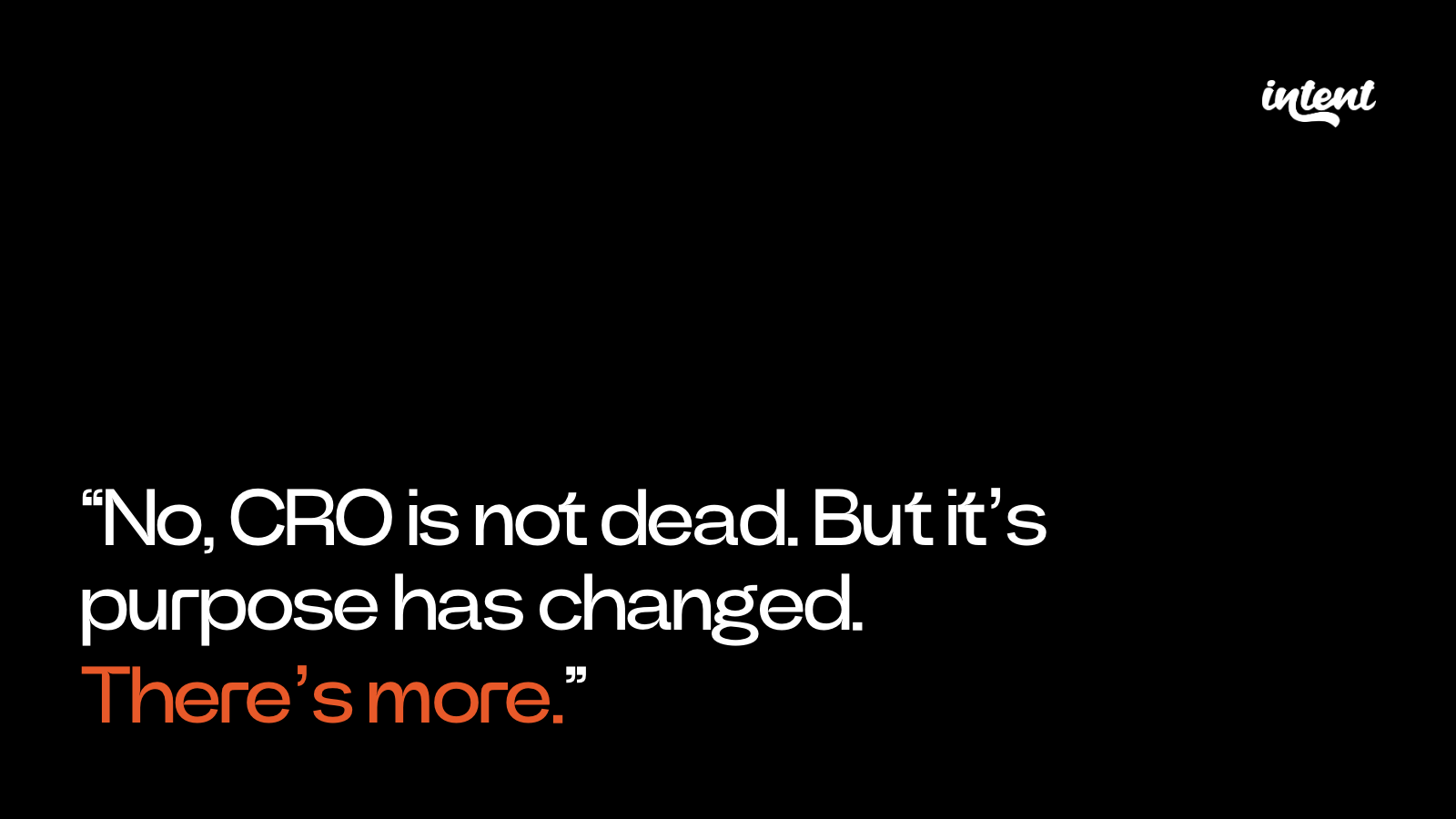
Not "invest more in CRO." And not "stop doing CRO," either, because each of these levels still holds a purpose and pretending otherwise is how vendors lose credibility. No, CRO is not dead.
But its purpose has changed. There's more.
Sure, if something is broken, fix it. If a step in the core journey confuses everyone like a login, a checkout, a filter that doesn't work, then everyone passes through it, the fix helps or hurts them all in the same direction, and the right answer is one answer. Optimising the average isn't a failure of ambition there. An experimentation partner of ours put it well: you don't stop the research, you don't stop the UX work, and if you don't have people designing properly for their users you're finished as a business regardless of what any agent does on top.
But once the site is good enough; once you've fixed what's broken and the remaining UX gains are genuinely marginal, I think the question changes. It stops being how do we make this better for everyone and becomes which of the things we already have should this particular person see, and when, and should they see anything at all.
Essentially the argument of diminishing returns. Unless your site is broken, terrible UX, or hard to navigate; the best bet is dynamic, trading-related experiences which capitalise on serving the right content at the right time. Sure I'm biased, but this is my arc within this industry over the past 15 years. I've seen what's possible and I'd like to share it with the world. A TLDR;
There are different ways to optimise, but just note that I've seen first hand that scalability is the biggest constraint to success. Not just that, but doing the same as everyone else, particularly "moving deck chairs on the Titanic" won't get you very far unless the baseline is so low.
The opportunity is vast. It amplifies existing experiences by autonomously serving those only to where the experience is best seen and best felt, excluding where it's not. Because no one in the organisation owns it, or because we are so accustomed to the way things work currently; the opportunity is still sitting there.
My prospect's instinct was right. He should probably move effort away from optimising the average. Just not away from the website.
If you're interested in how CRO is evolving, and want to learn more about intent-based personalisation, get in contact with our team here.
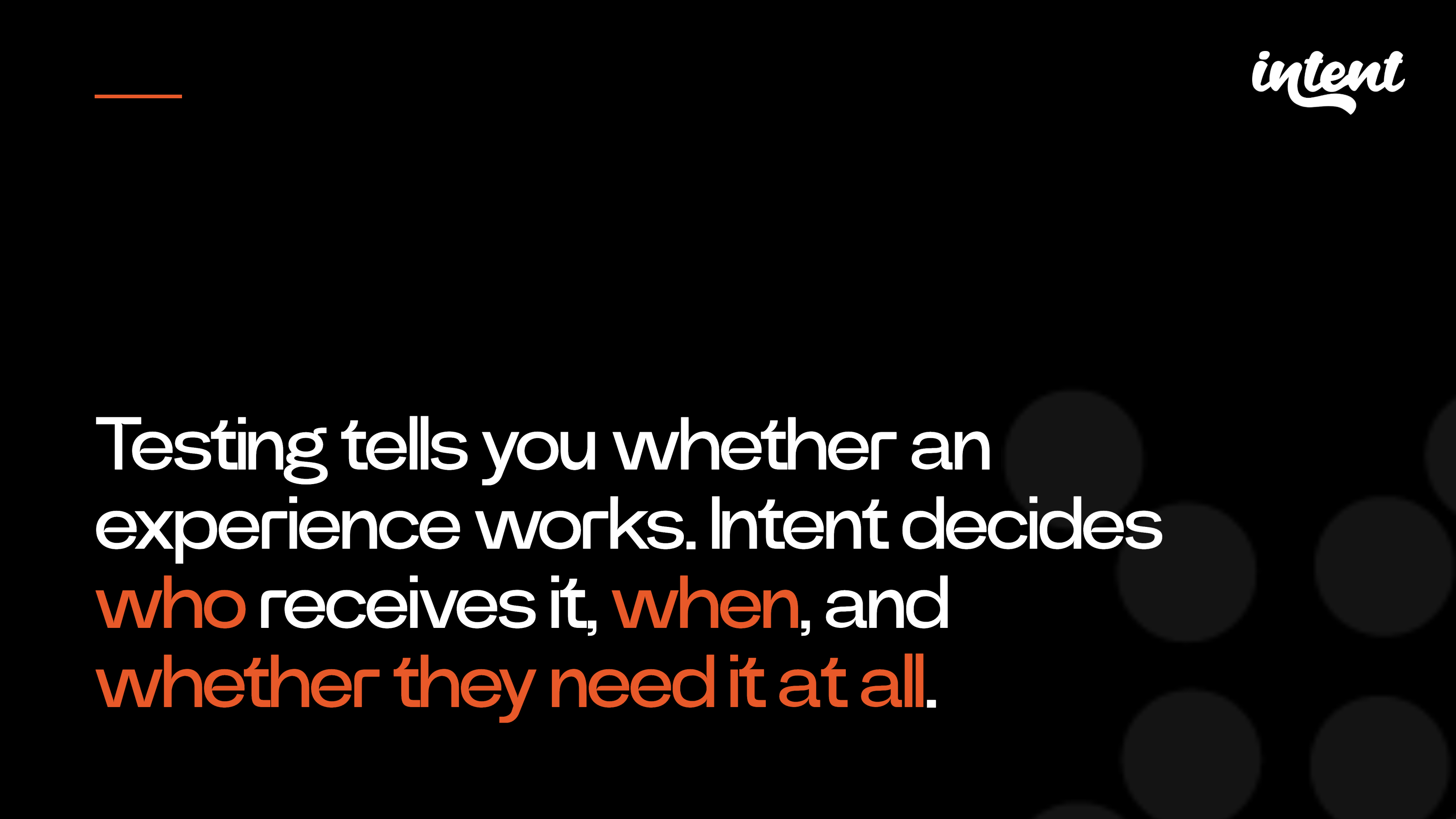
Experimentation is evidence to determine whether something works. Intent decides who receives what, when (or whether they need it at all). “Does this work.” Think of this as 80% exploration, and 20% exploitation.
The first works towards the best single answer for everybody to prove a hypothesis. The second works out where a single answer was never going to be enough; scaling a proven hypothesis for true commercial gain. “For whom does it work best, when should it be shown, and do a proportion of users even need it at all?” Think of this as 20% exploration, and 80% exploitation. Where testing tells you whether an experience works, but Intent decides who receives it, when, and whether they need it at all.
In this blog post, we'll identify the differences between Intent and experimentation, so you can understand when to utilise each strategy to further your business goals.
Defining A/B testing
An A/B test answers one single bounded question.
Does this change (a treatment) move the metric we care about, across our traffic, better than the alternative does (a control)?
It's a hypothesis, and what comes out the other end is 80% knowledge (learnings) and 20% value (hopefully positive gain). A primary "does this prove or disprove our hypothesis" binary answer.
Our intent engine answers a different question, and it answers it again every few seconds throughout a users session:
Given what this visitor is doing right now, which of the experiences we already know works suits them at this moment in time? (If any)
What comes out of that is not just a single decision, but hundreds of them a second, all trying to move the agents primary goal, or reward. The open question stopped being does this work a long time ago. What's left is who needs it, and when.
For example: if a visitor starts showing signs of basket abandonment. You can put a returns message in front of them, or a discount, or a trust signal, because you already trust all three of those mechanics. What you don't know is which one that particular person needs, at what point, or whether they need any of them at all. That's the decision the agent is making.
There are several reasons why experimentation (read: split testing) might not be an appropriate mechanism; here are four reasons:
But first, a note on the word experimentation. Throughout this set, experimentation means the whole practice of using evidence to drive ideas: user research, usability testing, prototyping, quasi-experiments and switchbacks where a split isn't possible, and A/B tests where it is. The split test is one instrument inside it, usually the last step rather than the whole of it.
1. Averages can lie.
An A/B test reports an average treatment effect which can hide segments or audiences that have a detrimental or negative impact.
An A/B test reports an average treatment effect. That's the whole point of it. Randomising across your population is what buys you a causal claim in the first place. The price you pay is that the average swallows everything inside it. A headline +2% can be +12% for hesitant first-timers and -4% for loyal returners. Same test. Same green tick. Two completely different stories.
Statisticians call these heterogeneous treatment effects, and there's good evidence that acting on them beats a blanket rollout. In one worked simulation of a ranking change, treating only the 69% of users predicted to benefit delivered a 2.2% gain in revenue per user against shipping it to everybody. A CUNY study of financial aid nudges captured roughly 75% of the total benefit while treating half the population.
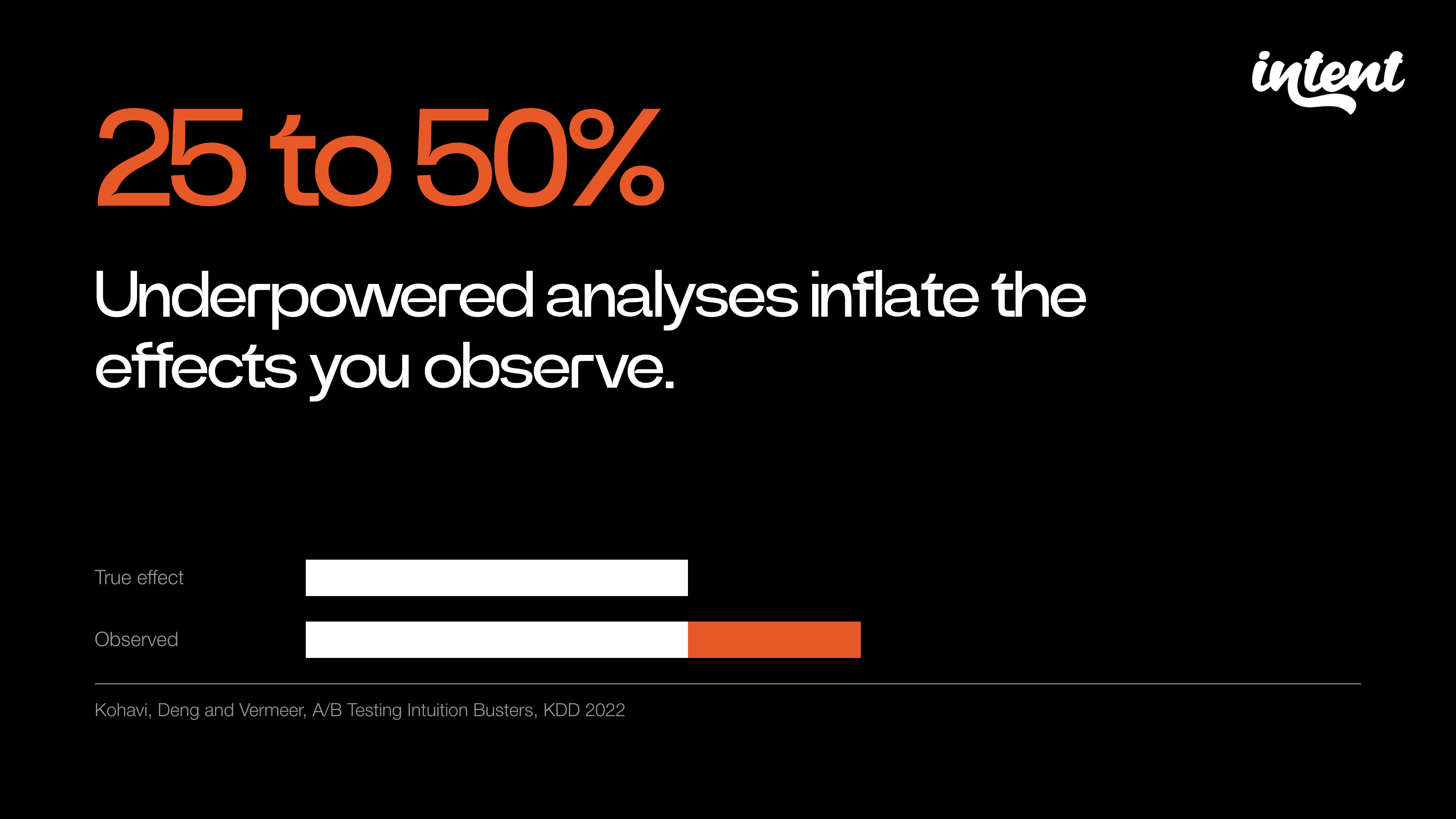
Experimentation is deliberately built to stop you trusting the segment breakdown. Pre-registration, power calculations, no post-hoc slicing. Those rules exist because sliced results are where false positives breed. Kohavi, Deng and Vermeer's A/B Testing Intuition Busters (KDD 2022) found that underpowered analyses inflate the effects you observe by 25 to 50%. At the power levels most mid-market programmes actually run at, over half of your significant results are false positives. So the question you have to answer to deploy well, for whom, is the question your test is worst at answering. That's a boundary, and a sensible one. Intent sits on the other side of it. It predicts for every visitor in advance, rather than carving up a sample after the fact.
Where Intent solves this problem: The experience is being delivered across hundreds of contexts, reallocating to where the experience "works" (where it's best seen and best felt), excluding it from where "it doesn't work." In theory, it only looks and focuses on the good, excluding the bad.
2. Testing assumes the trigger.
Every A/B test starts from a fixed, assumed rule (usually on page load). The trigger "when to show it" is often assumed, arbitrary, and based on a website proxy like "3 page views" or "PDP" rather than genuine user intent.
Nearly every A/B test starts from a fixed rule. Show this on the PDP after three pageviews. Fire this on exit intent. Serve this to returning visitors. Then it tests which creative performs best inside that rule.
The treatment gets examined. The trigger gets assumed.
There's a practical reason for that. The trigger space is far too big to write out by hand. Nobody can enumerate every combination of buying stage, purchase confidence, abandon risk, intent trend and product affinity, let alone power a test across them. So teams pick a proxy or an average and move on.
Proxies are usually where the damage happens. These are largely based on website attributes as opposed to personalised signals. Returning visitor stands in for higher intent. Mobile stands in for lower intent. Pageview count stands in for engagement, when a confused shopper racks up far more pageviews than a decisive one, and high intent visitors often convert inside three.
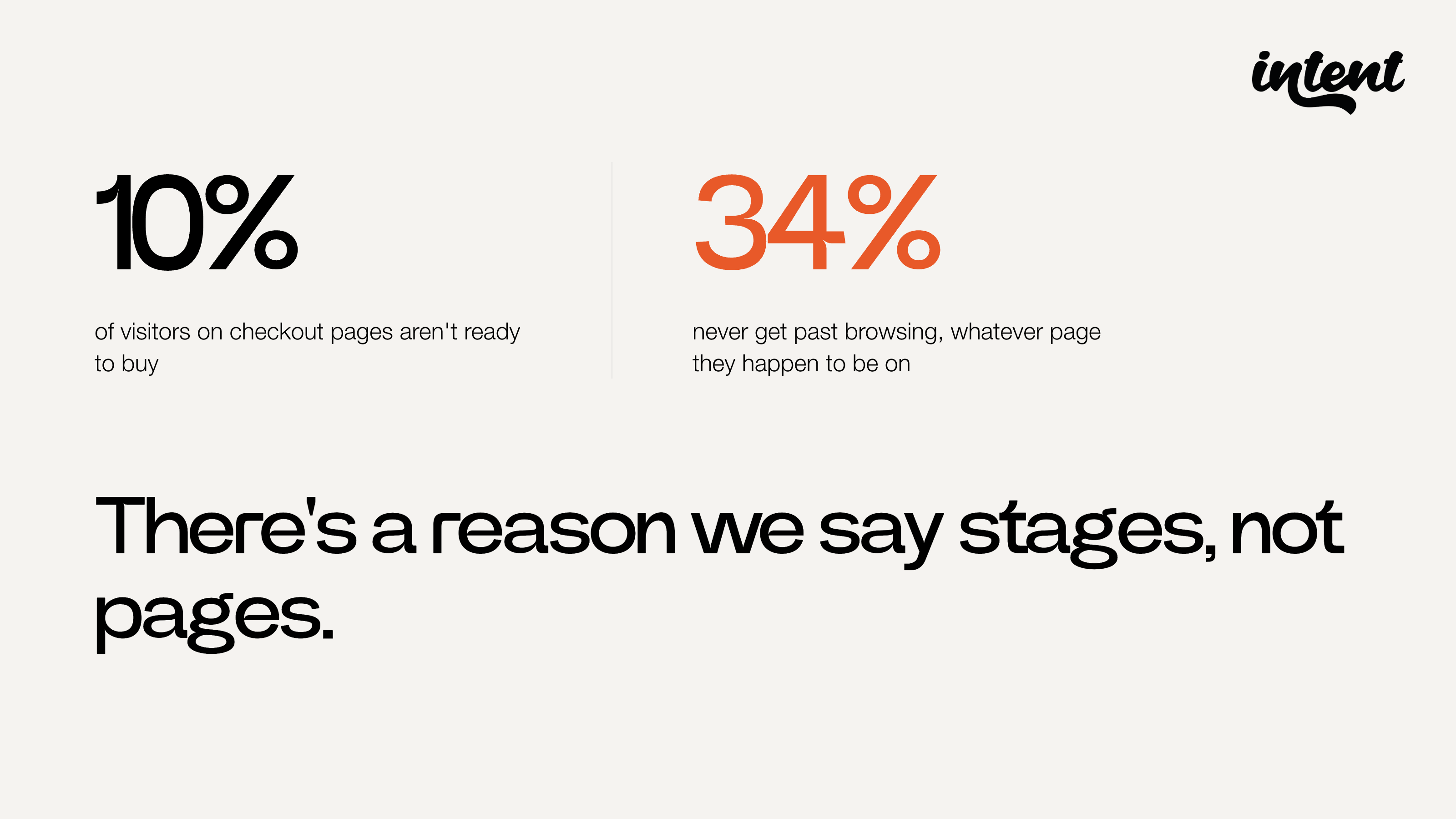
Our own Intent Gap research found 10% of visitors on checkout pages aren't ready to buy. And 34% never get past browsing, whatever page they happen to be on. There's a reason we say stages, not pages.
Where Intent solves this problem: Intent agentic delivery serves the individual at a moment in time. A user might need an experience on the 3rd page view after 30 seconds, a different user might need it after 50 seconds, a different user might need it after 9 page views and 1 second. The continuous prediction modelling gives a threshold to meet first, and then a mechanism to automate a decision second.
3. Statistical significance is a search for one answer.
The search for statistical significance can a) slow you down and b) inhibit your ability to personalise to different segments.
Significance exists to license a claim about a single population, and the claim is singular by design where B beats A: one answer, for everyone. That is exactly what costs time.
You need a sample big enough to speak for the whole population with a minimum detectable effect. If you want the claim to be about a segment instead (what some call "personalisation") you need that sample inside the segment too, so the wait multiplies. Most claim they don't have the traffic to personalise because of this.
Experimentation vendor's posterior is a belief about a variant. One distribution per arm, computed across everybody who saw it, resolving to a single winner for all your traffic. Better maths than a p-value, and the shape of the answer is identical. One number per variant, and a threshold you wait to cross before you act.
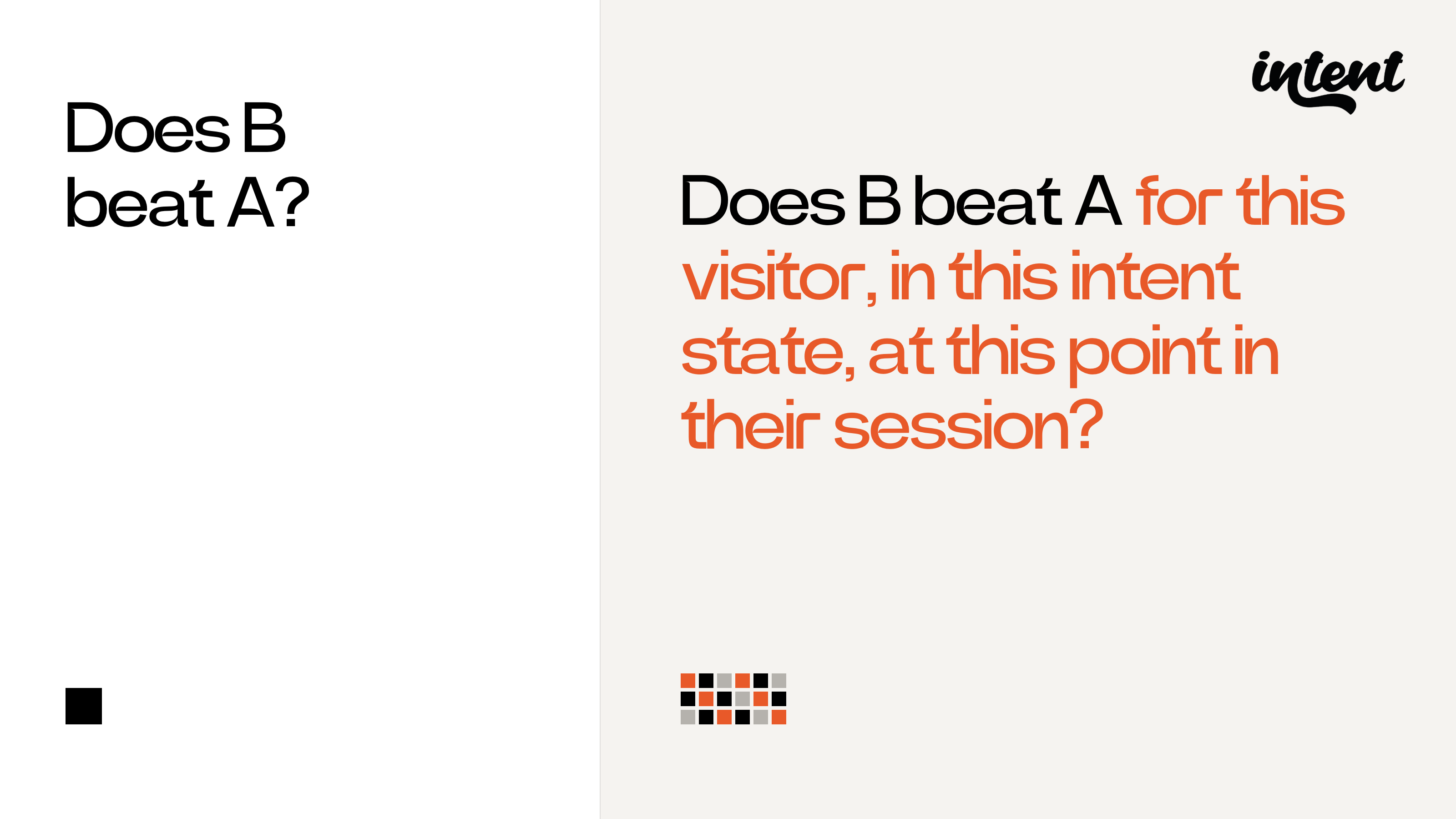
Our posterior at Made with Intent is a belief about a variant given a context. Where their question is whether B beats A, ours is whether B beats A for a visitor in this intent state, at this point in their session. The model predicts reward conditional on context, so what comes out is a policy; hundreds of answers, running at once.
Put it this way: instead of a human designing three segments and running three underpowered tests, the winner goes to the agent alongside its alternatives and the segment level optimisation runs continuously. Three mechanisms make that more traffic-efficient than a segmented test. Worth understanding rather than taking on trust.
1. Allocation is adaptive. Thompson Sampling draws plausible performance rates from each variant's posterior and routes traffic accordingly, so your exploration cost falls as confidence climbs rather than sitting at 50% for the duration. In practice agentic campaigns push 80 to 90% of traffic to the winner inside two to three weeks. A fixed-allocation A/B test takes around six. Optimised Control shrinks the control group automatically as confidence grows.
2. Without waiting for statistical significance. It borrows statistical strength across slices. This is the important one. Made With Intent runs a contextual bandit, not a multi-armed one. A multi-armed bandit only learns from the data each arm receives, so every segment needs its own volume, which is the same problem as a segmented A/B test in different clothing. A contextual bandit trains a model that predicts reward given context, so it can estimate performance for a combination it has never directly seen. Show it mobile traffic, low intent traffic and a particular page separately and it can predict for "mobile, low intent, that page" by generalising from how each component behaves. A hand-built segment can't borrow like that. Every cell starts at zero.
3. You're not assuming which segment to slice or review. The agent can build up to 500 contextual combinations and up to 75 moment-based triggers per campaign, and it trims its own feature selection to keep each slice sample-rich. Nobody has to guess which distinctions matter before there's evidence about which ones do.
Why we don't report per-segment significance
This surprises experimentation-native teams more than anything else in the product. It's a deliberate methodological choice.
Run an independent significance test on every intent combination and multiple comparisons swallow the results. At α = 0.05, roughly 14 independent tests give you about a 50% chance of at least one false positive. A hundred tests will throw up around five false positives by chance alone, and across hundreds of combinations you'd be manufacturing findings.
We trialled per-segment significance reporting and pulled it, because it surfaced spurious and inverse correlations. For example, users traverse through different stages of intent in their journey, at what point is a user in low intent and when did they see the treatment?
The per-segment decisions get justified differently. Is the model calibrated, meaning when it says 70% does it convert around 70% of the time (measured by expected calibration error)? Is it discriminating, meaning can it rank likely converters above unlikely ones (AUC around 0.84)? A well calibrated probability is a legitimate basis for acting on a slice. An underpowered significance test on that same slice is not.
This calls back to something we talked about earlier.The reason you shouldn't chase per-segment significance in your testing tool is the same reason we don't chase it in ours. Prediction is the right instrument for the for whom question, retrospective slicing isn't.
Why we don't report on single variant uplifts
You get one clean causal number, control against the agent's allocation, measured the way any experimentation lead would want it measured. You give up per-arm inference, and in exchange the arm is adaptive. That's the trade. An A/B test gives you clean inference on every arm and one winner for everybody. An agentic campaign gives you clean inference on one arm, and a different winner in every context.
Load five experiences into an agentic campaign and it looks like a five-arm test. It isn't. It's actually a two-arm experiment, the same shape as any A/B test you've run. The difference being:
• Control. A baseline you define.
• Variant. The agent's allocation across all five experiences.
A traditional A/B test asks which variant wins with a blanket rule. An agentic campaign asks a different question with an adaptive rule (it's a reason why we call them campaigns, not experiments)
Does allocating these experiences by intent beat applying a blanket rule?
We don't report on single variant uplifts eg: Variant B is better by 5% because:
1. There's no single number to give you. Experience B might be the winner for high intent, budget-conscious mobile visitors and the loser for low intent desktop. That's the entire point of running it this way. Collapsing it to one figure puts back exactly the average this campaign exists to get rid of.
2. The arms were never randomised against control. Traffic reaching experience B was chosen by the agent, on context and accumulated evidence. It isn't a random slice of your audience so there's no effective control. Comparing a deliberately selected group against everybody is confounded by construction, and nothing in the data separates the effect of the experience from the effect of the selection.
3. You'd be reading a state the system has already left. If experience B was struggling in a context, the agent would have noticed days ago and moved traffic away (hence: reallocation). The number in front of you is an average across a period in which allocation was actively changing, and the campaign has moved on since. Acting on it means acting on history the agent has already corrected for.
That distinction does three things, in order.
1. It changes what you can personalise. A per-variant posterior can only ever produce one answer for everyone, however good the statistics behind it are. Varying what people get requires probability conditional on the person. That's the whole game, and it matters far more than the frequentist argument ever did.
2. It changes when you can act. Certainty becomes a dial rather than a gate. At 62% probability, Thompson Sampling tilts the allocation and updates again tonight. Nobody declares anything. A stopping rule stops being necessary once allocation is continuous.
3. It changes how fast you get there. Nothing is waiting for a threshold, so allocation improves from the first night onward. There's no finish line to reach before the work starts paying.
Where Intent solves this problem: Our posterior at Made with Intent is a belief about a variant given a context. Where experimentation question is whether B beats A, ours is whether B beats A for a visitor in this intent state, at this point in their session. The model predicts reward conditional on context, so what comes out is a policy; hundreds of answers, running at once based on a series of probabilities using a contextual bandit.
4. Limited to a single answer for only one point in time.
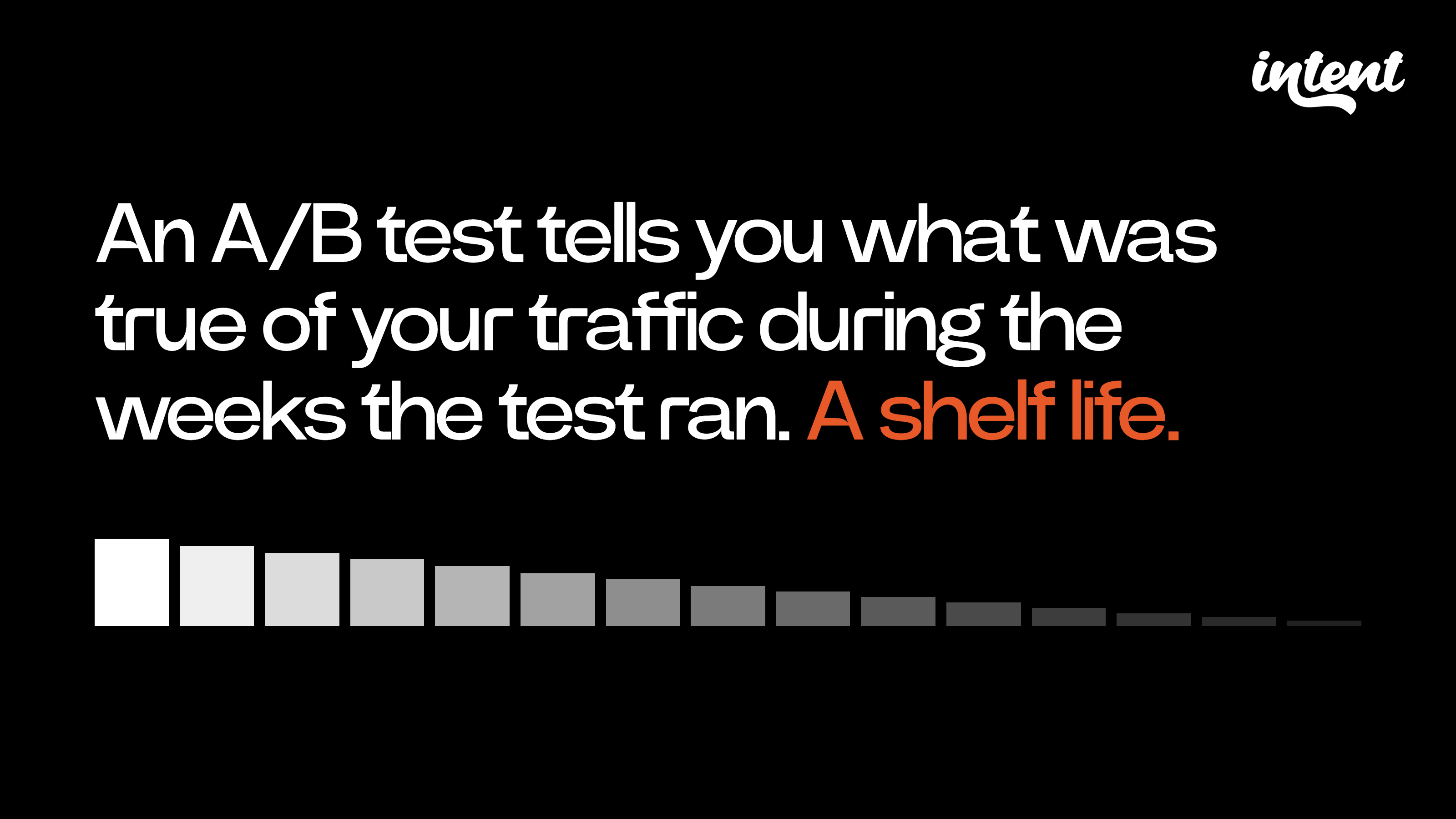
An A/B test only tells you what was true of your traffic during the weeks the test ran.
An A/B test tells you what was true of your traffic during the weeks the test ran; a shelf life. Nothing about that answer refreshes itself so brands often end up "re-testing" the same thing a few years later, hoping there's no change from a previous positive test. The world moves on, results degrade as users become "used" to the treatment, competitors copy; not to mention that your purchase lifecycle varies by days, weeks, months, years.
For example: a Microsoft experiment on MSN.com saw replacing one button with another produce a 4.7% increase in overall clicks. The daily breakdown post launch showed the difference decreasing rapidly day over day as users learned the change, leading to the team shut the experiment down mid-way. The conclusion was that the observed treatment effects "are not always permanently stable, sometimes revealing increasing or decreasing patterns over time."
There are a few reasons why this happens.
1. Novelty and primacy wear off. A new element gets attention because it's new. Returning visitors are briefly worse off because it isn't what they knew (which is why tests are often split, somewhat arbitrarily, between new and returning users)
2. Buying patterns differ throughout the year. December traffic behaves nothing like March traffic, different intent, different price sensitivity, different tolerance for being interrupted (especially for retailers)
3. The population itself drifts. Mix of paid traffic allocation shifts, category mixes alter or a competitor changes their delivery proposition. Macro-economic factors alter the interaction effect.
Does a mature site slowly accumulate a layer of decisions that were correct once, are serving everybody by default, yet are answerable to nobody? It is entirely possible to have a well-governed testing function and a site full of expired answers at the same time.
Where Intent solves this problem: Continuous allocation doesn't have this failure mode, because it never declares anything. The posterior is a live belief rather than a verdict, continually reallocating and therefore responding to changes, not static. Allocation is re-scored against current behaviour and retrained nightly, and standing exploration keeps a small share of traffic asking whether the current answer is still the right one. When February stops behaving like November, the agent finds out because it never stopped looking.
Intent vs experimentation: In depth
We've done a quick reference table on the differences between Intent and experimentation. Take a look, send it to your colleagues. You're welcome.
Experimentation
Intent-driven agentic delivery
Purpose
80% Exploration, 20% exploitation. Tells you whether an experience works
80% exploitation, 20% exploration. Tells you who receives an experience, when, and whether they need it at all.
What it decides
What to do, and whether it works. Proving a hypothesis.
Who receives it and when (or whether anyone should right now)
Unit of analysis
Entire population with an average effect.
The individual visitor, in session, re-scored continuously
What comes out
Evidence you can act on, value at an aggregate level.
A continuous daily allocation to where each experience is best seen and felt (i.e what works)
What counts as success
A trustworthy answer, including a learning of no effect
Incremental orders and protected margin
Best answer it can give
One answer, for everybody
A different value per person and per moment
How it's governed
Statistically. Power, statistical significance
Commercially. Probabilities, predictive modelling
What the probability is over
A variant. One posterior per arm, across everyone exposed. Frequentist or Bayesian, the shape of the answer is the same.
A variant given a context. A posterior per experience per intent state, so the output is a policy rather than a winner.
Arms under test
N variants, each measured against control. One winner, rolled out to everyone.
Two. Control against the agent's allocation policy. The policy contains N experiences, allocated per context.
Hit rate
10 to 20% of ideas move the target metric. Roughly 1 in 500 is a breakthrough. (Kohavi et al., 2014)
77.6% of agentic campaigns produce a result, against the under 20% of tests that beat their control. Different denominators, worth saying out loud: a campaign counts when it finds the right answer for some contexts, a test counts only when one variant beats another across everybody.
Time horizon
Fixed at the test window. Degrades silently after rollout; only a re-test reveals it, and nothing prompts one
Nothing is declared, so nothing expires. Reallocated nightly against current behaviour, with standing exploration watching for drift.
Experimentation and Intent aren't solving the same problem, and treating them as substitutes is where most testing programmes stall. An A/B test proves whether something works for everybody, on average. But it can't tell you who needs a returns message versus a discount versus nothing at all, and it becomes redundant the moment the traffic that validated it moves on.
Intent picks up where that boundary sits, deciding who an experience is for, when, and whether they need it at all, re-scored every few seconds instead of declared once and left to expire. Most eCommerce teams already have the first instrument. The second is what turns that evidence into revenue, visitor by visitor, instead of one rollout for everybody.
Book a demo to see how Made With Intent can help you deliver more appropriate experiences to your customers.
August 25, 2026
Become an Intent Insider
Get subscriber-only insights straight to your inbox. No spam. No inappropriateness.
You're in. Welcome. Expect an insider-only email soon.
Oops! Something went wrong while submitting the form.
By submitting this you agree to our (more than fair) terms.
This site uses essential cookies to run properly and optional cookies to improve your experience. Optional cookies only run if you accept them. Privacy Policy here.