Editor's note: this article is adapted from a recent Intent Live session with Jack Simkins, Digital Product Manager at Golfbreaks.com. Watch the full recording here.
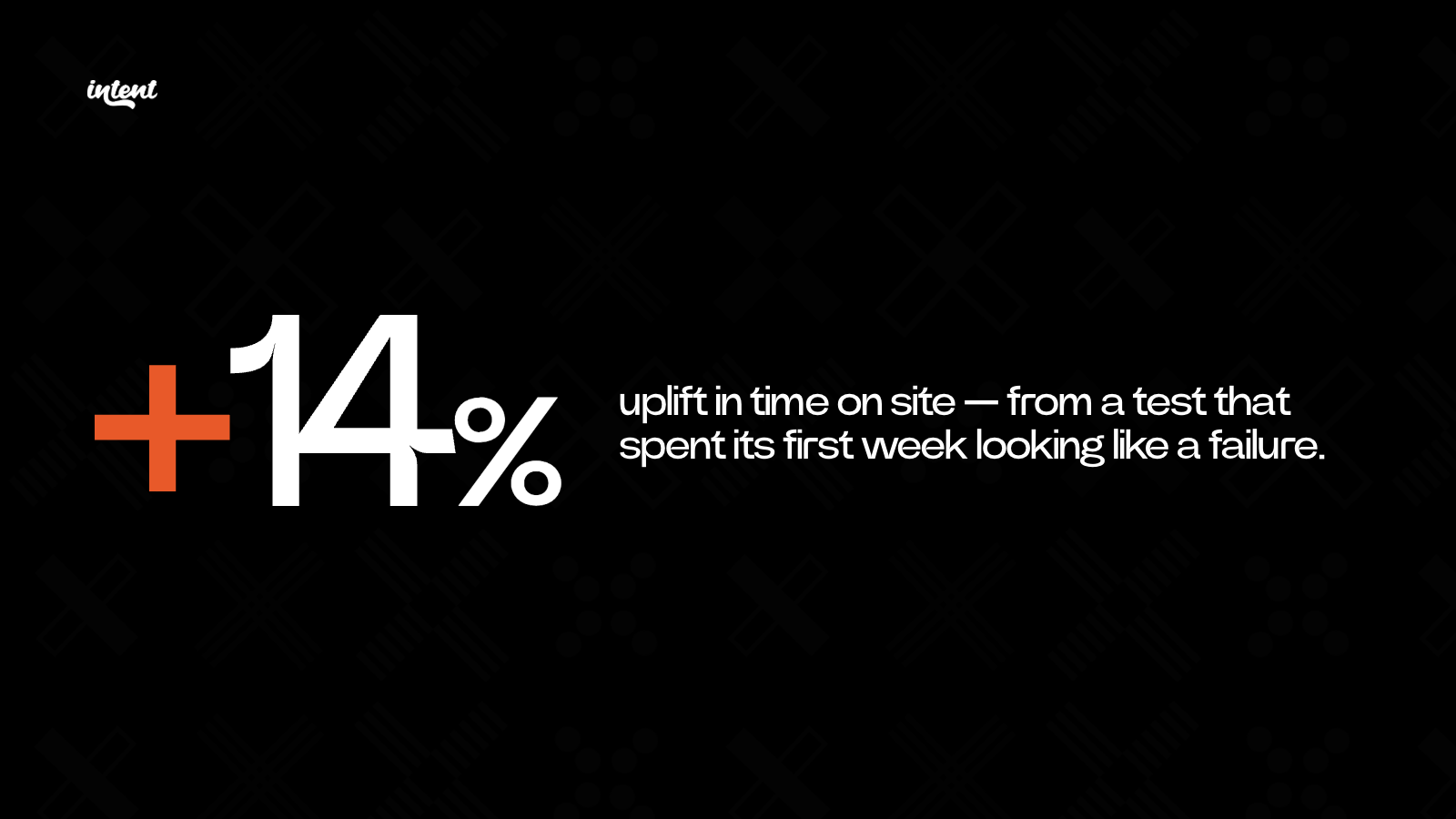
A test that lifted time on site by 14% still spent its first week looking like a failure. Conversion rate was down. Under a traditional A/B testing programme, Golfbreaks.com would have pulled the experiment.
They didn't. And the reason why says a lot about what happens when a genuinely high-consideration purchase journey meets a testing programme built for one-session eCommerce.
Golfbreaks.com is a golf tour operator based in Windsor, with offices in Copenhagen and Charleston, though the Made with Intent account focuses on the US and UK. It sends golfers on trips ranging from a single night in the UK to a week in Spain or Portugal, across a lot of different golfer segments. It's a lead generation business first. Visitors don't check out online in one sitting, they enquire, then a sales agent works out flights, transfers, accommodation, and course access, and gets them to a booking over the phone, sometimes weeks later.
That's not unusual for travel, where research and comparison typically happen across several separate visits and sites before a decision gets made. Optimising a single-session conversion rate for a purchase that actually plays out over weeks measures the wrong moment entirely.
A booking journey that can't be forced into one session
Jack has spent seven years at Golfbreaks.com, the last couple focused on conversion rate optimisation. "We've got quite a unique scenario whereby we're trying to encourage that inquiry," he said. "Particularly in travel, in the industry in general, it's quite an unusual thing to not be able to book entirely online."
A small portionof trips get booked online. But most go through a sales agent, because a golf trip has too many moving parts (courses, transfers, flights, accommodation, and group logistics) for most visitors to configure and commit to in one sitting.
Colin Spooner, Principal Value Consultant at Made with Intent, put his finger on why that matters: "It's not our traditional eCommerce brand where it's a pure purchase journey. But that almost plays into the hands of intent, where you need to think about that considered purchase and how to get people through the funnel before even thinking about the booking, weeks and months down the line."
Measuring what happens before conversion
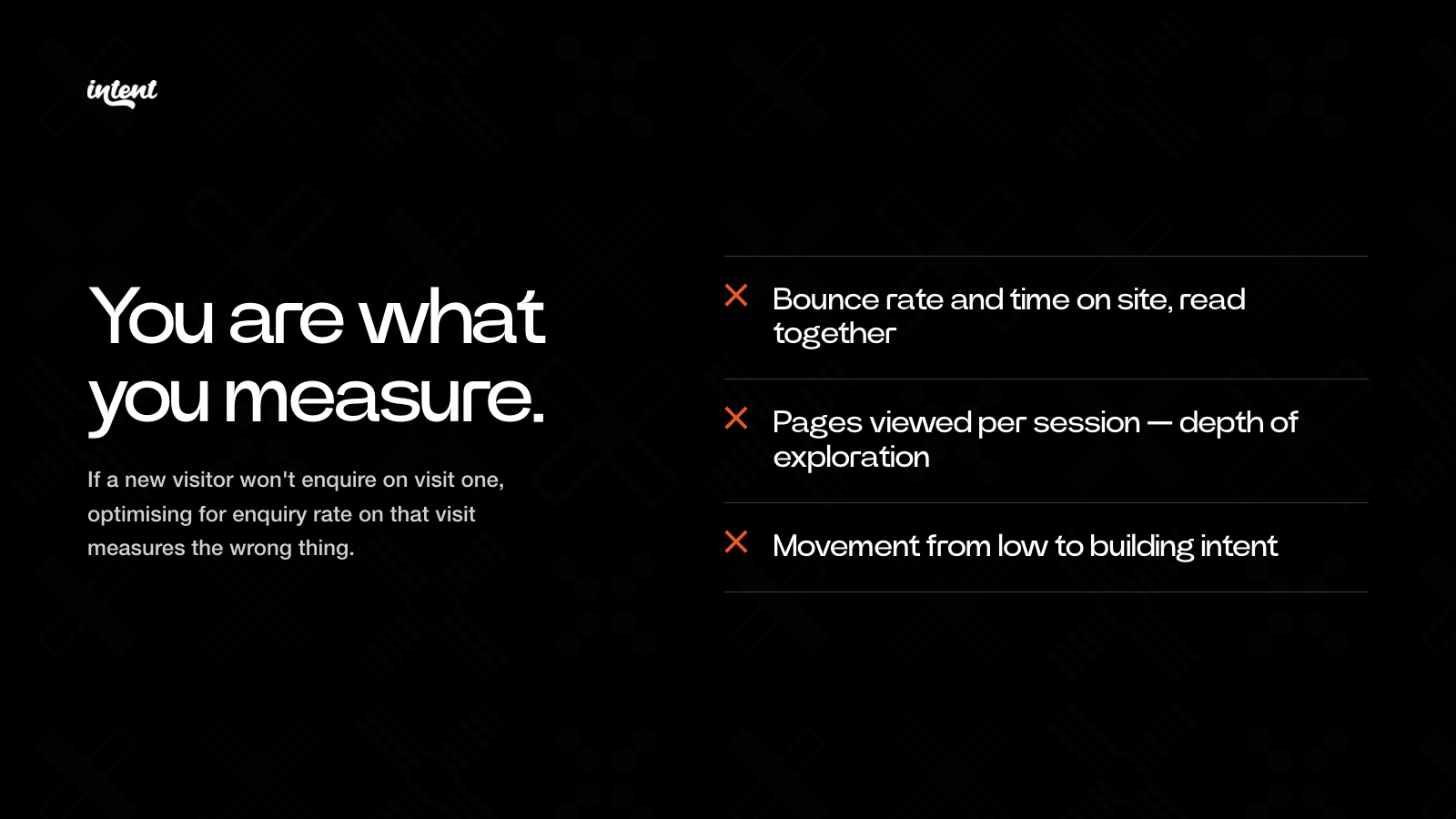
"You are what you measure" is a phrase the Golfbreaks.com team has adopted internally. If a new visitor is unlikely to enquire on their first visit, optimising purely for enquiry rate on that visit measures the wrong thing.
So alongside enquiry rate, the team tracks bounce rate and time on site together (a new visitor who bounces immediately clearly hasn't been given a reason to stay), pages viewed per session as a depth-of-exploration signal, and, specifically, movement from low to building intent, the kind of signals behind Made with Intent's content prioritisation and messaging use cases. None of these are vanity metrics here. They're proxies for whether a visitor is progressing through a decision process that runs across several sessions, not on a single visit.
Before building any experience, the team asks these questions to get in their customers shoes:
- What is a brand-new visitor actually trying to work out?
- Who are Golfbreaks.com?
- Can we be trusted?
- Do you have to pay full price up front?
- Can you book online at all?
That last one is really important. Because Golfbreaks.com can't be booked entirely online, setting that expectation early avoids disappointment later in the funnel, right when a visitor is closest to converting. As Colin put it, getting that messaging right up front was "a huge realisation" for how the whole experience needed to be built.
What agentic campaigns change about testing
Golfbreaks.com's testing programme runs on Made with Intent's agentic campaigns. In standard A/B testing, you decide up front which segment sees which variant, based on a hypothesis about who will respond to what. Agentic campaigns invert that: you define the strategy (the moment you're trying to influence, and the goal, whether that's enquiries, conversions, or a secondary metric) and hand the agent your set of tactics. It tests them against real segments and works out which one performs best, for whom, and when, using the same intent signals that power the rest of the platform.
For Jack, a self-described non-developer, the practical benefit was speed. "The tool allows me to get these experiences up much faster," he said. "My concept-to-live process is significantly shorter... it means the agents have got time to learn."
But the deeper change is what gets removed. "No longer am I having to set up those individual segments, or serve experiences to segments that I think will benefit from them," he said. "It's in the hands of the agent to then work out what segments it would benefit from... It's a much wider net." A message built for low-intent visitors might also help a segment already building toward a decision. A manual test is only as good as the human guess behind who it's shown to. An agent testing against a hundred segments simultaneously doesn't have that blind spot.
The "do nothing" variant is a genuine conversion tool
One of the more counter-intuitive parts of Golfbreaks.com's setup is what Jack calls the "do nothing" variant. In standard A/B testing, every visitor sees a control or one of several variants. Agentic campaigns add an option where the visitor sees nothing added or changed at all.
"The do nothing essentially sits within those variants as a copy of the control," Jack explained. "It's a safety net because it prevents us from showing negative experiences to customers that don't need to see it."
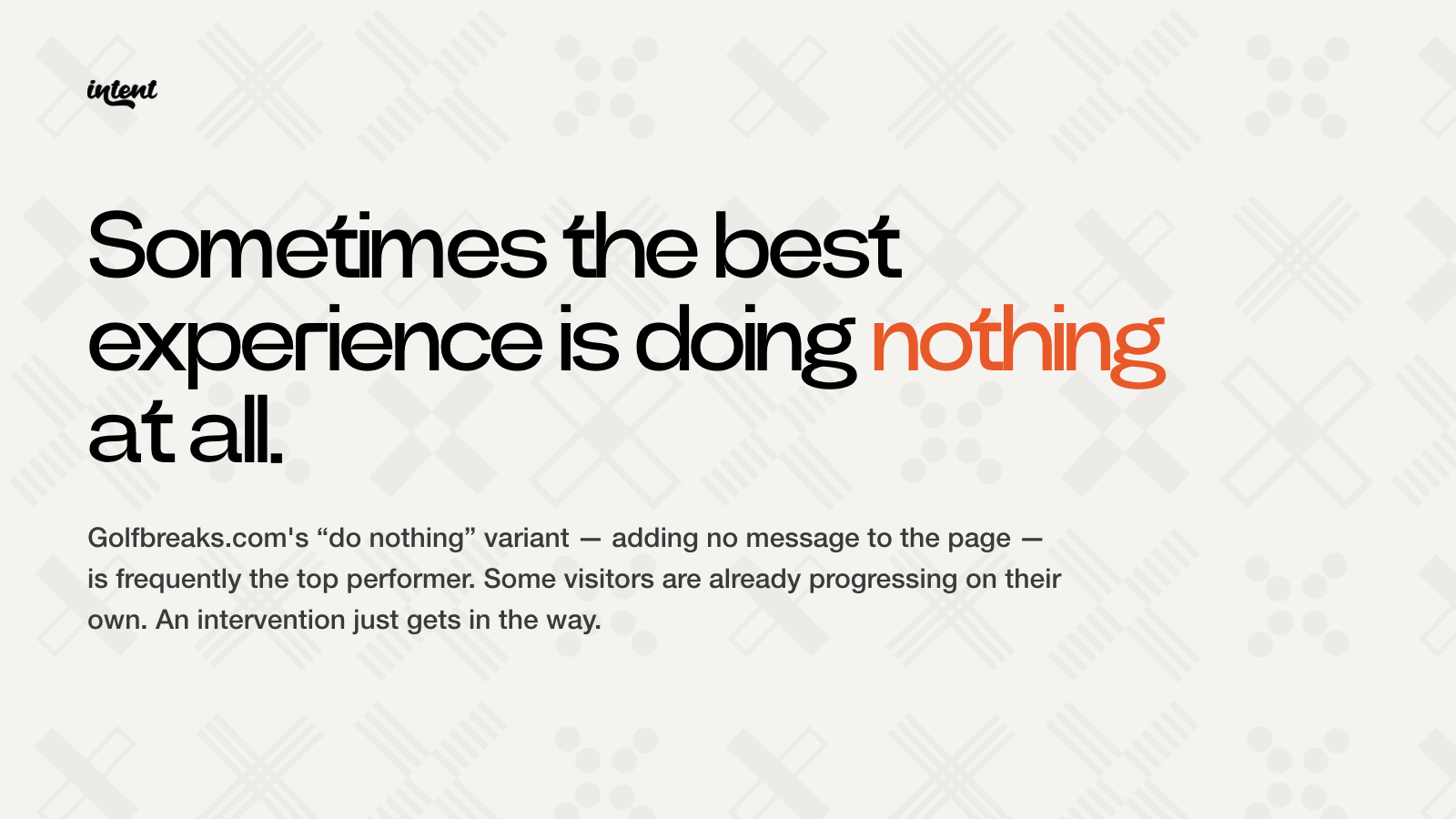
"In most experience it's always about adding things onto your site," Colin observed. "Having a version where actually sometimes the best thing is leaving the customer alone to progress, or even suppressing things on site, is a nice alternative to what we've experienced over the last 10, 20 years in experimentation." As the data below shows, it's frequently the top performer, because some visitors don't need an intervention. They're already progressing on their own, or they arrived with enough context that added messaging just gets in the way.
When the agent's early data looks wrong
Here's where the seven-day lesson from the top of this article comes back in. Jack's team built two welcome-visit experiences using the same messaging, one for the homepage, one for a location page such as a product discovery landing point for someone who searched "golf breaks in England."
The homepage experience delivered a 14% uplift in time on site. But conversion rate showed a negative trend for the first seven days. "With traditional AB testing, I would have perhaps turned it off," Jack said. "I would have panicked when I saw negative 14%, and I would have said, this isn't working."
He didn't, because the agent was still learning. That's consistent with what independent testing research shows more broadly: short test windows are more susceptible to random variation, and stopping early on interim results is one of the most common ways a genuinely winning test gets killed before it proves itself. Once the agent had enough data, performance turned around.
Same messaging, two different visitors
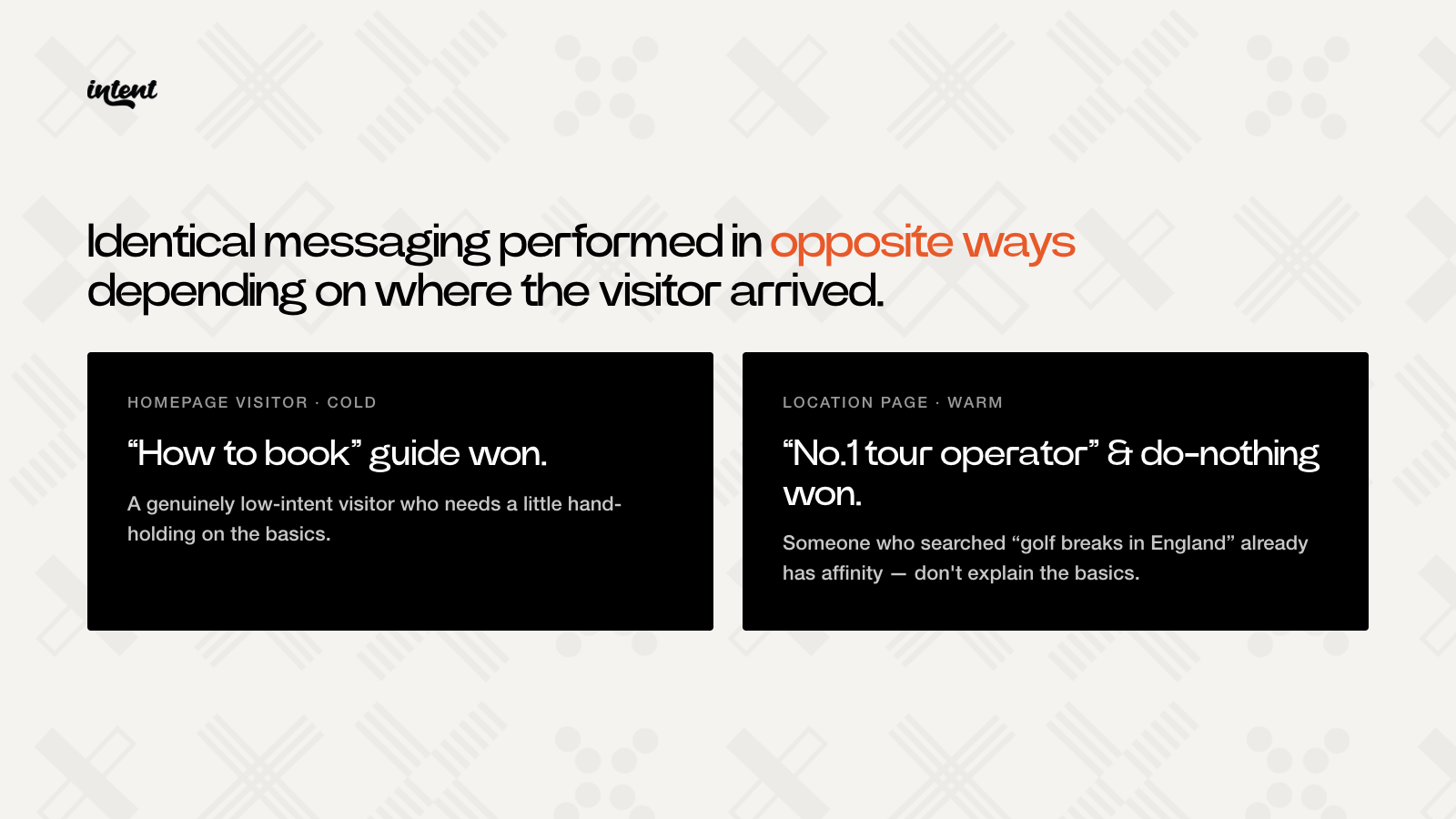
The location-page test surfaced something else: identical messaging performed in opposite ways depending on where a visitor arrived. On the homepage, a "how to book guide" message performed best, evidence of a genuinely low-intent visitor who needs some hand-holding.
On the location page, the top performer was a trust-building "number one tour operator" message and the do-nothing variant. Jack's take is that a visitor who searched "golf breaks in England" already has affinity toward the destination, closer to a returning visit mindset than a cold product visit. They don't need the basics explained.
A message about Golfbreaks.com's customisable packages underperformed with brand-new homepage visitors. It's true and important, but it's the wrong message at the wrong moment, the same lesson behind Made with Intent's discounting use case: showing a message before a visitor is ready for it does more harm than good.
The surprise that only showed up in the data
Asked what surprised him most, Jack pointed to something that had been sitting in plain sight. An early "ready to plan?" message aimed at brand-new visitors looked like a reasonable nudge. But in the data, it actually came across as overbearing.
"If you think about a new user landing on the site and asking, are you ready to plan? It's probably a bit overbearing," Jack said. "At the time, when you're setting up those tests, it's like, right, I'm going to use the same messages for the homepage, same message for the location page. They're surely going to work." They didn't, for every segment.
Colin's read: "The amount of times we see customers who have a predefined view of what will work, and it's completely different. That point around being subjective comes to life when you start to see the way the agent starts to make decisions." That tracks with the broader shift in shopper expectations, most consumers now expect a personalised experience and notice sharply when they don't get one, a generic message is no longer neutral, it actively reads as a miss.
When a message doesn't resonate with any segment, the fix is simple. Delete it, let the agent relearn, and add a new tactic later if needed. You don't need to manually re-segment.
Measure the journey, not just the moment
None of this is unique to golf holidays. Any purchase with a real consideration cycle shares the same shape, including B2B software, where roughly 70% of the buying journey typically happens before a buyer contacts a vendor at all. A first-time visitor is rarely the same as a returning, further-along one, and treating them identically wastes the message on the visitor least ready to act on it.
Three things carry over regardless of your industry. You don't need to be a developer to find early wins, a visual editor is enough to start. If your purchase journey has any real consideration cycle in it, top-of-funnel testing should measure more than conversion. And build a tactic sheet of messages at a global level, then let the data show which ones resonate with which visitors, rather than deciding that yourself up front.
If your own funnel has visitors who aren't ready to buy on visit one, the same logic applies. See the intent framework behind it. Or book a demo to see it against your own traffic.
If you've enjoyed this write up of our latest Intent Live session, why don't you join our next one?

Become an Intent Insider
Get subscriber-only insights we don't publish anywhere else and event invites before anyone else.
By submitting this form you agree to our (more than fair) terms.