
Made With Intent is an on-site intent engine for eCommerce businesses. It reads buying intent in real time and decides which experiences go to which visitors, and when.
Dynamic Yield is an experience optimization and personalization platform. It helps businesses tailor digital customer journeys across websites, mobile apps, and email.
This post explains where the two platforms work together, and where you'd still use Dynamic Yield instead.
If you can't wait until the end, here's a TLDR;
Pick Dynamic Yield if:
• Your priority is consistent personalisation across web, mobile app, email, and in-store kiosk
• You've got the team and budget to do a weeks long enterprise deployment
• Recommendation capabilities matters more than first-page view intent coverage.
Made With Intent is for you if:
• You want to read buying intent in real-time
◦ Then, serve the right content, the right experience at the appropriate moment
• Want to benefit from a 30-60 minute install time
And when we're thinking about Made With Intent and Dynamic Yield working together, here's how we recommend thinking about it:
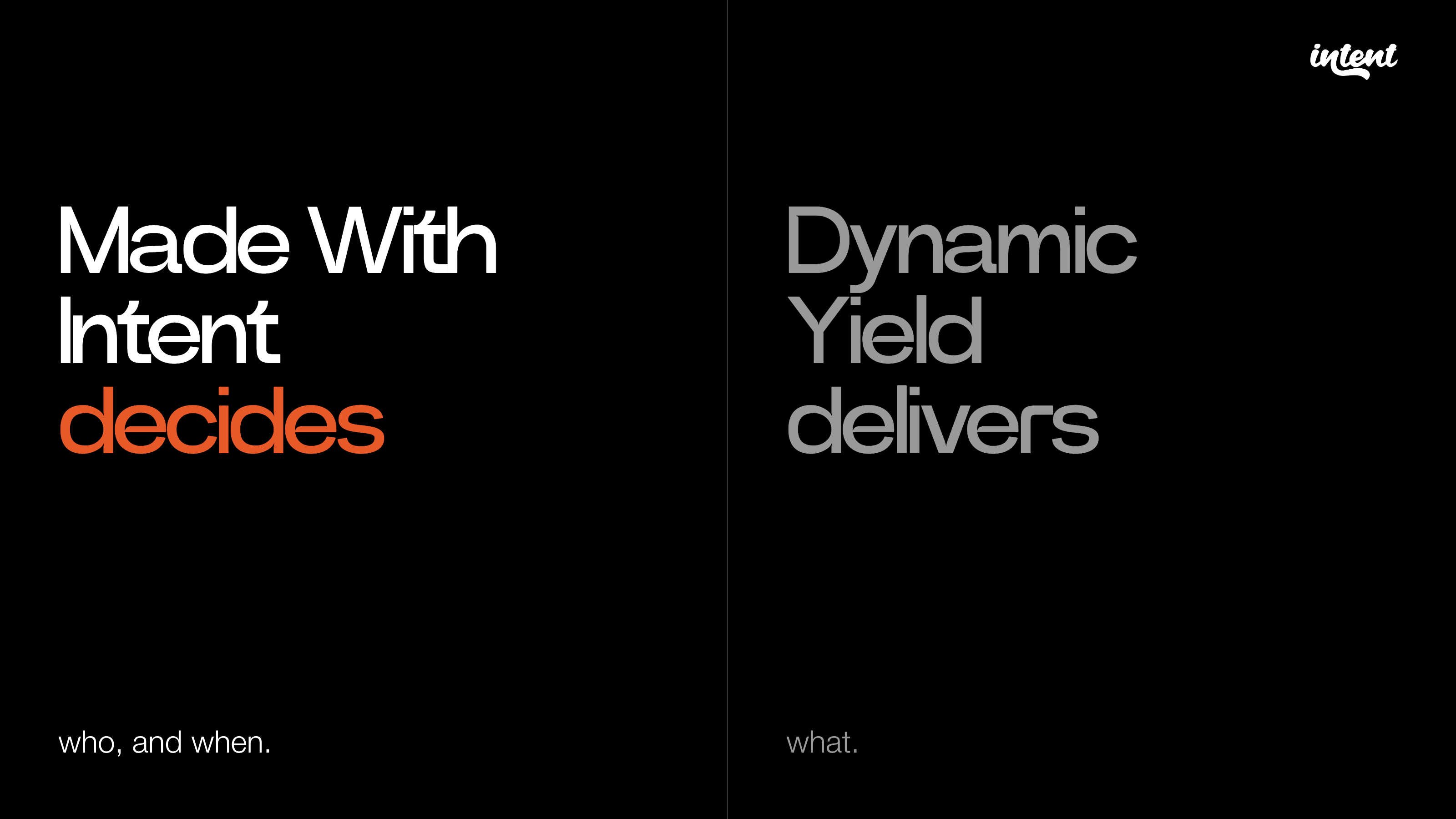
Made With Intent decides what experiences you should serve, to who and when, and Dynamic Yield delivers those experiences.
How Made With Intent is different to Dynamic Yield
There's three things that Made With Intent does different to Dynamic Yield. Let's dig into them below:
1. Made With Intent reads intent in real time
Dynamic Yield's intent workflow utilises two routes. First, Empathic Personalization classifies visitors into four inferred states, which are Curious, Interested, Focused and Satisfied.
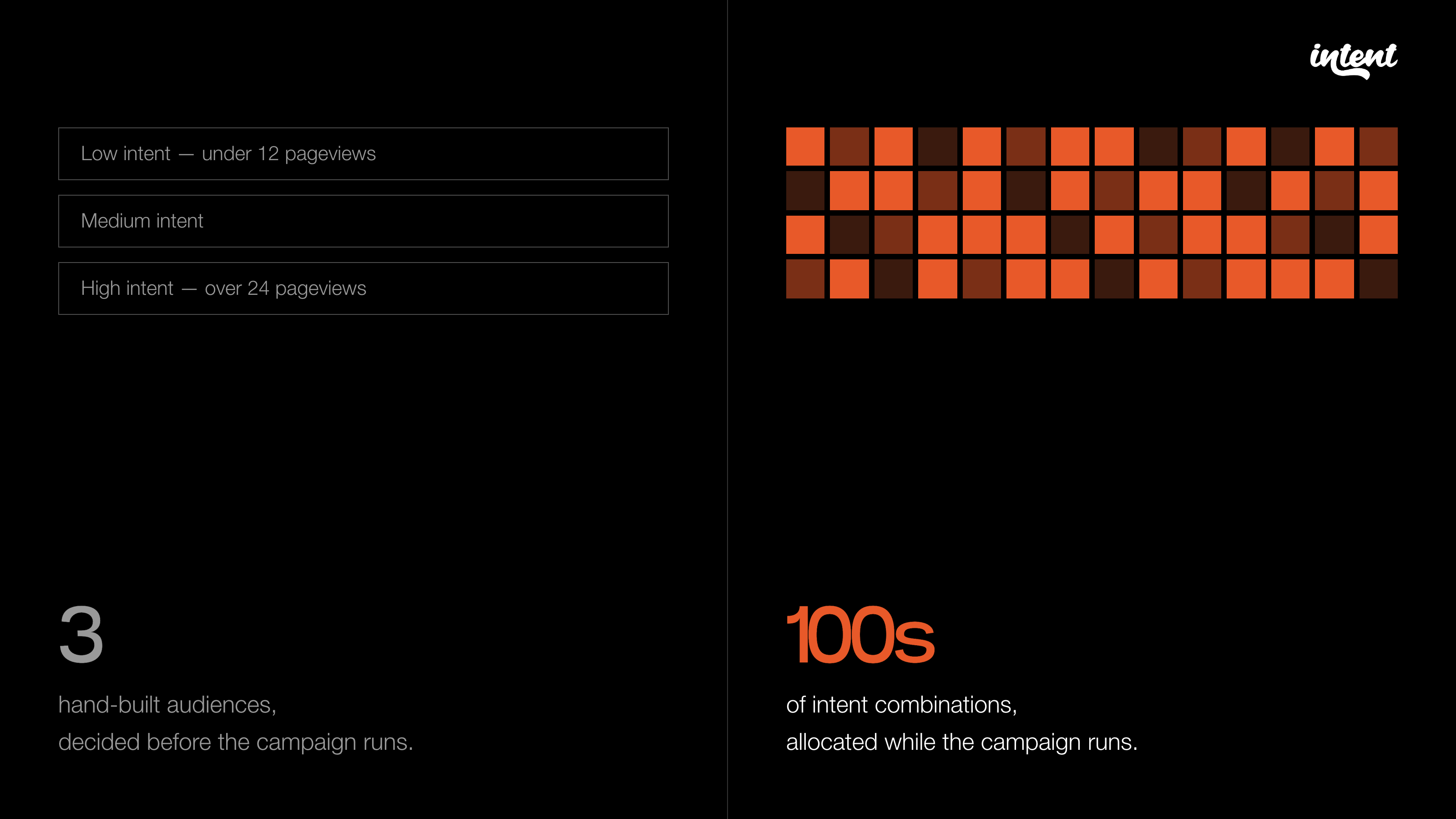
Its Audience Hub lets teams hand-build "low / medium / high intent" audiences from rules. Dynamic Yield's Primary Audiences framework shows a leading golf retailer defining low intent as fewer than 12 page views per session and high intent as more than 24.
That's a useful starting estimate, but page views aren't intent. A hesitant shopper racks up more pages than a decisive one. A high-intent visitor often converts inside three.
The more common version isn't pageview counts — it's event proxies. Add to cart equals high intent. Wishlist equals consideration. But an add to cart is as often a price check, a size comparison or a shipping-cost probe as it is a purchase signal. The event tells you what happened. It doesn't tell you what it meant.
Now, this is pretty fundamental: Dynamic Yield's model relies on behaviours your shoppers have already exhibited. It's a snapshot backwards in time, and like many what we call "rules-based" personalisation tools, you're reacting to things that have already have happened. Unlike Made With Intent.
Made With Intent reads buying intent directly — multi-dimensional, second-by-second signals predicting where the visitor is in their decision right now.
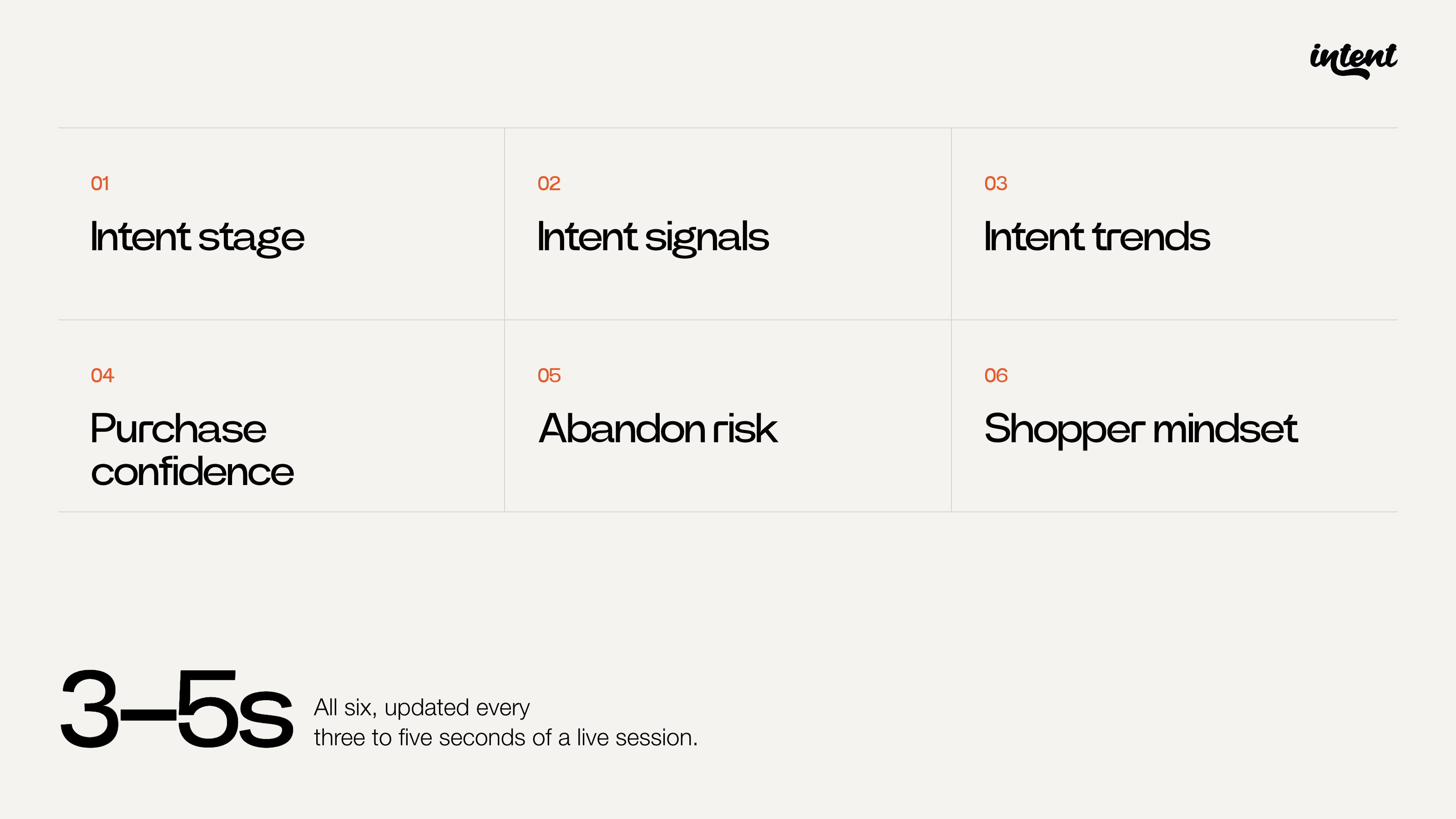
We break downs shopper behaviour into six stages, and these are: Intent stage. Intent signals. Intent trends. Purchase confidence. Abandon risk. Shopper mindset.
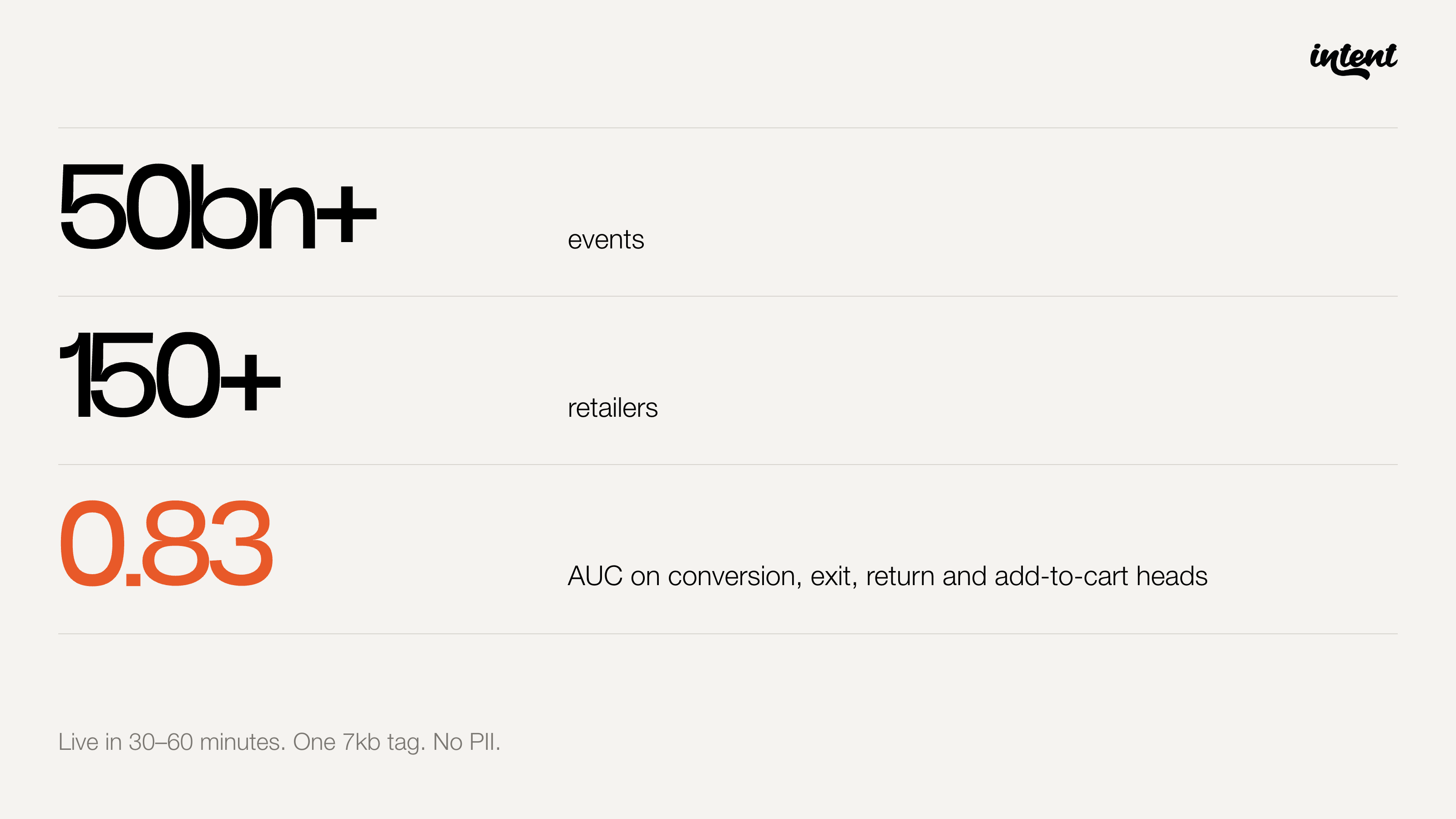
All updated every three–five seconds during a live session, on a model trained across 150+ retailers and 50 billion+ events.
2. Allocation across hundreds of intent combinations and not post-test segmentation
It takes eCommerce teams considerable time to build and maintain audience rules in Dynamic Yield. For instance, coding things such as "low intent equals fewer than 12 page views, high intent equals more than 24," then QA-ing those cohorts and redesigning them after each test.
Made With Intent replaces that with continuous intent prediction and delivery. The model decides who sees what, in real time, across hundreds of intent combinations. The actual grunt work is handled by our agent. Your team focuses on strategy, creative, and proof.
Our agent retrains daily, so the experience keeps allocating toward the intent combinations where impact is actually felt. Always on, always learning, always improving on where it started.
3. First-pageview coverage — no fallback needed
Behavioural data takes time to accrue; for anonymous or first-time visitors, Dynamic Yield falls back to geo-based predictive targeting and contextual signals.
Made With Intent has no fallback by design. It doesn't need one. We've trained it across 50bn+ events, in a range of contexts, giving the model day-one predictive power on every visitor, anonymous, identified, first-time, returning.
Made With Intent and Dynamic Yield: In depth
There are lots of areas of cross-over between Made With Intent and Dynamic Yield. The way our technologies work is similar in principle, but different in its practical implementation.
Let's start first with how Dynamic Yield's prediction capabilities work:
How Dynamic Yield's prediction works
| Dimension | Dynamic Yield (AdaptML) | Made With Intent |
|---|---|---|
| Core model output | Recommendations, audience affinities, content variants | Multi-dimensional buying intent per visitor |
| What it predicts | Which item / content / offer is most relevant | Intent stage, signals, trends, purchase confidence, abandon risk, shopper mindset |
| Underlying architecture | NextML (NLP) + AffinityML (LSTM RNN) | Multi-input, multi-output deep learning framework with ~800 behavioural signals and ~600 real-time per-visitor/session features |
| Signal type | Historical patterns + live session data | Live behavioural micro-signals (scroll hesitation, comparison patterns, dwell time, momentum shifts) |
| Update frequency | Continuously self-trains; predictions exposed at decision points (page loads, content surfaces) | Predictions update every 3–5 seconds during a live session; model retrains nightly |
| Training data | Per-merchant historical patterns | 50bn+ events across 150+ retailers |
| Validation | DY-published — confident but not externally benchmarked | AUC ~0.83–0.84 on conversion/exit/return/add-to-cart heads, calibrated probabilities |
While we're talking about AdaptML, we have to say, it's a really sophisticated bit of engineering. It utilises recurrent neural networks and NLP models to get smarter and smarter as it consume more data its got on a specific retailer's visitors.
However, it predicts what you'd expect (affinity and relevance), not what's happening in a visitor's decision right now.
Our model is a driven by a single purpose: it reads buying intent. Sure, it's a narrower job, but it's the one that determines whether a visitor converts, hesitates, or leaves.
Made With Intent vs Dynamic Yield
| Capability | Dynamic Yield | Made With Intent |
|---|---|---|
| Core job | Cross-channel personalisation engine (content, recs, audiences, testing) | On-site intent engine (intent read + agentic allocation + causal measurement) |
| Works on | All identified visitors fully; anonymous via geo/contextual fallback | Every visitor from the first pageview, no fallback needed |
| What it predicts | Content/product affinity, audience membership | Multi-dimensional intent: stage, signals, trends, confidence, abandon risk, mindset |
| Signal type | Historical + live session data, organised by audience rules | ~800 live behavioural signals per event; continuous micro-signal read |
| On-site experiences | WYSIWYG with mature templates and custom code; targeted by audience/rule | WYSIWYG + agentic campaigns; targeted by live intent |
| Allocation method | Static — predefined audience and variant, results read post-hoc | Dynamic — agent allocates across hundreds of intent combinations during the campaign |
| Measurement | Bayesian A/B between variants; holdback optional and manually configured | Bayesian A/B with holdback on every experience by default; reports causal incremental revenue |
| Multi-channel reach | Web, mobile app, email, in-store kiosk | Web only; other channels via integration to ESP/ad stack |
| Platform support | Platform-agnostic via SDK/JS/server APIs | Platform-agnostic via single 7kb GTM tag |
| PII handling | Captures behavioural and identifiable data per setup | No PII; ISO 27001 certified |
| Time to live | Weeks to months (G2 reviews) | 30–60 minutes via GTM |
| Ongoing maintenance | Configuration-heavy: Audience Hub rules, Empathic Personalization, Sections/Page Contexts/Selectors | Light: agentic campaigns reduce manual segmentation work after setup |
| Agentic campaigns | No agentic layer | Yes — strategy + tactics in, agent allocates dynamically |
When you should pick Dynamic Yield
Hey, we're not here to blindly sell you Made With Intent. Sometimes, our tool just isn't right for your business. So, unlike loads of other SaaS vendors, let us tell you when we wouldn't be a good fit:
• If you're trying to do cross-channel, Dynamic Yield is the right choice versus Made With Intent. We're web-first, and for multi-channel personalisation programmes Dynamic Yield is the right option.
• Recommendations: NextML and AffinityML are purpose built models for product and content recommendations. Made With Intent adds an intent decison later but it is not a replacement for NextML or AffinityML.
• Sophisticated email personalisation: Klaviyo-grade dynamic content across email and ad placements out of the box. If email is a key part of what you do, Dynamic Yield is a top choice.
• Security of a big vendor: Dynamic Yield is an eight-time Gartner Magic Quadrant Leader for personalisation engines. If you're enterprise org and need to run a formal RFP, this helps your procurement team make a decision.
• Strong experience builder. Sections, Page Contexts, and Selectors give users very fine control. But only after you've climbed the initial learning curve.
Where Made With Intent wins
Of course, this is an article designed to help you pick between Dynamic Yield and Made With Intent. From our table above, it's clear there's plenty of areas of overlap, but there's some stuff we do that, we don't mind saying, makes us a better choice. Have a read:
• Acts on the anonymous majority: Every visitor gets a multi-dimensional intent read from the first pageview. No prior data, no behavioural accrual, no geo fallback.
• Multi-dimensional intent prediction: The way we predict intent is comprehensive. We use six measures: stage, signals, trends, purchase confidence, abandon risk and shopper mindset. These are all updated every three-five seconds, unlike Dynamic Yield.
• Autonomously runs campaigns and makes decisions under directives: Agentic Campaigns can dynamically allocate experiences across hundreds of intent combinations during a campaign you'll run. Dynamic Yields's models are sophisticated. The targeting layer above them is still rule-driven. That's simply how the tool is built. But it means what experiences are served is decided before the campaign runs, and not during it.
• Cross-merchant model: 50 billion+ events across 150+ retailers. Day-one predictive power for our customers.
• Start within 30 minutes: Single 7kb GTM tag, no PII and we're ISO 27001 accredited.
So, it's time to make a decision: Let's pick one. Or both?
It's crunch time. We've given you all the facts, but it's time to wrap up and make a judgment call.
Pick Dynamic Yield if the you want consistent cross-channel personalisation — content and recommendations spanning web, mobile app, email, and kiosk. And if you have the technical resources to operate it.
Dynamic Yield's breadth and recommendation algorithm depth is class-leading, and trying to replicate the scale of that capability with Made With intent, plus some integrations would be a worse outcome for you.
Choose Made With Intent if you want a on-site decisioning, intent-driven experiences, and proven incrementality. Our tool delivers experiences natively, allocates them dynamically across hundreds of intent combinations, and proves causal lift on every one.
Now, something to think about. If you're an enterprise customer, you actually could consider both. And here's why:
• Dynamic Yield gives you the breadth and means of channels and mediums to serve personalised content to
• Made With Intent helps you accurately decide who, and when that content should be served
That's brought us to the end of the comparison blog post. If you're still unsure of the differences between Dynamic Yield and Made With Intent, the best thing for you to do is talk with one of our team.
You can book a demo here.
Disclaimer: This comparison is based on publicly available information from Dynamic Yield's documentation, marketing site, and customer reviews as of April 2026. Both products evolve continuously. If anything looks out of date, get in touch and we'll sort it.
Book a call
Ready to see a demo?
Click the button and our team will reach out arrange a time to understand your needs and show you Made With Intent.