Most lists of abandoned cart emails are judged by the wrong criteria. Subject line cleverness. Clean design. Brand-consistent copy. None of that tells you whether the email should have been sent at all, or whether it was built for the type of shopper who actually received it.
What makes an abandoned cart email effective is how well it matches the reason the customer left — not the subject line, the discount, or the design. The 10 examples below are organised by the abandonment scenario each one is built for, so you can borrow the right approach for the right situation rather than copying whichever email looks most impressive.
Editor's note: All examples are sourced from Really Good Emails (reallygoodemails.com), an independent email archive you've probably used at some point. I had Claude have a good peruse through it before deciding on which ones I'd write into the piece.
The one question every abandoned cart email list skips
Before the examples, let's just contextualise why people abandon carts.
There isn't one type of cart abandoner. There are at four (probably more), and the email that works for one will actively backfire for another:
- Interrupted shoppers: got distracted by life, had no real objection, often come back on their own
- Price-sensitive shoppers: saw the total at checkout (including shipping), did the maths, and thought: “Right, I’m off”
- Hesitant shoppers: browsed carefully, read reviews, maybe checked the returns page, still couldn't commit
- Indecisive shoppers: liked the brand but couldn't choose the right item, or weren't ready to decide
Sending a 20% discount to an interrupted shopper doesn't recover a sale. It gives margin away to someone who was already coming back. Sending a playful nudge to a shopper who couldn't verify your returns policy doesn't help them really. It's a case of wrong message at the wrong time.
Segmenting abandoners by type isn't a new idea. ConvertCart and others have proposed versions of this framework. What most implementations miss is applying it to real, named brand examples rather than wireframes, and being honest about when each approach goes wrong. In this blog post, we'll analyse each abandoned cart email example, pick out the pros and cons and do some commentary on them.
Abandoned cart emails for interrupted shoppers
These shoppers had no objection. Something pulled their attention away mid-session, and the purchase didn't complete. They're the most likely to come back without any email at all. That's exactly why this is the category where discounting causes the most damage. You're giving margin to a customer who was ready to buy.
The right email for an interrupted shopper is a clean, low-pressure reminder.
Casper — "Come Back to Bed"
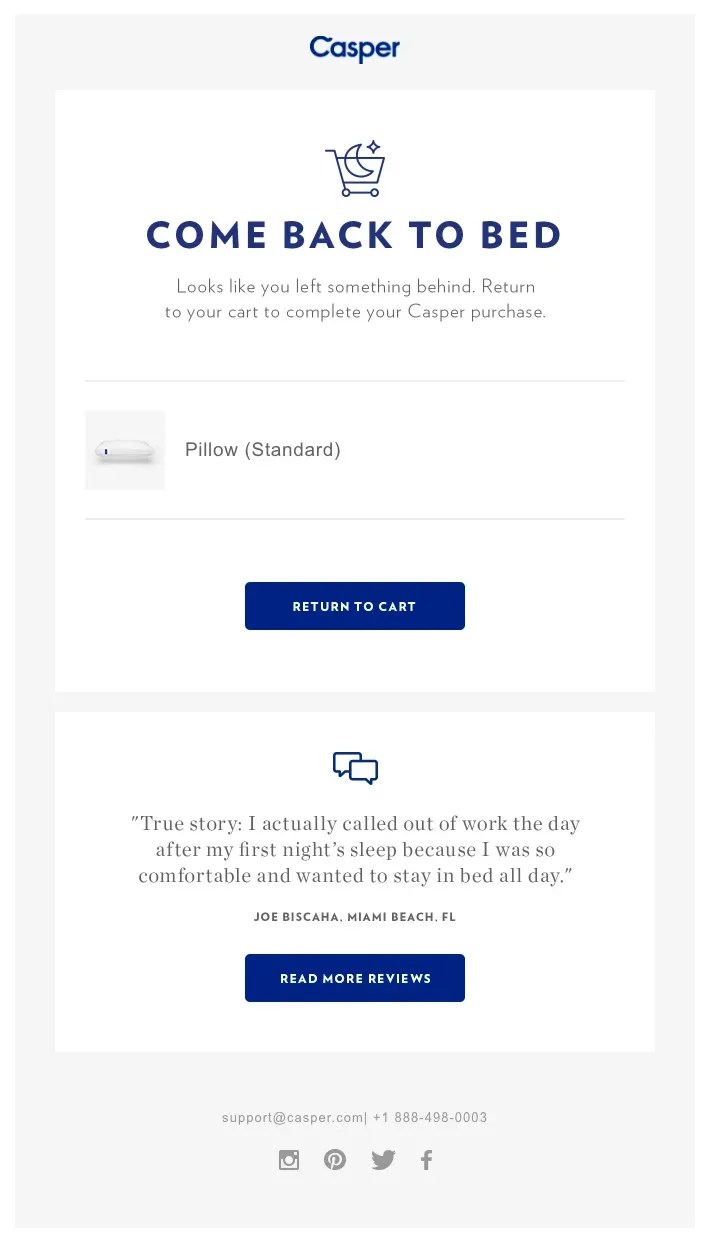
Casper's cart recovery email is clean and minimalist. Product image front and centre, a single CTA, social proof embedded lightly without being pushed. The copy is warm and brand-consistent without being clever for its own sake.
What it does well: the email assumes the shopper liked the product. Its only job is to put it back in front of them. It doesn't introduce urgency or price pressure that wasn't there before. We like the playfulness of the headline.
The assumption: the shopper was interrupted, not objecting. Is that assumption right often enough to make this format successful?
When it backfires: if Casper's flow also sends a discount to the same segment a day later, what about those that are ready to buy, forgot to do it, and they've earned themselves a nice discount for doing nothing?
Harry's — "So Close to the Finish Line"
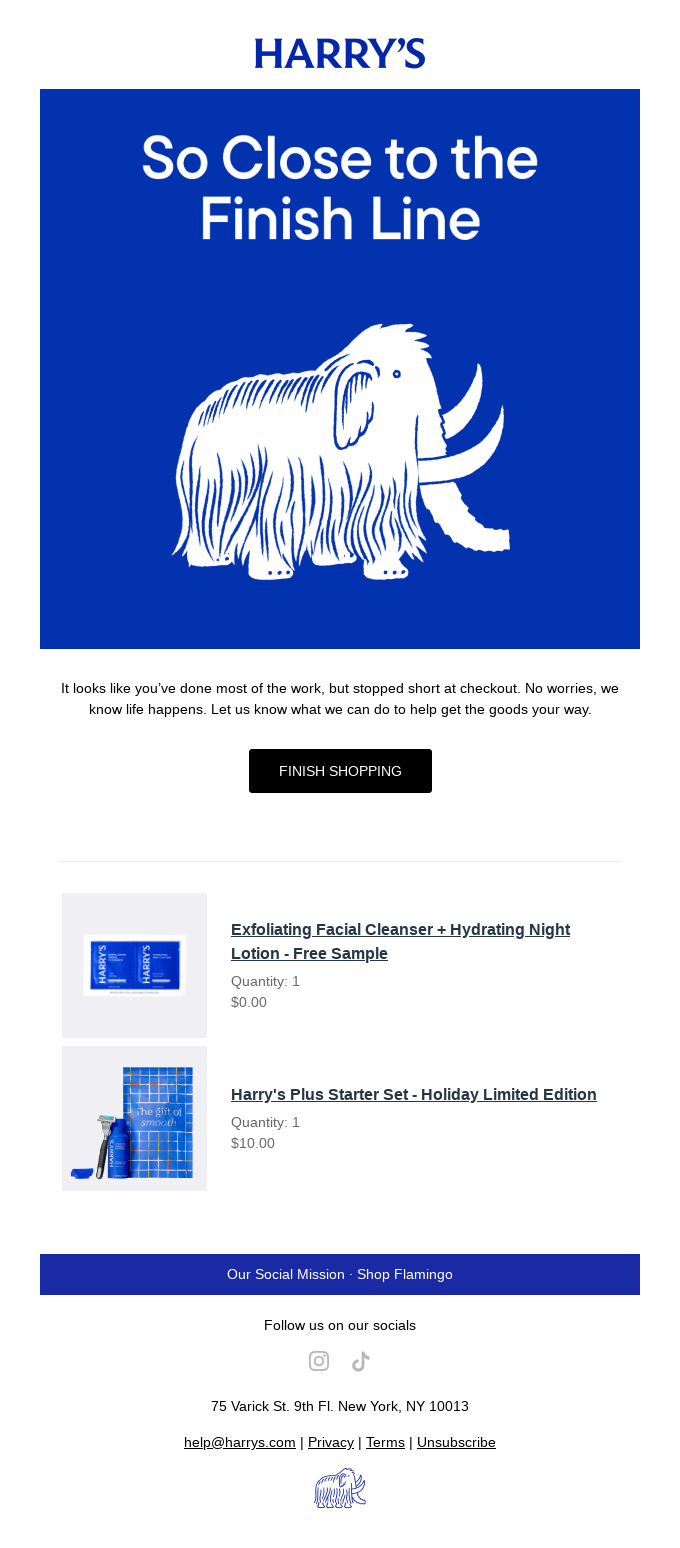
Harry's abandoned cart email doesn't try to be clever. The headline uses the brand's woolly mammoth mascot against a bold blue background: "So Close to the Finish Line." The copy: "It looks like you've done most of the work, but stopped short at checkout. No worries, we know life happens. Let us know what we can do to help get the goods your way."
What it does well: it treats the shopper as an adult. The tone assumes good faith on both sides. It's not manufacturing pressure or guilting the buyer. Worth noting that the abandoned cart here is a free sample and a $10 starter kit, a genuinely low-friction entry to the brand. The email is built for a purchase with almost no real barrier.
When it backfires: for a high-consideration or high-price product, empathy alone won't do it. The shopper needs a reason to come back, not just a reminder that they nearly did.
Pestie — "Did a bug crash your order?"
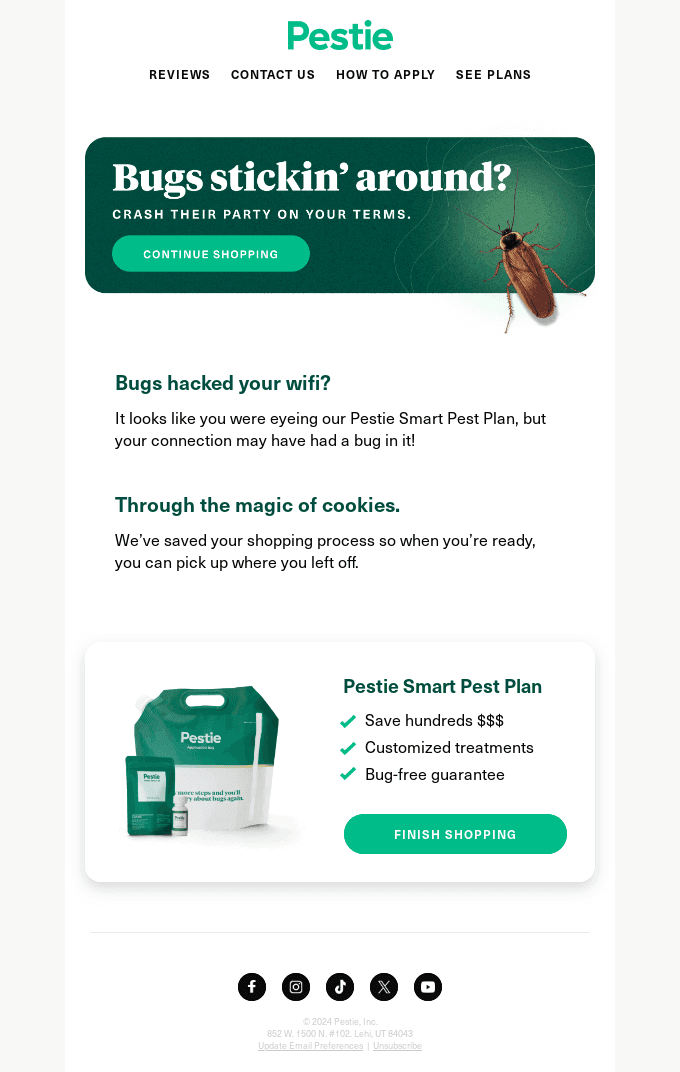
Pestie sells a subscription pest control plan. Their abandoned cart email is written entirely in pest puns: "Bugs hacked your wifi? It looks like you were eyeing our Pestie Smart Pest Plan, but your connection may have had a bug in it. Through the magic of cookies — we've saved your shopping process so when you're ready, you can pick up where you left off."
We're all about puns at Made With Intent. Especially in the marketing team. So, in our esteemed view this is already a 10/10 email.
What it does well: the puns are there for a reason. For a brand whose product is literally about bugs, the email signals that they don't take themselves too seriously. That's quite endearing for someone looking to build a long-term relationship with a brand.
When it backfires: for a first-time visitor who hasn't yet bought into the brand's personality, the jokes don't remove any real barrier. A shopper with a genuine price or trust objection gets pest puns. Bugger.
Wondering how to prevent your abandoned baskets before they happen? See how Made With Intent does it.
Abandoned cart emails for price-sensitive shoppers
These shoppers reached the checkout, saw the full total, and left. Extra costs at checkout, shipping, tax, unexpected fees, are the single biggest reasons shoppers abandon, cited by 39% of abandoners in Baymard Institute's latest quantitative study. It's why this is the category where price incentives are utilised.
There's two things that spring out here. First, not every discount is the right discount. There's a significant difference between a shipping waiver and a 25% reduction in product price. Second, financing is sometimes a more effective tool than a discount, particularly for high-consideration purchases where the monthly payment is more psychologically viable than the total cost.
Levi's — 25% off
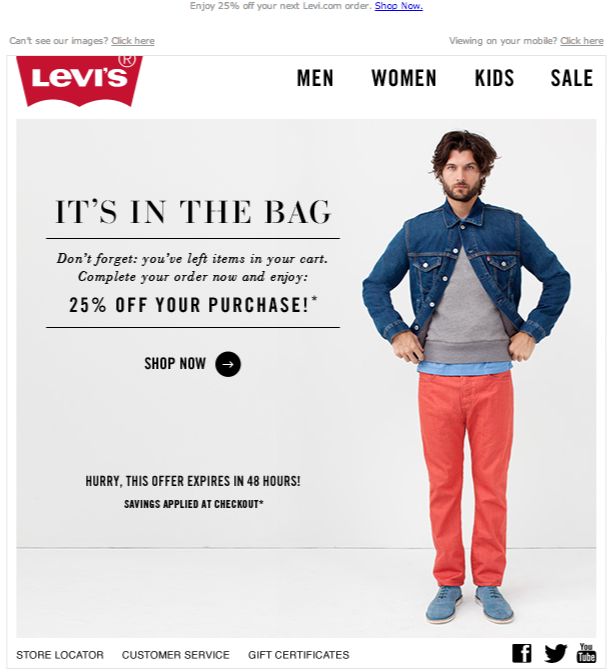
Levi's cart recovery email is bold and short. Big headline, big number: 25% off. One product image and a single CTA. It directly addresses the price barrier without ambiguity.
What it doesn't do: it has no mechanism to distinguish who actually needed the discount. The interrupted shopper gets 25% off alongside the price-sensitive shopper. That's the fundamental problem with blanket discount recovery flows. The discount is the easiest lever to pull, but it's applied without any understanding of whether it was needed.
Let's do some numbers on the back of a napkin. If 30% of your recoveries would have happened without the email, you've just cut margin on 30% of your "recovered" revenue for no commercial reason. No published figure exists for this across the industry. That's itself the problem. Many brands don't run a holdout test to find out.
What good looks like: a recovery flow that sends no discount in the first email, and only introduces one if the shopper didn't convert, reserved for segments whose behaviour suggests price was the actual barrier.
Slight Made With Intent-shaped sidebar: Appliances Direct ran exactly this approach and saved 42% of the margin they'd previously given away.
Aventon — "Need more time? Your ebike is still here (for now.)"
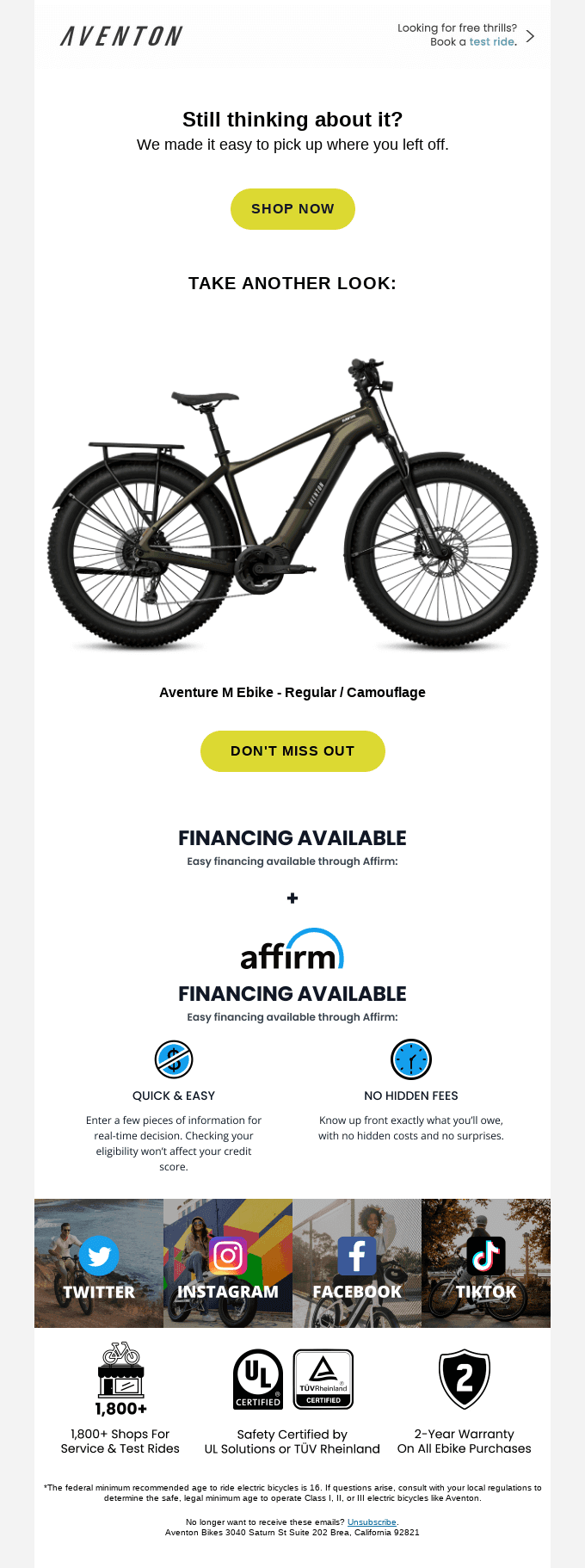
Aventon sells electric bikes. The subject line soft-pedals urgency; the email body leans almost entirely on financing. A prominent "FINANCING AVAILABLE via Affirm" section sits above the product image, with payment options broken down by monthly instalment. There's also a header CTA: "Book a test ride."
What it does well: it removes the price barrier without touching the headline price. Affirm installments reframe affordability: the shopper isn't being asked to find the full cost upfront, they're being asked to consider a monthly figure instead. It breaks down the £1,000+ cost in a manageable way.
The test ride CTA is smart. For a high-consideration purchase where the shopper has never experienced the product, a physical touchpoint is good way of getting people invested in the product beyond the digital experience.
The assumption: the shopper wants the product but the upfront cost is the specific barrier. If their hesitation is about product quality or brand trust, installments don't resolve it. Should there be more social proof to help people understand how the product helps them?
MasterClass — "HEY, WHAT HAPPENED?" + up to 50% off

MasterClass runs a subscription service for online courses instead of physical products. The headline is conversational and comes across slightly startled: "HEY, WHAT HAPPENED?" — before offering a deep discount and showcasing celebrity instructors.
What's interesting is the trust signals they have in play. Below the discount, MasterClass includes trust logos from companies including Deloitte and PayPal, and a section showing which type of learner (A, B, or C) might use the platform. Essentially, it segments the hesitant shopper by use case in the email itself.
What it does well: the social proof addresses a different objection from the price cut. The shopper may have left because of cost, or because they weren't sure the product was legitimate. The email handles both simultaneously.
The issue: a 50% off discount on a subscription product teaches the same lesson product discounting teaches in retail. Abandoners learn that waiting is rewarded. MasterClass should be asking how many of its subscribers will only ever subscribe when a 50% promotion is running, and whether that margin is sustainable.
Abandoned cart emails for hesitant or shoppers with trust issues
Blueland — "We love it, too. Then again... we might be biased."
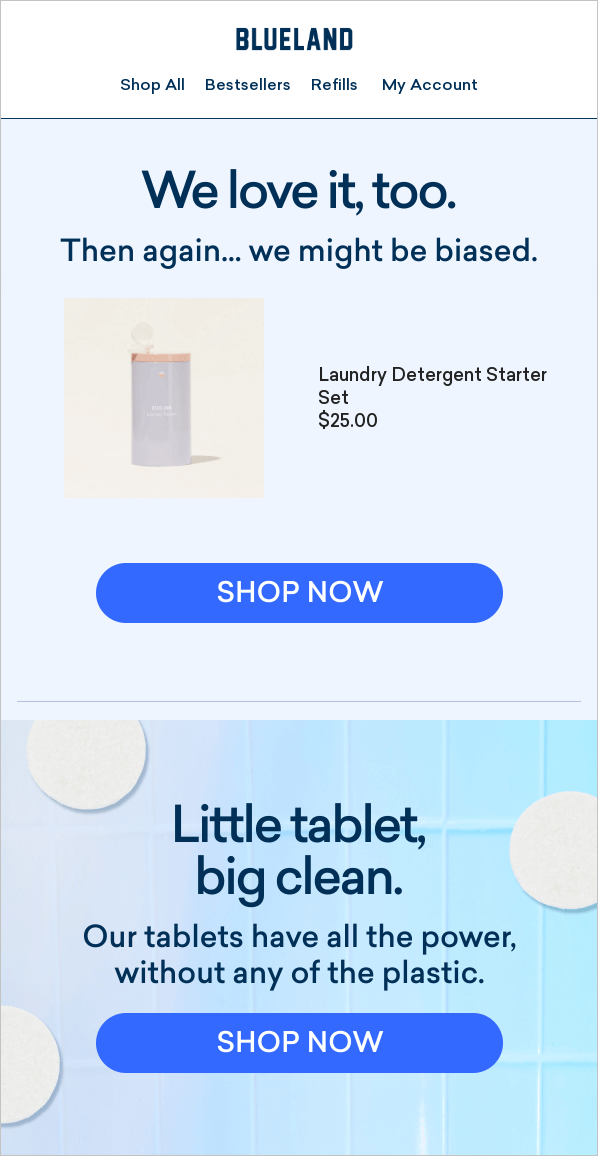
Blueland sells eco-friendly cleaning products, specifically dissolvable tablets that replace single-use plastic bottles. Their cart recovery headline is confident, and maybe a little self-aware: "We love it, too. Then again... we might be biased." Below it: product image, price ($25), and a product performance claim: "Little tablet, big clean. Our tablets have all the power, without any of the plastic." No discount.
What it does well: the product's differentiation is the trust signal. A shopper who abandoned their cart because they weren't convinced eco tablets actually work gets the product's performance claim restated clearly. The "we might be biased" line signals confidence rather than desperation. The brand isn't worried you're about to leave.
When it doesn't work: a shopper whose hesitation was "but does it clean as well as a conventional product?" gets a value message. The email doesn't resolve that specific doubt. Blueland's email works for shoppers already aligned with eco values. It doesn't do much for the unconvinced.
IMBODHI — "Pieces You'll Regret Leaving Behind"
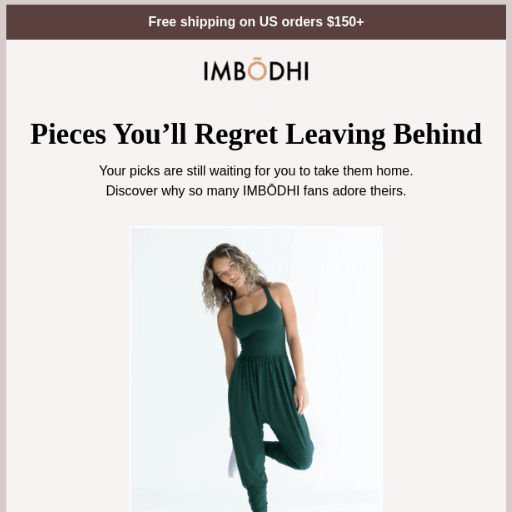
IMBODHI is a sustainable activewear brand. Their cart recovery email layers three distinct trust mechanisms without a single discount code. It has a FOMO headline ("Pieces You'll Regret Leaving Behind"), a Shop Pay financing section (buy now, pay in installments), and a grid of UGC customer photos under the hashtag #LiveEmbodied.
What it does well: it addresses both price hesitation (Shop Pay installments) and the social legitimacy question (real customers using the product) in a single email, without reducing the product price.
Why this may not work: "Pieces You'll Regret Leaving Behind" sets a slightly pressured tone for a first-time buyer who hasn't yet committed to the brand. FOMO framing works on a shopper who's close to being convinced. For someone who's genuinely struggling to build trust with your business, it can feel like the wrong kind of push.
Abandoned cart emails for indecisive shoppers
These shoppers want something but couldn't commit. They may be comparing options within the brand, unsure which variant or style to choose, or simply not ready to make the decision. The barrier isn't price or trust — it's the decision itself.
These emails solve a different problem: they simplify or reframe the choice, rather than removing a specific barrier. The risk is that showing more options can increase rather than reduce decision paralysis.
Lamborghini — "Can't Decide?"

Yes, Lamborghini makes wine. Their abandoned cart email doesn't reference the specific item left in the cart at all. The subject line is "Can't Decide?" The body opens with "Still thinking?" and pivots immediately to "Here's Some of Our Best Sellers," presenting four product recommendations.
What it does well: it treats indecision as a discovery problem. If you couldn't choose the item you had in your cart, perhaps a different set of options helps. The email resets the shopper's choice rather than pushing them back to a single item they couldn't commit to.
The risk: if the shopper had a specific item they definitely wanted and simply got distracted, showing four alternatives signals the brand wasn't paying attention. This email makes a particular bet about why the shopper left. It won't always be right.
Abandoned cart emails that use urgency and scarcity
Urgency in cart recovery works when it's true. Manufactured scarcity — "only 3 left!" when the warehouse holds 300 — erodes trust with shoppers who notice, and increasingly, shoppers notice.
The most credible urgency email in this list earns its subject line through genuine stock constraint, not a copywriting trick.
Alo Yoga — "The Airlift 7/8 Decadent Bodysuit in your cart sold out"
![Test] The Airlift 7/8 Decadent Bodysuit in your cart sold out from Alo Yoga - Desktop Email View | Really Good Emails](https://cdn.prod.website-files.com/683359648c5bfdeb492e5edc/6a4447b61cc56f8865d08dc8_image.png)
The subject line is the entire email. Alo Yoga's abandoned item is genuinely sold out. No manufactured pressure, just a fact. The headline inside: "YOUR MISSED CONNECTION." The email then pivots: a section shows the shopper's remaining cart items ("YOUR CART IS STILL WAITING") alongside alternative products in the same category.
What it does well: the scarcity is real. The brand doesn't need to claim urgency. It's already true. And the pivot to alternatives turns what could be a dead end into a continued shopping opportunity.
When it backfires: if the shopper wants only that specific item and no alternative will do, the email confirms the purchase is no longer possible. It won't convert in that scenario. But there was nothing to convert. The email's job shifts from recovery to brand experience.
The broader lesson: a brand that saves urgency emails for when the urgency is actually real builds more long-term credibility than one that manufactures it in every third recovery email.
The question these examples can't answer for you
There's a limit to what a "best abandoned cart email" list tells you.
I can't tell you what the recovery rates are for them. I can only offer you my opinion. Really Good Emails is an archive, not a performance tracker. The examples in this piece were chosen because they illustrate distinct strategic logic, not because any of them are proven to outperform the alternatives. "Best" here means "most instructive," not "highest converting."
The metric that actually matters is incremental recovery: the sales that happened because of the email, not alongside it. A shopper who abandons at 9pm, receives an automated reminder at 9:01pm, and buys at 9:15pm may have bought at 9:05pm without the email. That recovery appears in your platform's dashboard but contributes nothing incremental to revenue, and if it includes a discount, it actively costs you margin.
Measuring it properly requires a holdout group, a segment of abandoners who receive no email at all, used as a baseline against those who do. Most ESPs support suppression lists. The simplest test is withholding the first email from 10% of abandoners for 30 days and comparing purchase rates. Rejoiner has a good primer on the methodology if you want to set one up. Few brands run this. The ones that do are often surprised by how much of their "recovered" revenue would have happened regardless.
This is the honest limit of any examples-based approach to cart abandonment. The best use of a list like this isn't to copy the email that looks most impressive. It's to use the framework — which type of abandoner is this built for, and what does this email assume about why they left? — to evaluate the emails already in your own flow.
The most effective recovery strategies don't wait for abandonment at all. They identify visitors whose intent signals suggest they're at risk and intervene before the cart is left behind. That's a fundamentally different problem from choosing the right email to send after the fact. See how it works.
What makes an abandoned cart email work
Knowing which email to send requires knowing something about why the shopper left. Most brands don't know that. They send the same recovery sequence to every abandoner. And they wonder why their discount bill keeps rising while incremental recovery stays flat.
The brands that recover more tend to discount less. Not because they're precious about margin, but because they understand that not every abandoned cart is a lost sale in need of a coupon. Some abandoners need a simple reminder. Some need reassurance about the brand. Some need to know the financing option exists. And some were never going to buy in that session regardless of what was sent.
If you want to prevent basket abandons instead of just trying to recover them after they've happened, here's how intent-based cart recovery works.

Become an Intent Insider
Get subscriber-only insights we don't publish anywhere else and event invites before anyone else.
By submitting this form you agree to our (more than fair) terms.