The Made With Intent blog

Visual Editor has just shipped. It's a brand new feature for Made With Intent.
Yes, we know this isn't something groundbreaking, and you've used something like Visual Editor before, with your favourite tools, but this is one of the most requested features from our customers.
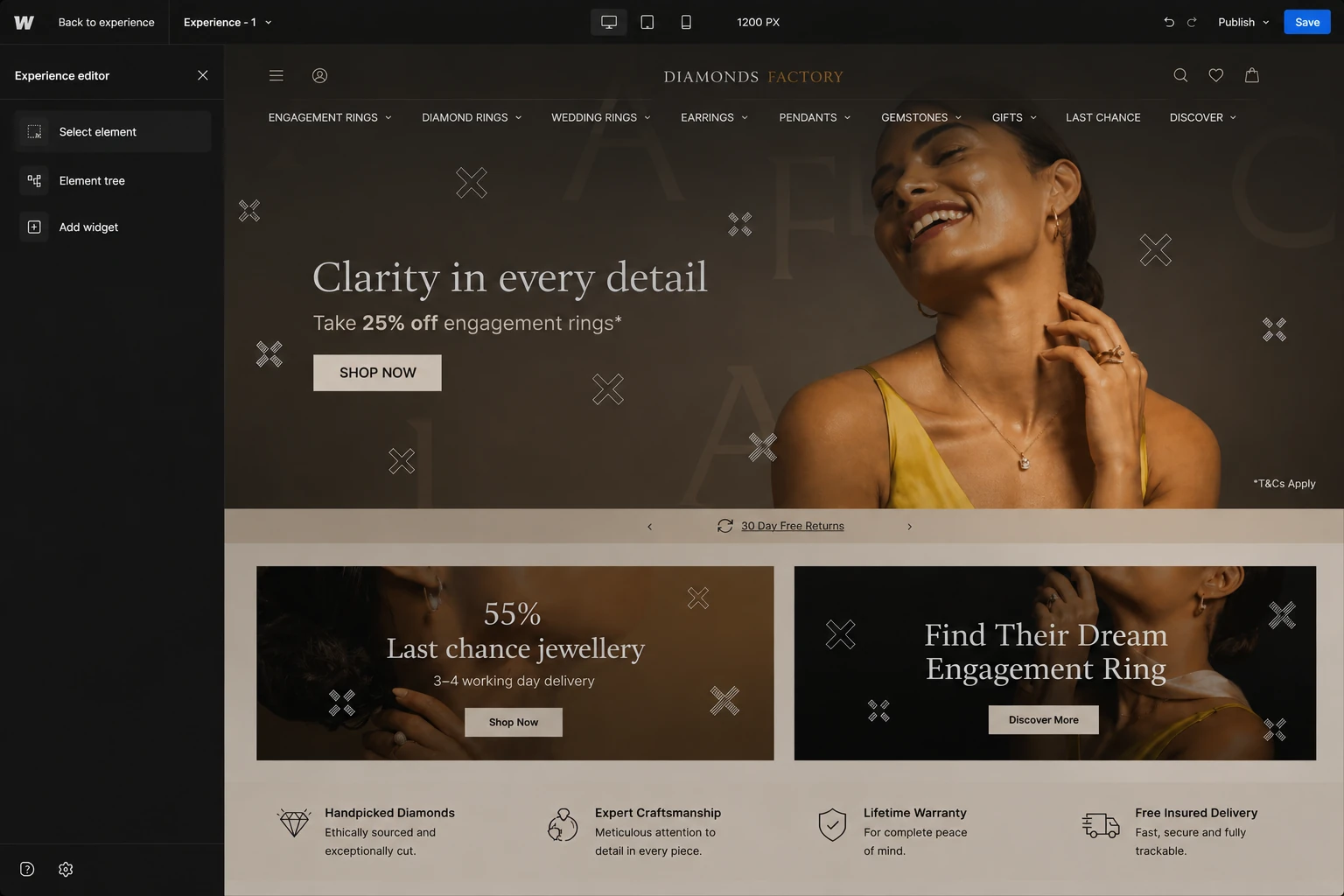
It lets you create and preview on-site changes against your own live website. You'll have more flexibility and control over the kinds of experiences you'd like our tool to test and deliver to your customers.
It'll reduce the need for developers to get involved, and give you a familiar, visual way of editing experiences, directly within Made With Intent, that you can ship on your own.
So, that's the short version. Here's a bit more background on what it does, why we built it and a sneak preview of what's coming next.

What Visual Editor does
Visual Editor lets you create and preview on-site changes against your own live website, without developer support and without guessing how something will look once it's live.
It solves a familiar problem. The person responsible for the site experience is rarely the person who can build it. As Ryan Jordan, our CPO, puts it:
"The people that are using our product are generally those who are responsible for the site experience but not necessarily technically able to always build for the site experience."
Here's a list of of some of things you'll be able to do with this new feature:
- Change a banner
- Update, restyle, hide or show a specific element on a page
- Fully customisable overlays, built to cater for every moment
- Build and preview components on your live site before they go anywhere near a visitor.
You'll have, no doubt, used lots and lots of WYSIWYG tools before in your favourite A/B testing, experience and ecommerce tools. We've deliberately designed Visual Editor to be familiar, and work similar to the products you know and love, so you'll find it intuitive to use.
We built Visual Editor because it is the feature that was most requested by our customers. We feel it's a natural evolution of our well-loved template library. With the ability to essentially edit your site by clicking and typing, we think it'll be flexible enough for non-technical people to pick it up and build something quick and dirty.
But this new feature will also let you see the context of what you've built in-situ, perfect for your site and your context, instead of leaving it to imagination.
But Ryan reckons you'll go further: "Previously, campaigns delivered with Made With Intent were generally thought about from a \"template\" first approach, but the Visual Editor now allows you to think about how real-time moments of intent can change the page and its content"

Moving towards a goal-orientated mindset
We reckon our Visual Editor will help you change your mindset. Most experience delivery tools tell you to pick a format first. You decide you want a pop-up, then you go and fill it with content. You decide you want a sticky banner, then you fill that with content. The format leads, and the goal follows.
But that's backwards for a lot of what teams are trying to do.
Let's take basket abandonment. One brand might come in knowing they want a pop-up. Fine, build the pop-up, fill it with content. But another brand comes in knowing only that they want to offer a 20% discount when someone's about to leave. They've got the goal. Why should we dictate how you deliver that discount?
So we've built Visual Editor to work from either end. Start with a format and add your content. Or start with your content: the discount, the message, the countdown timer. Then see how it looks as a sticky banner, a pop-up, a slide-in, or an in-page element.
"Most of the market always just goes format-into-content," Ryan explained. "What we're doing by flipping it and being able to go content-into-format is giving people the ability to play around."
On paper this might seem like a small thing. But we think this will give you different options to explore different solutions to the same problems you've been optimising and experimenting with for years. You'll be inspired to create different solutions to the same problems you've been having for years.

A quick note on CSP
Some sites run Content Security Policy (CSP) rules that can stop a visual editor from working on the page. To help with that, we're rolling out a Chrome extension called Intent Studio that unblocks it.
If your site's CSP rules mean you can't use the editor on the page yet, nothing else changes, everything you could do yesterday, you can still do today. For sites that don't have CSP rules, you should be fine without Intent Studio.
So, what's coming next?
We'll be adding more templates. We've built Visual Editor to be flexible deliberately, so people get used to it and start asking "can it do this, can it do that," we'll keep adding to what's there.
Longer term, this is where things get a bit interesting. We're finding with tools like Claude Design, many, many people are designing experiences using prompts, instead of fiddling around manually.
Ryan says: "It's now no longer click on an element and change the background colour to blue. It's tell an AI, make this background blue, and it kind of just does it for you."
The widgets behind Visual Editor have been built so that AI can understand them and make changes to them. This is the groundwork for letting you describe the change you want and have it built for you.
There's no hard date on when this is coming, but Ryan said it's a matter of weeks, not quarters.
Made With Intent has always been about one thing: enabling you to respond to real-time intent on your ecommerce site. Everything we do is in service of making that easier and more effective.
For a long time, acting on intent meant working within the formats we gave you or dev resource. Visual Editor changes that. It lowers the barrier between knowing what you want a visitor to experience and actually building it — without waiting on someone else to do it for you.
The gap between who owns the site experience and who can build it just got a lot smaller.
And the next step, simply describing the change instead of building it manually, is next.
Login to Made With Intent to see Visual Editor in action. If you're not a customer yet, and are curious, why don't you book a demo?
Latest articles
.png)
If you’ve read our original piece on Predictions, Not Proxies, you’ll already understand why ecommerce teams need to move beyond outdated signals like traffic source and funnel stage.
To recap, it’s time for a mindset shift in ecommerce. To go from using surface-level proxies to using real-time intent predictions based on actual behaviour. This follow-up brings data to back up that claim.
What is the quality of a visitor? What are their preferences? And are they progressing towards a purchase?
These are critical questions in ecommerce. They underpin everything from targeting and messaging to optimisation and conversion. And yet, most teams still rely on proxies to answer them. Proxies that are easy to measure, but misleading. Easy to action, but often off the mark.
Proxies became popular not because they were particularly predictive, but because they were easy. They were what was available. And in the absence of better tools, convenience often beat accuracy.
In this article, we explore three key areas where Intent-proxy metrics lead to incorrect assumptions about our visitors.
- Visitor Quality: Why source-based assumptions break down the deeper a visitor engages
- Visitor Preference: Why relying on add-to-cart ignores 6.6x more signals of interest
- Visitor Progression: Why real journeys aren’t linear and what that means for timing
It shows where proxies lead teams astray, what gets missed, and what becomes possible when you see the real story underneath.
Visitor Quality: The Proxy vs The Prediction
One of the most ingrained habits in ecommerce is defining visitor quality by how they arrive. PPC traffic is high intent. Social traffic is low intent. Mobile users convert worse. Returning visitors convert better.
These assumptions are so common they’ve become unquestioned. But they’re all based on aggregate averages. And averages flatten nuance.
When we analysed session-level intent across millions of visits, we saw a different story. Yes, there are differences at the top of the funnel. But as users engage more deeply, the source matters less. What matters is what they do now.
The difference between ‘high’ and ‘low’ quality traffic almost disappears when we look at visitors by their 46th event, rather than their 1st.

Our data shows that the gap between “low” quality traffic and “high” quality traffic closes the deeper they engage. Due to lower intent visitors progressively dropping off over the course of a journey, the remaining visitors will have a naturally higher intent.
We looked at how quality changes over time. Early on, yes, traffic source matters. But by the 30th, 40th, 50th event, it flattens out. The intent is shaped more by what visitors do than where they came from.
Social traffic looks low intent at first glance, but the ones who engage actually build really strong purchase intent.
But knowing which visitors have potential is only half the story. To personalise effectively, you also need to understand what they actually care about.
Visitor Preference: The Proxy vs The Prediction
It’s easy to think we know what visitors want. Add-to-cart events, product views and recency are the typical signals we treat as indicators of preference. But they’re all blunt. They assume interest based on the most trackable action, not the most telling one.
When we analysed onsite behaviour, we saw that affinity builds well before someone clicks ‘add to cart’. And in many cases, people never reach that point, even when they’re highly interested.
In our data, we identify a product affinity in 6.6x more visitors than we see actually add to cart.

Tracking the movement of a visitor’s intent to add to cart reliably indicates their affinities to products and attributes.
Only a small number of online shoppers add to cart, but many more show product interest through how they browse. Through scrolls, hesitations, returns and comparisons, we can see strong signals of affinity well before any CTA click.
In fact, we see product affinity in over 6 times more sessions than we see add-to-cart events. That’s a huge chunk of opportunity that goes unnoticed if you’re stuck with proxies.
Put another way, if you’re only reacting to add to cart events, you’re often too late to really influence what matters. You’ve missed the moment they started to care.
And once you understand what they want, there’s one final question: are they getting closer to buying, or drifting away?
Visitor Progression: The Proxy vs The Prediction
Most ecommerce sites still treat the typical page funnel as a reliable guide. Homepage to PLP to PDP to cart to checkout. And on paper, it works. But real journeys don’t follow that script. They loop. They stall. They rewind.
And yet, many personalisation and performance decisions still hinge on page depth. Someone in checkout must be ready to buy. Someone on PDP must be evaluating. Someone who’s viewed 10 pages must be high intent.
Not quite.
Intent declines in over 65% of journeys at some point. It’s the norm, not the exception.

It’s very common for visitor journeys to fluctuate as they engage. This graph demonstrates that the rate of visitors that indicated a drop in intent to purchase at some point increases the longer they shop. On average, 65% of visitors will lose intent at some point, with converting visitors showing a clear divergence from the typical visitor.
We found that intent doesn’t just rise as sessions go on. It’s not that people always leave with less intent, but that there are points within most sessions where the intent dips. That fluctuation is what matters.
Even among converters, a good chunk of them show a dip somewhere mid-journey. So if you’re only acting on high-intent signals, you’re missing the nuance.
If ecommerce journeys are this non-linear and you want to optimise experiences as much as possible, then real-time prediction isn’t a luxury. It’s a necessity.
The Real Opportunity
The previous Predictions, Not Proxies article made the case for change. I hope this one validates it, and shows what happens when you make it.
The truth is, ecommerce teams aren’t misreading intent because they’re careless. They’re misreading it because proxies were the only thing available for a long time. They were measurable. They were familiar. And they made things feel predictable.
But customer behaviour isn’t predictable. Not through proxies. Not in the way we’d like it to be as ecommerce teams. It’s dynamic, contextual and deeply individual.
And that’s the good news. Because once you stop relying on proxies, and start responding to predictions, everything sharpens. Personalisation becomes meaningful. Experiences become appropriate. And performance follows.
You can’t scale personalisation on proxies. But you can scale it by predicting intent.

Retailers ask for emails with the goal of growing their audience, their campaign reach, and their influence.
But most retailers are asking at the wrong time, in the wrong way, and it’s costing them.
In our Intent Gap research, we found 55% of online shoppers dislike pop-ups that appear early in a session. 45% say they actively make them less likely to buy. One in five even say they’d leave a site altogether if interrupted too soon.
37% of the retail sites analysed as part of the report used pop-ups, with 79% shown within the first 30 seconds.
The problem isn’t the capture itself. It’s the lack of context.
Most email capture strategies are built on fixed rules; time on site, page views, scroll depth. But these are proxies, not signals. They don’t reflect how a visitor is behaving or how likely they are to respond. They assume intent, rather than recognising it.
This isn’t about switching tactics. It’s about responding to behaviour in real time.
Rethink: Why you’re capturing emails
When email capture is treated as a numbers game, relevance drops. And the risk goes up. You might gain a contact in the short-term, but ultimately lose a customer.
The right question isn’t how do we collect more emails? It’s how do we make the exchange feel appropriate, valuable and well-timed. For both sides?
That means considering two things:
- Mindset: Where is the customer in their journey? Are they focused and confident? Or showing signs of struggle, and unlikelihood to progress?
- Value: What are you offering in return? Is it aligned to what they’re doing?
The best email capture doesn’t interrupt the journey. It supports it.
Optimise: Start capturing with Intent
To start with, optimise what already exists. Use intent segmentation to change when your capture prompts fire.
Play 1: Trigger email capture for abandoning visitors
Most email capture is delivered too soon, before visitors have shown any interest or given any signal that they’re ready for a value exchange.
The fix: Wait for signs of struggle or abandon, then trigger based on live behaviour.
Take On The Beach, who triggered capture only for visitors in the Engage or Build stages of the Intent Framework, who were showing subtle signs of drop-off. By adjusting the timing to match behaviour, they saw a 28% uplift in email sign-ups with no hit to conversion.
Why this works:
- You reach the right audience, in-session
- You increase sign-ups without sacrificing experience
- You stop defaulting to time-based rules that overlook nuance
Play 2: Ask for an email when a visitor is unlikely to progress
Instead of waiting for signs of struggle, or abandon, you can also target a visitor when they’re indicating they’re unlikely to move forward in their journey, by using Intent to Progress.
That’s what Le Chameau did. By limiting email capture to visitors who were unlikely to progress, and excluding focused shoppers entirely, they:
- Increased email sign-ups by 3%
- Drove 24% incremental revenue
- Protected high-value journeys from interruption
Grow: What comes next
Timing is essential. But message matters too.
Most capture prompts lead with a generic offer: “Sign up for 10% off.” But not everyone is looking to buy. And not everyone cares about a discount.
Visitors early on in their journey, who haven’t found the right product for them? Offer a newsletter prompt.
Shoppers who have a product affinity, but low likelihood to purchase? Suggest a save for later or price drop alert.
This approach moves email capture from a hard sell to a helpful nudge. Tailored to behaviour, aligned with intent.
It also opens the door to experimenting with softer incentives, different tones of voice, and varied placements. Especially for visitors who show high exit intent, but lower likelihood to return.
What happens when you get this right?
When email capture is powered by real-time intent:
- Sign-up rates increase, because prompts are more timely and contextual
- Conversion rates hold steady, because you don’t disrupt high-intent visitors
- List quality improves, with fewer disengaged or disinterested contacts
- Revenue grows, from visitors that may otherwise have been lost
Capture becomes strategic, not interruptive. And it builds long-term value in your customer base.
Your first three steps
If you’re looking to make an impact fast:
- Replace time-based triggers with intent-led email capture prompts
- Target abandoning or struggling visitors, and those unlikely to progress. Exclude focused shoppers
- Align your offer or message to the visitor’s behaviour and mindset
From there, test new placements, value exchanges and copy aligned to intent predictions. And treat capture as a recurring opportunity, not a one-off chance.
Because when you understand visitor behaviour, you don’t have to interrupt to make an impact. You just have to respond at the right time.
Want to see how intent-first email capture works in practice? Get a demo to learn how Made With Intent helps teams grow their lists without damaging their visitors’ experience.

An engaged customer list is a valuable asset. It’s no wonder most retail websites go for the obvious way of growing it: triggering a pop-up to everyone. Often seconds after someone lands, or as they go to exit.
Yet, asking for someone's email address moments after they arrive feels abrupt and annoying. It’s not the best start to a new relationship, is it?
The thing is, eCommerce makes these things easy to overlook. For most teams, a visitor's reaction to the pop-up is only perceptible through proxy metrics like close or conversion rate. This doesn’t give you the full picture. What’s not measurable is the number of people who were there to buy but didn’t, because of the email capture.
So we asked shoppers.
Our Intent Gap report found that showing an email capture pop up too soon has a 1 in 5 chance of causing a visitor to abandon your site.
Let’s be clear. It’s not all email capture pop-ups that frustrate customers. Some are viewed as valuable and helpful, with conversion rates in high double figures. It all comes down to timing and context.
We’ve heard from the shoppers, so it’s only fair we did the same with the retailers. We spoke with nine ecommerce leaders to understand why a catch-all approach to email capture pop-ups is still the norm despite how they make shoppers feel.
The status quo of email capture
More than half of shoppers find pop-ups annoying. 1 in 5 dislike them so much it stops them from shopping. Yet, 79% of pop-ups are triggered within the first 30 seconds.
Is this the best approach we have in 2025 and beyond?
“How we shop online has changed a lot over the last 5-10 years, yet we’re still relying on the same tactics. Customers are more savvy, shopping across multiple websites and are protective over who they give their personal information to.”
Jackie Barnett, Head of CRM at MandM Direct
As Jackie points out, immediate email capture pop-ups might have worked 10 years ago, but today's shoppers are worried about data security. Plus, with overflowing inboxes, most people are reluctant to offer up their info. Time on site pop-ups might well be “the way we’ve always done it,” but it won’t wash with today’s customers.
Another reason the industry is stuck using an outdated method? FOMO.
“Most brands do email pop-ups early or on exit because it feels safe. Like, catch the visitor before they leave or bounce. It's a numbers game--more eyeballs, more chances.”
Natalia Lavrenenko, UGC manager/Marketing manager
It’s a numbers game when it should be a people game. Where’s the value in collecting 1000s of email addresses of annoyed people? Will they read your emails, or mark them as spam? That’s if the email’s even real.
So, what’s really at stake here?
“If you've got a lot of inbound organic traffic, combined with a good lead magnet, you can do well on that 1%-2% conversion on popups. The con is that you're annoying everybody else.”
Brenna Milleville, Founder at Elly and Grace
Capturing emails from a tiny percentage of all traffic while actively irritating the vast majority. It’s a pretty bad deal, and everyone knows it. So why is this method still being used?
“There's pressure to capture volume. Just like the pressure to send more marketing emails, even though we know it’s ineffective. It can be hard to justify more targeted efforts without data, especially when a belief persists that more activity = more revenue.”
Alfie Calas, Head of CRM at thortful
This is the reality for many ecommerce teams. Goals and targets that direct them away from doing better work.
It comes down to what can be measured and what data is available. While it’s obvious a smaller, engaged list will outperform a larger, disengaged one, having the data to prove it is the stumbling block.
“Customers who consent to email tend to have a higher LTV, so capturing their email is a priority. The more emails we have, the more customers we can keep speaking to, the more chance we’ve got at cost-effectively retaining them!”
Jackie Barnett, Head of CRM at MandM Direct
As Jackie shared, the rationale behind capturing every email address vs. just those that matter is the idea of chance.
Email capture pop-ups triggered after 30 seconds on-site equate to a scattergun approach based on a wish and a prayer. What’s ignored is the loss of potential immediate sales from the people put off.
This isn't news to ecommerce professionals, but it's not just the pressure of targets that has seen it become an accepted behaviour. It's the limitations of visitor data and the targeting options available in their tech stack.
“Most out-of-the-box tools only allow for a handful of triggers, so marketers are restricted in the ways they can be creative about approaching customers for email capture.”
Alfie Calas, Head of CRM at thortful
“The prevalent [email capture] methods don't consider the unique journey and mood of each visitor.”
Ben Read, CEO at Mercha
It’s worth reiterating; a web page tells you nothing about the customers’ buying stage.
So when tools are limited to triggering pop-ups based on page or time on site, you miss critical signals. Your experience becomes disconnected from the context of the visitor.
If retailers want to improve their relationship with customers, this status quo has to change. The focus needs to shift to the shopper and how they behave in the context of the whole experience. This is how we create higher opt-in percentages, less friction, and more meaningful lists.
The cost of generic email capture
So much effort goes into crafting the perfect welcome email series, the tone of voice, database segmentation, data security practices, etc. But so little goes into the moment when customers are asked to sign up. Yet there’s much at stake. 40% of shoppers say email capture pop ups make them less likely to buy.
“I've learned that how and when you ask for an email can make or break a relationship with customers…Focus on building relationships, not just lists.”
Asim Rahat, Founder at Oswin Hyde
Asim found out the hard way: get it wrong, and there’s rarely a second chance. A poorly-timed pop-up might get closed, but it also sets the tone.
So, what’s the real cost of generic, ill-timed pop-ups?
The negative shift in perception and lost sales you’ll never track.
“A huge issue is the unseen impact on people who find these pop-ups a total turn-off. What percentage of potential customers are being lost each day due to this one-size-fits-all approach? Plus, the cost of the voucher codes being handed out to customers who would have purchased anyway or had no intention of making more than one purchase.”
Jackie Barnett, Head of CRM at MandM Direct
Because generic email capture is a catch-all, it’s hard to work out what’s in it for the customer. Retailers resort to bribing visitors with discounts. This leads to a bad outcome: lost margin.
Offering discount codes in sitewide pop-ups might help you capture emails, but that’s because you’re giving money away to everyone by default. We’ve already explored the status quo of discounts in this article if you want more on the subject.
Fundamentally, generic email capture pop-ups cost you customer relationships, margins, and sales. But if this is the industry standard, what options do retailers really have?
Approaching discounts based on visitor intent
“Imagine someone is browsing sneakers, comparing a few models, maybe even checking delivery options. They’re clearly into it, but not quite ready. That’s when a “Hey! Want 10% off your first order?” feels helpful, not annoying. It’s like catching them at the right moment in-store, not shouting at them the second they walk in.”
Kardelen Ozyurda, UX & CRO Manager at PUMA
That’s the shift. Ask when it feels natural.
If you're not sure when these moments occur in your customer's online buying experience, consider when you might go over to a customer in a store setting to ask if they want more help, more information, or some material to take home. This exercise can also help you work out what to offer in return—whether that’s a newsletter, discount code, or a stock alert.
It should be obvious to the visitor why you need their email address, because there's value for both parties.
“We ask for push notification permissions after customers have done a 'high-value' action, like adding a product to their basket or purchasing. It's an easier value exchange when the customer can see the why behind giving their permission. We found the rate of acceptance skyrocketed when we did this.”
Alfie Calas, Head of CRM at thortful
If you find yourself cringing at the idea of only asking people at the end of the journey and not everyone, consider this: intent-based email capture reduces impressions by 50%. But it also grows sign-ups by 40%.
You know why?
Because it only triggers when appropriate.
“Context is everything. Email capture should be aligned with genuine value, like after engaging content, unlocking a discount, or adding to cart. The more it feels like a fair exchange, the better. The key is making it feel earned, not demanded.”
Niall Young O'Brien, CRM Manager at Represent
The more value you can convey, the higher the conversion rate of your email capture.
What’s wild is transforming something that actively annoys people into something that they are happy to sign up for, just by changing when you show it. It’s no longer one-sided.
What you say is just as important as when you ask. The more relevant what you say is to the individual, their mindset, and stage in the buying journey, the more likely you’re going to get your form filled in. Not only that, but relevancy has an added bonus when it comes to relationship building.
“Personalise the ask, tie it to behaviour, interest, or value. Relevance builds trust, trust builds lists. Ask when you’ve earned it. Timing + relevance = quality leads and higher conversion.”
Brad Ledson, Email Marketing & CRM Manager
Brad echoes what Jackie said earlier. Today's customers want, or even need, to trust the company asking for their information before they will give it away.
If you offer a discount for first-time buyers shortly after someone checks out as a guest, they aren’t going to have much faith in your brand. Likewise, if the visitor is in product research mode, offering a discount won't resonate as well as offering a handy guide to the product.
Retailers want relationships, not emails. But old tactics and poor tech haven’t kept up with how customers should be treated. The status quo prioritises capturing emails over customer experience and sales. To flip the script, retailers need to ask for emails at the right time in the right way, based on buyer intent.
Want to capture emails without subjecting your customers to generic, inappropriate pop-ups? Explore Email Capture with Intent.
Thanks again to all the ecommerce experts who shared their thoughts with us:
Jackie Barnett, Head of CRM at MandM Direct
Brenna Milleville, Founder at Elly and Grace
Natalia Lavrenenko, UGC manager/Marketing manager at Rathly
Alfie Calas, Head of CRM at thortful
Asim Rahat, Founder at Oswin Hyde
Kardelen Ozyurda, UX & CRO Manager - Ecommerce Europe at PUMA
Niall Young O'Brien, CRM Manager at Represent
Brad Ledson, Email Marketing & CRM Manager

Scroll depth, traffic source, repeat visits. These have become shorthand for understanding online shoppers. We’ve optimised around them, targeted with them, and built personalisation strategies on top of them.
But here’s the problem. These signals weren’t designed to explain why people act the way they do. They just approximate it. They’re proxies, not predictions. And while they’ve been useful, they’ve also locked us into a static view of behaviour that’s long out of date.
It’s time to stop treating assumptions as insights. And to start acting on what people are actually doing in the moment. In this article I hope to clear up the distinction, and explain why. Let’s start with a definition.
Intent Proxies vs Intent Predictions
Intent proxies are overly broad signals that assume what a customer might do (like traffic source or a number of product views). Intent predictions are modelled probabilities based on all the behavioural data you have on them.
Ecommerce professionals have long relied on proxies like "repeat visits," "add-to-carts," or "time on site" as shorthand for intent. These are useful, but they're still indirect and quickly diminish in predictive power over the course of a user journey.
Intent prediction uses data models, like deep learning, that can interpret hundreds or thousands of behavioural signals at once (from click patterns to scroll depth to timing) and predict a customer’s likely next action, such as whether they’ll purchase or exit.

In practice, this shift helps you move from generalising ("social traffic converts at 1%") to acting on individuals ("this user, right now, has high purchase intent. Show them free shipping").
Why have ecommerce teams relied on proxies for so long?
Ecommerce professionals have relied on proxies for so long because they’ve been accessible, understandable, and actionable.
Historically, these were the signals that were easy to measure: traffic source, device type, funnel stage, and page views. They were available out-of-the-box in analytics tools and they told a story. One that felt close enough to intent to be useful. If email traffic converted better than social, it made sense to optimise for that. If users who viewed three or more products tended to buy, that felt like a good signal to lean into.
And to be fair, it worked to a degree. When you don’t have the tools or data to see deeper into user behaviour, proxies are the next best thing. They helped teams move fast and optimise what they could see.
The challenge now is that customer behaviour is more complex and the tools available have evolved. However, the old mental models are still familiar and baked into how teams report, target, and personalise. It's not that proxies were wrong. They were just the best option at the time.
Too often, proxies became the default not because they offered true insight, but because they were simply the easiest thing to measure. That convenience shaped strategies more than accuracy ever did.
The limitations of personalising using intent proxies
Personalising with intent proxies has a few key limitations, especially regarding accuracy, scale, and timing.
They generalise instead of personalise
Proxies treat users as groups. For example, "people on mobile convert less" or "email traffic is higher intent." However, not every mobile visitor has low intent and not every email clicker is ready to buy. You end up personalising for segments, not people. This misses the nuance in individual behaviour.
They can be misleading
More product views might suggest interest, or it might mean the user can’t find what they want. Longer time on site might mean they’re engaged, or it might mean they’re lost. Without context, proxies can be easily misinterpreted. This can lead to actions that feel off-base to the customer.
They’re static in a dynamic journey
Intent shifts from moment to moment. Users might start browsing casually, but after a few clicks and filters, their behaviour signals strong purchase intent. Proxies often rely on entry-level signals like traffic source or device type. These lose relevance quickly as the session unfolds.
They limit real-time responsiveness
Because proxies are often lagging indicators, they’re not great for adapting experiences in real-time. For example, you can’t adjust messaging during a session based on a proxy like "returning visitor." Intent predictions, on the other hand, can respond instantly to user behaviour.
The inform strategy and tactics
Worse, many experiences are now designed to maximise engagement for its own sake. When clicks, views, and dwell time become the KPIs, teams start optimising for behaviours that might actually signal friction. We reward the very signals that should raise concern.
How can we shift thinking away from proxies?
Shifting thinking away from proxies starts with changing how we view user behaviour. We need to move from static snapshots to dynamic journeys. Here’s how to encourage that mindset shift:
Start with empathy for the customer journey
Help teams see that proxies often flatten behaviour into categories like "mobile users don’t convert" or "email traffic is high intent." But customers are individuals, and their intent evolves. Encouraging teams to think about what this person is trying to do right now creates the foundation for moving beyond fixed labels.
Highlight the blind spots of proxies (without blame)
Instead of saying “proxies are wrong,” reframe it: “Proxies were useful when we didn’t have better tools.” Then, show where they fall short. For example, assuming more clicks always mean higher intent when they could mean confusion. This builds curiosity, not defensiveness.
Reframe success metrics
Encourage teams to go beyond segment-level metrics like “conversion by channel” and look at micro-conversions through user intent stages. This creates space to ask: Did we engage this user enough? How can we build intent? Do we nurture our prospects? Are high-intent users converting?
Introduce examples of predictive signals
Show how small behavioural patterns like scroll speed, click timing, or product revisits can be stronger indicators of intent than traditional proxies. This helps build trust in the value of prediction.
Position AI as a partner, not a replacement
Let people know they’re still in control. Their expertise sets the strategy. Prediction-enabling AI just gives them more accurate, real-time insights on which to act. That framing reduces resistance and opens the door to new thinking.
Pilot and prove
Start with one area, such as predicting exit intent or surfacing high-intent users mid-session, and show how acting on predictions outperforms proxies. Once teams see better outcomes, the shift happens naturally.
Common mistakes when approximating visitor intent
“High engagement = high intent”
It’s easy to assume that more clicks, time on the site, or pages viewed means a user is ready to buy. But sometimes, high engagement means they’re struggling. They can’t find the right product, are unsure about sizing, or get lost in filters. Without context, engagement alone can be misleading. And we optimise for these same engagement metrics. So even when they’re misleading, we treat them as wins.
“Intent is fixed at the start of the session."
Many teams look at early signals like the traffic source or device and treat that as a proxy for intent throughout the visit. But intent is dynamic. Someone who arrives from a casual source can quickly become highly intent based on what they see, click, and do. Behaviour during the session tells a richer story than how they arrived.
“We know intent because we know our funnel.”
There’s an assumption that where someone is in the funnel (homepage vs. product page vs. checkout) is their intent. However, two users on the same page can have completely different goals. One might be ready to buy, and the other may just browse or price-check. Funnel logic reflects how your site is structured, not how your customer thinks. Two people in the same place are rarely on the same path. That difference matters.
“It’s all or nothing.”
Intent is a mental state that reflects a purpose or determination. It isn’t binary. It’s a spectrum. A user might be five percent likely to convert. That doesn’t mean ignoring them. It means nurturing them. Treating intent as a sliding scale lets you personalise the experience in a way that matches where they are, not where you wish they were.
Why proxies prevent 1-to-1 scalable personalisation
Proxies force everyone into buckets. They’re coarse by nature, designed to simplify. A proxy says, “Mobile users don’t convert well,” or “Returning visitors are higher intent.” But in reality, not all mobile users behave the same. Not all returning visitors are ready to buy. These buckets blur the nuance between individuals, and that’s where personalisation breaks down.
You can’t scale one-to-one personalisation if your inputs are averages.
Let’s say your strategy is to show a promotion to users with high intent. If you're relying on proxies, you're basically saying, “Show the promo to everyone from email, on desktop, who’s viewed three or more products.” But in that group, maybe only a fraction are actually ready to convert. Others might just be browsing, or worse, stuck.
Now multiply that logic across your site. You end up serving the wrong message to the wrong people in the name of personalisation. It's segmentation dressed up as relevance.
True one-to-one requires a signal that’s individual, real-time, and predictive. Proxies are none of those. They’re static and based on assumptions. They don’t adapt as a user’s behaviour evolves. This means your personalisation, no matter how clever, can’t actually match the customer's intent at the moment.
So proxies hold us back. Not because they’re bad. They’re inherently not designed for individual-level decisions. They're shortcuts, not signals. Scaling personalisation on top of shortcuts just doesn't work.
How AI drives the shift from proxies to predictions
Historically, personalisation was limited by human capacity. You could track a few signals like channel, device, or funnel stage, and build rules around them. But the truth is, humans can only hold a handful of variables in their heads at once. That’s why proxies became the default. They were simple enough to manage, and they sort of worked.
But true intent is messy. It's fluid. It changes moment by moment. And it’s made up of hundreds of small behavioural signals that don’t fit into neat boxes. No human team can look at all those signals across thousands or millions of users and make smart, real-time decisions for each one.
That’s the reason. AI can process what humans can’t. It doesn't rely on a predefined playbook. It learns patterns from behaviour itself and sees nuance at a scale that would be invisible otherwise.
Deep learning models don’t need to predetermine what matters. They look at raw behaviour like scroll speed, hover patterns, revisit frequency, and hesitation before clicking. Then they learn what combinations of signals typically indicate interest, confusion, or high intent. They do this across millions of examples, constantly adjusting in real-time.
This means that instead of relying on assumptions like "email traffic converts better," AI can say that this user shows high purchase intent based on the last 12 seconds of behaviour, even if they came from a low-converting channel. A proxy would miss that completely.
So AI enables this shift not just because it's faster or more powerful. It unlocks a level of behavioural understanding that was never accessible before. It sees the nuance at scale and surfaces it so you can act.
Critically, you still define what "acting" looks like. AI doesn't replace that judgment. It removes the barrier between what you want to do and your ability to do it for every customer.
Ecommerce growth has always relied on reading signals.
For years, attribute data and intent proxies have helped teams move faster, personalise better, and optimise what they could see. These inputs weren’t perfect, but they were accessible, and they worked, up to a point.
That point is now.
What’s changed isn’t just the technology. It’s the opportunity. When you can see not just who someone is, or what they’ve done, but what they’re likely to do next, everything shifts. You can adapt experiences in real time, match the message to the moment, and unlock new growth that static segmentation could never reach.
Proxies will still have their place. But they’re no longer the ceiling.
Individual, real-time intent predictions are the next layer of advantage. And for teams looking for smarter, more sustainable ways to grow, that’s not just a technical shift. It’s a strategic one.
It’s also what Made With Intent makes possible for ecommerce teams.

We need to talk about how ecommerce brands collect emails.
Pop-ups demanding your email the second you land on a site? We've all seen them. We've all clicked the 'X'.
Yet this is still ecommerce’s default behaviour. A visitor hasn’t scrolled, clicked or even looked around, and already the brand is asking for their data. Sometimes dangling a discount. Sometimes just promising to keep them "in the loop." But always interrupting. Always assuming.
It’s digital directness at its most extreme. And the numbers show it is doing more harm than good.
As we found in The Intent Gap report, 55% of shoppers dislike pop-ups that appear early in a session. 45% say those pop-ups make them less likely to buy. And one in five say they would leave a site altogether if interrupted too soon.
Yet 79% of the leading retail sites we analysed fire pop-ups within the first 30 seconds.
Brands might think they are winning because the database grows. But what they are really doing is playing a game of short-term gain, long-term pain.
The people and teams at these brands are aware of this. We know because we asked them for an article on ecommerce’s email capture issue. But despite knowing it, most don’t have an easy way of changing their behaviour.
This is one of the biggest blindspots in ecommerce. It’s time to rethink the entire logic of email capture.
Email capture works...But at what cost?
For CRM teams, email capture is a KPI. The more addresses in the database, the better.
But the real question is not whether these pop-ups collect emails. They do. Some of the time. Around 2% of the time, in fact.
The question is whether they should.
Because when you look closer, that growth comes with a hidden cost. And it is more than just a momentary annoyance.
Shoppers are irritated. Journeys are disrupted. Trust is eroded.
And perhaps worst of all, most email capture pop-ups offer a discount as the incentive. Usually 10%. It feels easy. It feels like a win. But the truth is, you’re not just interrupting a visitor. You’re also handing out margin you never needed to give away.
Yet inside ecommerce teams, nobody measures the downstream impact. Very few ask how those emails perform once collected. Whether they open the emails. Whether they engage. Whether they unsubscribe immediately or, worse, mark it as spam.
Because the metric is the email captured. Not the value of that email.
It is the lazy default. A blunt trade-off between quantity and quality. And it only survives because brands never step back to challenge the assumption that capturing an email is always better than not.
But is it?
Imagine this offline. A shopper walks into a store, takes two steps past the entrance, and a salesperson jumps in front of them demanding their contact details in exchange for 10% off. It would be absurd. Yet online, it is the norm.
We measure the upside. We ignore the downside.
Why do brands still do this?
Because it is easy.
Because the tools make it easy.
Because the KPI is set. Grow the database at all costs.
The truth is, the tools most ecommerce teams rely on aren’t built to do anything else. They only support rigid, rule-based triggers. You can fire a pop-up after a set time, after a certain number of pages, or when a mouse scrolls to the top of the screen. Blunt instruments that don't adapt to what the visitor is actually doing.
Because the tools are so limited, teams don’t have to think strategically. They pick one of the arbitrary options, turn it on, and move on to the next task. When platforms lead with convenience over context, strategy suffers. The tech shapes the behaviour.
But it is not just the tools. Organisational silos compound the problem. Email capture, discounting and experience are often owned by three different teams. Each has valid goals, but they are pulling in different directions.
CRM teams want emails. UX teams want less friction. Trading teams want conversions.
And no one asks the simple question: at what point would you be comfortable giving your email address to a retailer?
The anonymity of ecommerce only deepens the problem. I call this the veil of anonymity. Because shoppers can’t push back or protest, teams feel detached. When you remove human connection from the buying experience, it becomes easier to justify inappropriate interruptions. It becomes easy to forget that shoppers are real people.
How intent changes the game
This is not an argument against email capture. It is an argument for more appropriate email capture.
Not based on arbitrary page views or timers. Based on real behaviour. Real signals. Real moments of relevance.
You need to wait for the right time when the visitor has committed something towards that relationship before you ask that question.
And those moments will vary. There is no single 'right' page or second. Instead, teams should look at the journey through the lens of the visitor. Not the website.
For example:
- Browsing content? Offer to send more, like recipes or inspiration.
- Comparing products? Offer to save favourites to their inbox.
- At the basket, but hesitating? Offer to email them the basket or send price alerts.
- Showing signs of exit? Use that as the trigger to invite them to continue the conversation.
This is exactly what brands like Le Chameau and On The Beach have done by adding real-time intent to their email capture tactics.
Le Chameau used intent signals to show email capture only to disengaging visitors, not those in a focused, progressing journey. You can read the full play here.
The result:
- 3% more sign-ups.
- 24% incremental revenue from that segment.
On The Beach used exit signals to trigger email capture earlier in the session, before visitors had fully disengaged. Explore their play here.
The result:
- 28% more email captures.
Not more pop-ups. Not more impressions. Just better timing. Better targeting. And better outcomes.
A more considered playbook for email capture
Want to do the same? Here’s how to rethink your approach:
When should you ask?
- Not on entry
- When visitors show signs of struggle, hesitation or exit
- When they have built some product affinity or journey progression
Who should you ask?
- Not everyone.
- Exclude visitors in a Focus state, who are progressing naturally
- Target those most at risk of leaving or showing hesitation
What should the offer be?
- Not always a discount
- Offer content, save-for-later prompts, alerts, or softer relationship-building asks
And above all: stop thinking of email capture as a one-shot pop-up. Think of it as a sequence of opportunities to connect, at the right moment for the right customers.
You get a pop-up demanding your email before you’ve even looked around. How does that make you feel?
That is the question we should be asking of every tactic, every journey, every decision.
Because this is not just about collecting more emails. Or it shouldn’t be. It is about thinking in terms of value as much as volume. From interruptions to relationships. From blunt force to appropriate timing.
It is always better to start a relationship with respect than to do a fast grab for 10%.
Want to see how others are using intent to grow email lists without hurting experience? Read up on Email Capture with Intent.

Retailers aren’t discounting to be generous. They discount to drive conversion. But when you throw codes at everyone, all the time, it stops working. And, they’re not always needed.
Our Intent Gap report found 83% of online shoppers say they’ve used a discount code when they would have paid full price.
That’s not incremental revenue you’re gaining. That’s margin erosion.
Worse still, this catch-all approach conditions customers to expect a discount. Once they’ve had that 10% off, they’ll wait for it next time.
Shoppers aren’t fooled. They know the discount game. And they’re playing it better than most retailers. I’ve definitely logged in to my account, added some items to my basket and waited for that abandon basket email to come through. More than once.
But we’ve already covered the problem with the status quo of discounting, both from the ecommerce leader’s perspective and why we think intent changes things. This piece is about how to solve it.
To be clear. We’re not saying discounting needs to stop. But it does need to change.
Rethink: Why you’re discounting
Conversion rate matters. But it doesn’t tell the full story.
Of course if you give somebody a better deal they’re more likely to convert. So when it comes to the pros of discounting, we feel it’s smarter to be looking at metrics like:
- Incremental revenue: Are you gaining additional purchases, or giving away a % to those you’d have had anyway?
- Margin protection: Are discounts going to those who actually need them? Who wouldn’t purchase without?
- Intent to purchase: Are you helping someone over the line, or just handing out money to all?
Most retailers discount too early, too often, and to too many people. The fix isn’t more codes. It’s smarter targeting.
So where do you start?
Rethink: Who you’re discounting
At Made With Intent, we use a framework that maps where a visitor is in their buying stage (Engage, Build, Maintain, Convert), and what behavioural signals they’re showing (Focused, Struggling, Abandoning).
That gives us 12 core intent-based segments. And not all of them need a discount.
Start with visitors in the Maintain or Convert stages who are showing signs of struggle or abandonment. These people have intent. You’re just helping them follow through on it when they signal they’re hesitating, or going to leave.
On the other side, visitors in earlier stages or those showing focus don’t need an incentive nudge (at least not yet!). Give them one, and you’re spending margin unnecessarily.
Once you know who to target, the next step is how and when to show the offer.
Optimise: 2 ways to start discounting with intent
You don’t need to build something new. Just optimise what you’re already doing. Once you’ve tightened your audience, it’s time to rethink your triggers and delivery.
Play 1: Trigger discounts for high-intent abandoning visitors
Most retailers show discounts on landing. Pop-ups fire after 30 seconds, three pages, or immediately. But these rules have nothing to do with actual buying behaviour, they’re just proxies.
Instead, you should look for visitors with purchase intent. Then wait for signs of abandonment. Only then do you trigger the offer. And deliver it to visitors directly on site - not through an email sign-up campaign.
Appliances Direct adopted this play and focused their incentives on the Convert Abandon segment, also known as visitors showing high intent but clear exit signals. By targeting only this segment, they saved 42% in margin while maintaining conversion rates. See how Appliances Direct did it.
Better Bathrooms also used this exact approach to great effect. By targeting Maintain Intent Abandon visitors showing hesitation on PDPs, they triggered context-aware discounts only when abandonment looked likely. The result? A 25.6% increase in conversion rate without widening the net. Read more about Better Bathrooms' approach.
Why does this work?
- These visitors are already ready to buy, but something’s causing them not to
- You reduce giving away unnecessary discounts to casual browsers
- You create a smoother journey (no email sign-up delay, no inbox hunting for a code)
Besides, our Intent Gap report found 85% of online shoppers leave the site just to go find a discount code anyway. So either don’t make blanket offers, or don’t make them. Serve it when it matters instead.
Play 2: Offer timely incentives for struggling visitors
Not every visitor needs a discount. But some need a little help before they slip away.
While we recommend most retailers start by targeting Abandon signals, there’s a critical opportunity earlier in the journey. Struggling visitors. Our Maintain and Convert Struggle segments are shoppers who have shown clear intent, but are starting to lose confidence or momentum.
By detecting this behaviour in real-time, you can intervene. Either with the same promotional offer or a lighter-touch incentive, such as free delivery or even a lower-value discount.
These nudges help prevent drop-off before it turns into abandonment, while letting you reserve larger offers for those who really need them.
You can also factor in a visitor’s intent to return to site in the future. If someone is abandoning with high purchase intent but is unlikely to come back, you might want to push a stronger offer.
This is where the nuance of real-time intent shines. You’re not treating everyone the same. You’re responding with the right kind of support at the right time.
The core segments in our framework make these two plays possible with minimal effort. But the power of real-time intent data can take discount strategies even further.
Grow: What comes next
By this point, you’ve cut waste and improved impact. But what if you could push performance even further without giving away more?
Once you’ve refined your targeting and timing, the next stage is relevance and context. This is where Optimise starts becoming Grow.
Made With Intent lets you track affinities to products, categories, price points or brands based on rising purchase intent. You can use this to personalise the discount depending on visitor interests or your margin.
Seasalt Cornwall used this data to deliver category-based discounts only to visitors in the Maintain Abandon segment - those with clear product interest showing signs of hesitation. The result? An 89% uplift in conversion rate by focusing offers where they mattered most. Read the full Seasalt case study.
But this is just one way of interpreting it. Other examples include:
- Varying the discount amount based on product margin (e.g. 20% off dresses, 5% off jewellery)
- Offering an alternative incentive, such as free delivery on larger high-ticket goods, to further protect margin
- Using copy that makes the discount feel personal (“Still thinking about that top? Here’s 10% off”)
Now you’re not just nudging in the right time and place, but with the right offer for them. Tailoring both incentive type and depth to how your visitors are behaving, and where they are in their journey.
This is where smarter discounting becomes smarter merchandising.
What happens when you get this right?
When intent-based discount works, you don’t see conversion drop. You see:
- Stable conversion overall (because the people who don’t need a discount don’t miss it)
- Higher conversion for those who do receive the discount
- More incremental revenue and margin saved
You also build a better customer base. One that’s not hooked on the discount drug.
Discounting doesn’t have to feel like a trick. It can feel like understanding your visitor, and using the levers you have available to you.
Your first 3 steps
If you're looking to make an impact fast, here’s where to begin:
- Replace early blanket discount pop-ups with intent-based triggers
- Offer high-intent abandoning visitors a discount while they’re in-session
- Intervene with high-intent struggling visitors, offering the same or a lighter incentive
From there, you should explore your segments further. Looking at affinity and intent to return data to identify the next priority.
This isn’t about giving more or even less discounts. It’s about giving smarter discounts, only when they make a difference.
Want to see how Made With Intent makes this possible? Get a demo of our real-time intent agent.
No results found.
Product News
View All
Visual Editor has just shipped. It's a brand new feature for Made With Intent.
Yes, we know this isn't something groundbreaking, and you've used something like Visual Editor before, with your favourite tools, but this is one of the most requested features from our customers.
It lets you create and preview on-site changes against your own live website. You'll have more flexibility and control over the kinds of experiences you'd like our tool to test and deliver to your customers.
It'll reduce the need for developers to get involved, and give you a familiar, visual way of editing experiences, directly within Made With Intent, that you can ship on your own.
So, that's the short version. Here's a bit more background on what it does, why we built it and a sneak preview of what's coming next.

What Visual Editor does
Visual Editor lets you create and preview on-site changes against your own live website, without developer support and without guessing how something will look once it's live.
It solves a familiar problem. The person responsible for the site experience is rarely the person who can build it. As Ryan Jordan, our CPO, puts it:
"The people that are using our product are generally those who are responsible for the site experience but not necessarily technically able to always build for the site experience."
Here's a list of of some of things you'll be able to do with this new feature:
- Change a banner
- Update, restyle, hide or show a specific element on a page
- Fully customisable overlays, built to cater for every moment
- Build and preview components on your live site before they go anywhere near a visitor.
You'll have, no doubt, used lots and lots of WYSIWYG tools before in your favourite A/B testing, experience and ecommerce tools. We've deliberately designed Visual Editor to be familiar, and work similar to the products you know and love, so you'll find it intuitive to use.
We built Visual Editor because it is the feature that was most requested by our customers. We feel it's a natural evolution of our well-loved template library. With the ability to essentially edit your site by clicking and typing, we think it'll be flexible enough for non-technical people to pick it up and build something quick and dirty.
But this new feature will also let you see the context of what you've built in-situ, perfect for your site and your context, instead of leaving it to imagination.
But Ryan reckons you'll go further: "Previously, campaigns delivered with Made With Intent were generally thought about from a \"template\" first approach, but the Visual Editor now allows you to think about how real-time moments of intent can change the page and its content"

Moving towards a goal-orientated mindset
We reckon our Visual Editor will help you change your mindset. Most experience delivery tools tell you to pick a format first. You decide you want a pop-up, then you go and fill it with content. You decide you want a sticky banner, then you fill that with content. The format leads, and the goal follows.
But that's backwards for a lot of what teams are trying to do.
Let's take basket abandonment. One brand might come in knowing they want a pop-up. Fine, build the pop-up, fill it with content. But another brand comes in knowing only that they want to offer a 20% discount when someone's about to leave. They've got the goal. Why should we dictate how you deliver that discount?
So we've built Visual Editor to work from either end. Start with a format and add your content. Or start with your content: the discount, the message, the countdown timer. Then see how it looks as a sticky banner, a pop-up, a slide-in, or an in-page element.
"Most of the market always just goes format-into-content," Ryan explained. "What we're doing by flipping it and being able to go content-into-format is giving people the ability to play around."
On paper this might seem like a small thing. But we think this will give you different options to explore different solutions to the same problems you've been optimising and experimenting with for years. You'll be inspired to create different solutions to the same problems you've been having for years.

A quick note on CSP
Some sites run Content Security Policy (CSP) rules that can stop a visual editor from working on the page. To help with that, we're rolling out a Chrome extension called Intent Studio that unblocks it.
If your site's CSP rules mean you can't use the editor on the page yet, nothing else changes, everything you could do yesterday, you can still do today. For sites that don't have CSP rules, you should be fine without Intent Studio.
So, what's coming next?
We'll be adding more templates. We've built Visual Editor to be flexible deliberately, so people get used to it and start asking "can it do this, can it do that," we'll keep adding to what's there.
Longer term, this is where things get a bit interesting. We're finding with tools like Claude Design, many, many people are designing experiences using prompts, instead of fiddling around manually.
Ryan says: "It's now no longer click on an element and change the background colour to blue. It's tell an AI, make this background blue, and it kind of just does it for you."
The widgets behind Visual Editor have been built so that AI can understand them and make changes to them. This is the groundwork for letting you describe the change you want and have it built for you.
There's no hard date on when this is coming, but Ryan said it's a matter of weeks, not quarters.
Made With Intent has always been about one thing: enabling you to respond to real-time intent on your ecommerce site. Everything we do is in service of making that easier and more effective.
For a long time, acting on intent meant working within the formats we gave you or dev resource. Visual Editor changes that. It lowers the barrier between knowing what you want a visitor to experience and actually building it — without waiting on someone else to do it for you.
The gap between who owns the site experience and who can build it just got a lot smaller.
And the next step, simply describing the change instead of building it manually, is next.
Login to Made With Intent to see Visual Editor in action. If you're not a customer yet, and are curious, why don't you book a demo?

MANCHESTER, 02/05/24 - Made With Intent have raised £1.5m to bring their segmentation platform and their vision for more appropriate eCommerce to market. Led by Mercuri, with Portfolio Ventures and previous investors Haatch following, the seed funding will support the fully remote team of 15 with their product, marketing and partnership efforts.
The idea came after the founder, David Mannheim, recognised a fundamental flaw in online retail strategies. After 15 years of optimising conversion rates in eCommerce, he realised the industry’s fixation on conversion metrics was the very thing holding it back.
“The current measures of success are the problem. Metrics like conversion rate, and therefore the actions retailers take to improve them, are short-term, retrospective and aggregated,” David explains. “This creates a race to the bottom. A numbers game that forgets how people really buy.”
Made With Intent looks to change this by giving retailers two things—a more human, segmented perspective of their website performance and a predictive targeting mechanism that lets other marketing tech respond to customer needs in real time. The company reports this new intent-based approach creates a 9.4% average revenue uplift compared to generic optimisation.
“eCommerce is often guilty of trying to convert all customers at all times,” David states. “It focuses on the minority who are ready to buy, at the expense of those who are not. Our product helps retailers be appropriate for every customer. To progress both in-market and future buyers.”
The Beta launched in September has already helped customers like Ernest Jones, Bensons for Beds and Rapha align how they sell with actual buying behaviours. Nik Fletcher, Head of Digital Experience at Rapha, describes the product as “the closest we can get to understanding subconscious visitor signals, like we can in a physical store.”
The platform works by collecting data through an easy to implement script, modelling 250+ signals from online shoppers and returning predictive intent metrics in real time. Visitors are then automatically segmented based on their journey, momentum and how likely they are to buy, exit or return in the future.
This data and the targeting of segments are handled in platform, but the tool is designed to be complementary. With integrations to 40+ marketing tools, from ad networks to experience tools and CRMs, eCommerce teams can use Made With Intent to deliver more appropriate shopping experiences or reengagement tactics with the tools they already use.
“Made With Intent has embraced first-principle thinking and a decade of insights to shake up the vast eCommerce market,” comments Alan Hudson, Founding General Partner at Mercuri. “It empowers online commerce, making it more personal and focused on the quality of prospective customers. The product roadmap excites us and, importantly, those using it.”
“As a VC investor we look at a vast number of potential investments each year, however we only invest in less than a dozen. Made With Intent's strategy is similar for its customers - to focus on the quality of the prospect, not the number of prospects."
With an existing user base in the UK, Denmark, Germany and the USA, the company aims to reach 100 global customers within two years. David Mannheim adds, "Made With Intent is about more than a platform. It's about a movement to create a more personal, human eCommerce. This investment brings us closer to fulfilling our mission."
For media or product enquiries please contact Daniel Gripton, VP Marketing, on LinkedIn.
Subscribe to our newsletter
Written by an actual human our monthly newsletter is your deep-dive into everything Intent-related and eCommerce. Go on, give it a go.