The Made With Intent blog
Made With Intent is an on-site intent engine for eCommerce businesses. It reads buying intent in real time and decides which experiences go to which visitors, and when.
Dynamic Yield is an experience optimization and personalization platform. It helps businesses tailor digital customer journeys across websites, mobile apps, and email.
This post explains where the two platforms work together, and where you'd still use Dynamic Yield instead.
If you can't wait until the end, here's a TLDR;
Pick Dynamic Yield if:
• Your priority is consistent personalisation across web, mobile app, email, and in-store kiosk
• You've got the team and budget to do a weeks long enterprise deployment
• Recommendation capabilities matters more than first-page view intent coverage.
Made With Intent is for you if:
• You want to read buying intent in real-time
◦ Then, serve the right content, the right experience at the appropriate moment
• Want to benefit from a 30-60 minute install time
And when we're thinking about Made With Intent and Dynamic Yield working together, here's how we recommend thinking about it:
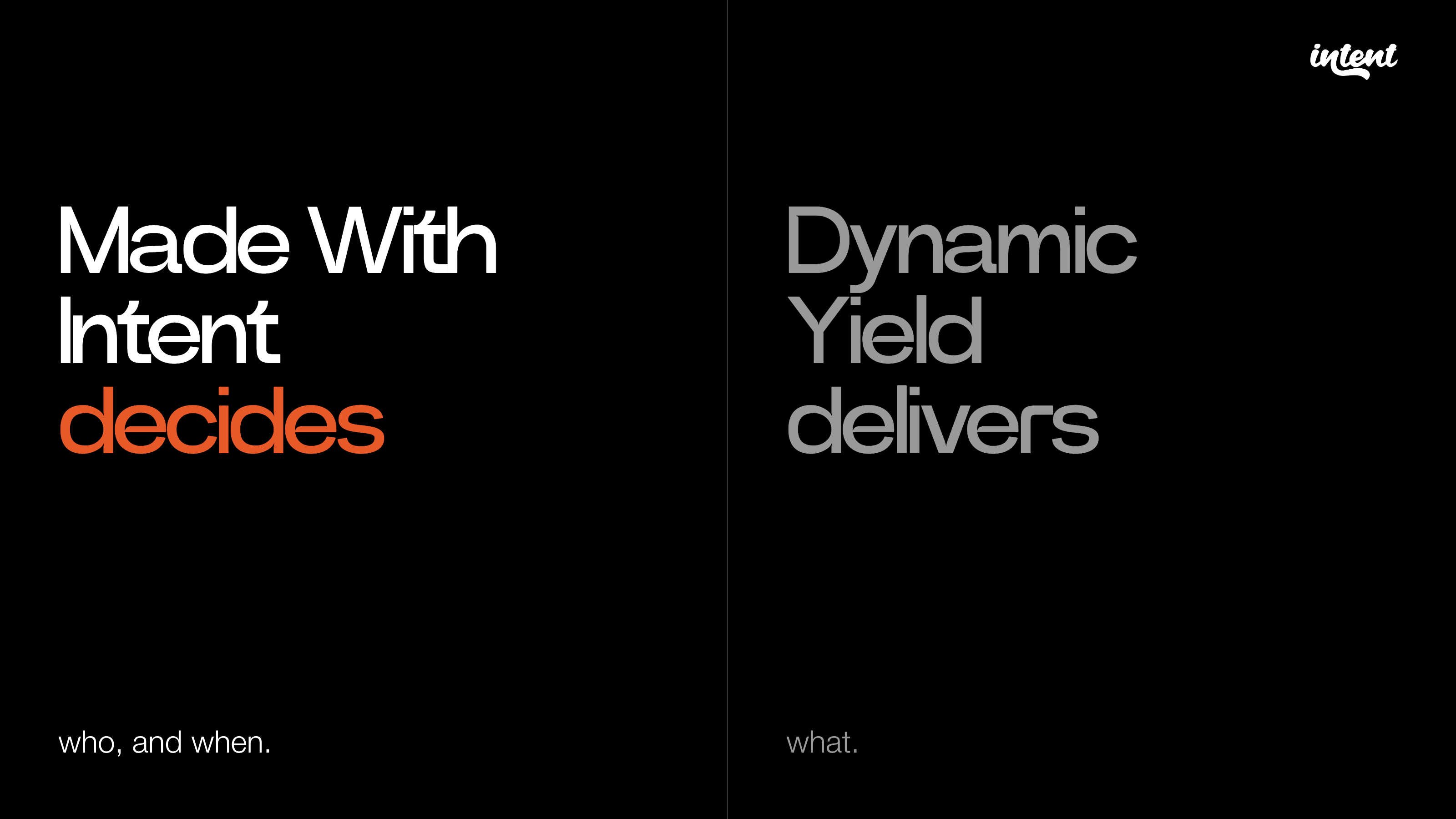
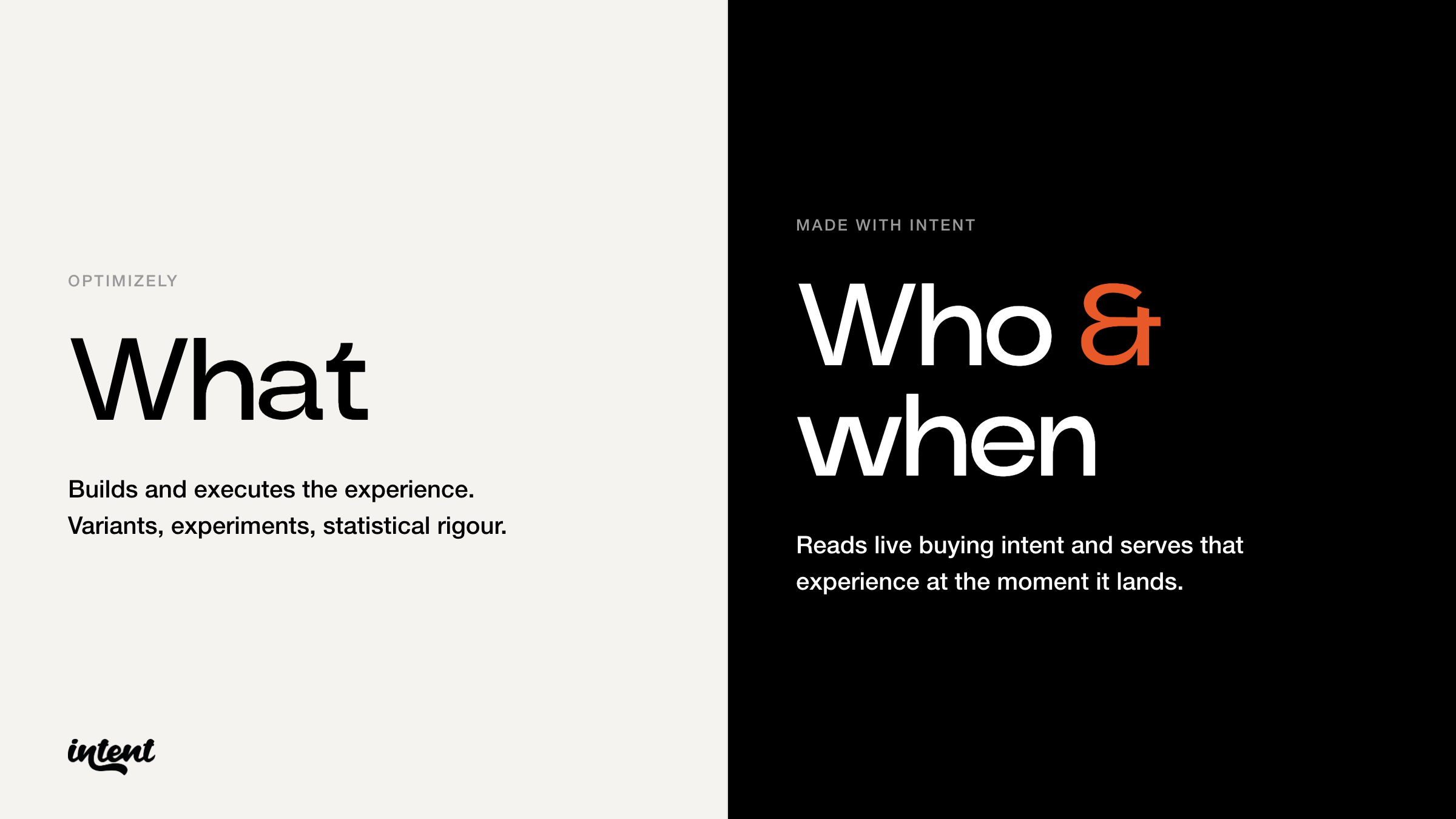
Made With Intent decides what experiences you should serve, to who and when, and Dynamic Yield delivers those experiences.
How Made With Intent is different to Dynamic Yield
There's three things that Made With Intent does different to Dynamic Yield. Let's dig into them below:
1. Made With Intent reads intent in real time
Dynamic Yield's intent workflow utilises two routes. First, Empathic Personalization classifies visitors into four inferred states, which are Curious, Interested, Focused and Satisfied.
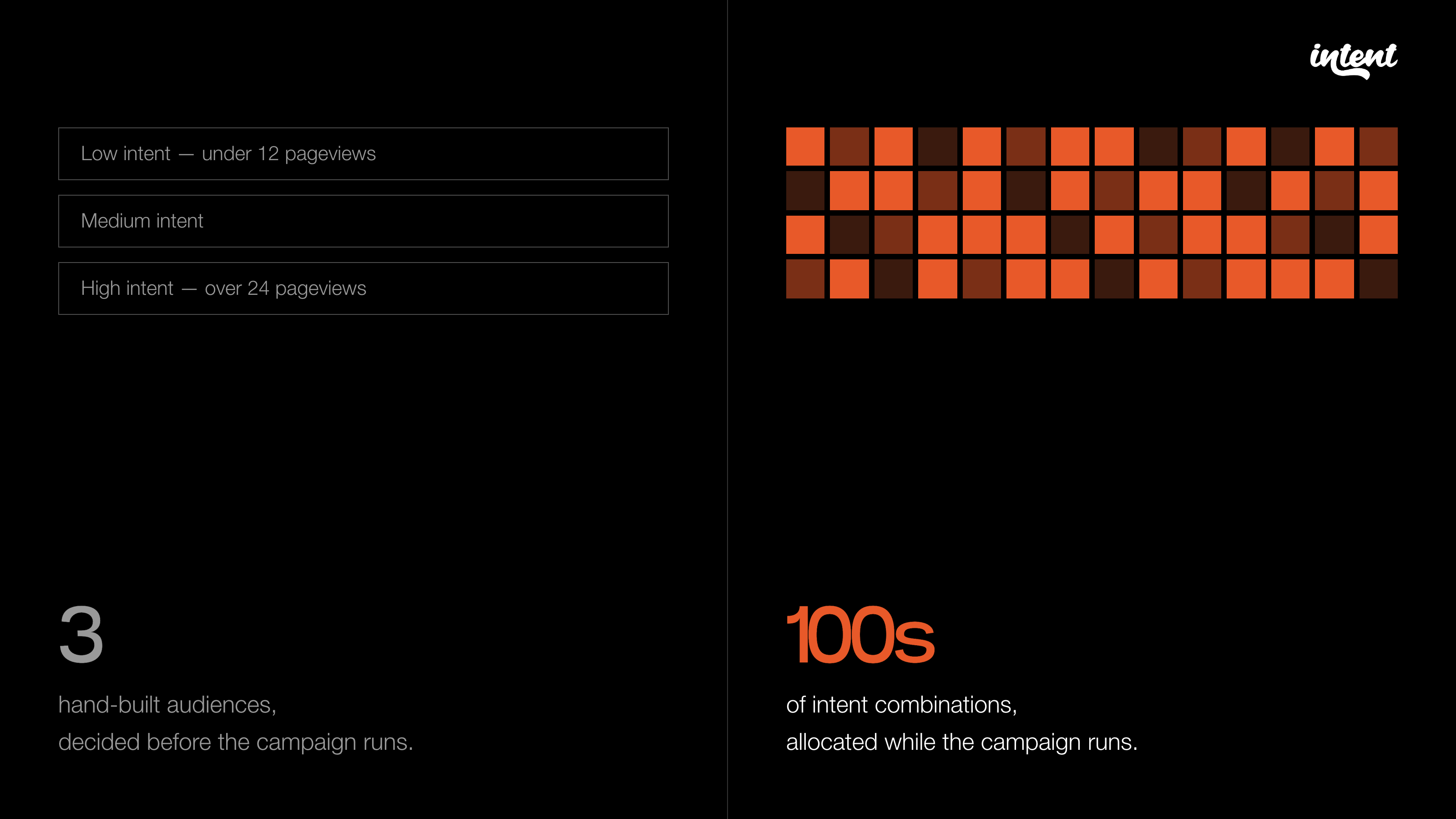
Its Audience Hub lets teams hand-build "low / medium / high intent" audiences from rules. Dynamic Yield's Primary Audiences framework shows a leading golf retailer defining low intent as fewer than 12 page views per session and high intent as more than 24.
That's a useful starting estimate, but page views aren't intent. A hesitant shopper racks up more pages than a decisive one. A high-intent visitor often converts inside three.
The more common version isn't pageview counts — it's event proxies. Add to cart equals high intent. Wishlist equals consideration. But an add to cart is as often a price check, a size comparison or a shipping-cost probe as it is a purchase signal. The event tells you what happened. It doesn't tell you what it meant.
Now, this is pretty fundamental: Dynamic Yield's model relies on behaviours your shoppers have already exhibited. It's a snapshot backwards in time, and like many what we call "rules-based" personalisation tools, you're reacting to things that have already have happened. Unlike Made With Intent.
Made With Intent reads buying intent directly — multi-dimensional, second-by-second signals predicting where the visitor is in their decision right now.
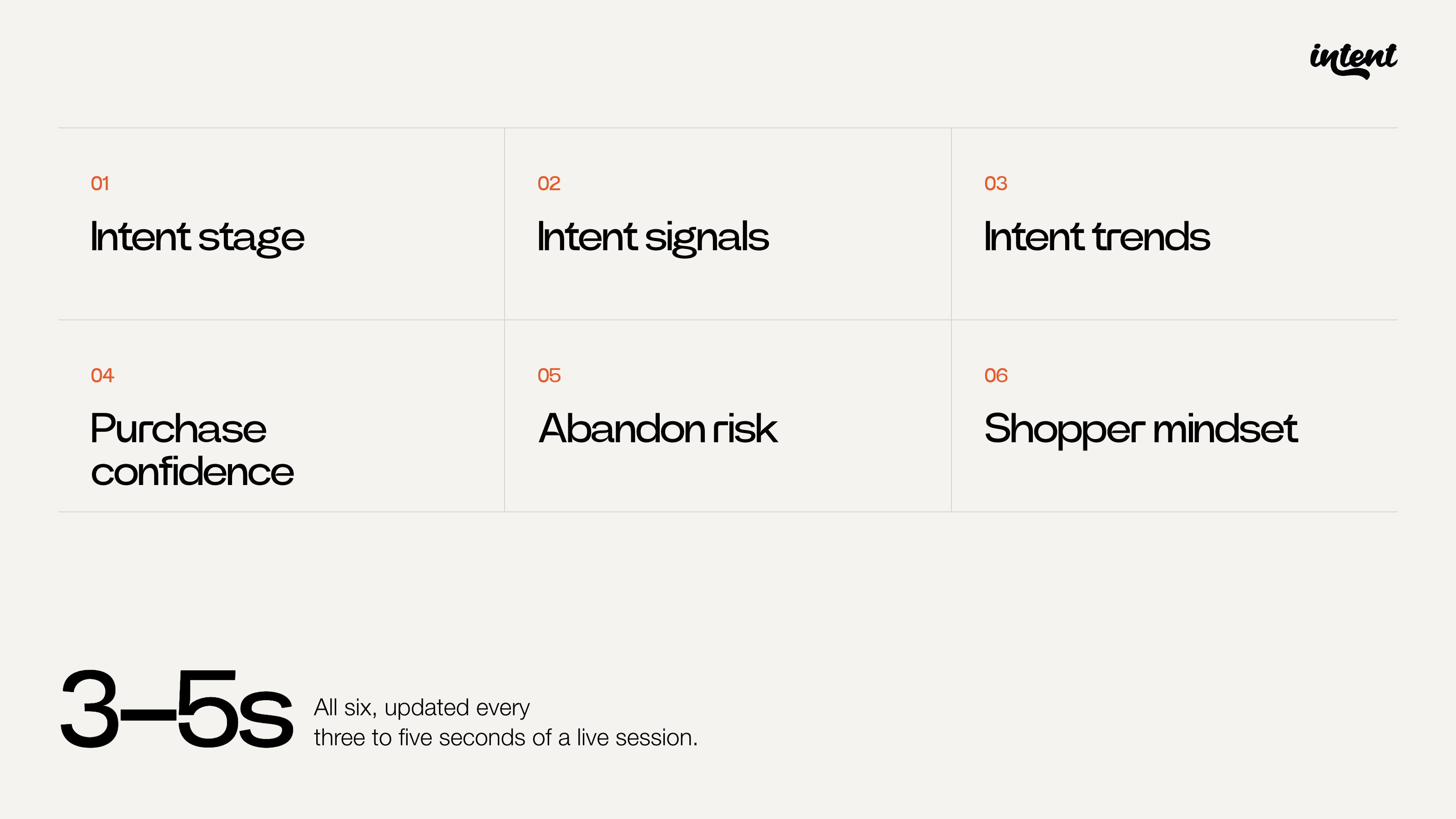
We break downs shopper behaviour into six stages, and these are: Intent stage. Intent signals. Intent trends. Purchase confidence. Abandon risk. Shopper mindset.
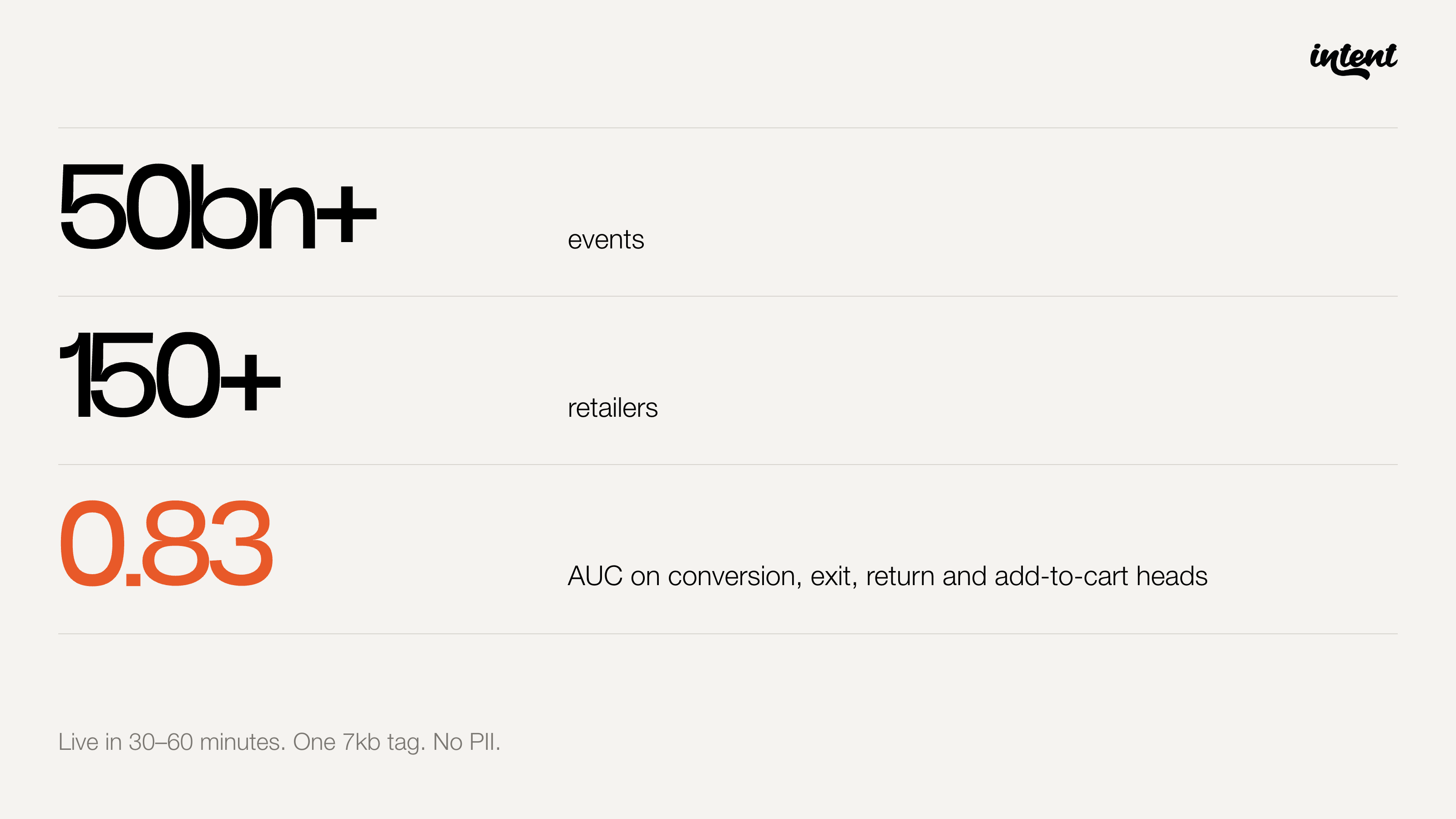
All updated every three–five seconds during a live session, on a model trained across 150+ retailers and 50 billion+ events.
2. Allocation across hundreds of intent combinations and not post-test segmentation
It takes eCommerce teams considerable time to build and maintain audience rules in Dynamic Yield. For instance, coding things such as "low intent equals fewer than 12 page views, high intent equals more than 24," then QA-ing those cohorts and redesigning them after each test.
Made With Intent replaces that with continuous intent prediction and delivery. The model decides who sees what, in real time, across hundreds of intent combinations. The actual grunt work is handled by our agent. Your team focuses on strategy, creative, and proof.
Our agent retrains daily, so the experience keeps allocating toward the intent combinations where impact is actually felt. Always on, always learning, always improving on where it started.
3. First-pageview coverage — no fallback needed
Behavioural data takes time to accrue; for anonymous or first-time visitors, Dynamic Yield falls back to geo-based predictive targeting and contextual signals.
Made With Intent has no fallback by design. It doesn't need one. We've trained it across 50bn+ events, in a range of contexts, giving the model day-one predictive power on every visitor, anonymous, identified, first-time, returning.
Made With Intent and Dynamic Yield: In depth
There are lots of areas of cross-over between Made With Intent and Dynamic Yield. The way our technologies work is similar in principle, but different in its practical implementation.
Let's start first with how Dynamic Yield's prediction capabilities work:
How Dynamic Yield's prediction works
While we're talking about AdaptML, we have to say, it's a really sophisticated bit of engineering. It utilises recurrent neural networks and NLP models to get smarter and smarter as it consume more data its got on a specific retailer's visitors.
However, it predicts what you'd expect (affinity and relevance), not what's happening in a visitor's decision right now.
Our model is a driven by a single purpose: it reads buying intent. Sure, it's a narrower job, but it's the one that determines whether a visitor converts, hesitates, or leaves.
Made With Intent vs Dynamic Yield
When you should pick Dynamic Yield
Hey, we're not here to blindly sell you Made With Intent. Sometimes, our tool just isn't right for your business. So, unlike loads of other SaaS vendors, let us tell you when we wouldn't be a good fit:
• If you're trying to do cross-channel, Dynamic Yield is the right choice versus Made With Intent. We're web-first, and for multi-channel personalisation programmes Dynamic Yield is the right option.
• Recommendations: NextML and AffinityML are purpose built models for product and content recommendations. Made With Intent adds an intent decison later but it is not a replacement for NextML or AffinityML.
• Sophisticated email personalisation: Klaviyo-grade dynamic content across email and ad placements out of the box. If email is a key part of what you do, Dynamic Yield is a top choice.
• Security of a big vendor: Dynamic Yield is an eight-time Gartner Magic Quadrant Leader for personalisation engines. If you're enterprise org and need to run a formal RFP, this helps your procurement team make a decision.
• Strong experience builder. Sections, Page Contexts, and Selectors give users very fine control. But only after you've climbed the initial learning curve.
Where Made With Intent wins
Of course, this is an article designed to help you pick between Dynamic Yield and Made With Intent. From our table above, it's clear there's plenty of areas of overlap, but there's some stuff we do that, we don't mind saying, makes us a better choice. Have a read:
• Acts on the anonymous majority: Every visitor gets a multi-dimensional intent read from the first pageview. No prior data, no behavioural accrual, no geo fallback.
• Multi-dimensional intent prediction: The way we predict intent is comprehensive. We use six measures: stage, signals, trends, purchase confidence, abandon risk and shopper mindset. These are all updated every three-five seconds, unlike Dynamic Yield.
• Autonomously runs campaigns and makes decisions under directives: Agentic Campaigns can dynamically allocate experiences across hundreds of intent combinations during a campaign you'll run. Dynamic Yields's models are sophisticated. The targeting layer above them is still rule-driven. That's simply how the tool is built. But it means what experiences are served is decided before the campaign runs, and not during it.
• Cross-merchant model: 50 billion+ events across 150+ retailers. Day-one predictive power for our customers.
• Start within 30 minutes: Single 7kb GTM tag, no PII and we're ISO 27001 accredited.
So, it's time to make a decision: Let's pick one. Or both?
It's crunch time. We've given you all the facts, but it's time to wrap up and make a judgment call.
Pick Dynamic Yield if the you want consistent cross-channel personalisation — content and recommendations spanning web, mobile app, email, and kiosk. And if you have the technical resources to operate it.
Dynamic Yield's breadth and recommendation algorithm depth is class-leading, and trying to replicate the scale of that capability with Made With intent, plus some integrations would be a worse outcome for you.
Choose Made With Intent if you want a on-site decisioning, intent-driven experiences, and proven incrementality. Our tool delivers experiences natively, allocates them dynamically across hundreds of intent combinations, and proves causal lift on every one.
Now, something to think about. If you're an enterprise customer, you actually could consider both. And here's why:
• Dynamic Yield gives you the breadth and means of channels and mediums to serve personalised content to
• Made With Intent helps you accurately decide who, and when that content should be served
That's brought us to the end of the comparison blog post. If you're still unsure of the differences between Dynamic Yield and Made With Intent, the best thing for you to do is talk with one of our team.
You can book a demo here.
Disclaimer: This comparison is based on publicly available information from Dynamic Yield's documentation, marketing site, and customer reviews as of April 2026. Both products evolve continuously. If anything looks out of date, get in touch and we'll sort it.



Latest articles
Made With Intent is an on-site intent engine for eCommerce businesses. It reads buying intent in real time and decides which experiences go to which visitors, and when.
Dynamic Yield is an experience optimization and personalization platform. It helps businesses tailor digital customer journeys across websites, mobile apps, and email.
This post explains where the two platforms work together, and where you'd still use Dynamic Yield instead.
If you can't wait until the end, here's a TLDR;
Pick Dynamic Yield if:
• Your priority is consistent personalisation across web, mobile app, email, and in-store kiosk
• You've got the team and budget to do a weeks long enterprise deployment
• Recommendation capabilities matters more than first-page view intent coverage.
Made With Intent is for you if:
• You want to read buying intent in real-time
◦ Then, serve the right content, the right experience at the appropriate moment
• Want to benefit from a 30-60 minute install time
And when we're thinking about Made With Intent and Dynamic Yield working together, here's how we recommend thinking about it:
Made With Intent decides what experiences you should serve, to who and when, and Dynamic Yield delivers those experiences.
How Made With Intent is different to Dynamic Yield
There's three things that Made With Intent does different to Dynamic Yield. Let's dig into them below:
1. Made With Intent reads intent in real time
Dynamic Yield's intent workflow utilises two routes. First, Empathic Personalization classifies visitors into four inferred states, which are Curious, Interested, Focused and Satisfied.
Its Audience Hub lets teams hand-build "low / medium / high intent" audiences from rules. Dynamic Yield's Primary Audiences framework shows a leading golf retailer defining low intent as fewer than 12 page views per session and high intent as more than 24.
That's a useful starting estimate, but page views aren't intent. A hesitant shopper racks up more pages than a decisive one. A high-intent visitor often converts inside three.
The more common version isn't pageview counts — it's event proxies. Add to cart equals high intent. Wishlist equals consideration. But an add to cart is as often a price check, a size comparison or a shipping-cost probe as it is a purchase signal. The event tells you what happened. It doesn't tell you what it meant.
Now, this is pretty fundamental: Dynamic Yield's model relies on behaviours your shoppers have already exhibited. It's a snapshot backwards in time, and like many what we call "rules-based" personalisation tools, you're reacting to things that have already have happened. Unlike Made With Intent.
Made With Intent reads buying intent directly — multi-dimensional, second-by-second signals predicting where the visitor is in their decision right now.
We break downs shopper behaviour into six stages, and these are: Intent stage. Intent signals. Intent trends. Purchase confidence. Abandon risk. Shopper mindset.
All updated every three–five seconds during a live session, on a model trained across 150+ retailers and 50 billion+ events.
2. Allocation across hundreds of intent combinations and not post-test segmentation
It takes eCommerce teams considerable time to build and maintain audience rules in Dynamic Yield. For instance, coding things such as "low intent equals fewer than 12 page views, high intent equals more than 24," then QA-ing those cohorts and redesigning them after each test.
Made With Intent replaces that with continuous intent prediction and delivery. The model decides who sees what, in real time, across hundreds of intent combinations. The actual grunt work is handled by our agent. Your team focuses on strategy, creative, and proof.
Our agent retrains daily, so the experience keeps allocating toward the intent combinations where impact is actually felt. Always on, always learning, always improving on where it started.
3. First-pageview coverage — no fallback needed
Behavioural data takes time to accrue; for anonymous or first-time visitors, Dynamic Yield falls back to geo-based predictive targeting and contextual signals.
Made With Intent has no fallback by design. It doesn't need one. We've trained it across 50bn+ events, in a range of contexts, giving the model day-one predictive power on every visitor, anonymous, identified, first-time, returning.
Made With Intent and Dynamic Yield: In depth
There are lots of areas of cross-over between Made With Intent and Dynamic Yield. The way our technologies work is similar in principle, but different in its practical implementation.
Let's start first with how Dynamic Yield's prediction capabilities work:
How Dynamic Yield's prediction works
While we're talking about AdaptML, we have to say, it's a really sophisticated bit of engineering. It utilises recurrent neural networks and NLP models to get smarter and smarter as it consume more data its got on a specific retailer's visitors.
However, it predicts what you'd expect (affinity and relevance), not what's happening in a visitor's decision right now.
Our model is a driven by a single purpose: it reads buying intent. Sure, it's a narrower job, but it's the one that determines whether a visitor converts, hesitates, or leaves.
Made With Intent vs Dynamic Yield
When you should pick Dynamic Yield
Hey, we're not here to blindly sell you Made With Intent. Sometimes, our tool just isn't right for your business. So, unlike loads of other SaaS vendors, let us tell you when we wouldn't be a good fit:
• If you're trying to do cross-channel, Dynamic Yield is the right choice versus Made With Intent. We're web-first, and for multi-channel personalisation programmes Dynamic Yield is the right option.
• Recommendations: NextML and AffinityML are purpose built models for product and content recommendations. Made With Intent adds an intent decison later but it is not a replacement for NextML or AffinityML.
• Sophisticated email personalisation: Klaviyo-grade dynamic content across email and ad placements out of the box. If email is a key part of what you do, Dynamic Yield is a top choice.
• Security of a big vendor: Dynamic Yield is an eight-time Gartner Magic Quadrant Leader for personalisation engines. If you're enterprise org and need to run a formal RFP, this helps your procurement team make a decision.
• Strong experience builder. Sections, Page Contexts, and Selectors give users very fine control. But only after you've climbed the initial learning curve.
Where Made With Intent wins
Of course, this is an article designed to help you pick between Dynamic Yield and Made With Intent. From our table above, it's clear there's plenty of areas of overlap, but there's some stuff we do that, we don't mind saying, makes us a better choice. Have a read:
• Acts on the anonymous majority: Every visitor gets a multi-dimensional intent read from the first pageview. No prior data, no behavioural accrual, no geo fallback.
• Multi-dimensional intent prediction: The way we predict intent is comprehensive. We use six measures: stage, signals, trends, purchase confidence, abandon risk and shopper mindset. These are all updated every three-five seconds, unlike Dynamic Yield.
• Autonomously runs campaigns and makes decisions under directives: Agentic Campaigns can dynamically allocate experiences across hundreds of intent combinations during a campaign you'll run. Dynamic Yields's models are sophisticated. The targeting layer above them is still rule-driven. That's simply how the tool is built. But it means what experiences are served is decided before the campaign runs, and not during it.
• Cross-merchant model: 50 billion+ events across 150+ retailers. Day-one predictive power for our customers.
• Start within 30 minutes: Single 7kb GTM tag, no PII and we're ISO 27001 accredited.
So, it's time to make a decision: Let's pick one. Or both?
It's crunch time. We've given you all the facts, but it's time to wrap up and make a judgment call.
Pick Dynamic Yield if the you want consistent cross-channel personalisation — content and recommendations spanning web, mobile app, email, and kiosk. And if you have the technical resources to operate it.
Dynamic Yield's breadth and recommendation algorithm depth is class-leading, and trying to replicate the scale of that capability with Made With intent, plus some integrations would be a worse outcome for you.
Choose Made With Intent if you want a on-site decisioning, intent-driven experiences, and proven incrementality. Our tool delivers experiences natively, allocates them dynamically across hundreds of intent combinations, and proves causal lift on every one.
Now, something to think about. If you're an enterprise customer, you actually could consider both. And here's why:
• Dynamic Yield gives you the breadth and means of channels and mediums to serve personalised content to
• Made With Intent helps you accurately decide who, and when that content should be served
That's brought us to the end of the comparison blog post. If you're still unsure of the differences between Dynamic Yield and Made With Intent, the best thing for you to do is talk with one of our team.
You can book a demo here.
Disclaimer: This comparison is based on publicly available information from Dynamic Yield's documentation, marketing site, and customer reviews as of April 2026. Both products evolve continuously. If anything looks out of date, get in touch and we'll sort it.

Your A/B testing programme just found a winner. A new discount banner lifted conversion by a healthy margin, the test ran long enough to be statistically significant, and the result is sitting in a dashboard somewhere with a green checkmark next to it. Mission accomplished, right?
For most eCommerce teams, the default answer is the same: roll it out to 100% of visitors.
That decision gets made without a second thought, because it doesn't feel like a decision at all. It feels like the natural conclusion of a successful test. You've gone and validated your hypothesis. And when you've got a winner, there's a paper trail to an uplift.
It isn't. It's a choice, and for most brands it's the wrong one.
A/B testing tells you which experience wins across your traffic as a whole. It doesn't tell you which specific visitor should see that winner, or when. That's a different question, that's answered in an entirely different way. It's a decision that requires you needing to know something about the person you're serving an experience to in the first place.
Let's be clear — A/B testing definitely has a place
A/B testing tools do exactly what they're built to do, and they do it well. They replace opinion with evidence. A test that runs to statistical significance tells you, with confidence, that variant B outperforms variant A on your website or mobile app.
Made With Intent customers continue to use tools like Convert, VWO, and AB Tasty alongside our tool, because testing answers a question nothing else can: does this specific change move the number we care about?
Think about what a test actually proves. It proves that, across hundreds or thousands of visitors, variant B beat variant A. It says nothing about any single visitor in front of you right now. Statistical significance is for large volumes of people not a prediction about the individual standing at your checkout, which is a limitation CRO metrics share more broadly.
The difference between A/B testing tools and Made With Intent
Should 100% of people get your A/B test winner?
Once a test determines a winner, most teams roll that experience out broadly, often to every visitor who fits the original test's targeting. Many testing tools do offer segment targeting: device type, geography, new versus returning.
Some brands go further and layer in basic rules, like showing a winning banner only after 30 seconds on site, or only to visitors on their third page view. These rules feel like personalisation. They're really just a slightly more granular version of the same default: a fixed condition, checked once, applied broadly.
But look closely at how it gets set up. Teams choose segments once, at test design time, and then leave them alone. Even a well-built intent-based segmentation programme needs continuous application, not just at launch, or it drifts back into the same static-rule problem.
A rule that says "show this to returning visitors" doesn't change three minutes later when a returning visitor starts behaving like someone about to abandon their basket, or like someone who was going to buy anyway with or without an incentive.
The real problem is narrower and more difficult to solve. The targeting decision is frozen at the moment the test launches, while the person in front of it keeps changing their mind. (Their intent)
A discount that lifts conversion in aggregate can still be the wrong call for two specific people in your test group. A first-time visitor who's price-sensitive and hesitating needs it. A loyal customer who's already three products deep into checkout, on their fourth order this year, does not.
It's the same tension at the heart of whether discounting is a race to the bottom or a genuine growth lever. There's no problem with offering discounts, but it can be a blunt instrument or entirely inappropriate depending on where your customer is at in their buying journey.

How reading intent allows you to respond immediately to changing demands
A/B testing tools make their decision once, when the page loads or the session starts. Whatever segment a visitor falls into at that moment determines what they see for the rest of that test.
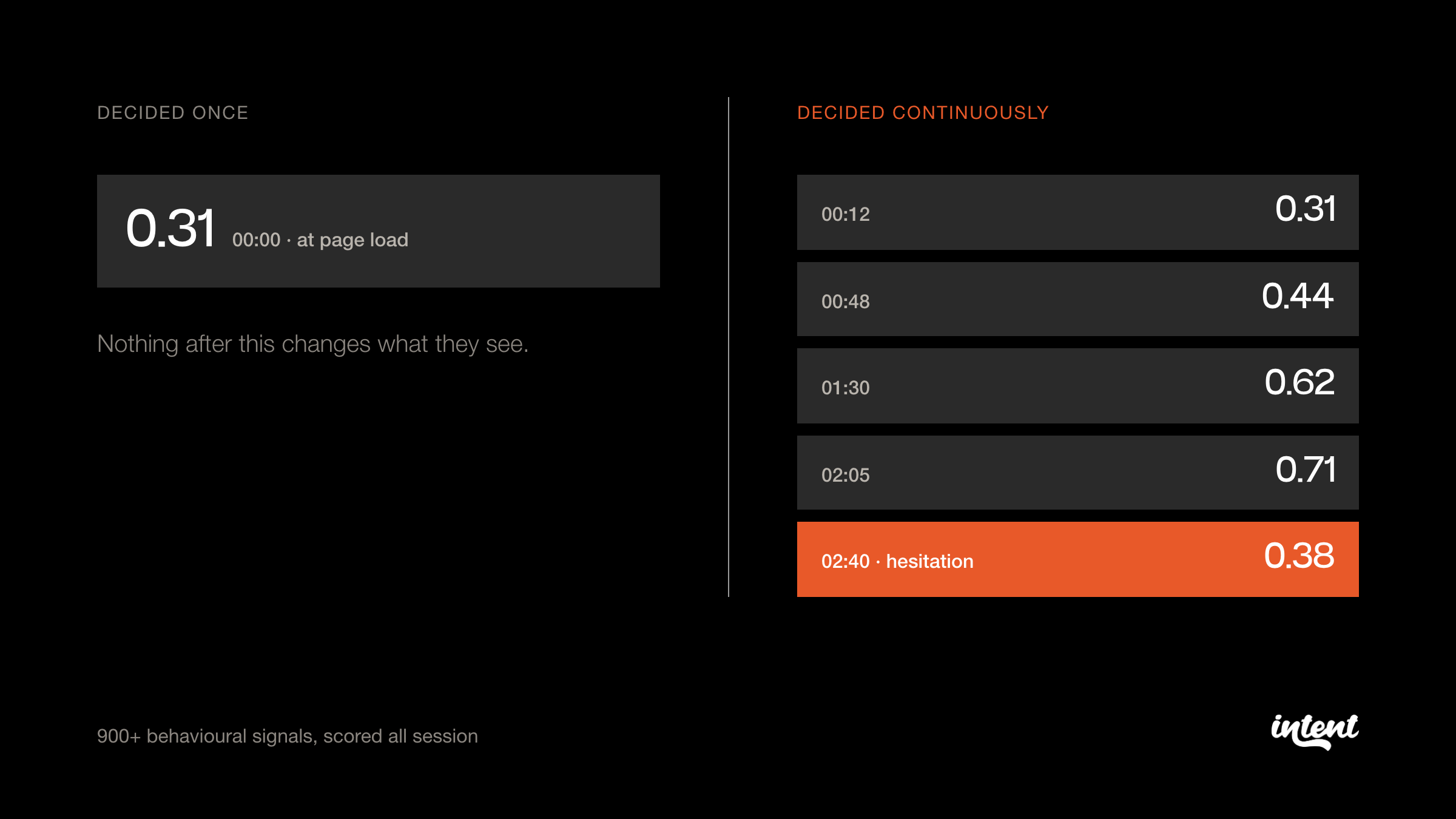
But purchase intent isn't fixed at page load. A visitor can arrive browsing casually, spend four minutes comparing two products, add one to their basket, then hesitate at the price for 30 seconds before starting to type a discount code into Google in another tab. That's not a static segment. That's a person, moving in real time, and most testing infrastructure was never built to react to this situation as it unfolds.
Some testing and CRO tools react to single behavioural triggers: an exit-intent popup fired on mouse movement toward the browser bar, a scroll-based banner, a basic engagement score. We think those are great, and definitely worth using. However, they're single-trigger rules, checked once a condition is met, and not a continuous read on a person as they use your website and apps.
What real-time behavioural data adds
Made With Intent's platform tracks over 900+ behavioural signals through each visitor's session, including scroll speed, click sequences, time spent, and product comparison patterns, updating its prediction of purchase intent continuously rather than once. When intent shifts, the response can shift with it.
None of this means every session tells a dramatic story. Plenty of visitors browse, leave, and never come close to converting in that session, and no amount of real-time signal turns a casual browser into a buyer. The claim isn't that every visitor is secretly ready to buy. It's that the visitors who are ready look different from the ones who aren't, and a rule set once at test launch can't tell the difference between them three minutes into the session.
What real-time intent-based deployment looks like
Picture the same winning discount from earlier. Instead of firing it to every visitor who matches a fixed segment, an intent-based system asks a narrower question: Is this specific visitor showing signals of hesitation or exit risk right now, or are they already moving smoothly toward checkout?
Made With Intent's Intent Scoring analyses those signals continuously and its Timing Engine decides the moment to act, rather than firing on a page-load rule or a fixed timer. A hesitant first-time visitor comparing prices across tabs might see the discount. A returning customer already at the payment page, showing no hesitation signals at all, doesn't need it, and doesn't get it. This is what discounting with intent looks like in practice: the same offer, reserved for the visitors who actually need it to convert.
The winning experience from your test doesn't change. Who receives it, and when, does.
Take a product page test that proved a scarcity message ("only 3 left") increased add-to-basket rate. Fired at everyone, it also lands on a loyal customer who's bought the same product line four times before and knows exactly what they want. To that visitor, it reads as pressure, not information. Deployed by intent, the same message is reserved for the visitors actually showing comparison and hesitation behaviour, the ones it was designed to nudge in the first place.
How an actual company used Made With Intent alongside A/B testing
Appliances Direct, a UK home appliances retailer, ran into a version of this problem. Their discounting was broad and largely untargeted; offers went out early in the visitor journey, without real-time context, regardless of whether a given shopper actually needed the incentive to convert.
Using Made With Intent, they began reserving discounts for visitors showing genuine exit and abandonment signals, rather than firing them to everyone who matched a static segment. They left everyone else to convert at full price, as they were always going to.
In the end, they made a 42% saving in margin previously given away to visitors who would have converted regardless, without a drop in conversions from the visitors who needed the discount to purchase.
But don't take our word for it. Take a look at our Appliances Direct case study and make up your mind yourself.
That figure lines up with a broader pattern. Made With Intent's own Intent Gap research found that 83% of shoppers have used a discount code despite being ready to pay full price.

Why new test winners are rare
That scarcity of new winners isn't unique to Appliances Direct. Research from Microsoft's own experimentation team, drawn from thousands of controlled experiments at Bing and elsewhere, found that only 10 to 20% of test ideas move the metric they were designed to move, and that a genuine breakthrough, the kind of result that reshapes a programme rather than nudging it, shows up in roughly one in 500 experiments. The findings come from Kohavi et al.'s Seven Rules of Thumb for Web Site Experimenters (2014). Most of what a mature testing programme finds after the early wins are used up is small, single-digit-percentage gains, not new step changes.
Testing tells you what works. Intent tells you for whom, right now.
None of this is an argument against testing. It's an argument for finishing the job testing starts.
Your A/B testing programme answers one question well: does this experience outperform the alternative? What it was never built to answer is a second, quieter question that gets decided by default instead of by design: who should see this winning experience, and at what moment in their session?
Testing finds your best experience. Making sure it reaches the right person, at the right moment, without giving away margin to people who didn't need it, is a different problem, and it needs a different kind of data to solve.
If you want to see what your existing winning experiences would look like deployed by real-time intent instead of a blanket rule, book a demo and we'll walk through it against your own traffic.
Made With Intent is an on-site decision engine for eCommerce businesses. It reads people's buying intent in real time and allocates experiences to the visitors most likely to respond to them
Optimizely is a digital experience platform. It does web and feature experimentation, rule-based personalisation, content recommendations. It's designed for teams running structured test-and-learn programmes at scale.
This blog post explains where the two platforms complement each other and when you would use both versus just one on its own. But if you're too impatient to read to the end, we've got you:
Made With Intent and Optimizely serve different functions. Optimizely handles experimentation and rule-based personalisation.
Made With Intent reads visitor intent in real time and decides who sees an experience and when. The two work really well together:
Optimizely executes what, Made with Intent decides who and when. We serve your Optimizely experiences when it matters (the right time within their session) and to whom, all based on what really matters; their intent.
How Made With Intent is different to Optimizely
1. Respond to users in real-time with experiences tailored to what their digital body language tells you
Optimizely's strongest targeting comes from rule-based audiences in Web Experimentation and Personalization, boolean logic on geo, device, behavioural events, URL targeting, and page Tags, plus optional machine learning (ML) layers:
- Adaptive Audiences (interest categories inferred from content engagement)
- Content Recommendations (NLP-driven topic affinity per visitor)
- Optimizely Data Platform (ODP) real-time audiences
The Stats Engine inside experiments is genuinely best-in-class — sequential testing with always-valid p-values — but the targeting decision still asks the marketer to define which audience rule a visitor fits into.
Made With Intent flips the model. It reads buying intent in real-time from the first pageview. Stage, signals, trends, purchase confidence, abandon risk, shopper mindset, and re-scores every three-five seconds.
Targeting is driven by what's happening now, in real-time, by a human, not by which rule-defined audience or topic interest a visitor has been mapped into. Nor by behaviour that's already happened. This means you can respond to the signals that sit between events and pageviews; what we call moments that matter.
You can read more about How Made With Intent Works, and the moments that matter, by clicking the link.
2. Segment the right experience to your customers automatically, without fiddling with rule trees manually
Your team currently builds and maintains audiences in Optimizely's Audience Builder, Dynamic Customer Profiles, Adaptive Audiences, and ODP. All with decision rule trees, content-tagging taxonomies, attribute conditions, event conditions.
Even with contextual bandits reallocating traffic within a defined audience, the audience definition itself stays manual: design the rules, QA the segments, redesign as the catalogue and content evolve. These segments are website-attributes, too. Not human attributes, not intent based (the most human of all attributes). That's where personalisation really succeeds.
Made With Intent replaces all of the above with continuous intent prediction and delivery.
Our agent decides who sees what, in real time, across hundreds of intent combinations. You'll focus on strategy, creative and proof, instead of tweaking and analysing rules or segments all the time.
The agent retrains daily, which means the experience compounds toward intent combinations where impact is seen and felt. In an always on state, always learning, always getting better.
Where Optimizely's multi-armed bandits (if used) allocate traffic across the variants of a single experiment to maximise one fixed metric within one defined audience, Made With Intent allocates across hundreds of audiences (intent combinations) — adding the layer of to whom and when an experience should be served, and measuring it against a holdback rather than just exploiting the winner.
Made With Intent and Optimizely: In depth
Here is how the two platforms compare on the things that matter most for eCommerce teams:
Where does Made With Intent integrate with Optimizely?
We've broken this section down into three parts. We want to be honest about where you'll gain functionality by utilising Made With Intent with Optimizely, where we augment it, and things we simply don't do, or Optimizely does better.
How Made With Intent adds new functionality to Optimizely
Understand and act on every visitor (including anonymous) from the first pageview. Optimizely's Personalization is rule-driven. It works once a visitor matches an audience rule. Content Recommendations builds a per-visitor interest profile from content engagement, which strengthens as the session progresses.
Made With Intent's model, which collates 50bn+ monthly events across 150+ retailers, reads continuous intent from pageview one, every few seconds. Anonymous, identified, first-time, returning. The opening moments of a session get the same intent read as the tenth pageview.
Automatically identify and serve the best experiences to people without guessing. Optimizely's contextual multi-armed bandit (CMAB, powered by Opal) is the closest thing in their stack, and it's genuinely good, so it's worth being precise about what it does.
A CMAB picks the best-performing variation for each visitor based on context (device, geo, behavioural history) to maximise one primary metric, within a single experiment.
Three design choices define it: the context attributes are declared up front and can't be added or removed once it starts (even paused); it optimises exclusively to a single primary metric fixed at launch; and it begins with a 100% exploration phase, randomly serving variations until it has gathered enough data before it shifts to exploiting the winner.
It's a smarter way to split traffic across the variations you built for the audience you defined.
But we'd like to go into detail on what that context is.
Device, geo and behavioural history are proxies for a person. They describe who a visitor appears to be, not what they want or how close they are to buying. They're arbitrary website attributes that correlate with conversion only loosely, and a bandit optimising over them is tuning against a weak signal.
Intent — buying stage, momentum, hesitation, purchase confidence — is the proximate driver of what a visitor actually does next. The proxies describe identity; intent describes decision, and decision is what moves the metric. Optimising the allocation over the wrong variable caps how much a CMAB can ever find.
Made With Intent's agentic campaigns work a level up.
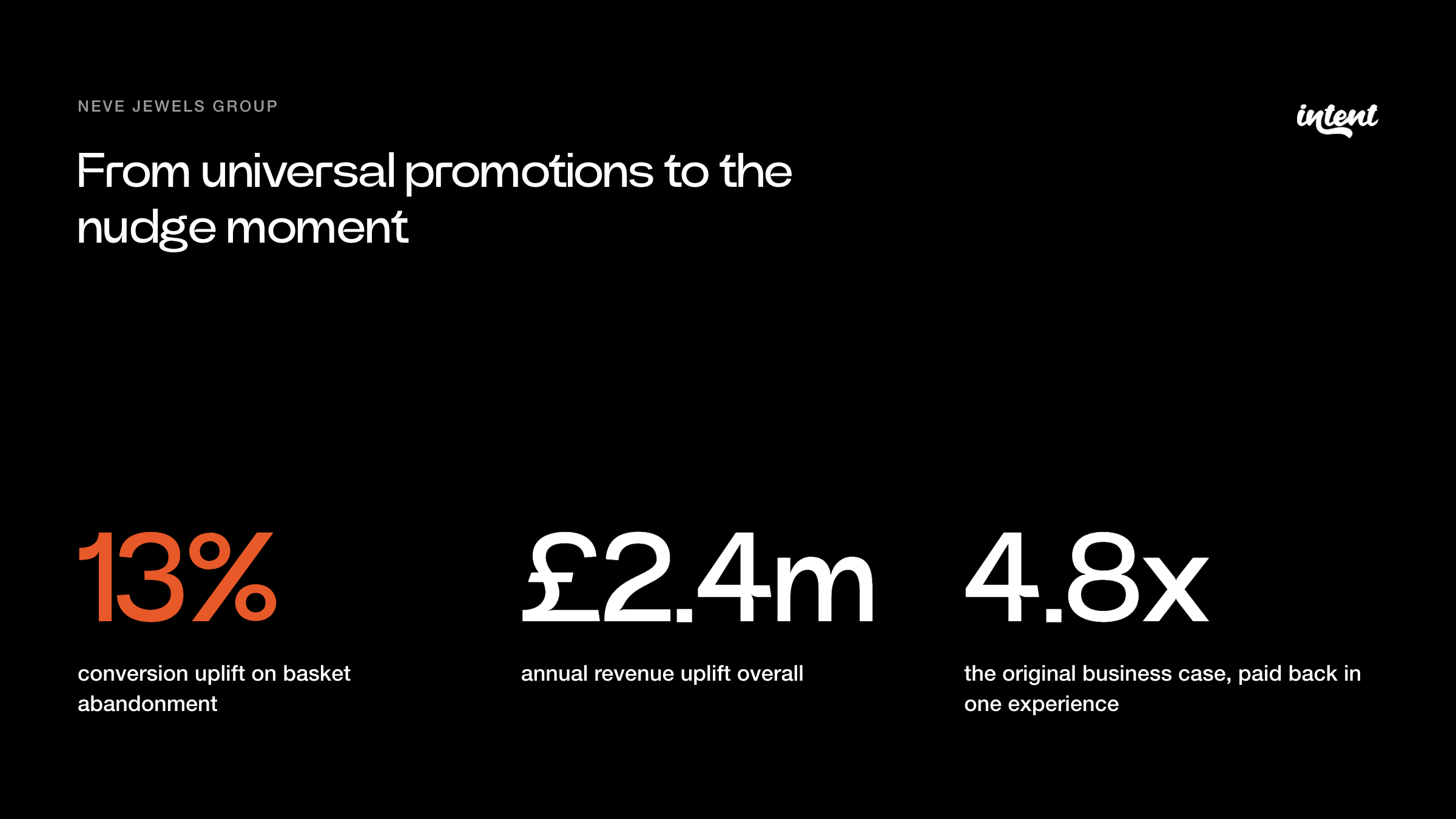
Rather than splitting traffic across the variations of one experiment to maximise one metric, it allocates across hundreds of intent combinations.
Diamonds Factory, a Made With Intent customer, ran 560+ on a single abandonment use case, where the 'context' is live, multi-dimensional intent (stage, signal, trend, purchase confidence, abandon risk, mindset) that updates every 3–5 seconds and is discovered by the agent, not enumerated by the team upfront. Learn more about basket abandonment here.
There's no per-experiment exploration tax, because the model is trained across 50bn+ events, 150+ retailers and live from page view one.
And because a bandit is built to shift traffic toward winners, it has no standing no-treatment baseline — Made With Intent keeps a holdback on every experience, so it can answer "did this cause incremental orders," the question a metric-maximising bandit structurally can't.
Causal incrementality on every experience. Optimizely's Stats Engine reports variant lift with always-valid p-values; genuinely strong for variant comparison.
Made With Intent runs a holdback group on every experience by default and reports incremental orders against a no-intervention baseline.
The difference is between "variant A beat variant B" and "this experience caused X orders that wouldn't have happened otherwise."
Where Made With Intent improves Optimizely
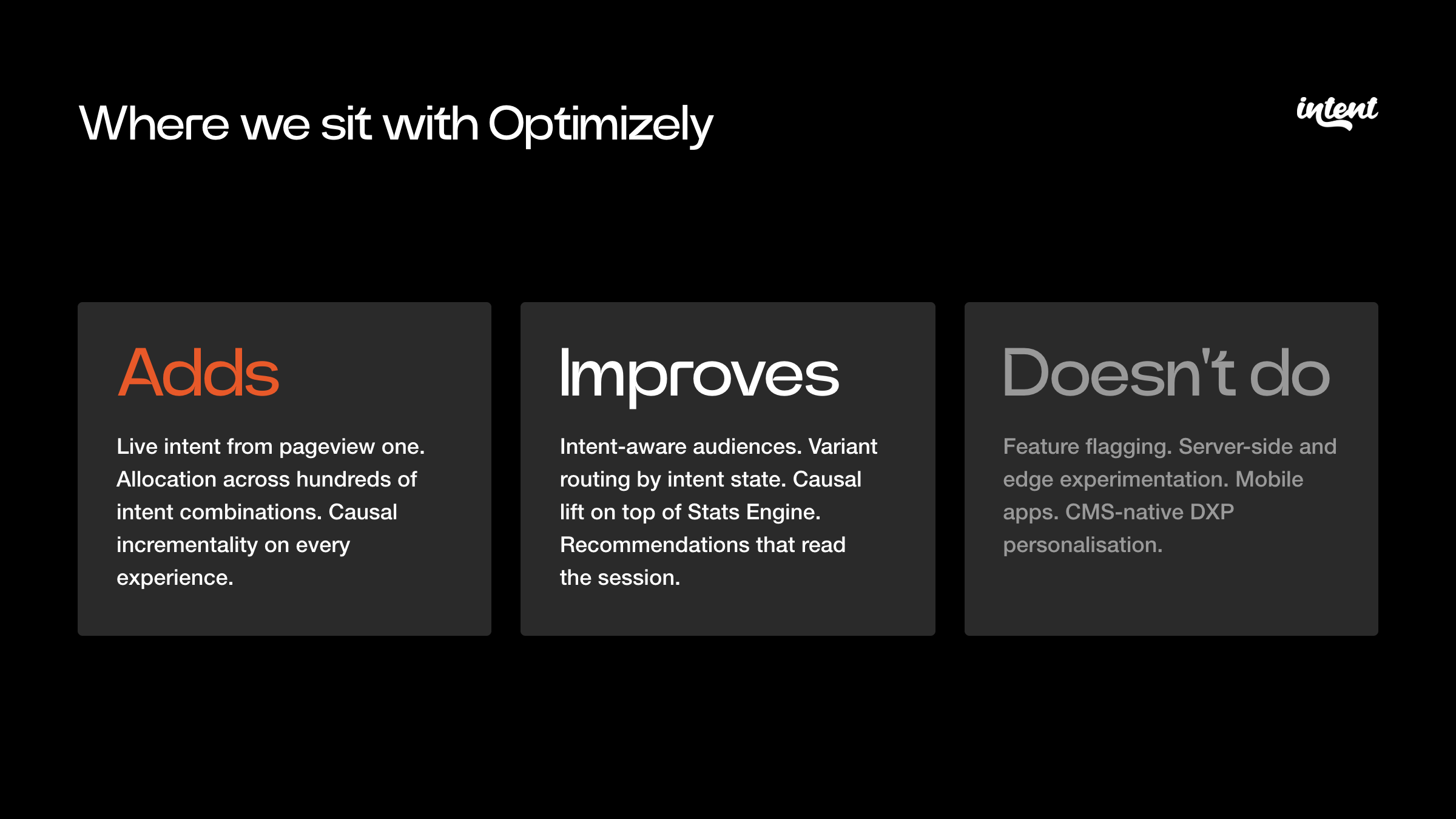
These are things Optimizely does that get better with Made With Intent on top:
- Audience Builder and ODP audiences become intent-aware
Instead of boolean rules on attributes and events, or content-engagement interest categories, Optimizely audiences can take Made With Intent's live intent attributes and target on signals that actually predict conversion. ODP's segment builder picks these up as attribute conditions; Web Experimentation picks them up as Tags. - Personalization variants get the right routing
Made With Intent decides which Optimizely-created variant a visitor should see based on their current intent state, replacing rule-based audience routing. The marketer keeps the variant production; our agent handles the allocation. - Web Experimentation tests get causal lift on top of variant performance. Run Optimizely tests with Stats Engine as you do today. Add Made With Intent's holdback measurement on the experience itself to answer "would users have purchased regardless of any variant?"
- Content Recommendations recommend to live intent, not just topic affinity. Made With Intent lets Content Recommendations reflect what's happening in this session, not just historical topic engagement. Particularly useful for anonymous visitors where you’re not sure what their behaviour is telling you.
What Made With Intent doesn't do
- Feature flagging and server-side experimentation. Optimizely Feature Experimentation (SDKs in 19+ languages, Edge Workers, Agent microservice) is a category leader. We don’t offer anything here.
- Sequential testing methodology for variant comparison. The Stats Engine's mSPRT-based always-valid p-values are best-in-class for inferring variant winners under continuous monitoring. Made With Intent uses Bayesian A/B with holdback.
- CMS-native content personalisation across the wider DXP. Optimizely Content Cloud, Content Marketing Platform and the broader DXP integration are all things that are not within Made With Intent's scope.
- Made With Intent isn’t going to change your recommendations process Optimizely's NLP-driven content recommendations and ecommerce product recommendations are well-established. Made With Intent adds an intent layer; we don’t replace what’s powering your recommendations process.
- Mobile app personalisation. Optimizely Feature Experimentation has native SDKs for iOS, Android, React Native. Made With Intent is web-first.
- Edge experimentation. Optimizely's Edge Worker integrations (Cloudflare, Akamai, Fastly) sit outside Made With Intent's use case
How to get started with Optimizely and Made With Intent
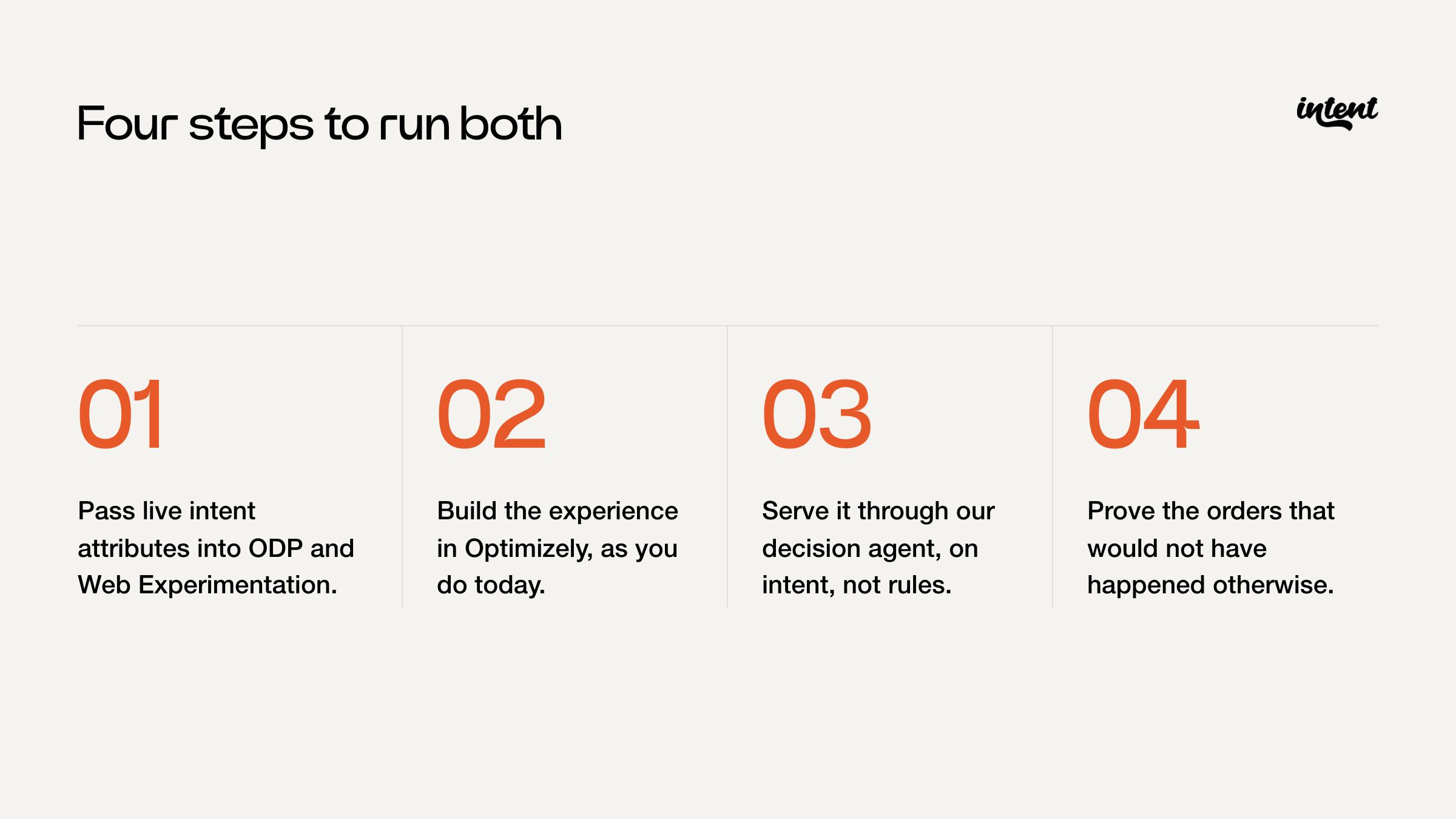
- Use Made With Intent to create intent-ready audiences in Optimizely: Pass Made With Intent's live intent attributes — purchase confidence, abandon risk, buying stage, intent trend — into ODP as attribute conditions, or into Web Experimentation as Tags.
Build audiences like "high purchase confidence + declining intent trend" (needs reassurance), "medium confidence + high abandon risk" (needs timely intervention), "low confidence + active comparison signals" (needs guidance, not a discount). - Execute experiences in Optimizely using those audiences. Use Web Experimentation and Personalization for what they do well, so things like variant production, Stats Engine analysis, content variations across the DXP.
- Serve the experience (or a variant) through Made With Intent's decision agent, where the experience is served based on visitor intent rather than rule-defined audiences.
- Use Made With Intent to prove the incrementality of "Optimizely + intent". Holdback groups on top of the Optimizely experience answer the CFO question: did this cause incremental orders, or did we just personalise for visitors who would have bought anyway? Particularly valuable for discounting — Made With Intent surfaces which high-intent visitors needed no incentive.
Neve Jewels Group, the luxury jewellery brands Austen Blake and Sacet, moved from universal promotions to intent-level targeting across their basket abandonment strategy.
Rather than applying the same discount to every abandoning visitor, Made With Intent segmented interventions across four intent levels, targeting what Director of Customer Experience Jo Homer described as "the nudge moment."
The result: 13% conversion uplift on basket abandonment, and £2.4m in annual revenue uplift overall, 4.8x the original business case, paid back within a single experience. You can learn more here.
What sort of businesses work best with Made With Intent?
This all depends on the size and structure of your eCommerce operation.
Mid-market retailers (£20m–£100m online revenue)
Made With Intent often leads here. Optimizely's Intelligence Cloud commonly lands at £50–80k+/year for this band, based on G2 reviews and procurement data. Made With Intent's session-based pricing, 30 to 60 minute install, and agentic layer fit eCommerce teams of two to ten people who need to ship and prove things quickly.
If you are running Optimizely for the Stats Engine and feature experimentation and those are load-bearing, keep them. Add Made With Intent for intent targeting and causal measurement of your on-site experiences.
Enterprise retailers with dedicated personalisation teams
Both, with clear role separation. Optimizely for the experimentation surface, Stats Engine credibility, server-side feature flagging, and DXP integration. Made With Intent for on-site intent-driven decisioning and causal measurement.
Try Made With Intent today
There you have it. Made With Intent and Optimizely are designed to complement one-another, not compete with one another. Many of our clients use Optimizely to continue A/B testing, while using Made With Intent to serve experience to customers on a 1:1 basis.
If you're interested in learning more about how Made With Intent works, and how you can use it in your tool stack, book a demo here.
Disclaimer: This comparison is based on publicly available information from Optimizely's documentation, marketing site, and customer reviews as of July 2026. Both products evolve continuously. If anything looks out of date, get in touch.

Editor's note: this article is adapted from a recent Intent Live session with Jack Simkins, Digital Product Manager at Golfbreaks.com. Watch the full recording here.
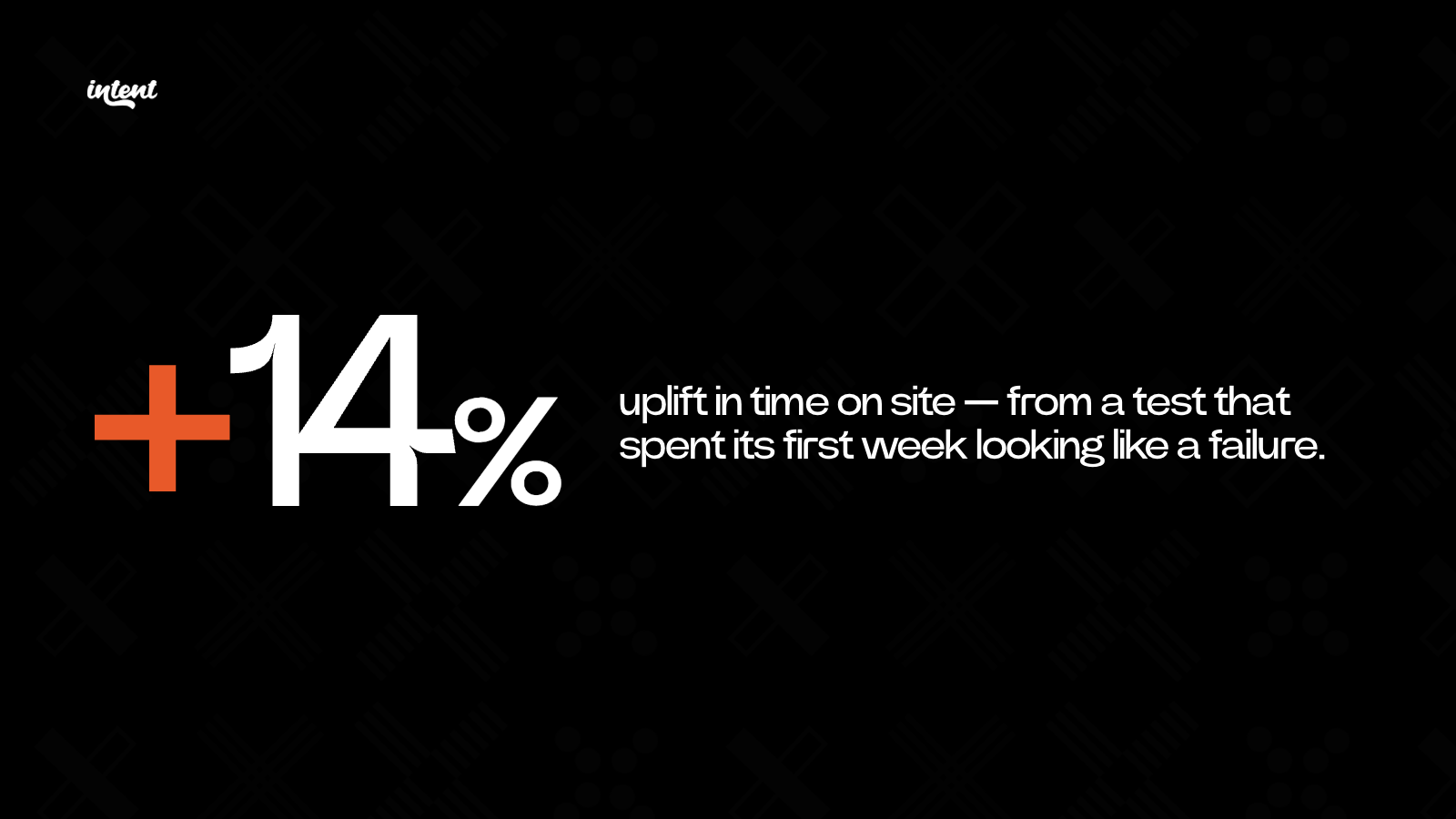
A test that lifted time on site by 14% still spent its first week looking like a failure. Conversion rate was down. Under a traditional A/B testing programme, Golfbreaks.com would have pulled the experiment.
They didn't. And the reason why says a lot about what happens when a genuinely high-consideration purchase journey meets a testing programme built for one-session eCommerce.
Golfbreaks.com is a golf tour operator based in Windsor, with offices in Copenhagen and Charleston, though the Made with Intent account focuses on the US and UK. It sends golfers on trips ranging from a single night in the UK to a week in Spain or Portugal, across a lot of different golfer segments. It's a lead generation business first. Visitors don't check out online in one sitting, they enquire, then a sales agent works out flights, transfers, accommodation, and course access, and gets them to a booking over the phone, sometimes weeks later.
That's not unusual for travel, where research and comparison typically happen across several separate visits and sites before a decision gets made. Optimising a single-session conversion rate for a purchase that actually plays out over weeks measures the wrong moment entirely.
A booking journey that can't be forced into one session
Jack has spent seven years at Golfbreaks.com, the last couple focused on conversion rate optimisation. "We've got quite a unique scenario whereby we're trying to encourage that inquiry," he said. "Particularly in travel, in the industry in general, it's quite an unusual thing to not be able to book entirely online."
A small portionof trips get booked online. But most go through a sales agent, because a golf trip has too many moving parts (courses, transfers, flights, accommodation, and group logistics) for most visitors to configure and commit to in one sitting.
Colin Spooner, Principal Value Consultant at Made with Intent, put his finger on why that matters: "It's not our traditional eCommerce brand where it's a pure purchase journey. But that almost plays into the hands of intent, where you need to think about that considered purchase and how to get people through the funnel before even thinking about the booking, weeks and months down the line."
Measuring what happens before conversion
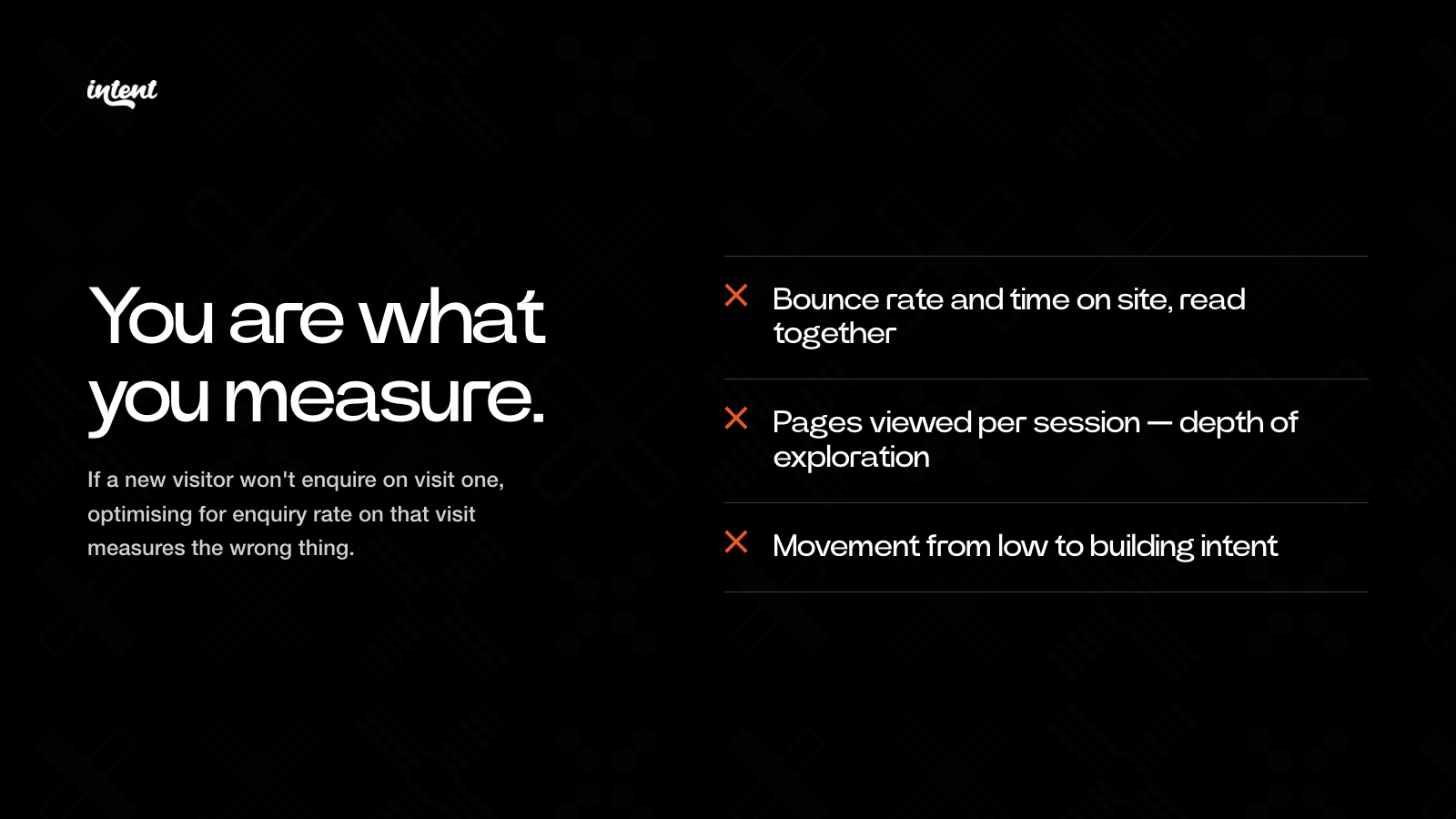
"You are what you measure" is a phrase the Golfbreaks.com team has adopted internally. If a new visitor is unlikely to enquire on their first visit, optimising purely for enquiry rate on that visit measures the wrong thing.
So alongside enquiry rate, the team tracks bounce rate and time on site together (a new visitor who bounces immediately clearly hasn't been given a reason to stay), pages viewed per session as a depth-of-exploration signal, and, specifically, movement from low to building intent, the kind of signals behind Made with Intent's content prioritisation and messaging use cases. None of these are vanity metrics here. They're proxies for whether a visitor is progressing through a decision process that runs across several sessions, not on a single visit.
Before building any experience, the team asks these questions to get in their customers shoes:
- What is a brand-new visitor actually trying to work out?
- Who are Golfbreaks.com?
- Can we be trusted?
- Do you have to pay full price up front?
- Can you book online at all?
That last one is really important. Because Golfbreaks.com can't be booked entirely online, setting that expectation early avoids disappointment later in the funnel, right when a visitor is closest to converting. As Colin put it, getting that messaging right up front was "a huge realisation" for how the whole experience needed to be built.
What agentic campaigns change about testing
Golfbreaks.com's testing programme runs on Made with Intent's agentic campaigns. In standard A/B testing, you decide up front which segment sees which variant, based on a hypothesis about who will respond to what. Agentic campaigns invert that: you define the strategy (the moment you're trying to influence, and the goal, whether that's enquiries, conversions, or a secondary metric) and hand the agent your set of tactics. It tests them against real segments and works out which one performs best, for whom, and when, using the same intent signals that power the rest of the platform.
For Jack, a self-described non-developer, the practical benefit was speed. "The tool allows me to get these experiences up much faster," he said. "My concept-to-live process is significantly shorter... it means the agents have got time to learn."
But the deeper change is what gets removed. "No longer am I having to set up those individual segments, or serve experiences to segments that I think will benefit from them," he said. "It's in the hands of the agent to then work out what segments it would benefit from... It's a much wider net." A message built for low-intent visitors might also help a segment already building toward a decision. A manual test is only as good as the human guess behind who it's shown to. An agent testing against a hundred segments simultaneously doesn't have that blind spot.
The "do nothing" variant is a genuine conversion tool
One of the more counter-intuitive parts of Golfbreaks.com's setup is what Jack calls the "do nothing" variant. In standard A/B testing, every visitor sees a control or one of several variants. Agentic campaigns add an option where the visitor sees nothing added or changed at all.
"The do nothing essentially sits within those variants as a copy of the control," Jack explained. "It's a safety net because it prevents us from showing negative experiences to customers that don't need to see it."
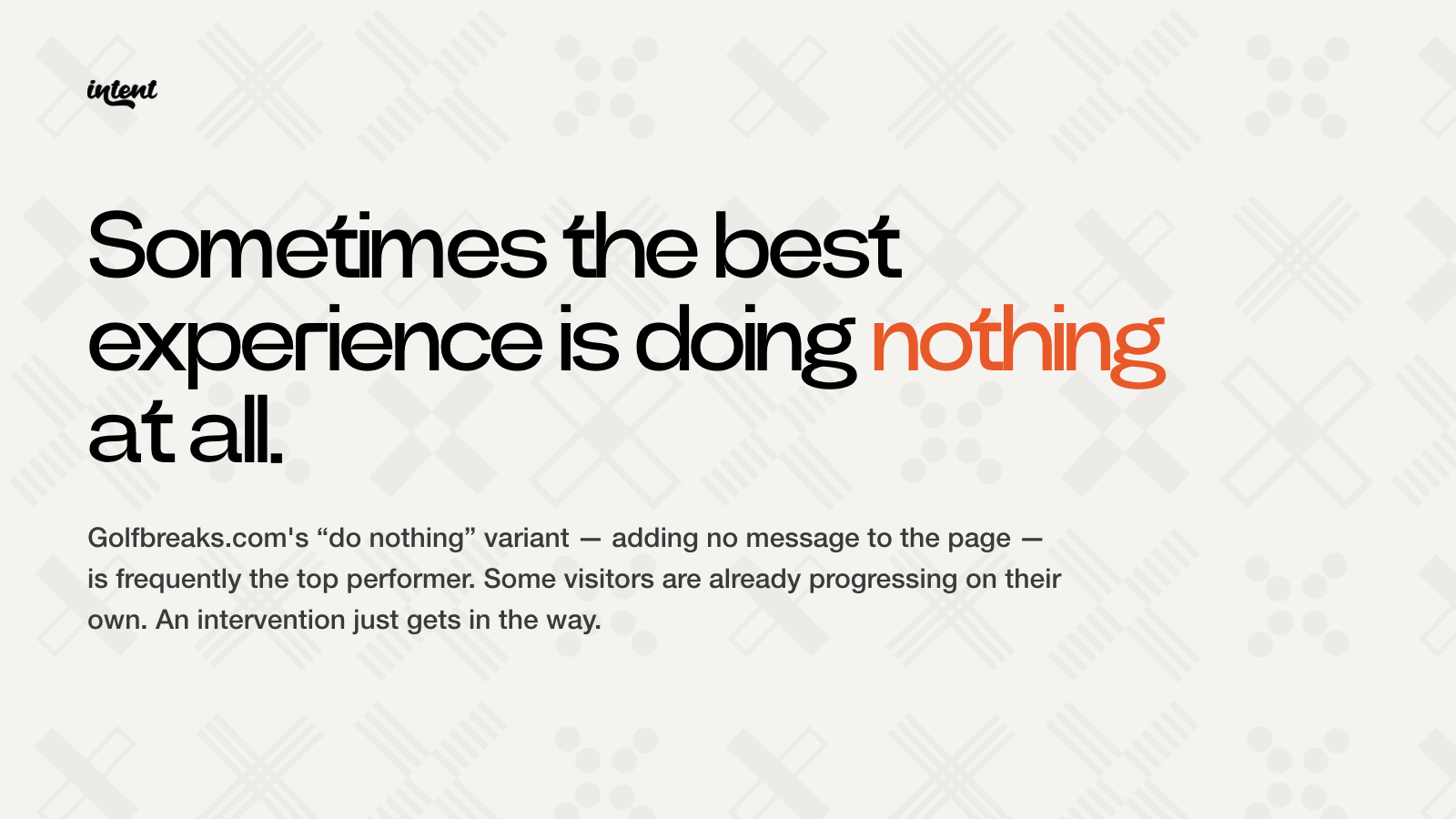
"In most experience it's always about adding things onto your site," Colin observed. "Having a version where actually sometimes the best thing is leaving the customer alone to progress, or even suppressing things on site, is a nice alternative to what we've experienced over the last 10, 20 years in experimentation." As the data below shows, it's frequently the top performer, because some visitors don't need an intervention. They're already progressing on their own, or they arrived with enough context that added messaging just gets in the way.
When the agent's early data looks wrong
Here's where the seven-day lesson from the top of this article comes back in. Jack's team built two welcome-visit experiences using the same messaging, one for the homepage, one for a location page such as a product discovery landing point for someone who searched "golf breaks in England."
The homepage experience delivered a 14% uplift in time on site. But conversion rate showed a negative trend for the first seven days. "With traditional AB testing, I would have perhaps turned it off," Jack said. "I would have panicked when I saw negative 14%, and I would have said, this isn't working."
He didn't, because the agent was still learning. That's consistent with what independent testing research shows more broadly: short test windows are more susceptible to random variation, and stopping early on interim results is one of the most common ways a genuinely winning test gets killed before it proves itself. Once the agent had enough data, performance turned around.
Same messaging, two different visitors
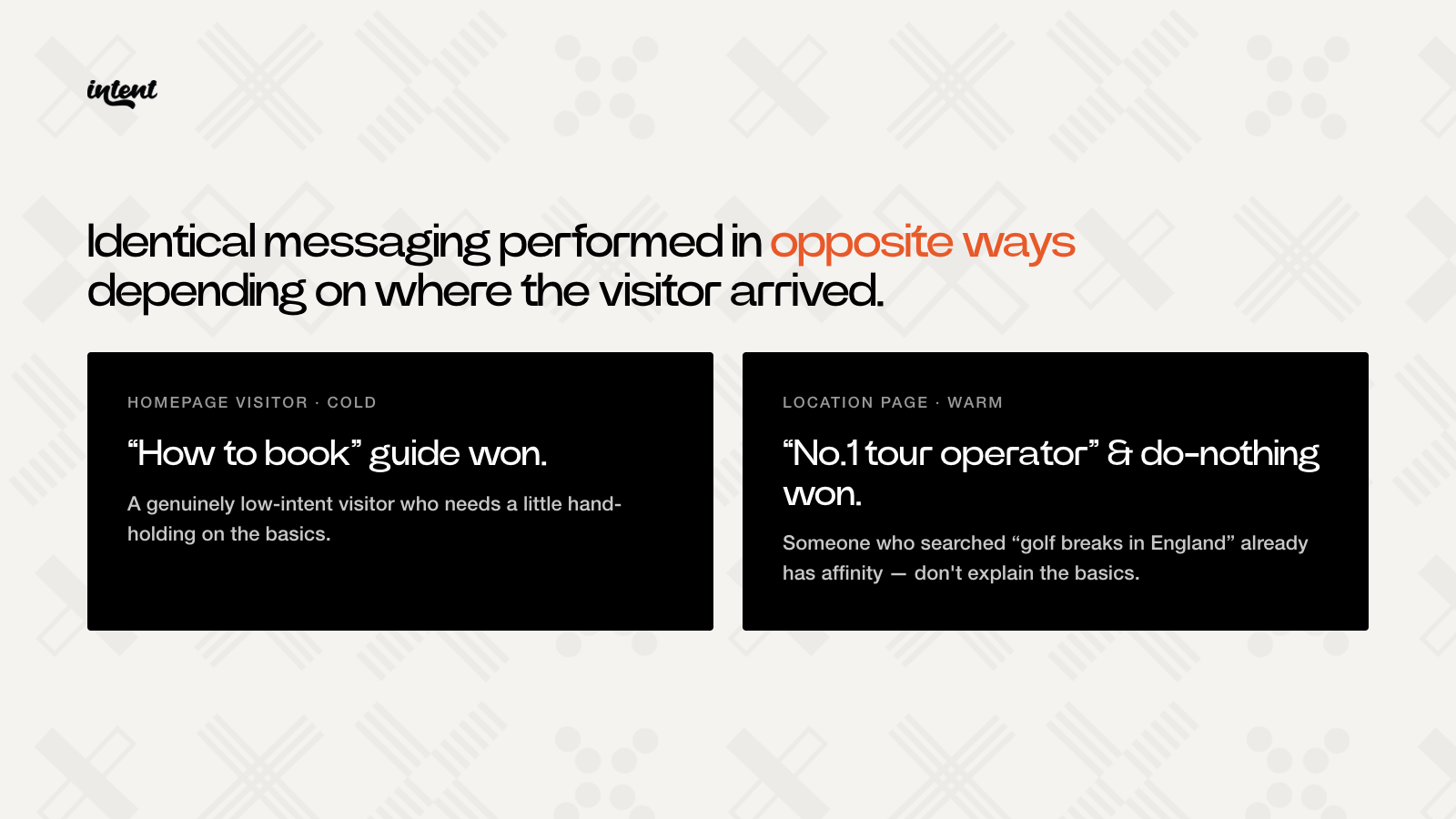
The location-page test surfaced something else: identical messaging performed in opposite ways depending on where a visitor arrived. On the homepage, a "how to book guide" message performed best, evidence of a genuinely low-intent visitor who needs some hand-holding.
On the location page, the top performer was a trust-building "number one tour operator" message and the do-nothing variant. Jack's take is that a visitor who searched "golf breaks in England" already has affinity toward the destination, closer to a returning visit mindset than a cold product visit. They don't need the basics explained.
A message about Golfbreaks.com's customisable packages underperformed with brand-new homepage visitors. It's true and important, but it's the wrong message at the wrong moment, the same lesson behind Made with Intent's discounting use case: showing a message before a visitor is ready for it does more harm than good.
The surprise that only showed up in the data
Asked what surprised him most, Jack pointed to something that had been sitting in plain sight. An early "ready to plan?" message aimed at brand-new visitors looked like a reasonable nudge. But in the data, it actually came across as overbearing.
"If you think about a new user landing on the site and asking, are you ready to plan? It's probably a bit overbearing," Jack said. "At the time, when you're setting up those tests, it's like, right, I'm going to use the same messages for the homepage, same message for the location page. They're surely going to work." They didn't, for every segment.
Colin's read: "The amount of times we see customers who have a predefined view of what will work, and it's completely different. That point around being subjective comes to life when you start to see the way the agent starts to make decisions." That tracks with the broader shift in shopper expectations, most consumers now expect a personalised experience and notice sharply when they don't get one, a generic message is no longer neutral, it actively reads as a miss.
When a message doesn't resonate with any segment, the fix is simple. Delete it, let the agent relearn, and add a new tactic later if needed. You don't need to manually re-segment.
Measure the journey, not just the moment
None of this is unique to golf holidays. Any purchase with a real consideration cycle shares the same shape, including B2B software, where roughly 70% of the buying journey typically happens before a buyer contacts a vendor at all. A first-time visitor is rarely the same as a returning, further-along one, and treating them identically wastes the message on the visitor least ready to act on it.
Three things carry over regardless of your industry. You don't need to be a developer to find early wins, a visual editor is enough to start. If your purchase journey has any real consideration cycle in it, top-of-funnel testing should measure more than conversion. And build a tactic sheet of messages at a global level, then let the data show which ones resonate with which visitors, rather than deciding that yourself up front.
If your own funnel has visitors who aren't ready to buy on visit one, the same logic applies. See the intent framework behind it. Or book a demo to see it against your own traffic.
If you've enjoyed this write up of our latest Intent Live session, why don't you join our next one?

Most lists of abandoned cart emails are judged by the wrong criteria. Subject line cleverness. Clean design. Brand-consistent copy. None of that tells you whether the email should have been sent at all, or whether it was built for the type of shopper who actually received it.
What makes an abandoned cart email effective is how well it matches the reason the customer left — not the subject line, the discount, or the design. The 10 examples below are organised by the abandonment scenario each one is built for, so you can borrow the right approach for the right situation rather than copying whichever email looks most impressive.
Editor's note: All examples are sourced from Really Good Emails (reallygoodemails.com), an independent email archive you've probably used at some point. I had Claude have a good peruse through it before deciding on which ones I'd write into the piece.
The one question every abandoned cart email list skips
Before the examples, let's just contextualise why people abandon carts.
There isn't one type of cart abandoner. There are at four (probably more), and the email that works for one will actively backfire for another:
- Interrupted shoppers: got distracted by life, had no real objection, often come back on their own
- Price-sensitive shoppers: saw the total at checkout (including shipping), did the maths, and thought: “Right, I’m off”
- Hesitant shoppers: browsed carefully, read reviews, maybe checked the returns page, still couldn't commit
- Indecisive shoppers: liked the brand but couldn't choose the right item, or weren't ready to decide
Sending a 20% discount to an interrupted shopper doesn't recover a sale. It gives margin away to someone who was already coming back. Sending a playful nudge to a shopper who couldn't verify your returns policy doesn't help them really. It's a case of wrong message at the wrong time.
Segmenting abandoners by type isn't a new idea. ConvertCart and others have proposed versions of this framework. What most implementations miss is applying it to real, named brand examples rather than wireframes, and being honest about when each approach goes wrong. In this blog post, we'll analyse each abandoned cart email example, pick out the pros and cons and do some commentary on them.
Abandoned cart emails for interrupted shoppers
These shoppers had no objection. Something pulled their attention away mid-session, and the purchase didn't complete. They're the most likely to come back without any email at all. That's exactly why this is the category where discounting causes the most damage. You're giving margin to a customer who was ready to buy.
The right email for an interrupted shopper is a clean, low-pressure reminder.
Casper — "Come Back to Bed"
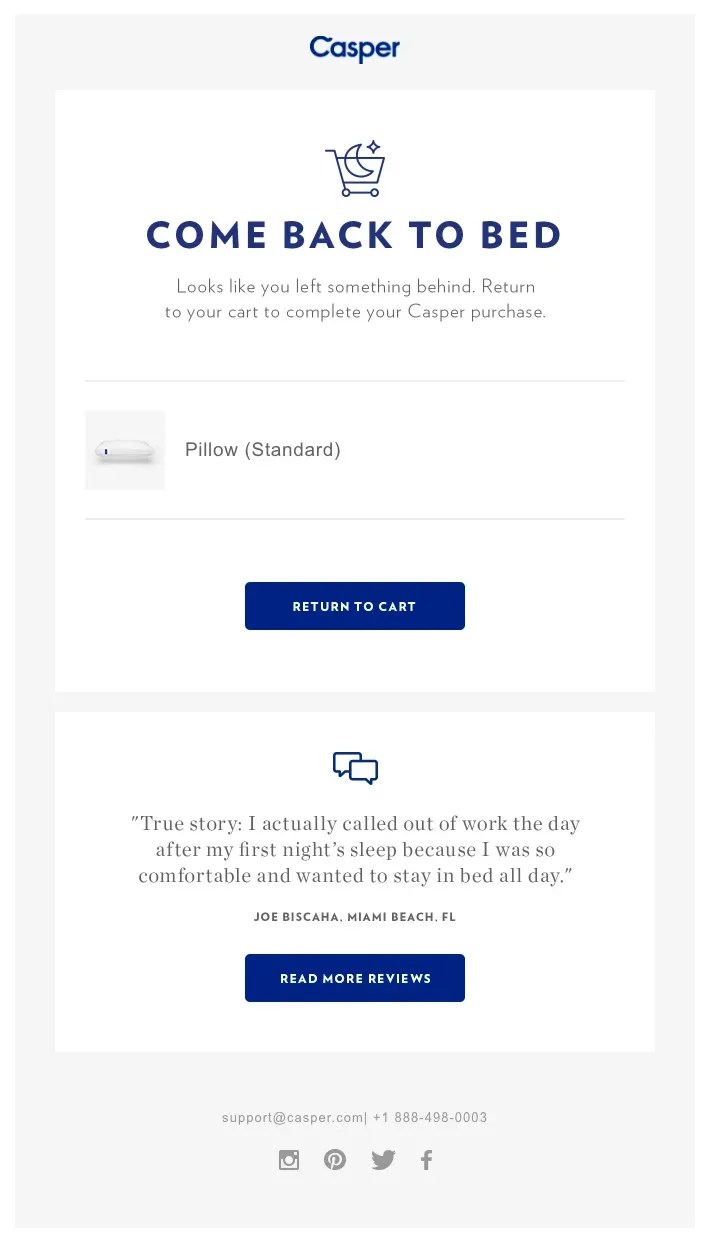
Casper's cart recovery email is clean and minimalist. Product image front and centre, a single CTA, social proof embedded lightly without being pushed. The copy is warm and brand-consistent without being clever for its own sake.
What it does well: the email assumes the shopper liked the product. Its only job is to put it back in front of them. It doesn't introduce urgency or price pressure that wasn't there before. We like the playfulness of the headline.
The assumption: the shopper was interrupted, not objecting. Is that assumption right often enough to make this format successful?
When it backfires: if Casper's flow also sends a discount to the same segment a day later, what about those that are ready to buy, forgot to do it, and they've earned themselves a nice discount for doing nothing?
Harry's — "So Close to the Finish Line"
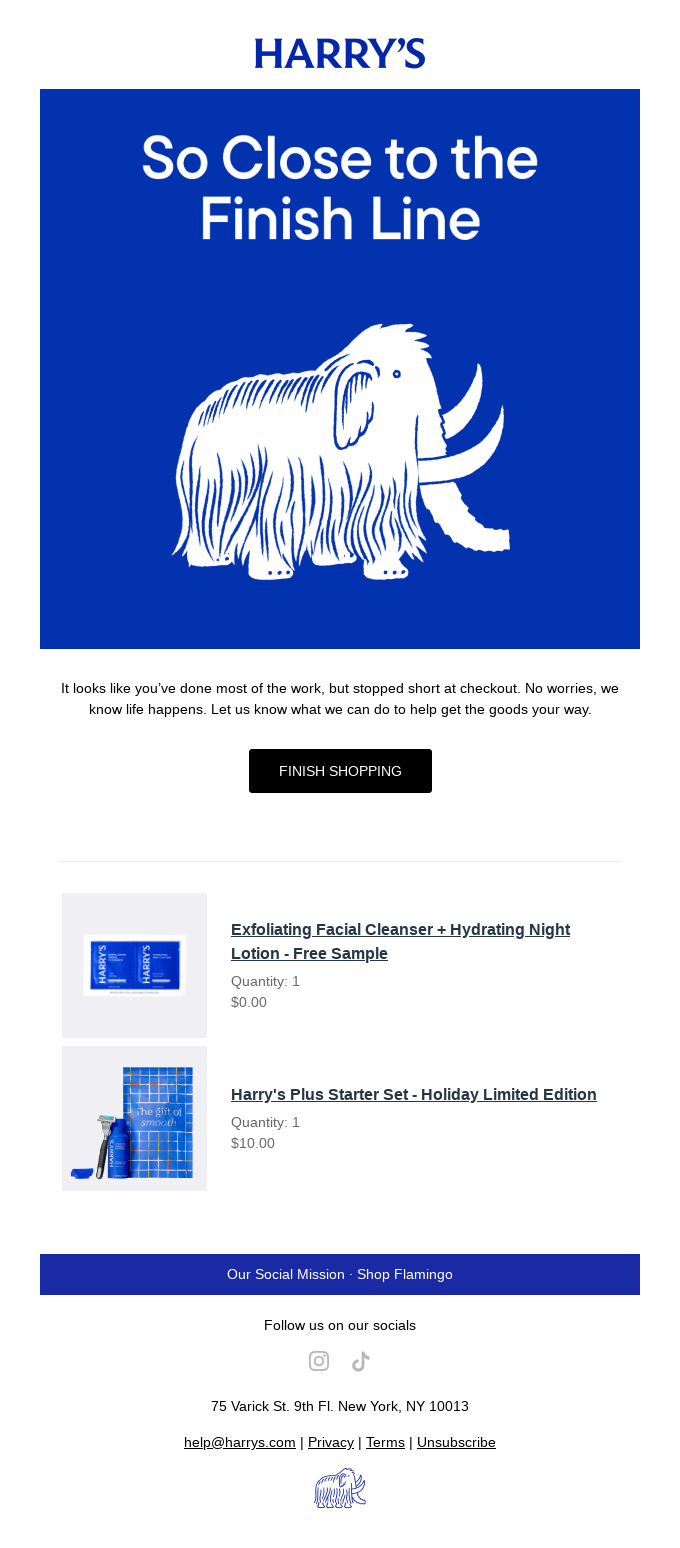
Harry's abandoned cart email doesn't try to be clever. The headline uses the brand's woolly mammoth mascot against a bold blue background: "So Close to the Finish Line." The copy: "It looks like you've done most of the work, but stopped short at checkout. No worries, we know life happens. Let us know what we can do to help get the goods your way."
What it does well: it treats the shopper as an adult. The tone assumes good faith on both sides. It's not manufacturing pressure or guilting the buyer. Worth noting that the abandoned cart here is a free sample and a $10 starter kit, a genuinely low-friction entry to the brand. The email is built for a purchase with almost no real barrier.
When it backfires: for a high-consideration or high-price product, empathy alone won't do it. The shopper needs a reason to come back, not just a reminder that they nearly did.
Pestie — "Did a bug crash your order?"
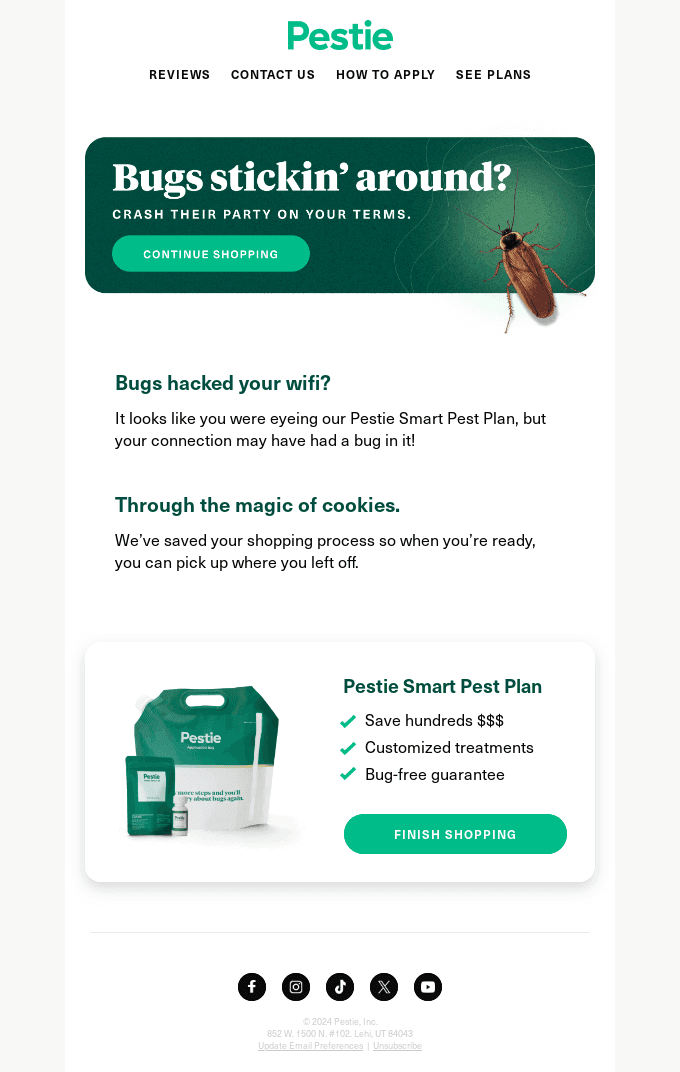
Pestie sells a subscription pest control plan. Their abandoned cart email is written entirely in pest puns: "Bugs hacked your wifi? It looks like you were eyeing our Pestie Smart Pest Plan, but your connection may have had a bug in it. Through the magic of cookies — we've saved your shopping process so when you're ready, you can pick up where you left off."
We're all about puns at Made With Intent. Especially in the marketing team. So, in our esteemed view this is already a 10/10 email.
What it does well: the puns are there for a reason. For a brand whose product is literally about bugs, the email signals that they don't take themselves too seriously. That's quite endearing for someone looking to build a long-term relationship with a brand.
When it backfires: for a first-time visitor who hasn't yet bought into the brand's personality, the jokes don't remove any real barrier. A shopper with a genuine price or trust objection gets pest puns. Bugger.
Wondering how to prevent your abandoned baskets before they happen? See how Made With Intent does it.
Abandoned cart emails for price-sensitive shoppers
These shoppers reached the checkout, saw the full total, and left. Extra costs at checkout, shipping, tax, unexpected fees, are the single biggest reasons shoppers abandon, cited by 39% of abandoners in Baymard Institute's latest quantitative study. It's why this is the category where price incentives are utilised.
There's two things that spring out here. First, not every discount is the right discount. There's a significant difference between a shipping waiver and a 25% reduction in product price. Second, financing is sometimes a more effective tool than a discount, particularly for high-consideration purchases where the monthly payment is more psychologically viable than the total cost.
Levi's — 25% off
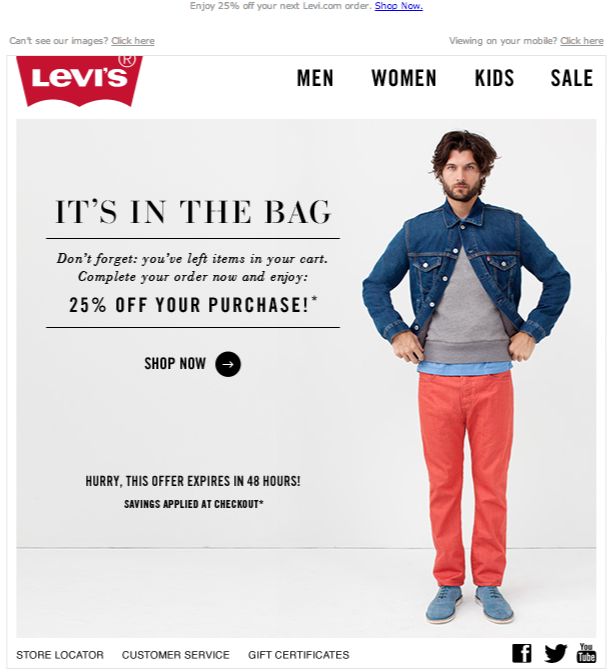
Levi's cart recovery email is bold and short. Big headline, big number: 25% off. One product image and a single CTA. It directly addresses the price barrier without ambiguity.
What it doesn't do: it has no mechanism to distinguish who actually needed the discount. The interrupted shopper gets 25% off alongside the price-sensitive shopper. That's the fundamental problem with blanket discount recovery flows. The discount is the easiest lever to pull, but it's applied without any understanding of whether it was needed.
Let's do some numbers on the back of a napkin. If 30% of your recoveries would have happened without the email, you've just cut margin on 30% of your "recovered" revenue for no commercial reason. No published figure exists for this across the industry. That's itself the problem. Many brands don't run a holdout test to find out.
What good looks like: a recovery flow that sends no discount in the first email, and only introduces one if the shopper didn't convert, reserved for segments whose behaviour suggests price was the actual barrier.
Slight Made With Intent-shaped sidebar: Appliances Direct ran exactly this approach and saved 42% of the margin they'd previously given away.
Aventon — "Need more time? Your ebike is still here (for now.)"
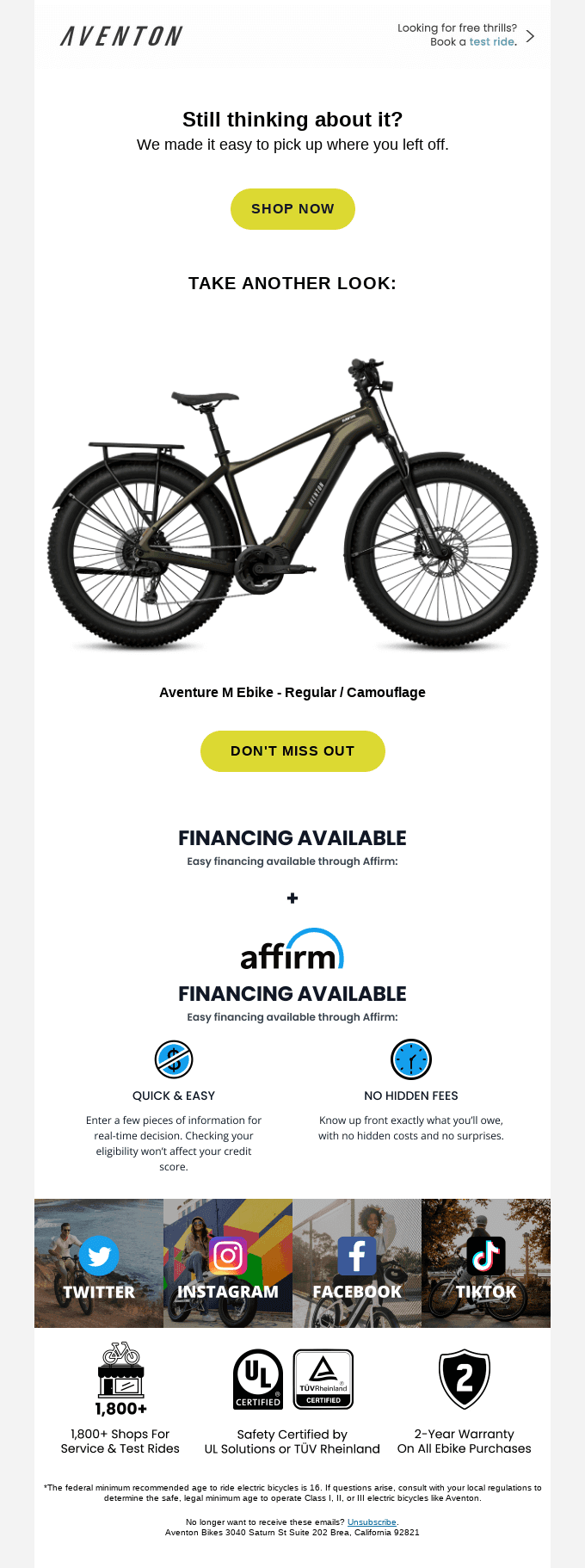
Aventon sells electric bikes. The subject line soft-pedals urgency; the email body leans almost entirely on financing. A prominent "FINANCING AVAILABLE via Affirm" section sits above the product image, with payment options broken down by monthly instalment. There's also a header CTA: "Book a test ride."
What it does well: it removes the price barrier without touching the headline price. Affirm installments reframe affordability: the shopper isn't being asked to find the full cost upfront, they're being asked to consider a monthly figure instead. It breaks down the £1,000+ cost in a manageable way.
The test ride CTA is smart. For a high-consideration purchase where the shopper has never experienced the product, a physical touchpoint is good way of getting people invested in the product beyond the digital experience.
The assumption: the shopper wants the product but the upfront cost is the specific barrier. If their hesitation is about product quality or brand trust, installments don't resolve it. Should there be more social proof to help people understand how the product helps them?
MasterClass — "HEY, WHAT HAPPENED?" + up to 50% off

MasterClass runs a subscription service for online courses instead of physical products. The headline is conversational and comes across slightly startled: "HEY, WHAT HAPPENED?" — before offering a deep discount and showcasing celebrity instructors.
What's interesting is the trust signals they have in play. Below the discount, MasterClass includes trust logos from companies including Deloitte and PayPal, and a section showing which type of learner (A, B, or C) might use the platform. Essentially, it segments the hesitant shopper by use case in the email itself.
What it does well: the social proof addresses a different objection from the price cut. The shopper may have left because of cost, or because they weren't sure the product was legitimate. The email handles both simultaneously.
The issue: a 50% off discount on a subscription product teaches the same lesson product discounting teaches in retail. Abandoners learn that waiting is rewarded. MasterClass should be asking how many of its subscribers will only ever subscribe when a 50% promotion is running, and whether that margin is sustainable.
Abandoned cart emails for hesitant or shoppers with trust issues
Blueland — "We love it, too. Then again... we might be biased."
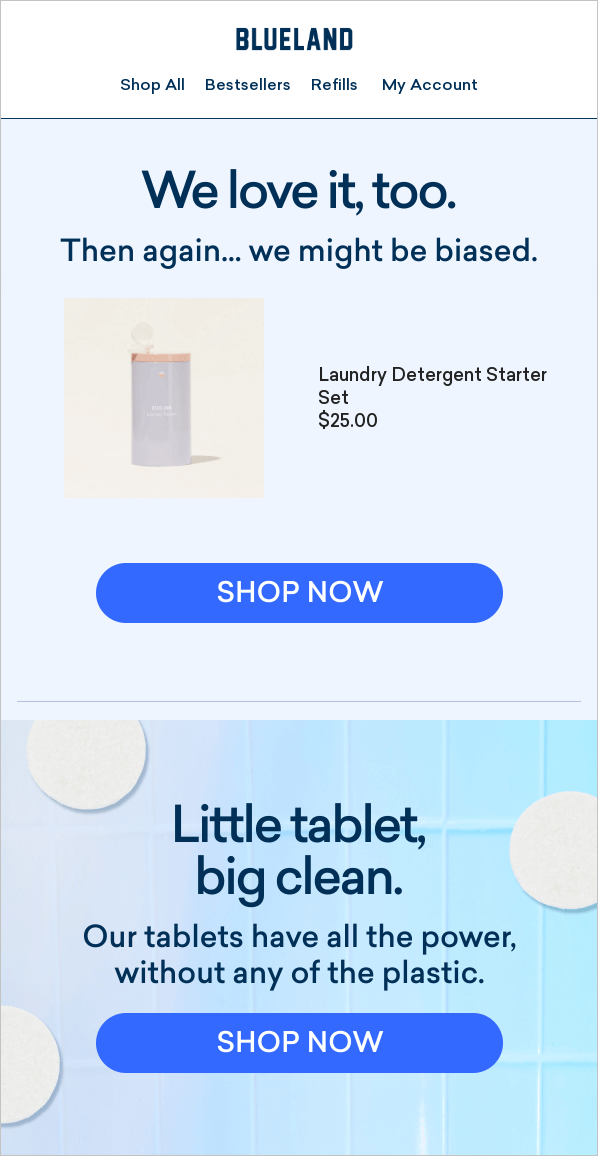
Blueland sells eco-friendly cleaning products, specifically dissolvable tablets that replace single-use plastic bottles. Their cart recovery headline is confident, and maybe a little self-aware: "We love it, too. Then again... we might be biased." Below it: product image, price ($25), and a product performance claim: "Little tablet, big clean. Our tablets have all the power, without any of the plastic." No discount.
What it does well: the product's differentiation is the trust signal. A shopper who abandoned their cart because they weren't convinced eco tablets actually work gets the product's performance claim restated clearly. The "we might be biased" line signals confidence rather than desperation. The brand isn't worried you're about to leave.
When it doesn't work: a shopper whose hesitation was "but does it clean as well as a conventional product?" gets a value message. The email doesn't resolve that specific doubt. Blueland's email works for shoppers already aligned with eco values. It doesn't do much for the unconvinced.
IMBODHI — "Pieces You'll Regret Leaving Behind"

IMBODHI is a sustainable activewear brand. Their cart recovery email layers three distinct trust mechanisms without a single discount code. It has a FOMO headline ("Pieces You'll Regret Leaving Behind"), a Shop Pay financing section (buy now, pay in installments), and a grid of UGC customer photos under the hashtag #LiveEmbodied.
What it does well: it addresses both price hesitation (Shop Pay installments) and the social legitimacy question (real customers using the product) in a single email, without reducing the product price.
Why this may not work: "Pieces You'll Regret Leaving Behind" sets a slightly pressured tone for a first-time buyer who hasn't yet committed to the brand. FOMO framing works on a shopper who's close to being convinced. For someone who's genuinely struggling to build trust with your business, it can feel like the wrong kind of push.
Abandoned cart emails for indecisive shoppers
These shoppers want something but couldn't commit. They may be comparing options within the brand, unsure which variant or style to choose, or simply not ready to make the decision. The barrier isn't price or trust — it's the decision itself.
These emails solve a different problem: they simplify or reframe the choice, rather than removing a specific barrier. The risk is that showing more options can increase rather than reduce decision paralysis.
Lamborghini — "Can't Decide?"

Yes, Lamborghini makes wine. Their abandoned cart email doesn't reference the specific item left in the cart at all. The subject line is "Can't Decide?" The body opens with "Still thinking?" and pivots immediately to "Here's Some of Our Best Sellers," presenting four product recommendations.
What it does well: it treats indecision as a discovery problem. If you couldn't choose the item you had in your cart, perhaps a different set of options helps. The email resets the shopper's choice rather than pushing them back to a single item they couldn't commit to.
The risk: if the shopper had a specific item they definitely wanted and simply got distracted, showing four alternatives signals the brand wasn't paying attention. This email makes a particular bet about why the shopper left. It won't always be right.
Abandoned cart emails that use urgency and scarcity
Urgency in cart recovery works when it's true. Manufactured scarcity — "only 3 left!" when the warehouse holds 300 — erodes trust with shoppers who notice, and increasingly, shoppers notice.
The most credible urgency email in this list earns its subject line through genuine stock constraint, not a copywriting trick.
Alo Yoga — "The Airlift 7/8 Decadent Bodysuit in your cart sold out"
![Test] The Airlift 7/8 Decadent Bodysuit in your cart sold out from Alo Yoga - Desktop Email View | Really Good Emails](https://cdn.prod.website-files.com/683359648c5bfdeb492e5edc/6a4447b61cc56f8865d08dc8_image.png)
The subject line is the entire email. Alo Yoga's abandoned item is genuinely sold out. No manufactured pressure, just a fact. The headline inside: "YOUR MISSED CONNECTION." The email then pivots: a section shows the shopper's remaining cart items ("YOUR CART IS STILL WAITING") alongside alternative products in the same category.
What it does well: the scarcity is real. The brand doesn't need to claim urgency. It's already true. And the pivot to alternatives turns what could be a dead end into a continued shopping opportunity.
When it backfires: if the shopper wants only that specific item and no alternative will do, the email confirms the purchase is no longer possible. It won't convert in that scenario. But there was nothing to convert. The email's job shifts from recovery to brand experience.
The broader lesson: a brand that saves urgency emails for when the urgency is actually real builds more long-term credibility than one that manufactures it in every third recovery email.
The question these examples can't answer for you
There's a limit to what a "best abandoned cart email" list tells you.
I can't tell you what the recovery rates are for them. I can only offer you my opinion. Really Good Emails is an archive, not a performance tracker. The examples in this piece were chosen because they illustrate distinct strategic logic, not because any of them are proven to outperform the alternatives. "Best" here means "most instructive," not "highest converting."
The metric that actually matters is incremental recovery: the sales that happened because of the email, not alongside it. A shopper who abandons at 9pm, receives an automated reminder at 9:01pm, and buys at 9:15pm may have bought at 9:05pm without the email. That recovery appears in your platform's dashboard but contributes nothing incremental to revenue, and if it includes a discount, it actively costs you margin.
Measuring it properly requires a holdout group, a segment of abandoners who receive no email at all, used as a baseline against those who do. Most ESPs support suppression lists. The simplest test is withholding the first email from 10% of abandoners for 30 days and comparing purchase rates. Rejoiner has a good primer on the methodology if you want to set one up. Few brands run this. The ones that do are often surprised by how much of their "recovered" revenue would have happened regardless.
This is the honest limit of any examples-based approach to cart abandonment. The best use of a list like this isn't to copy the email that looks most impressive. It's to use the framework — which type of abandoner is this built for, and what does this email assume about why they left? — to evaluate the emails already in your own flow.
The most effective recovery strategies don't wait for abandonment at all. They identify visitors whose intent signals suggest they're at risk and intervene before the cart is left behind. That's a fundamentally different problem from choosing the right email to send after the fact. See how it works.
What makes an abandoned cart email work
Knowing which email to send requires knowing something about why the shopper left. Most brands don't know that. They send the same recovery sequence to every abandoner. And they wonder why their discount bill keeps rising while incremental recovery stays flat.
The brands that recover more tend to discount less. Not because they're precious about margin, but because they understand that not every abandoned cart is a lost sale in need of a coupon. Some abandoners need a simple reminder. Some need reassurance about the brand. Some need to know the financing option exists. And some were never going to buy in that session regardless of what was sent.
If you want to prevent basket abandons instead of just trying to recover them after they've happened, here's how intent-based cart recovery works.

Why standard advice on eCommerce bounce rate might not be enough
In 2023, Google Analytics 4 replaced Universal Analytics (UA) as the default, shifting the definition of bounce rate entirely. Under UA, any single-page session counted as a bounce, regardless of how long the visitor stayed or what they did. Under GA4, a "bounce" is a session with no meaningful engagement in the first ten seconds (Google Analytics Help, 2023).
Most published advice on reducing eCommerce bounce rate, including almost everything ranking on the first page of Google right now, predates that change. The benchmarks cited, the comparisons drawn, the thresholds used to define a "good" or "bad" rate: much of it is calibrated to a metric that no longer exists in its original form. It's worth bearing in mind before treating a published figure as a reliable signal that something is broken.
There's a connection here to the intent signals argument. GA4 defines a bounce as a session with no meaningful engagement, which is itself the absence of any intent signal. However, the metric has quietly moved closer to what we're suggesting: that what matters is whether a visitor showed signs of engagement and intent, not simply whether they viewed more than one page.
The standard fixes aren't useless. A page that takes four seconds to load on mobile will lose shoppers. Navigation that buries products three levels deep creates friction. These are real problems. But they're also largely table stakes. Most mid-market eCommerce teams have addressed them, or at least know they need to.
What the generic checklist rarely asks is: why did this particular visitor leave this particular page? Speed explains some of it. Confusing navigation explains more. But there's a third explanation that gets far less attention: the visitor arrived with a specific intent, and the experience they landed on didn't reflect it.
What on-site intent signals actually are
Intent signals aren't abstract. They're specific, observable events already firing on your site every day, most of them visible in your analytics if you know where to look.
Consider what happens in the first thirty seconds of a session. A visitor lands on a product detail page. Do they scroll past the first image, or stop there? Do they interact with the size selector, or skip straight past it? Do they hover over the "Add to Basket" button without clicking? Do they navigate to a second product, return to the category page, or leave entirely?
Each of those micro-behaviours carries a signal. Taken individually, they don't mean anything. Taken together, they start to suggest something about intent: whether the visitor is browsing loosely, comparing seriously, or hitting a wall they can't get past.
Some of the most informative on-site signals include:
- Scroll depth: how far down the page a visitor gets before stopping or leaving
- Hover behaviour: where the cursor lingers without a click (interest that didn't convert to action)
- On-site search queries: what visitors type into the search bar, and crucially, what they do next
- Dwell time relative to site average: a visitor spending significantly longer on a PDP than average may be closer to buying than the raw bounce metric suggests
- Variant and size selection: engaging with product options is a meaningful buying signal, regardless of whether a purchase follows
- Back-navigation patterns: returning from a PDP to the same category page repeatedly often indicates comparison behaviour, not disinterest
None of these signals individually tells you what a visitor intends to do. But patterns across them might tell you something useful about why they're not finding what they came for, and whether the bounce that follows is a genuine commercial loss or an inevitable one.
For a deeper look at why behavioural signals tend to outperform the proxy metrics most teams rely on, Predictions Not Proxies, our blog post, is worth a read.
The signals worth watching by page type
One limitation of tracking bounce rate as a single site-wide number is that it flattens very different problems into one metric. A visitor who bounces from the homepage is probably experiencing something quite different from one who bounces from a product detail page after two minutes of engagement. The signals worth reading, and the interventions that might help, differ depending on where the bounce is happening.
Homepage
Homepage bounces are often about relevance at first impression. Was the visitor expecting something the page doesn't immediately surface? Traffic source matters here. A visitor arriving from a paid social ad promoting a specific sale and landing on a generic homepage is likely to read that as a mismatch before they've even scrolled.
You should, instead, consider time to first scroll, engagement with any navigation element, and click-through to any product page. A visitor who lands and never scrolls is usually gone for reasons that faster load times can't fully address.
Category pages
Bounce from a category page often points to a discovery problem. Either the product range isn't what the visitor expected, or the tools for narrowing it down (filters, sorting, on-site search) aren't doing their job.
You could monitor for filter use, scroll depth through the product grid, and whether visitors click through to multiple PDPs or just one (or none). A visitor who opens the filter panel but doesn't apply anything may be signalling that the available options don't map to what they had in mind.
Product detail pages
PDP bounce is the most commercially sensitive, because this is where visitors are closest to a decision and where intent signals tend to be richest. Image engagement, variant selection, and dwell time relative to site average can all suggest whether a visitor is actively evaluating or has already decided the product isn't right.
A visitor who spends three minutes on a PDP, selects a size, and then leaves is a very different prospect from one who bounced in under ten seconds. Treating both as equivalent in a site-wide bounce metric misses that distinction entirely, and probably points the subsequent analysis in the wrong direction.
Paid landing pages
For pages receiving meaningful paid traffic, the most important signal is often the simplest: does the message on the page match the ad that brought the visitor here? Post-click relevance is frequently the first place to look when bounce rate on paid traffic is elevated, before speed or UX enter the conversation.
Consider a fashion retailer seeing high PDP bounce from paid social. You may think audience mismatch or slow load times. But scroll depth data tells a different story. Visitors are reaching the size selector and stopping, not scrolling away. The real problem is out-of-stock variants being featured in the ad creative. Shoppers arrive, find their size unavailable, and leave. This is nothing to do with a UX fix, simply a case of reading the right signal, the right context.
Acting on intent signals before the bounce happens
Reading these signals is useful. Responding to them is where it gets more interesting.
The standard eCommerce pop-up is a useful counterexample. A blanket overlay triggered by exit intent, offering a discount to everyone regardless of what they've been doing, ignores every signal the visitor has sent. A visitor who spent four minutes on a PDP, selected a variant, and then paused receives the same intervention as one who arrived and left in eight seconds. So, really, you're not delivering a proper personalised experience that's appropriate to your customers' different needs.
A more considered approach starts with the signal, instead of the user navigating away. A visitor showing strong PDP engagement (extended dwell time, variant selection, multiple image views) is telling you something. The right response is probably social proof surfaced at that moment: stock scarcity, recent purchase activity, a well-timed review. Not a discount. A visitor who used the search bar, found no useful results, and is now leaving needs a different intervention entirely: a related product suggestion, or a prompt to browse a relevant category.
The interventions don't have to be complex to be more relevant. Start with your highest-bounce page type, identify which signals are already firing there, and ask whether your current exit triggers reflect any of them. That's a reasonable first step, and it costs nothing to consider.
If you're looking at how this kind of approach works for browse abandonment specifically, our browse abandonment use case walks through one way to think about it.
What a bounce means for your CRM, and why it matters
Bounce rate is typically discussed as a traffic or UX problem. It's less often discussed as a CRM problem. But there's an argument that it should be.
Every visitor who leaves without converting, subscribing, or taking any traceable action represents not just a lost session, but a lost contact. For a brand spending meaningfully on paid acquisition, that loss isn't only the missed immediate sale. It's the absence of any first-party data to re-engage with later. The CAC clock is ticking whether or not the visit converts.
The intent signals that might help reduce bounce in the moment are the same signals that could inform a more relevant recovery sequence when the bounce does happen. A visitor who engaged with a specific category, hovered on a product, and then left is a different re-engagement prospect from one who arrived on the homepage and bounced immediately. Where that behavioural data is captured, it can feed a browse abandonment email or SMS that speaks to what the visitor was actually looking at, not a generic "you left something behind" message.
Most browse abandonment recovery today operates on a relatively simple trigger. The visitor viewed a product and left. Intent signals could make that logic more nuanced, and the message that follows more relevant to where the visitor actually was in their decision.
How to read bounce rate differently
Bounce rate, as a metric, doesn't tell you very much on its own. It tells you someone left. It doesn't tell you why, which page type to prioritise, or whether the bounce represents a genuine commercial loss or a session that was never going to convert.
On-site intent signals can't answer all of those questions. But they might answer more of them than page speed tests and navigation audits typically do. For eCommerce teams who've already done the basics and are still looking for what to try next, it's worth examining what visitors are doing before they leave, not just that they left.
That shift in framing, from "how do we stop bounces?" to "what are bounces telling us?", might be where the more useful work sits.
If you want to see how Made With Intent reads on-site intent signals across eCommerce traffic, book a demo and we'll walk through it with your site.
No results found.


Subscribe to our newsletter
Written by an actual human our monthly newsletter is your deep-dive into everything Intent-related and eCommerce. Go on, give it a go.